The first night our dog barked at my husband holding our newborn, I apologized to the wrong person.
I apologized to my husband.
Not the dog.
That mistake nearly cost me everything.
His name was Cooper, an old chocolate Labrador with silver around his muzzle and eyes so gentle that strangers trusted him before they trusted people. He had slept beside my bed through college heartbreak, my mother’s illness, and every lonely apartment before marriage. When I married Evan, Cooper accepted him because I did.
At least, I thought he did.
For eight years, Cooper had never bitten, lunged, or even snapped at anyone. Children climbed over him. Delivery men stepped around him. My nieces once dressed him in a pink tutu, and he endured it with the weary dignity of an old king.
Then my son Noah was born.
And Cooper changed.
Not with me.
Not with my mother.
Not with visitors.
Only with Evan.
Every time Evan lifted Noah from the bassinet, Cooper rose from wherever he was lying. His ears went back. His body stiffened. A low growl rumbled in his chest.
“Again?” Evan snapped one afternoon, holding Noah against his shoulder while the baby slept. “Do you see this, Mara? He’s unstable.”
Cooper stood between Evan and the hallway, barking once, sharp and furious.
“He’s just adjusting,” I said, though my voice sounded weak even to me.
Evan glared at the dog. “Adjusting? He sounds like he wants to attack me while I’m holding my own son.”
The words hit exactly where he intended.
My own son.
I was exhausted then. New motherhood had turned time into something liquid and cruel. Nights blurred into feedings, diapers, trembling hands, and the constant fear that I was doing everything wrong. Evan seemed calm where I was unraveling. He read parenting blogs. He measured formula with scientific precision. He told everyone I was “emotional but doing my best,” which sounded supportive until I heard the pity underneath.
So when he said Cooper was dangerous, part of me believed him.
That was the worst part.
I looked at my loyal old dog, saw his anxious eyes, and wondered whether love had made me blind.
“Maybe he’s jealous,” Evan said. “It happens.”
Cooper barked again.
Evan flinched dramatically and stepped behind me.
“You see? We can’t live like this.”
That night, he said the words for the first time.
“We should rehome him.”
My heart cracked.
“No.”
“Mara, we have a baby now.”
“He’s my family.”
“So am I.”
The conversation ended there, but the seed had been planted. Over the next two weeks, Evan watered it carefully.
Every time Cooper barked, Evan sighed.
Every time Cooper paced, Evan shook his head.
Every time Cooper positioned himself near Noah’s nursery door, Evan muttered, “This isn’t normal.”
But something about it bothered me.
Because Cooper was normal with everyone else.
When I held Noah, Cooper lay peacefully beside the rocking chair.
When my mother came over, he rested his chin on her slipper.
When my sister carried Noah around the kitchen, Cooper followed with soft curiosity, tail wagging.
But when Evan took Noah?
The barking began.
Not sometimes.
Always.
One afternoon, I tested it.
I handed Noah to my mother.
Cooper stayed calm.
I handed Noah to my sister.
Calm.
I took him back.
Calm.
Then Evan entered from the garage, smelling faintly of rain and that sharp mint gum he chewed whenever he was nervous.
“Give him here,” he said.
The moment Noah touched Evan’s arms, Cooper stood.
His lips pulled back.
A growl vibrated through the room.
Evan’s face hardened.
“There. That’s it. I’m calling the shelter.”
“No, you’re not.”
He stared at me.
“Mara.”
“No.”
For a second, his expression slipped. The patient husband vanished, replaced by something cold and resentful.
Then Noah whimpered, and Evan smiled again.
“Fine,” he said softly. “But when something happens, remember I tried to protect us.”
That sentence stayed with me.
When something happens.
Not if.
When.
The night everything changed began at 2:47 a.m.
I remember the exact time because the clock on my bedside table glowed red in the darkness when I woke.
Cooper was barking downstairs.
Not warning.
Not complaining.
Screaming.
I reached for the bassinet beside me.
Empty.
My hand hit cool sheets.
For one impossible second, my body refused to understand.
Then I turned toward Evan’s side of the bed.
Empty too.
My heart slammed against my ribs.
I ran barefoot into the hallway.
The barking grew louder as I descended the stairs.
“Evan?” I shouted.
No answer.
The kitchen light was on.
I rounded the corner and froze.
Evan stood near the counter with Noah cradled in one arm.
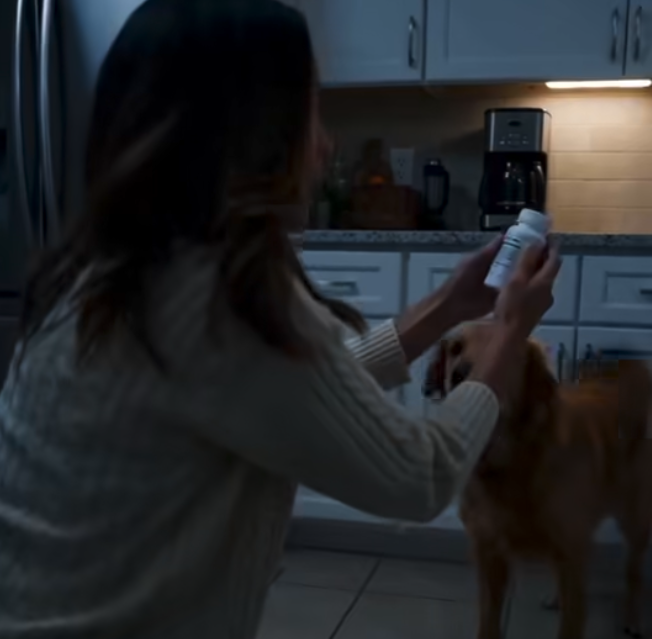
In his other hand was a small brown bottle.
Cooper stood between them and the sink, teeth exposed, growling so viciously I barely recognized him.
“Get this dog out of here!” Evan shouted.
“What are you doing?” I whispered.
His head snapped toward me.
For one second, pure panic flashed across his face.
Then anger covered it.
“Feeding him. What does it look like?”
“At three in the morning? With what?”
Noah whimpered faintly against his chest.
I stepped closer.
“What’s in your hand?”
Evan curled his fingers around the bottle.
“Nothing.”
Cooper lunged.
Not at Evan’s throat.
Not at his hand holding Noah.
At the bottle.
It flew from Evan’s grip, hit the tile, and spun across the floor. The cap popped loose. A clear liquid spilled beneath the refrigerator.
The label rolled into the kitchen light.
I saw two words.
Not baby vitamins.
Not infant drops.
Not medicine prescribed by any doctor.
SLEEP AID.
My blood turned to ice.
“Evan,” I said slowly. “Why do you have that near our baby?”
He swallowed.
“It’s not what it looks like.”
That sentence is always a confession wearing a mask.
I grabbed Noah from him.
Evan did not stop me.
Cooper immediately stopped growling and moved to my side, pressing his body against my legs like a shield.
“What did you give him?” I demanded.
“Nothing.”
“What did you give my son?”
“Keep your voice down.”
That was when I understood.
He was not afraid of hurting Noah.
He was afraid of being heard.
I backed away, clutching the baby.
Evan stepped forward.
Cooper snarled.
Evan stopped.
His eyes flicked from the dog to me, calculating.
“Mara, you’re exhausted. You’re not thinking clearly.”
There it was again.
The careful voice.
The one that made me doubt myself.
But this time, Noah stirred in my arms, too limp, too quiet, and something primal rose in me.
I ran.
I locked myself in the upstairs bathroom with Noah and called 911.
Then I called my mother.
Then I called the emergency pediatric line.
Evan pounded on the door for seven minutes.
Cooper stayed outside it.
Barking until police arrived.
At the hospital, doctors examined Noah while I sat beneath fluorescent lights with dried tears on my face and Cooper’s hair still stuck to my nightgown.
My mother held my hand.
I could not stop shaking.
Noah was okay.
Sleepy.
Monitored.
Safe.
But the doctor’s expression was grave when she returned.
“There are traces of a sedative in his system,” she said gently.
The room tilted.
My mother gasped.
I closed my eyes.
For three weeks, Evan had insisted our baby was “finally sleeping better” whenever he handled night feedings.
For three weeks, I had thanked him through tears.
For three weeks, Cooper had known.
The police searched the house that morning.
They found more bottles hidden in Evan’s locked toolbox in the garage.
They found printed articles about infant sleep.
They found deleted messages to someone named Lena.
And then they found the thing that changed the entire case.
A life insurance policy.
Not on Evan.
Not on me.
On Noah.
Taken out one week after his birth.
My husband had forged my signature.
I vomited in the hospital bathroom when detectives told me.
But the truth was not finished with us.
It never is.
Lena was Evan’s ex-girlfriend.
Not just an ex-girlfriend.
His former fiancée.
The woman he told me had “become unstable” years ago.
Police found her within hours.
When she walked into the station, she carried a folder thick with documents and looked at me with the haunted face of someone who had been waiting years for another woman to believe her.
“I’m sorry,” she said before sitting down. “I tried to warn you.”
My mouth went dry.
“What?”
“I sent letters before the wedding. Emails too. He must have intercepted them.”
Evan had always checked the mail.
He had set up our shared email filters.
He had handled everything “technical” because I was “too busy.”
Lena opened the folder.
Inside were medical records.
Police reports.
Photographs of bruises.
And one tiny hospital bracelet.
She had once had a baby with Evan.
A daughter.
Grace.
The child had died at seven weeks old.
The death had been ruled accidental.
Lena had insisted something was wrong.
Nobody believed her.
Evan had cried at the funeral.
Played the grieving father.
Then left Lena three months later and disappeared.
“He hated crying,” Lena whispered. “He hated losing sleep. He hated anything he couldn’t control.”
I felt the room closing in.
“How did Cooper know?” I asked, though I wasn’t sure anyone could answer.
Lena looked at me strangely.
“Cooper?”
“My dog.”
Her face changed.
“What kind of dog?”
“Chocolate Lab.”
She reached into the folder and pulled out an old photograph.
My breath stopped.
There was Evan, younger, smiling beside Lena.
And lying at Lena’s feet was a chocolate Labrador puppy.
Cooper.
I stared at the photo.
“No,” I whispered.
Lena’s eyes filled.
“His name was Cooper because Grace loved the sound of it when she babbled. Evan told me he ran away after she died.”
My entire body went cold.
Cooper had not started hating Evan when Noah was born.
Cooper had remembered him.
He had remembered the scent.
The voice.
The danger.
He had already lost one baby to that house of lies.
And he was not going to lose another.
Evan’s trial lasted four months.
The courtroom was packed every day.
He wore clean suits and soft expressions.
He tried to look wounded.
Misunderstood.
A father falsely accused by a hysterical wife and a grieving ex-fiancée.
But the evidence buried him.
The forged policy.
The hidden bottles.
The security footage from the kitchen.
The recovered messages.
The old files from Grace’s case, reopened after Lena testified.
And Cooper.
Not on the stand, of course.
But everywhere.
In photographs.
In police bodycam footage.
In the recording from that night, barking like thunder outside the bathroom door while I begged for help.
The prosecutor said something during closing arguments that made the entire courtroom go silent.
“Sometimes the first witness to evil is not a person. Sometimes it is the creature in the room who has no motive to lie.”
Evan was convicted.
Not just for what he tried to do to Noah.
But for what investigators finally proved he had done years earlier.
Lena wept when the verdict was read.
So did I.
Not because justice fixed everything.
It didn’t.
But because finally, someone believed the truth before another mother had to bury a child.
A year later, Noah took his first steps in our backyard.
He wobbled across the grass toward Cooper, who had grown slower but no less devoted.
“Coop!” Noah squealed.
Cooper lifted his head.
His tail thumped weakly against the ground.
Noah fell forward into him, laughing.
I stood on the porch with Lena beside me.
We had become something neither of us expected.
Not friends exactly.
Something deeper.
Two women connected by grief, survival, and the dog who had tried to save both our children.
Lena visited every month.
She brought flowers for Grace’s memory and toys for Noah.
At first, I worried it hurt her.
Then one day she told me, “Loving him helps me love her without drowning.”
So we let love be complicated.
We let healing be slow.
My mother moved in for a while, then stayed because Noah adored her and because I no longer believed I had to prove strength by suffering alone.
The house changed too.
I painted the kitchen yellow.
Threw away the old crib Evan had assembled.
Changed every lock.
Burned nothing, though I wanted to.
Instead, I packed Evan’s things into boxes and handed them to his lawyer.
I kept Cooper’s bed in the nursery.
He had earned that place.
Every night, after Noah fell asleep, Cooper lay across the doorway like a guardian carved from old loyalty and stubborn love.
One evening, I sat beside him and whispered, “I’m sorry I didn’t believe you.”
Cooper opened one cloudy eye.
Then he placed his paw on my hand.
Forgiveness, when it comes from a dog, is devastatingly generous.
On Noah’s second birthday, we held a small party in the backyard.
There were balloons, cupcakes, sticky toddler hands, and too much noise.
Lena came.
So did the detective who had reopened Grace’s case.
Even the prosecutor sent a card.
Noah wore a crown made of construction paper and fed Cooper bits of cake when he thought nobody was watching.
Near sunset, Lena handed me a wrapped gift.
“For you,” she said.
Inside was a framed photograph.
The old one.
Evan and Lena had been cut out.
Only Cooper remained, young and bright-eyed beside baby Grace’s blanket.
Beside it, Lena had placed a new photograph.
Cooper lying beside Noah in the grass.
Two babies.
One dog.
One promise fulfilled.
I cried so hard I had to sit down.
Lena sat beside me.
“I used to think he failed her,” she whispered.
I shook my head.
“No.”
Cooper lifted his head from across the yard, as if hearing us.
“He carried her warning all the way to Noah.”
Lena covered her mouth.
And for the first time since I had known her, her tears looked peaceful.
That night, after everyone left, I carried Noah upstairs.
Cooper followed slowly, one careful step at a time.
At the nursery door, he paused.
Noah reached down from my arms.
“Good boy,” he said.
Cooper wagged his tail.
I tucked Noah into bed and watched him fall asleep beneath a mobile of stars.
Then I sat in the hallway with Cooper’s head in my lap.
“You saved him,” I whispered.
The old dog sighed.
His body relaxed.
His eyes closed.
For the first time since Noah was born, he did not sleep across the doorway.
He slept beside me.
As if his work was finally done.
People ask me when I stopped being afraid.
They expect me to say the day Evan went to prison.
Or the day Noah’s test results came back clear.
Or the day the court recognized Grace’s truth.
But fear does not vanish because a judge strikes a gavel.
It leaves slowly.
In pieces.
It leaves when your child laughs in his sleep.
It leaves when your mother hums in the kitchen.
It leaves when sunlight touches a room that once held terror and turns it ordinary again.
It leaves when an old dog who once barked like a siren finally rests.
I still think about that bottle sometimes.
About how small it looked on the kitchen floor.
How harmless evil can appear when it fits in the palm of a hand.
But I think more about Cooper.
How he barked when nobody listened.
How he stood between danger and innocence.
How he remembered what humans tried to forget.
My husband said the dog was jealous.
He was wrong.
Cooper was grieving.
Guarding.
Warning.
Loving.
And in the end, the truth was simple.
The dog never went crazy when my husband held the baby.
The dog was the only sane one in the room.
And because of him, my son lived.
Because of him, another mother finally got justice.
Because of him, the house that almost became a nightmare became a home again.
Years later, when Noah asks why there is a bronze paw print framed above his bed, I tell him the truth.
“That belonged to the first hero who ever loved you.”
And every time Noah smiles, every time he runs across the yard beneath the afternoon sun, every time he wraps his arms around my neck and calls me Mom, I silently thank the old dog who refused to be quiet.
Because sometimes angels do not arrive with wings.
Sometimes they arrive with gray muzzles, tired eyes, and a bark loud enough to wake the truth.
