The first time the old Labrador jumped onto a hospital bed, Nurse Emily Carter nearly screamed loud enough to wake the entire intensive care ward.
It was 2:17 in the morning.
Rain battered the windows of St. Mercy Hospital like impatient fingers. The hallway lights buzzed softly above polished floors, and the only sounds came from machines breathing for people who could not breathe well enough on their own.
Then came the muddy pawprints.
Large.
Wet.
Impossible.
Emily saw them before she saw the dog.
They crossed the hallway from the emergency stairwell, curved past the medication cart, and disappeared through the half-open door of room 214.
“Oh, no,” she whispered.
Not again.
The dog had been appearing for eleven nights straight.
A yellow Labrador, old and soaked and scarred, with cloudy eyes, a torn ear, and a limp in his back leg. Security had dragged him out five times. Housekeeping had complained three times. Patients had yelled. Doctors had threatened to call animal control.
Yet every night, somehow, he came back.
Always to the same room.
Room 214.
The room of Arthur Whitmore, seventy-eight years old, retired history teacher, unconscious for twenty-six days after collapsing alone in his apartment.
No visitors.
No family.
No flowers.
No cards.
Just one silent old man connected to tubes.
And one forbidden dog who refused to leave him.
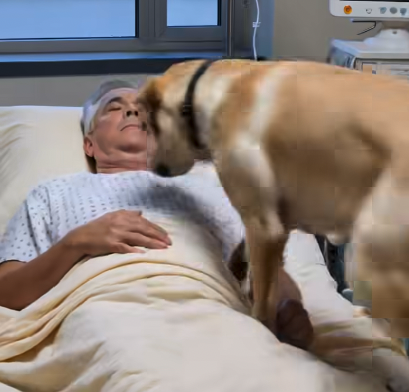
Emily stepped into the room and found the Labrador halfway onto Arthur’s bed, muddy paws pressed into the clean white blanket.
“Hey!” she snapped, rushing forward. “No. Absolutely not.”
The dog looked at her.
Not with fear.
Not with guilt.
With pleading.
His ribs rose and fell too fast. His wet fur clung to his body. A thin whine escaped his throat as he pressed closer to Arthur’s chest.
Emily grabbed his collarless neck gently but firmly.
“You can’t be here,” she said, though something inside her softened at the way his body trembled. “You’re going to get both of us in trouble.”
The dog suddenly barked.
Sharp.
Desperate.
Emily froze.
Arthur’s heart monitor changed.
BEEP.
BEEP.
BEEP.
Faster.
Irregular.
The line on the screen jumped.
Emily’s training snapped into place.
“Mr. Whitmore?”
The dog barked again and lowered his head against the old man’s chest as if listening for something no machine could hear.
Arthur’s fingers twitched.
Emily forgot to breathe.
“Mr. Whitmore?”
His eyelids fluttered.
The Labrador pressed his muzzle against Arthur’s hand.
And then, after nearly a month of silence, Arthur Whitmore opened his eyes.
The room fell impossibly still.
His gaze was unfocused at first, wandering across ceiling tiles, monitors, IV lines. Then his eyes lowered to the muddy dog beside him.
His face crumpled.
With trembling fingers, he grabbed the Labrador’s fur.
“Sam,” he whispered.
Emily’s skin prickled.
The dog made a sound so soft it was almost a sob.
Arthur’s eyes filled with tears.
“You found me.”
By morning, everyone in St. Mercy Hospital knew.
The coma patient in 214 had woken up.
The dirty dog had been there when it happened.
And the first word Arthur Whitmore had spoken was not a nurse’s name.
Not a doctor’s.
Not a prayer.
It was Sam.
Dr. Julian Reyes stood at the foot of Arthur’s bed with his arms folded, trying to remain professional while the Labrador slept with his head resting against Arthur’s side.
“This is medically unusual,” he said.
Emily raised an eyebrow. “That’s one way to say miracle.”
Dr. Reyes sighed. “Nurse Carter.”
“He woke up because of the dog.”
“He woke up while the dog was present.”
“Doctor.”
He looked at her.
Emily pointed at the old man, who was now awake enough to stroke the dog’s head weakly.
“He recognized him.”
Arthur’s voice was rough as paper.
“Don’t send him away.”
Dr. Reyes softened.
“Mr. Whitmore, we need to understand where this dog came from.”
Arthur looked down at the Labrador.
His hand shook as it moved over the dog’s scarred ear.
“This isn’t just a dog.”
Emily leaned closer.
Arthur swallowed hard.
“This is my boy.”
The words confused everyone.
But the Labrador lifted his head.
As if he understood.
Arthur Whitmore had been a man of routines.
Every morning at six, he made tea.
Every afternoon at four, he sat near his window and read old letters.
Every Friday, he walked three blocks to buy chicken from a market he no longer needed, because he lived alone and barely cooked.
His neighbors thought he was lonely.
They were wrong.
He was waiting.
Thirty years earlier, Arthur had been a young teacher with a wife named Margaret and a seven-year-old son named Samuel.
Sam was bright, stubborn, and always running ahead.
He loved dogs more than people.
“He said animals listened better,” Arthur told Emily later, his eyes fixed on the Labrador. “Maybe he was right.”
One summer afternoon, Arthur took Sam to a lakeside fair.
There were balloons, music, fried dough, children racing between booths.
Then a storm rolled in without warning.
Wind.
Panic.
People running.
A power pole cracked.
Lights went out.
Arthur held Sam’s hand.
Then a crowd surged between them.
For one second, his son’s fingers slipped.
One second.
That was all it took.
Sam vanished.
Police searched for weeks.
The lake was dragged.
Flyers covered every telephone pole.
Margaret stopped sleeping.
Arthur stopped teaching.
No body was found.
No ransom call came.
No explanation.
Their son simply disappeared.
Margaret died five years later still believing Sam might walk through the door.
Arthur spent the next twenty-five years doing the same.
He left the porch light on every night.
He kept Sam’s room untouched.
He bought chicken every Friday because it had been Sam’s favorite.
And on the last page of his medical record, hidden beneath emergency contact forms and old allergy notes, Emily found a handwritten instruction:
If found unconscious, please notify Samuel Whitmore, son.
No number.
No address.
Just a name.
A hope disguised as paperwork.
The hospital tried to remove the Labrador that afternoon.
Policy was policy.
The dog had no vaccination records, no tag, no proof of ownership.
But when security stepped into room 214, Arthur’s heart rate spiked so violently the monitors screamed.
Sam—because Arthur refused to call him anything else—stood over the old man and growled.
Not threatening.
Warning.
Emily stepped between security and the bed.
“You’re not taking him.”
The guard frowned. “Nurse Carter, this dog has been wandering through sterile areas.”
“And that man woke up because of him.”
Dr. Reyes entered behind them.
For once, he looked less like a doctor and more like a man carrying a private burden.
“The dog stays temporarily,” he said. “I’ll authorize an exception under emotional support observation until we verify records.”
The guard stared. “You can do that?”
Dr. Reyes looked at Arthur, whose trembling hand clung to the dog’s fur.
“I just did.”
Emily smiled faintly.
Arthur whispered, “Thank you.”
But his eyes never left the Labrador.
“Sam,” he murmured again.
The dog licked his fingers.
And Emily wondered whether grief could become so deep that it taught the heart to recognize love in another shape.
The truth began with a microchip.
A volunteer from a local rescue scanned the Labrador that evening.
The machine beeped.
A name appeared.
Buddy.
Owner: Daniel Mercer.
Emily’s heart sank.
Not Arthur.
Not Sam.
The rescue volunteer called the number, but it was disconnected.
The address listed was an abandoned house across town.
Dr. Reyes looked almost relieved.
“Then the dog isn’t his.”
Arthur heard from the bed.
His face folded inward.
Emily hated the cruelty of facts.
But then the volunteer scrolled further.
“Wait,” she said. “There’s a transfer note.”
She frowned.
“This chip was updated nine years ago. The original registering organization was a therapy dog program connected to a foster care center.”
Emily leaned over.
“What foster care center?”
The volunteer read the name.
“Bright Haven Children’s Home.”
Arthur went completely still.
Emily noticed.
“Mr. Whitmore?”
His lips parted.
“That’s where they thought Sam might have been taken.”
Everyone turned toward him.
Arthur’s breathing grew shallow.
“After he disappeared, one detective believed he may have been placed under a different name. There was never enough proof.”
The room seemed to shrink.
Dr. Reyes quietly said, “What was the detective’s name?”
Arthur closed his eyes.
“Daniel Mercer.”
The name hit the room like thunder.
Daniel Mercer.
The dog’s registered owner.
Detective Laura Finch arrived before midnight.
She was young, sharp-eyed, and carried a folder thick with old paper.
Arthur’s missing-child case had gone cold before she was born, but the hospital’s call had stirred something buried in the police archives.
She stood in room 214 beside Emily, Dr. Reyes, Arthur, and the sleeping Labrador.
“Daniel Mercer was the lead detective on Samuel Whitmore’s disappearance,” she said. “He died nine years ago.”
Arthur stared at the ceiling.
“He never stopped looking.”
“No,” Finch said softly. “He didn’t.”
She opened the folder.
“After Mercer retired, he volunteered at Bright Haven Children’s Home. He trained therapy dogs for traumatized children.”
Emily felt her pulse quicken.
“And Buddy?”
Finch looked at the dog.
“Buddy was one of his dogs.”
Arthur whispered, “Why would that dog come to me?”
Finch hesitated.
“Because Daniel Mercer left instructions.”
She removed a faded envelope from the file.
It had been found in a sealed evidence box after the hospital requested records.
On the front, written in old ink, were the words:
For Arthur Whitmore, if he ever wakes to the truth.
Arthur’s face drained of color.
Emily opened her mouth, but no sound came.
Finch handed him the letter.
His hands shook too badly, so Emily read it aloud.
Arthur,
If you are reading this, then I failed to tell you while I was alive.
I found Samuel.
Not in time.
Not in the way I promised.
But I found him.
He was placed under another name after the fair. A woman involved in an illegal adoption ring took several children that year. By the time I traced him, he was sixteen and living as Daniel Reed.
He remembered almost nothing clearly, except a lake, a storm, and a father calling his name.
I tried to reunite you.
But he was afraid.
He had been told his real parents abandoned him.
He carried too much pain.
Then illness took him before I could convince him.
Arthur made a broken sound.
Emily stopped reading, tears burning her eyes.
Arthur whispered, “No.”
But Finch gently nodded for her to continue.
Before Samuel died, he helped train a Labrador named Buddy at Bright Haven.
He said the dog listened like someone he once loved.
He made me promise that if Buddy ever found a lost old man who smelled like tea, paper, and Friday chicken, I should let him stay.
I think some part of Samuel remembered you.
I am sorry I could not bring your son home.
But maybe, one day, Buddy will.
Emily could barely finish.
The room was silent except for the heart monitor.
Arthur stared at the Labrador.
Not his son.
Not truly.
But loved by his son.
Touched by his son.
Sent, impossibly, through time and grief, by the boy he had lost.
Buddy opened his cloudy eyes and rested his head on Arthur’s chest.
Arthur sobbed.
For the first time in thirty years, he did not cry like a man waiting.
He cried like a father who had finally been found.
The revelation should have broken him.
Instead, it gave him something to hold.
Arthur grew stronger over the next week.
Slowly.
Painfully.
With Buddy beside him.
He ate because Buddy watched every spoonful with serious concern.
He sat up because Buddy whined until he tried.
He walked three steps because Emily promised Buddy could walk beside him if he did.
Hospital staff who once chased the Labrador away began sneaking him treats.
Patients requested visits.
Children in pediatrics drew pictures of “the miracle dog.”
Even Dr. Reyes, who had argued about infection protocol, began carrying dog biscuits in his coat pocket.
“You’ve become soft,” Emily teased.
He shrugged. “Clinical adjustment.”
Arthur laughed for the first time on day eight.
The sound startled everyone.
Buddy barked once, tail thumping against the bed.
But the happiest moment came when Detective Finch returned with a small box.
Inside were items recovered from Samuel’s adult life.
A photograph of him at sixteen, thin and serious.
A volunteer badge from Bright Haven.
A worn red dog leash.
And a cassette tape labeled:
For Dad, if I’m ever brave enough.
Arthur held the tape like glass.
The hospital found an old player in storage.
Everyone left the room except Emily and Buddy.
Arthur pressed play.
Static crackled.
Then a young man’s voice filled the room.
“I don’t know how to start this.”
Arthur covered his mouth.
The voice continued.
“My name is Daniel now, but sometimes I dream someone calls me Sam. I don’t know if you’re real. I don’t know if I made you up because I needed someone to miss me.”
Arthur shook with silent sobs.
“But there’s this dog at the home. Buddy. He sits with me when I can’t breathe. He makes me feel like maybe I was loved once. If you’re out there… if you looked for me… I’m sorry I didn’t know how to come home.”
The tape clicked softly.
Then Sam’s voice returned, smaller.
“I remember chicken on Fridays. And a porch light. And someone saying, ‘I’ll find you, Sammy.’ If that was you… thank you for trying.”
Arthur bent forward over the tape.
Buddy pressed against him.
Emily cried quietly near the door.
On the recording, Samuel gave a shaky laugh.
“Buddy likes violin music, hates thunder, and steals socks. Take care of him if he ever finds you. I think he’s better at finding lost people than anyone.”
The tape ended.
Arthur did not move for a long time.
Then he whispered into Buddy’s fur, “He remembered.”
Buddy closed his eyes.
As if that was the message he had carried all along.
Two months later, Arthur left St. Mercy Hospital.
Not in a wheelchair, as everyone expected.
He walked.
Slowly.
With a cane in one hand and Buddy’s red leash in the other.
Doctors applauded.
Nurses cried.
Security guards who had once dragged Buddy into the rain stood at attention like guilty soldiers.
Emily hugged Arthur carefully.
“You behave,” she said.
Arthur smiled. “I’m seventy-eight. I make no promises.”
Buddy barked.
Everyone laughed.
Dr. Reyes handed Arthur a folder.
“Your discharge papers. And the official therapy animal approval.”
Arthur looked down at Buddy.
“Official, are we?”
The Labrador wagged his tail.
Detective Finch waited by the exit with one final gift.
A photograph, restored and framed.
Arthur, younger, kneeling beside seven-year-old Sam at the lakeside fair.
Sam holding fried chicken in one hand.
Arthur holding his son’s shoulder.
Both smiling.
Arthur touched the glass.
For a moment, the decades folded.
The hospital hallway disappeared.
He was there again.
Before the storm.
Before the loss.
Before the waiting.
Then Buddy nudged his leg.
Arthur looked down.
Not back.
Down.
At the life still beside him.
He smiled through tears.
“Come on, Buddy,” he said. “Let’s go home.”
Arthur’s house changed after that.
The porch light still stayed on, but no longer as a plea.
Now it was a welcome.
For Emily, who visited on Sundays.
For Detective Finch, who brought updates about the adoption ring investigation that had finally reopened.
For Dr. Reyes, who pretended to stop by only for “medical follow-up” but always stayed for tea.
And for the children from Bright Haven, who came once a month to read stories to Buddy in Arthur’s living room.
Arthur turned Sam’s untouched bedroom into a small music-and-reading room for foster children.
He kept Sam’s photograph on the shelf.
The cassette tape beside it.
The red leash hanging near the door.
Buddy slept beneath the window, where afternoon light warmed his old bones.
Some nights, Arthur still woke from dreams of the fair.
The storm.
The hand slipping away.
But now, when grief came, Buddy was there.
A warm weight beside the bed.
A reminder that love did not always return the way people expected.
Sometimes it came back muddy.
Old.
Uninvited.
Leaving pawprints down sterile hospital halls.
Jumping onto beds where rules said it did not belong.
Refusing to leave until the living remembered why they had to keep living.
On Buddy’s first anniversary of coming home, Arthur returned to St. Mercy Hospital.
Room 214 had a new patient now, a little girl recovering from surgery. Buddy visited with his official vest and his slow, gentle walk.
The nurses gathered.
Patients smiled.
Even security opened the door for him.
Emily knelt beside Buddy and scratched behind his torn ear.
“Hard to believe we tried to throw you out.”
Arthur chuckled.
“You didn’t know he was staff.”
Dr. Reyes appeared with a badge hanging from Buddy’s collar.
Emily read it aloud.
Buddy Whitmore
Volunteer Therapy Dog
Special Assignment: Finding Lost Hearts
Arthur laughed until tears filled his eyes.
That afternoon, as they left the hospital, rain began falling softly.
Buddy paused at the entrance.
For a second, he looked back toward the hallway.
Toward room 214.
Toward the place where everyone had called him filthy.
Toward the place where he had brought a father back from the edge of death and delivered a son’s final message.
Arthur bent down with effort and touched his head.
“You did it, boy,” he whispered. “You brought him home.”
Buddy leaned into his hand.
And in that gentle pressure, Arthur felt something he had waited thirty years to feel.
Peace.
Not because every wound had vanished.
Not because the past had been undone.
But because love had survived the storm.
Samuel had remembered.
Mercer had kept searching.
Buddy had carried the message.
And Arthur, at last, had stopped waiting alone.
Together, the old man and the old Labrador stepped into the rain.
Not as two lost souls.
But as a family.
And behind them, through the glowing hospital windows, the nurses watched the muddy pawprints fade slowly from the floor, smiling through tears because they finally understood.
The dog had never been making a mess.
He had been leaving a trail home.
