The first note of Noah Bell’s violin performance was so soft that half the audience leaned forward without realizing it.
It trembled through the old theater like a secret.
A single silver thread of sound.
Fragile.
Lonely.
Beautiful.
Noah stood beneath the great golden arch of Briarwood Academy’s auditorium, his small shoulders stiff, his polished shoes planted exactly on the taped mark his music teacher had placed on the floor. His bow hand shook. His dark hair was combed too neatly. His rented black jacket was slightly too big at the wrists.
But when he played, something changed.
The nervous ten-year-old boy disappeared.
And for a few seconds, everyone saw what only one creature in the world had always believed about him.
That Noah Bell was brave.
In the shadows outside the side entrance, soaked by rain, a muddy yellow Labrador lifted his head.
His ears twitched.
His tail tapped once against the wet pavement.
“You came,” Noah had whispered to him fifteen minutes earlier, before stepping onto the stage.
The dog’s name was Rusty, though nobody at Briarwood Academy called him that.
To the teachers, he was “that filthy animal.”
To the parents, he was “a health hazard.”
To Principal Margaret Vale, he was “a liability.”
But to Noah, Rusty was the only friend who never laughed when his hands shook.
The Labrador had appeared behind the school six months earlier, ribs showing, fur dirty, one ear torn from an old injury. Most children screamed and ran when he wandered near the playground. The janitor threw buckets of water to chase him away. Parents complained that a stray dog ruined the academy’s reputation.
Only Noah had knelt beside the dumpster one rainy afternoon and offered him half a cheese sandwich.
Rusty had not eaten it at first.
He had stared at Noah’s hands.
Those tiny trembling hands.
Then he had gently taken the bread as if accepting something sacred.
After that, he followed Noah everywhere from a distance.
Outside classrooms.
Behind the fence during recess.
Near the music hall windows whenever Noah practiced violin alone.
Noah’s mother, Claire Bell, had noticed.
She was sitting in the third row tonight, gripping her purse so tightly her knuckles were white. She knew about the dog. She had even fed him twice when nobody was looking.
But she also knew Briarwood Academy.
Its polished floors.
Its wealthy donors.
Its perfect families.
Its smiling cruelty.
And she knew how much Noah had already endured there.
“He is not normal,” one parent had whispered after Noah froze during a spelling competition.
“Such a strange boy,” another had said when he cried because the cafeteria lights buzzed too loudly.
Claire had spent years teaching Noah that sensitive did not mean weak.
But the world kept trying to teach him otherwise.
Tonight was supposed to be different.
Tonight, Noah had earned the solo.
Tonight, for once, everyone would hear him.
The music swelled.
His bow glided more confidently now.
Parents raised phones.
Teachers nodded.
Principal Vale smiled her practiced public smile from the aisle.
And above the stage, hidden behind velvet curtains and painted beams, an old lighting rig trembled.
At first, the sound was almost nothing.
A faint metallic click.
Then a slow, strained creak.
Nobody heard it.
Nobody except Rusty.
The Labrador outside the door went still.
His nose lifted.
Rain ran down his muzzle.
Burning dust.
Hot wire.
Metal under stress.
Rusty’s body remembered before his mind could explain.
Smoke.
Screaming.
Falling beams.
A child crying beneath rubble.
His paws scraped against the pavement.
Inside, Noah reached the delicate middle section of the piece.
His eyes closed.
For the first time all night, he was not afraid.
Then Rusty barked.
One sharp sound outside the backstage door.
A stagehand turned in irritation.
“Not now,” he muttered.
Rusty barked again.
Louder.
Desperate.
The metallic creak above the stage deepened.
A bolt snapped loose and bounced once along the catwalk.
Still, no one in the audience noticed.
Music covered everything.
Rusty slammed his body against the backstage door.
Once.
Twice.
The latch burst open.
The Labrador exploded into the wings, dragging mud across black curtains.
A student screamed.
The stage manager dropped her clipboard.
“No!” shouted Mrs. Hargrove, the music teacher. “Get that dog out!”
Rusty did not slow down.
He saw Noah.
He saw the lights trembling above him.
He saw the exact spot where death was about to fall.
The Labrador launched himself onto the stage.
Gasps tore through the auditorium.
Noah’s eyes opened.
“Rusty?”
The dog barked with such panic that the bow slipped in Noah’s fingers.
Mrs. Hargrove stormed forward, red-faced with fury.
“You filthy beast! You ruined everything!”
Parents stood.
Phones kept recording.
Principal Vale hissed to security, “Remove it immediately!”
Rusty ignored them all.
The lighting rig gave another violent shudder.
Noah looked up too late.
Rusty moved first.
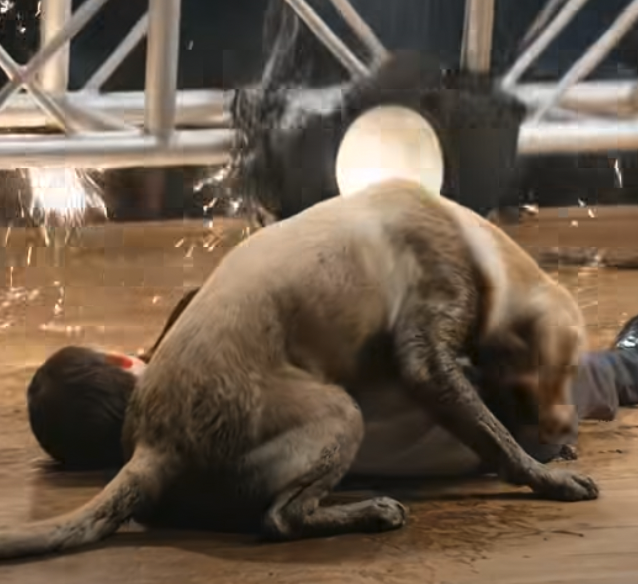
He hurled all seventy pounds of himself directly into Noah’s chest.
The violin flew from the boy’s hands.
It struck the floor and shattered.
Noah crashed backward, sliding across the stage.
The audience erupted.
“What is wrong with that animal?”
“He attacked the boy!”
“Someone do something!”
Then came the sound.
CRAAAAACK.
The entire ceiling seemed to split open.
A blinding shower of sparks rained down.
The lighting rig tore loose with a scream of metal and plunged onto the exact place where Noah had been standing one second earlier.
The crash shook the theater.
Wood splintered.
Glass burst.
Children screamed backstage.
The audience froze in collective horror.
Noah lay beneath Rusty, sobbing, alive.
The Labrador stood over him, teeth bared at the falling sparks, shielding the boy with his own body.
Then a heavy steel bracket slid from the broken rig and struck Rusty across the back.
The dog made one small sound.
Not a bark.
Not a cry.
Just a breath leaving him.
Then he collapsed beside Noah.
“No!” Noah screamed.
The boy crawled toward him, hands shaking violently now, not from fear of people, but from love.
“Rusty! Rusty, wake up!”
Claire reached the stage before anyone could stop her.
She dropped beside her son and the dog, pulling Noah into one arm while pressing her other hand against Rusty’s muddy neck.
A pulse.
Weak.
But there.
“He’s alive,” she whispered.
Noah clung to the dog’s wet fur.
The auditorium, moments ago furious at the animal, had gone completely silent.
Every phone was still recording.
Every adult who had shouted at him now stared at the twisted metal where a child would have died.
Principal Vale’s face had turned as pale as paper.
Mrs. Hargrove covered her mouth with both hands.
And above them, smoke curled from the broken ceiling.
Rusty was taken to an emergency veterinary hospital under police escort.
Noah refused to let go of him until the doctors physically lifted the Labrador onto a stretcher.
“He saved me,” Noah kept repeating. “Please don’t let him die. He saved me.”
Claire held her son as he shook.
“He knows,” she said, though her own voice was breaking. “He knows you love him.”
Outside the hospital, news vans arrived before midnight.
The video had already spread across the city.
The dirty dog who ruined a violin recital.
The collapse.
The boy saved by inches.
By morning, Rusty was no longer a nuisance.
He was a hero.
But heroes, Claire learned, could still be in danger.
A veterinarian named Dr. Lena Ortiz met them in the waiting room at dawn. Her scrubs were stained. Her eyes were tired but kind.
“He has cracked ribs, deep bruising, and trauma along the spine,” she said gently. “But he made it through surgery.”
Noah’s face crumpled with relief.
“Can I see him?”
“For a few minutes.”
Rusty lay in a recovery kennel wrapped in blankets, one leg bandaged, breathing slowly through oxygen tubes.
Noah pressed his small hand against the glass.
The Labrador’s eyes opened.
His tail moved once.
Barely.
Noah began crying.
“I’m sorry about my violin,” he whispered. “I don’t care. I don’t care about it. I just want you.”
Dr. Ortiz watched them quietly.
Then her expression changed.
“Mrs. Bell,” she said, “there’s something else.”
Claire looked up.
“We found a microchip.”
Noah turned.
“A chip?”
Dr. Ortiz nodded. “Rusty wasn’t always a stray.”
Claire felt something tighten in her chest.
“Who owned him?”
The veterinarian hesitated.
“The registered name is not Rusty.”
She looked down at the form.
“His name was Atlas.”
Noah frowned.
Atlas.
The name felt too large for the muddy dog curled behind glass.
Dr. Ortiz continued carefully.
“He belonged to a fire-rescue unit.”
Claire stared.
“What?”
“He was trained for disaster response. Collapse detection. Smoke recognition. Structural danger alerts.”
Noah looked at Rusty with wide eyes.
“That’s how he knew.”
Dr. Ortiz nodded.
“But there’s more. Atlas disappeared four years ago after a theater fire.”
The room went still.
“A theater fire?” Claire asked.
The doctor glanced through the glass at the sleeping dog.
“The official records say he entered a burning auditorium searching for a missing child. The child was rescued. Atlas vanished during the evacuation and was presumed dead.”
Noah whispered, “He wasn’t dead.”
“No,” Dr. Ortiz said softly. “He was still searching.”
Detective Aaron Miles arrived an hour later.
He was not there because of the dog.
He was there because the ceiling collapse was not an accident.
A maintenance inspection had been completed just two days before the recital.
The rig should have been safe.
But someone had loosened the support bolts.
Someone had cut halfway through a cable.
Someone had tampered with the electrical box above the stage.
Claire listened from the hospital hallway as the detective explained.
Her stomach turned cold.
“You mean someone tried to hurt those children?”
Detective Miles answered carefully.
“We don’t know the intended target yet.”
Noah sat nearby, hugging his knees.
His face had gone blank in the way it did when the world became too loud.
Claire knelt in front of him.
“Sweetheart.”
He did not look at her.
“It was supposed to be me,” he said.
“No.”
“Yes.” His voice was tiny. “Everyone hates me.”
Claire’s heart broke.
“Noah Bell, listen to me. People can be cruel, but that does not mean you deserve cruelty.”
He looked toward Rusty’s room.
“Rusty knew.”
Detective Miles watched the boy closely.
“What do you mean, Noah?”
Noah swallowed.
“Rusty doesn’t only come when I play violin. He comes when I’m scared.”
That sentence stayed with everyone.
By afternoon, the investigation turned toward Briarwood Academy.
Security footage showed something strange.
A person entering the theater late the previous night wearing a janitor’s uniform and a baseball cap.
The figure moved with confidence.
Avoided cameras.
Used a key.
Principal Vale insisted only approved staff had access.
But the janitor, Mr. Alvarez, had an alibi. Hospital records proved he had been with his wife all night.
So someone had stolen the uniform.
Then the detective found another detail.
Two weeks before the recital, Noah had been selected for the violin solo over another student: Mason Whitlock.
Mason’s father, Gregory Whitlock, was Briarwood’s biggest donor.
A proud, polished man who wore expensive suits and spoke to teachers as if they were employees.
He had loudly complained about Noah getting the solo.
“My son has represented this school for years,” Gregory had told Principal Vale. “That Bell boy freezes if someone coughs too loudly.”
Claire remembered hearing those words in the hallway.
She had never told Noah.
Now, standing in the principal’s office, she watched Gregory Whitlock laugh at the detective’s questions.
“You cannot be serious,” he said. “You think I sabotaged a stage because of a children’s recital?”
Detective Miles did not smile.
“Did you enter the theater last night?”
“No.”
“Do you own a key?”
“I’m a board member.”
“That wasn’t my question.”
Gregory’s jaw tightened.
Principal Vale looked terrified.
But before the interrogation could go further, Mason spoke.
The twelve-year-old boy stood near the door, pale and shaking.
“Dad,” he whispered. “Tell them.”
Gregory snapped, “Be quiet.”
Mason flinched.
Claire recognized that flinch.
It was the same one Noah made when adults got too loud.
Detective Miles turned to him.
“Mason, what do you know?”
The boy’s eyes filled with tears.
“My dad didn’t cut the cable.”
Gregory exhaled sharply, relieved.
Then Mason added:
“But he paid someone to scare Noah.”
The room went silent.
Gregory’s face changed.
“Mason.”
The boy began crying.
“He said the rig would drop a little. Just enough to cancel the show. Just enough so I could perform at the rescheduled recital. He said nobody would get hurt.”
Claire felt rage rise so fast she could barely breathe.
“Nobody would get hurt?”
Gregory pointed at Mason.
“My son is confused.”
But Mason shook his head.
“No. I heard you on the phone. You said, ‘Make sure the Bell kid never touches that stage again.’”
Principal Vale sank into her chair.
Detective Miles stepped forward.
“Gregory Whitlock, you need to come with me.”
But the twist was not finished.
Because when police traced the payment, it did not lead to Gregory’s hired technician.
It led to someone else.
Someone inside the school.
Mrs. Hargrove.
The music teacher.
Noah refused to believe it at first.
Mrs. Hargrove was strict.
Cold.
Often cruel.
But she had taught him violin for two years.
“She hates when I make mistakes,” he whispered. “But she wouldn’t…”
Claire could not finish the sentence for him.
Mrs. Hargrove confessed after six hours.
Gregory Whitlock had offered her money to create a “technical interruption.” She claimed she only meant for a spotlight to fail, embarrassing Noah and delaying the recital.
But once she tampered with the system, she damaged more than she understood.
The old rig became unstable.
The cable overheated.
The ceiling began to fail.
She had not meant to kill anyone.
But intention did not erase consequence.
When Detective Miles told Claire, she felt no satisfaction.
Only exhaustion.
So much pride.
So much cruelty.
So much danger created because adults could not bear to see a trembling little boy succeed.
Three days later, Rusty woke fully.
Noah was there.
He had been there every day after school, reading to him, playing recordings of violin music from Claire’s phone.
When Rusty lifted his head, Noah gasped.
“Mom!”
Rusty blinked slowly.
Then he licked Noah’s fingers.
Noah laughed and cried at the same time.
Dr. Ortiz smiled from the doorway.
“He’s going to need a long recovery,” she said. “But he wants to live.”
Claire looked at the dog.
“No,” she said softly. “He wants to stay.”
The legal process moved quickly.
Because Rusty’s original handler was found.
Captain Daniel Price, retired from the fire department, arrived at the clinic with a limp and a photograph in his hand.
The moment Rusty saw him, the Labrador struggled to stand.
“Atlas,” Daniel whispered.
Rusty whined.
The old firefighter dropped to his knees.
For a long moment, man and dog simply leaned into each other.
Daniel explained the truth.
Four years earlier, Atlas had saved a child during the Grand Meridian Theater fire.
But the child’s mother died before firefighters could reach her.
Afterward, Atlas had changed.
Restless.
Haunted.
Then one night he disappeared.
“I thought he was gone,” Daniel said, stroking the dog’s head. “But maybe he heard another child who needed him.”
Noah looked down.
“Can he stay with me?”
The question broke everyone.
Daniel studied the boy.
Then Rusty.
Then he smiled through tears.
“I think he already chose.”
Briarwood Academy reopened weeks later, though nothing felt the same.
Gregory Whitlock faced charges.
Mrs. Hargrove lost her position and awaited sentencing.
Principal Vale resigned after records showed she had ignored repeated maintenance warnings to protect the school’s image.
The theater was repaired under public scrutiny.
And Noah Bell received a new violin.
Not from the school.
Not from donors.
From hundreds of strangers who had watched the video and sent small contributions with handwritten notes.
For the brave boy.
For the hero dog’s best friend.
The replacement violin was beautiful.
But Noah kept one broken piece from the old one: the scratched wooden chin rest.
He placed it beside Rusty’s bed.
“So we remember,” he said.
Claire asked, “Remember what?”
Noah thought for a moment.
“That broken things can still be part of music.”
Claire hugged him tightly.
Two months later, the school held a new recital.
This time, it was not at Briarwood’s old theater.
It was outside, in the town square, beneath strings of lights and a clear evening sky.
No heavy rigging.
No velvet curtains.
No polished cruelty hiding behind tradition.
Just families, folding chairs, cool air, and an old yellow Labrador lying proudly in the front row wearing a blue service vest.
Noah walked onto the small platform.
His hands still trembled.
But this time, when people noticed, they did not laugh.
They waited.
Claire sat beside Captain Price.
Dr. Ortiz sat nearby.
Detective Miles stood in the back with his arms folded, pretending he was not emotional.
Mason Whitlock came too, sitting quietly with his mother. When Noah saw him, Mason mouthed two words.
I’m sorry.
Noah nodded.
Not forgiveness fully.
Not yet.
But a beginning.
Then he looked at Rusty.
The Labrador lifted his head.
Their eyes met.
And Noah began to play.
The first note was soft again.
Fragile.
Lonely.
Beautiful.
But this time it did not tremble for long.
The melody rose into the evening, carrying grief and fear and gratitude and something even stronger than courage.
Hope.
People cried openly.
Claire pressed a hand to her mouth.
Captain Price closed his eyes, hearing in the music all the lives Atlas had saved, all the ghosts he had carried, all the years he had wandered alone.
When Noah reached the final section, Rusty stood.
The crowd noticed.
A nervous ripple moved through them.
After everything, nobody ignored that dog anymore.
But Rusty did not bark.
He did not warn.
He simply walked slowly to the platform and sat beside Noah.
As if telling the world:
This time, I am not here because danger is coming.
This time, I am here because he is safe.
Noah smiled through tears and played the final note.
For one perfect second, silence held the square.
Then applause erupted like thunder.
Noah laughed.
Rusty barked once.
The crowd laughed with him.
Years later, people would still tell the story of the dirty Labrador who ruined a violin performance and saved a child from a collapsing ceiling.
They would talk about the shocking investigation.
The jealous donor.
The corrupt teacher.
The hidden past of a rescue dog presumed dead.
They would say it was a miracle.
But Noah knew the truth was both simpler and deeper than that.
Rusty had not ruined his performance.
He had finished it.
Because before Rusty, Noah thought music was about playing perfectly so people would finally accept him.
After Rusty, he understood something else.
Music was about being heard.
Even when your voice shook.
Even when the world called you strange.
Even when everyone mistook your warning for noise.
On the night of the new recital, Noah knelt beside Rusty after the applause faded and whispered the same words he had spoken outside the theater months before.
“You came.”
Rusty leaned his heavy head against the boy’s chest.
Noah wrapped both arms around him.
This time, nobody screamed.
Nobody tried to drag the dog away.
Nobody called him filthy.
The crowd simply watched as a boy and a battered old Labrador held each other beneath the lights.
Two souls everyone had underestimated.
Two hearts that had survived the collapse.
And somewhere in the quiet after the applause, Noah understood the happiest ending of all.
He had not lost his music that night.
He had found the one friend who had been listening all along.
