The first time Max chased the school bus, everyone laughed.
By the three hundredth time, half the town wanted him gone.
He was a big, rough-coated shepherd mix with one bent ear, muddy paws, and eyes the color of warm honey. Nobody knew exactly where he slept at night. Some said under the porch of the abandoned Miller house. Some said near the old maintenance shed beside Brackett Bridge. Others swore they had seen him lying by the cemetery gates, facing the grave of the man who used to own him.
Every morning at 7:12, Max appeared on County Road 6.
Not a minute early.
Not a minute late.
The yellow school bus would come rattling over the hill, headlights glowing through fog or rain or winter dust, and Max would burst from the trees like he had been waiting for it his whole life.
He ran beside it.
Barked at it.
Followed it from the first stop near Pine Hollow all the way to Brackett Bridge.
Then, just before the bridge, he always slowed.
Always stopped.
Always watched the bus cross.
And once it reached the other side safely, Max turned around and disappeared.
At first, Mr. Collins, the bus driver, thought it was funny.
“Morning, mutt,” he’d mutter through the windshield.
The children loved it too.
They pressed their palms to the fogged glass and cheered.
“There he is!”
“Max is racing us!”
“Go, Max, go!”
But adults were never as forgiving as children.
Parents began complaining.
“He’s going to cause an accident.”
“He scares the little ones.”
“What if he runs under the wheels?”
“What if he bites somebody?”
Town officials received calls. Posts appeared online. People took blurry pictures and wrote angry captions.
DANGEROUS STRAY CHASING SCHOOL BUS AGAIN.
SOMETHING NEEDS TO BE DONE.
For months, the town of Bellweather grew more certain that Max was a problem.
Only one person defended him.
Her name was Ruth Bell.
She was eighty-one, thin as a fence rail, with silver hair she pinned tightly behind her ears and a voice that could still silence a room when she wanted it to.
“He is not dangerous,” she said at the town meeting one Thursday night. “He is trying to tell you something.”
Someone laughed.
“What, Ruth? That he likes buses?”
A few people chuckled.
Ruth didn’t.
She gripped her cane and looked at them with tired, furious eyes.
“You people have forgotten who he belonged to.”
That quieted the room for exactly two seconds.
Then Mayor Dunleavy sighed. “We all respected Thomas Bell, Ruth. But your brother has been dead almost a year.”
Ruth’s jaw tightened.
“And that bridge has been his worry for longer than that.”
At the mention of Brackett Bridge, Mr. Collins looked up from the back row.
Everyone in Bellweather knew the bridge. It was old, narrow, and built over the deep ravine where Silver Creek ran fast after storms. Every school day, Mr. Collins drove twenty-six children across it.
The county inspected it twice a year. It had always passed.
Barely, some whispered.
But passed.
Mayor Dunleavy tapped his pen. “This meeting is about the dog, Ruth.”
“No,” Ruth said. “It’s about whether anyone in this town still knows how to listen.”
Nobody answered.
Because nobody wanted to admit they had stopped listening long ago.
Especially to an old woman.
Especially to a dog.
Especially to a dead engineer’s warning.
Thomas Bell had been the kind of man who noticed cracks before anyone else noticed walls.
For thirty-two years, he served as Bellweather’s municipal engineer. Roads, drainage, culverts, bridges—Thomas knew every bolt, beam, and storm drain in town. He drove a faded blue pickup, carried a notebook in his shirt pocket, and treated infrastructure the way some men treated family.
With devotion.
With worry.
With memory.
Max had gone everywhere with him.
Sitting in the truck bed.
Following him along roadsides.
Waiting patiently while Thomas measured erosion or tapped concrete with a hammer.
People used to joke that Max knew the town’s drainage system better than half the council.
Thomas always smiled and scratched the dog behind his bent ear.
“He knows enough,” he would say. “Sometimes more than people.”
But in the year before his death, Thomas changed.
He became restless.
Sleepless.
He talked often about Brackett Bridge.
Too often, some said.
He argued with county inspectors. He requested funding for repairs. He warned that the foundation had shifted after repeated flooding. He wrote letters, sent reports, called meetings.
Most people brushed it off.
Thomas was old.
Thomas worried.
Thomas had always worried.
Then one November morning, he collapsed beside Brackett Bridge with Max barking wildly over him until a passing mail carrier stopped.
By the time help arrived, Thomas Bell was gone.
After the funeral, Max disappeared for three days.
When he returned, he was different.
He no longer slept on Ruth’s porch.
He no longer ate regularly.
He no longer followed friendly hands.
Every morning, he chased the school bus.
And every morning, people misunderstood.
Mr. Collins was not a cruel man.
He liked routine, strong coffee, quiet roads, and children who stayed seated while the bus was moving. He had driven school routes for nineteen years without a serious accident, and he was proud of that.
But Max tested his patience.
Especially on rainy days.
Especially when parents called the transportation office demanding to know why “that wild dog” was still running near their children.
Especially when Superintendent Hale warned him that if the dog caused a crash, everyone would be looking at him.
So by late spring, Mr. Collins stopped seeing Max as a mystery.
He saw him as a hazard.
“Stay back,” he muttered each morning when the dog appeared.
Max barked harder.
“I said stay back.”
The children still loved him.
A little girl named Ellie Foster always pressed her forehead to the window and waved.
“Hi, Max!”
Max would glance up at her sometimes, tongue out, paws pounding wet pavement.
Ellie was seven, small for her age, and carried a purple backpack nearly as big as her body. Her mother, Claire, was among the few parents who had not complained.
“He doesn’t look mean,” Ellie once told Mr. Collins.
“Dogs don’t have to look mean to be dangerous,” he replied.
Ellie frowned. “Maybe people don’t either.”
He had no answer for that.
The storm came on a Tuesday.
It began before dawn, pounding roofs, bending trees, filling ditches until water ran silver along both sides of County Road 6.
By 6:30, Mr. Collins stood in the bus depot sipping gas-station coffee and watching rain sheet across the windshield.
“Roads are ugly,” said another driver.
“They’ll be worse by afternoon,” Collins replied.
His phone buzzed with a message from dispatch.
ROUTES ACTIVE. USE CAUTION.
He climbed into Bus 14, started the engine, and listened as the wipers squealed across the glass.
Something about the morning felt wrong.
Maybe it was the rain.
Maybe it was the way the sky remained dark even as the clock edged toward seven.
Maybe it was the memory of Ruth Bell’s voice at the town meeting.
That bridge has been his worry for longer than that.
Collins pushed the thought away.
The route began normally.
Children climbed aboard under umbrellas.
Backpacks dripped onto the rubber aisle.
Ellie Foster was last at the Pine Hollow stop, her yellow raincoat bright against the gray morning.
“Morning, Mr. Collins,” she said.
“Morning, Ellie. Sit tight.”
She took her usual seat on the right side, four rows back, where she could see the trees.
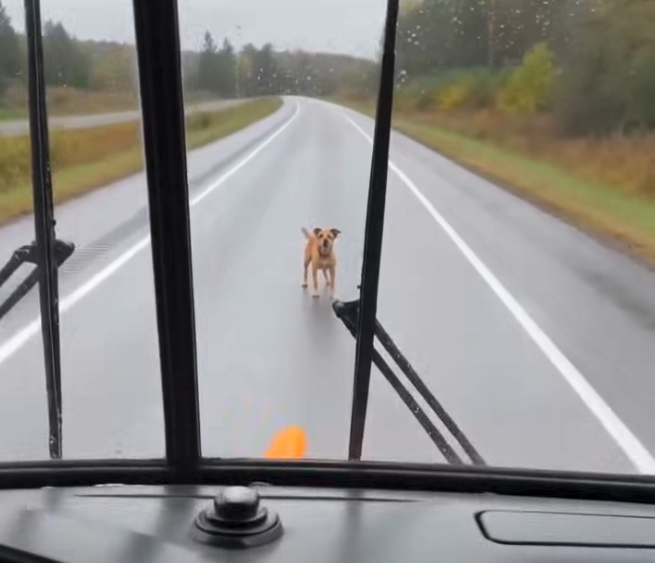
At 7:12, Max appeared.
But he did not run beside the bus.
He stood in the middle of the road.
Collins frowned.
The dog was soaked, fur plastered dark against his body, chest heaving as if he had already been running for miles. His paws were planted wide. His head was low.
The bus rolled closer.
Max did not move.
Collins slowed.
“Come on, dog,” he muttered.
Max barked once.
Sharp.
Commanding.
The children stirred.
“Why isn’t he running?” someone asked.
The bus crept forward.
Max held his ground.
Collins hit the horn.
The blast echoed through the rain.
Max flinched but stayed.
Then he turned his head.
Not toward Collins.
Not toward the children.
Toward Brackett Bridge.
The bridge waited ahead, half-hidden by rain and mist.
Silver Creek roared beneath it.
Collins’s hands tightened around the wheel.
“Move,” he whispered.
Max barked again, frantic now, then ran several steps toward the bridge, stopped, spun back, and barked at the bus.
Ellie stood in the aisle.
“Sit down!” Collins snapped.
“He’s scared,” she said.
The bus rolled another few feet.
Max charged back and planted himself directly in front of the bumper.
Collins slammed the brakes.
The bus lurched.
Children screamed.
Lunchboxes hit the floor.
A boy began crying.
For one furious second, Collins saw nothing but red.
He threw the bus into park, grabbed his raincoat, and stormed down the steps.
“That’s enough!”
Rain struck his face like needles.
Max backed away but did not run.
“What is wrong with you?” Collins shouted.
The dog barked, then darted toward the bridge again.
Stopped.
Looked back.
Barked.
Collins followed his gaze.
At first, he saw only rain.
Then he noticed the road.
A dark seam ran across the asphalt near the bridge entrance.
Not a painted line.
Not a shadow.
A crack.
Water pulsed through it.
Collins went still.
Behind him, Ellie’s voice trembled from the bus doorway.
“Mr. Collins?”
“Stay inside.”
He took one step forward.
Then another.
The crack widened as water surged beneath the surface. A section of road near the bridge dipped almost imperceptibly, as if something underneath had hollowed out.
Collins’s stomach turned cold.
He backed away slowly.
Then the far guardrail groaned.
It was a low metallic sound, almost hidden beneath the storm.
Almost.
Collins ran.
He vaulted into the bus and grabbed the radio.
“Dispatch, this is Bus 14. Stop all traffic at Brackett Bridge. Now. I repeat, stop all traffic at Brackett Bridge. Possible structural failure.”
Static hissed.
“Bus 14, confirm your location.”
“County Road 6, south approach. I am not crossing. Send police. Send county. Send everyone.”
Outside, Max stood in the rain between the bus and the bridge.
Still guarding.
Still watching.
Still waiting for the humans to understand.
Within twenty minutes, sheriff’s deputies arrived.
Within forty, county inspectors were on scene.
By then, parents had begun receiving calls. Cars lined the road. Umbrellas bloomed beneath the storm. Mothers cried when they saw the bus stopped safely before the bridge.
Claire Foster pushed through the crowd and ran straight to Ellie.
“My baby.”
“I’m okay, Mom,” Ellie said, sobbing now that the danger had passed. “Max stopped us.”
The inspectors worked in grim silence.
They placed cones.
Measured fissures.
Checked supports.
Then one of them climbed down toward the ravine and came back pale.
The lead inspector approached Sheriff Grant.
“We need to close this road immediately.”
“How bad?”
The man looked toward the bridge.
“If that bus had crossed with that load, I can’t guarantee it would have made it.”
Nobody spoke.
The rain kept falling.
On the road.
On the bus.
On the old dog, who stood apart from everyone as if unsure whether he was still unwanted.
Then Ellie broke away from her mother and ran to him.
“Ellie!” Claire shouted.
But Max only lowered his head as the little girl wrapped both arms around his wet neck.
“You saved us,” she whispered.
Max closed his eyes.
For a moment, even the rain seemed softer.
By afternoon, Bellweather changed its mind.
Towns can do that quickly when shame becomes public.
The same people who had called Max dangerous now posted about him as a hero.
The same mayor who wanted him removed held a press conference.
The same parents who had demanded action now brought blankets and food.
But Ruth Bell watched it all from the edge of the crowd with an expression that was not triumph.
It was grief.
Mr. Collins noticed her standing near the roadblock, one hand gripping her cane, the other pressed against her heart.
He approached slowly.
“Mrs. Bell.”
She looked at him.
“I’m sorry,” he said.
She studied his face, then nodded once.
“Most people are sorry after they finally see.”
He accepted that.
“I should have listened.”
“Yes,” she said. “You should have.”
A gust of wind lifted rain from the trees.
Collins looked toward Max, now lying beneath a tent someone had set up for him.
“Did Thomas know?”
Ruth’s eyes filled immediately.
“My brother knew that bridge was failing. He spent months trying to prove it.”
“Why didn’t anyone act?”
“Money. Pride. Delay. The usual things that kill people quietly before disaster finishes the job.”
Collins swallowed.
Ruth reached into her coat pocket and pulled out a small weathered notebook.
“Thomas left this in my kitchen the night before he died. I couldn’t make sense of it. Maybe because I didn’t want to.”
She handed it to him.
The pages were filled with measurements, dates, sketches of bridge supports, notes about erosion beneath the south approach.
On the last page, in shaky handwriting, Thomas had written:
Morning route. Bus weight. South seam worsening. Max reacts before vibration. Must stop them before spring floods.
Collins felt the blood drain from his face.
“He trained Max?”
Ruth nodded.
“Not exactly. Thomas took Max with him during inspections. The dog learned the route. Learned the sound of the bus. Learned where Thomas worried. Every morning after my brother died, Max kept doing the only job he understood.”
“To watch the bridge.”
“To watch the children.”
Collins looked down at the notebook.
For months, the dog had not been chasing the bus.
He had been escorting it.
Making sure it crossed safely.
Until the morning it couldn’t.
The official investigation began that week.
At first, people believed the story was simple.
Old bridge.
Heavy rain.
Hero dog.
But stories in small towns are rarely simple.
The county pulled records.
Thomas’s reports resurfaced.
Emails were found.
Photos.
Warnings.
Requests for emergency funds.
All ignored or delayed.
Then something worse emerged.
The final inspection report from seven months earlier had been altered.
Thomas had originally marked Brackett Bridge as requiring immediate repair.
But the version sent to the state listed it as stable.
The signature at the bottom was Thomas Bell’s.
Ruth knew it was fake the moment she saw it.
“My brother never signed in blue ink,” she said.
Sheriff Grant leaned back in his chair.
“That’s what proves it?”
“No,” Ruth said. “That’s what makes me angry. This proves it.”
She pointed to the signature.
Thomas Bell had written his capital T with a sharp hook at the bottom his entire life.
This signature had no hook.
A forgery.
The question was why.
And by whom.
The answer arrived through a frightened clerk named Marcy Vale.
She worked at the county public works office and had kept quiet for months because she had two children, a mortgage, and a boss who knew how to destroy reputations.
But after seeing the school bus on the news, after seeing Ellie Foster crying into Max’s fur, Marcy walked into Sheriff Grant’s office with a flash drive and shaking hands.
“I can’t carry this anymore,” she said.
The flash drive contained recordings.
Voicemails.
Scanned documents.
Proof that county supervisor Alan Reeves had buried Thomas’s reports to avoid delaying a profitable new development project across the bridge.
If Brackett Bridge closed, construction traffic would reroute twenty miles.
The developers would lose money.
Reeves would lose campaign donors.
So he changed the report.
He told Thomas to stop making trouble.
When Thomas refused, Reeves threatened him.
One voicemail chilled everyone who heard it.
“You’re an old man with an old dog and a notebook nobody cares about. Let this go before you embarrass yourself.”
Three days after receiving that message, Thomas died.
Officially, a heart attack.
But now, even that began to feel less certain.
Ruth sat in the sheriff’s office as the recording ended.
She did not cry.
She simply whispered, “Thomas wasn’t afraid of dying. He was afraid nobody would believe him after.”
Collins, sitting beside her, looked down at his hands.
“I didn’t.”
Ruth touched his arm.
“You do now.”
The town divided again, but this time not over the dog.
Over guilt.
Some demanded Reeves’s arrest.
Others insisted mistakes happened.
Mayor Dunleavy claimed he knew nothing.
The developers denied involvement.
County officials promised transparency, which made everyone trust them even less.
Meanwhile, Max stayed with Ruth.
He refused all celebrity treatment.
He ignored news cameras.
He tolerated children.
He accepted bacon from Ellie.
But each morning at 7:12, he still walked to County Road 6 and sat near the barricades facing Brackett Bridge.
The bus route had changed.
The children no longer crossed there.
Yet Max watched anyway.
As if his duty wasn’t finished.
One evening, Mr. Collins visited Ruth with a bag of dog food and an apology he had rehearsed six times.
Ruth let him in without comment.
Max lay by the fireplace, head on his paws.
“He still goes to the bridge,” Collins said.
“Yes.”
“Why?”
Ruth looked toward the window.
“Because something is still there.”
Collins felt a chill.
“What do you mean?”
“My brother had one last inspection file. He kept it in a red folder. The night before he died, he called me and said, ‘If anything happens, the truth is under the old road.’ I thought he meant the bridge.”
“And now?”
Ruth looked at Max.
“Now I wonder if Max knows exactly what he meant.”
The next morning, Collins arrived at Ruth’s house before dawn.
Sheriff Grant came too.
So did Sarah, the county engineer assigned to replace the disgraced inspection team.
Ruth opened the door already dressed.
“I was wondering when you’d catch up,” she said.
They followed Max to Brackett Bridge.
The storm damage had exposed sections of the old roadbed near the south approach. Mud had washed away beneath a collapsed shoulder, revealing broken concrete, rusted drainage pipes, and tangled roots.
Max went straight to a spot below the guardrail.
He pawed at the mud.
Barked once.
Then looked back.
Sarah crouched. “There’s something here.”
They dug carefully.
At first, they found only stones.
Then plastic.
A sealed construction tube, cracked but intact.
Inside was a red folder wrapped in oilcloth.
Ruth covered her mouth.
Thomas’s handwriting marked the front.
If I am gone, do not trust the official report.
Inside were photographs.
Original inspection documents.
Copies of emails.
And one printed image from a trail camera Thomas had hidden near the bridge.
The photo showed Alan Reeves at the south approach, late at night, removing survey markers Thomas had placed to track movement in the road.
But the final page contained the real shock.
Thomas had discovered that the bridge damage was not just neglect.
It had been accelerated by illegal dumping from the development site upstream. Heavy runoff had been redirected toward the ravine, scouring soil beneath the supports. Reeves knew. The developers knew.
And if Thomas exposed them, the entire project would collapse.
Ruth read the final handwritten note aloud, voice trembling:
Max knows the morning bus. If I cannot stop this myself, he may still try. Please listen to him.
Nobody moved.
Then Max pressed his head against Ruth’s leg.
She bent down and held him.
“Oh, Tommy,” she whispered. “We finally did.”
Alan Reeves was arrested two days later.
The development company came under state investigation.
Brackett Bridge was demolished and rebuilt properly, with Thomas Bell’s original recommendations used as the foundation plan.
At the groundbreaking ceremony, Mayor Dunleavy tried to give a speech.
No one paid much attention.
They were watching Max.
He sat beside Ruth in a blue collar Ellie had chosen for him, one bent ear twitching in the wind.
The children from Bus 14 stood in a row holding handmade signs.
THANK YOU, MAX.
OUR BRIDGE HERO.
GOOD BOY.
Mr. Collins stepped up to the microphone.
For a moment, he couldn’t speak.
Then he looked at Max.
“I spent months thinking he was chasing us,” he said. “I thought he was a nuisance. A danger. A problem someone else needed to solve.”
His voice broke.
“But he was doing what the rest of us failed to do. He was paying attention.”
The crowd fell silent.
“He remembered Thomas Bell’s work when we forgot it. He watched over our children when officials ignored warnings. And on the morning when it mattered most, he stood in the road and refused to move.”
Ellie Foster began crying.
So did half the adults.
Collins turned to Ruth.
“I’m sorry it took almost losing everything for us to understand.”
Ruth nodded, tears shining in her eyes.
Then she guided Max forward.
The town unveiled a bronze plaque that would later be mounted on the new bridge.
It read:
BRACKETT MEMORIAL BRIDGE
Dedicated to Thomas Bell, who warned us.
And to Max, who made us listen.
Months passed.
The new route remained longer, but no parent complained.
Not anymore.
Every morning, Max rode with Mr. Collins.
At first, the school board objected.
Then the children objected louder.
So Max became the unofficial mascot of Bus 14.
He lay on a padded mat beside the front seat, calm and watchful, greeting each child with a tail thump.
Ellie always sat closest.
“You’re not chasing anymore,” she told him one morning.
Max rested his chin on his paws.
“You’re riding.”
Mr. Collins glanced in the mirror and smiled.
But the biggest surprise came on the first anniversary of Thomas Bell’s death.
Ruth received a letter from the state engineering board.
Thomas’s buried documents had led to reforms in rural bridge inspections statewide. His warnings had saved not only Bellweather, but possibly other towns too.
At the bottom of the letter was a sentence Ruth read three times.
Posthumously, Thomas Bell is recognized for extraordinary public service.
Ruth sat at her kitchen table and wept.
Max placed his head in her lap.
She scratched behind his bent ear.
“He did it, boy,” she whispered. “And so did you.”
One year after the storm, the new bridge opened.
The whole town gathered.
This time there were no angry signs.
No complaints.
No talk of removing the dog.
Children wore yellow ribbons. Parents brought flowers. The school band played badly but proudly.
Mr. Collins drove Bus 14 to the entrance of the bridge.
Max sat beside him.
The road ahead gleamed new and strong beneath the morning sun.
Ruth stood near the plaque, holding Thomas’s old notebook.
For a second, she could almost see her brother there.
Faded blue jacket.
Work boots.
Pencil tucked behind his ear.
Max suddenly stood.
His tail began to wag.
Not wildly.
Softly.
As if greeting someone familiar.
Ruth looked toward the far side of the bridge.
There was no one there.
Only sunlight.
Only wind.
Only the creek moving bright below.
But Max gave one quiet bark.
Then he stepped forward.
Mr. Collins opened the bus door.
“Ready, partner?”
Max climbed down and walked onto the bridge.
Slowly.
Carefully.
The entire town watched as the old dog crossed first.
When he reached the center, he stopped and looked back.
For nearly a year, he had chased the bus because he refused to let children cross danger alone.
Now, at last, the danger was gone.
The bus followed.
Children pressed their hands to the windows.
Parents cried openly.
Ruth held the notebook to her chest.
And when Bus 14 rolled safely across Brackett Memorial Bridge, the crowd erupted.
Max stood on the other side, sunlight on his golden fur, ears lifted, eyes bright.
He did not bark.
He did not chase.
He simply sat down.
His job was finally done.
That evening, Ruth found him asleep on Thomas’s old porch, peaceful in a way he had not been since the funeral. She sat beside him as fireflies blinked over the grass.
“You can rest now,” she said.
Max opened one eye.
His tail tapped once.
Then he sighed, deep and content.
From that day forward, people in Bellweather told the story differently.
They did not say, “That was the dog who chased the school bus.”
They said, “That was the dog who remembered when people forgot.”
And whenever a child asked how a dog could save an entire bus, Ruth always gave the same answer.
“Because love pays attention,” she said. “Even when nobody else does.”
