For seven days, Buddy refused to die.
That was what nine-year-old Noah Whitaker kept telling himself every time the old golden retriever lifted his cloudy eyes and looked at him as if he were trying to speak.
Buddy had been part of the family longer than Noah had been alive. His muzzle had gone white, his hips had grown stiff, and he slept more than he played now, but he had always eaten.
Always.
Chicken from Dad’s plate.
Peanut butter from Noah’s fingers.
The soft canned food Mom bought when his teeth started hurting.
But now Buddy only sniffed the bowl, turned away, and walked slowly to the garage.
Every day.
The same path.
Through the kitchen.
Past the laundry room.
Across the cold concrete floor.
To the far wall behind Dad’s old workbench.
There, Buddy would lie down, press his nose toward the dusty corner, and stare.
For hours.
At first, Noah’s mother said, “He’s just old, honey.”
His father said, “Maybe he smells a mouse.”
But Noah knew Buddy.
Buddy did not stare at mice.
Buddy chased mice.
Or at least he used to.
On the third day, they took him to the veterinarian. Dr. Keller ran blood tests, checked his heart, pressed his hands gently along Buddy’s stomach and ribs.
“He’s not in organ failure,” the vet said, looking confused. “His numbers are surprisingly good for his age.”
“So why won’t he eat?” Noah’s mother asked.
Dr. Keller sighed. “Sometimes older dogs become depressed. Has anything changed at home?”
Noah looked at his father.
His father looked away.
Something had changed.
Grandpa had died two months earlier.
Not Noah’s real grandpa by blood, but the only grandpa he had ever known. Henry Whitaker had lived in the small blue house before Noah’s family moved in with him. After Grandma Rose died, Dad said Grandpa Henry needed help.
But Noah remembered something else.
Grandpa Henry had once grabbed Dad by the arm in the garage and whispered, “You need to tell them before the house does.”
Dad had seen Noah standing there and immediately smiled too big.
“Grandpa gets confused sometimes,” he had said.
But Grandpa had not looked confused.
He had looked afraid.
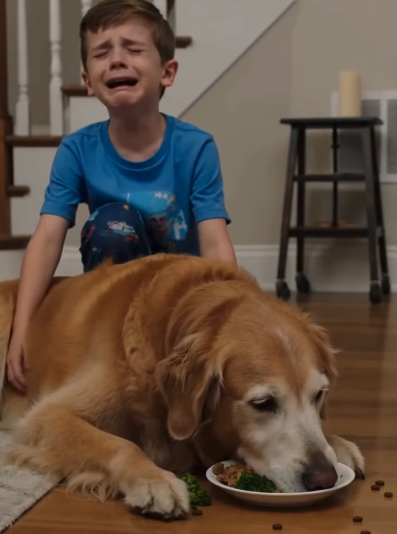
By the fifth day, Buddy was thinner. His golden fur hung loose around his shoulders. Noah began sleeping on the floor beside him with a blanket and a flashlight shaped like a dinosaur.
“Please eat,” Noah whispered one night, holding out a piece of bacon. “Please, Buddy. I’ll give you all my allowance. I won’t even get mad when you steal my socks.”
Buddy only touched his nose to Noah’s wrist.
Then he looked toward the garage door.
Noah started crying.
His mother, Claire, found him there just after midnight.
“Oh, baby,” she whispered, kneeling beside him.
“He’s waiting for something,” Noah said.
Claire brushed his hair back. “Dogs do strange things when they’re old.”
“No. He’s trying to show us.”
Claire’s expression changed for a second.
Just one second.
Then she hugged him tightly.
The next morning, Noah woke to shouting.
His father, Michael, stood in the garage with a flashlight, pulling boxes away from the wall.
“There’s nothing here!” he snapped.
Buddy lay in the corner, eyes fixed on the floor beneath the workbench.
Claire stood behind Michael, pale and silent.
“Maybe we should move the bench,” she said quietly.
Michael froze.
Then he laughed.
It was a terrible laugh.
“Move Dad’s bench? For what? A dog’s feelings?”
Buddy suddenly growled.
Noah had never heard that sound from him before.
Michael stepped back.
The garage went silent.
On the seventh night, Buddy seemed weaker than ever. He would not stand. He barely lifted his head when Noah wrapped both arms around him and sobbed into his fur.
“You can’t leave me,” Noah whispered. “You’re my best friend.”
Buddy’s body trembled.
Then, slowly, he rose.
Not like a dying dog.
Like a soldier remembering his final order.
He walked straight to the garage.
Noah followed first.
Then Claire.
Then Michael, muttering, “This is ridiculous,” though his voice shook.
Buddy reached the workbench and began scratching.
Hard.
Frantic.
His claws scraped against the concrete.
Scratch.
Scratch.
Scratch.
Then he barked once.
A broken, desperate sound.
Claire covered her mouth.
“Michael,” she whispered. “Move it.”
“No.”
“Move it.”
Michael turned on her. “You don’t know what you’re asking.”
That was when Noah understood.
His father knew.
Claire stepped past him and grabbed the side of the workbench herself. Noah helped. It was heavy, but together they shifted it inch by inch until its legs screamed against the concrete.
Behind it was an old square of flooring, slightly different from the rest.
A hidden panel.
Buddy pressed his nose to it and whimpered.
Michael sank onto a storage crate.
“No,” he said. “Dad promised he destroyed it.”
Claire stared at him. “Destroyed what?”
Michael did not answer.
Claire found the edge of the panel and pulled.
It lifted.
Underneath was a small metal box wrapped in black plastic.
The air changed instantly.
Cold seemed to rise from the hole.
Noah backed into Buddy, and Buddy leaned against him, steadying him.
Claire opened the box.
Inside were envelopes, photographs, a small baby blanket, and a cassette recorder so old Noah had only seen one like it in movies.
On top was a letter.
Claire unfolded it with shaking hands.
Her face lost all color.
Michael stood up. “Claire, don’t.”
But she was already reading.
“To my son, Michael, and to the boy who was never supposed to be lost…”
Noah stopped breathing.
Claire whispered, “What is this?”
Michael’s lips trembled.
Buddy pushed his head against Noah’s chest.
Claire pulled out the photographs.
The first showed Grandpa Henry standing in the garage years ago beside a young woman holding a baby.
The woman was Claire.
The baby was not Noah.
Claire gasped and dropped the picture.
“No,” she said. “No, that’s impossible.”
Michael started crying.
Not quietly.
Not with dignity.
He broke.
“I was nineteen,” he whispered. “Dad said it was the only way.”
Claire stared at him as if she no longer knew his face.
“The only way to what?”
Michael wiped his mouth with the back of his hand.
“You were in the accident. You don’t remember the pregnancy. You don’t remember him.”
Claire staggered.
Noah grabbed her hand.
Michael looked at Noah with unbearable shame.
“Before you were born, your mother and I had another son.”
The garage became so silent Noah could hear Buddy breathing.
“A baby boy,” Michael continued. “Eli.”
Claire’s knees gave out. Michael reached for her, but she slapped his hand away.
“You told me I lost the baby,” she said.
Michael squeezed his eyes shut.
“I know.”
“You told me he died.”
“I know.”
Her voice broke into something sharp and animal. “Where is my son?”
Michael pointed at the box.
Claire tore through the papers until she found a document with an address, adoption records, hospital forms, and a final letter from Henry.
Michael’s father had written everything.
Years ago, Michael had panicked. He was young, broke, and terrified after Claire’s accident. His father convinced him that a disabled young couple could not raise a premature baby. Henry arranged a secret adoption through a private lawyer and told Claire, when she woke from her coma, that the baby had died.
Michael had lived with the lie.
Henry had lived with the guilt.
And Buddy had been there.
Buddy, a young dog then, had slept beside the box for years whenever Henry cried in the garage.
After Henry died, the smell of the old blanket must have changed. Or maybe Buddy simply remembered grief. Maybe love had a scent.
Claire found the cassette recorder with a tape still inside.
Her hands shook as she pressed play.
Henry’s old voice crackled through the garage.
“Claire, if you’re hearing this, I was a coward. I let fear make a monster out of me. Your son lived. His name was Eli, though the family who took him may have changed it. Buddy knows the box because I used to sit with him here every year on Eli’s birthday. I should have told you. I am sorry. Please find him.”
Claire made a sound Noah had never heard before.
A mother’s heart breaking twice.
Michael knelt in front of her.
“I wanted to tell you,” he sobbed. “Every year I wanted to. Dad said it would destroy you. Then Noah came, and I thought if I buried it deep enough—”
“You buried my child,” Claire said.
Those words ended him.
For a long moment, nobody moved.
Then Buddy did.
The old dog stepped forward, lowered his head into the metal box, and gently pulled out the baby blanket. He carried it to Claire and placed it in her lap.
Claire clutched it to her chest and wept.
Noah cried too, though he did not fully understand everything yet. He only knew that somewhere in the world, he had a brother.
And Buddy had found him.
The next weeks were a blur of lawyers, phone calls, apologies, and silence.
Michael moved into the guest room.
Claire barely spoke to him.
But she did not stop searching.
The adoption lawyer had died years earlier, but the records led to a family two towns over. Eli had been renamed Daniel Mercer.
He was twenty-three years old.
A paramedic.
Alive.
When Claire saw his photo online, she dropped the phone.
He had Michael’s dark eyes.
But he had Claire’s smile.
They contacted him through an intermediary. They waited three agonizing days.
On the fourth day, Daniel called.
Claire answered and could not speak.
So Daniel spoke first.
“Hi,” he said softly. “I think… I think you might be my mother.”
Claire folded in half around the phone.
“Yes,” she whispered. “Yes. I am.”
They met the following Sunday at a small park beside the river.
Noah stood between his parents, holding Buddy’s leash.
Buddy had eaten for the first time that morning.
Not much.
Just a few bites.
But enough to make Noah cheer.
Daniel arrived wearing a gray jacket and nervous eyes. He looked at Claire first.
Then Michael.
Then Noah.
Then Buddy.
The old dog lifted his head.
Daniel froze.
“That dog,” he whispered.
Claire’s eyes filled. “You know him?”
Daniel knelt slowly.
Buddy walked to him without hesitation and placed his head against Daniel’s chest.
Daniel began to cry.
“My adoptive mom gave me this when I was little,” he said, pulling a worn photograph from his wallet.
It showed a baby wrapped in the same blanket, with a golden puppy curled beside him.
Buddy.
Claire covered her mouth.
Daniel looked up at her through tears.
“I used to dream about him,” he said. “I thought I invented him.”
“No,” Claire whispered. “He remembered you.”
Michael stood apart, broken by guilt.
Daniel looked at him for a long time.
“I’m not ready to forgive you,” he said.
Michael nodded, tears falling. “I know.”
“But I’m here,” Daniel added. “That has to be enough for today.”
And it was.
Noah stepped forward, shy and trembling.
“Are you really my brother?”
Daniel smiled through tears.
“I think I am.”
Noah hugged him so suddenly that Daniel laughed and cried at the same time.
Buddy leaned against both of them.
For the first time in seven days, his tail wagged.
Months passed.
Healing was not simple.
Michael went to counseling. Claire went too, sometimes with him, sometimes without him. Forgiveness did not arrive like sunlight. It came like spring after a brutal winter, slow and uncertain.
Daniel visited every weekend.
He taught Noah how to wrap a sprained wrist, how to skip rocks, and how to make pancakes without burning the edges.
Claire kept the baby blanket in a wooden frame near the fireplace.
And Buddy?
Buddy lived.
The vet called it remarkable.
Noah called it a miracle.
But Claire understood.
Buddy had not been dying.
He had been starving for the truth.
On Buddy’s fifteenth birthday, the whole family gathered in the backyard. Daniel brought a cake shaped like a bone. Noah made a paper crown. Michael, still quieter than before, placed a bowl of chicken at Buddy’s feet.
Buddy sniffed it.
Everyone held their breath.
Then he ate.
Noah screamed with joy.
Daniel laughed.
Claire cried.
Michael covered his face.
As the sun lowered behind the trees, Buddy rested his gray muzzle on Noah’s knee. Daniel sat on the other side of him, shoulder touching his little brother’s.
Noah looked at Buddy and whispered, “You saved us.”
Buddy blinked slowly.
As if he already knew.
And maybe he did.
Because some secrets are buried under concrete.
Some are buried under fear.
But love remembers where to dig.
And that old dog had remembered long enough to bring a lost son home.
