The first time Cooper dug in that corner of the backyard, I thought he had found a mole.
The second time, I thought he had smelled an old bone.
By the hundredth time, I knew my dog was trying to tell us something.
And by the time the police surrounded our house with crime scene tape, I wished we had listened sooner.
My name is Hannah Miller, and before that spring, my life was painfully ordinary.
I lived in a pale yellow house at the end of Willow Street with my husband, Mark, and our golden retriever, Cooper. We had hydrangeas under the front window, a squeaky back gate Mark promised to fix every weekend, and one family portrait hanging above the living room fireplace.
The portrait showed Mark as a little boy standing between his parents.
His mother, Evelyn, looked elegant and cold.
His father, Arthur Miller, stood tall in a gray suit, one hand resting on Mark’s shoulder.
I had seen that portrait so many times I barely noticed it anymore.
Until a detective stood in my backyard holding a faded photograph from a buried metal container and asked my husband why the man in the evidence bag was the exact same man from our living room wall.
Mark went completely white.
“That’s impossible,” he whispered.
But it wasn’t.
Nothing after that was impossible anymore.
Cooper had always been a gentle dog.
He was loyal, goofy, terrified of thunderstorms, and obsessed with tennis balls. He followed me from room to room like I was the center of the universe. If I cried during sad movies, he climbed onto the couch and pressed his warm body against me until I laughed.
So when he became obsessed with the far corner of our backyard, we didn’t worry at first.
That corner was ugly anyway.
The grass never grew there properly. The soil stayed dark even in dry weather. A twisted old maple tree leaned over the fence, dropping leaves into our yard like it was trying to bury something.
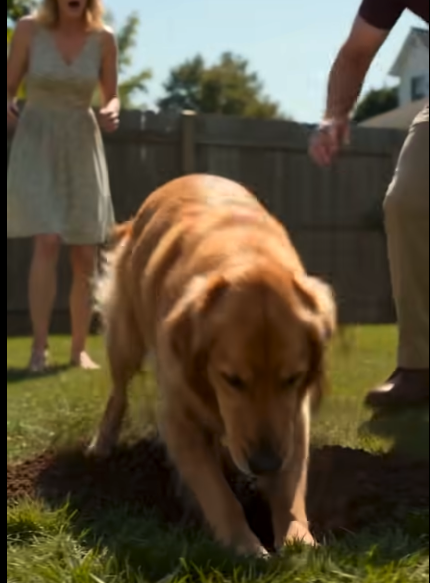
Every morning, Cooper ran straight there.
He sniffed.
Pawed.
Dug.
Then stopped and stared at the ground.
Mark thought it was funny.
“Maybe he buried his retirement fund,” he joked one Saturday, sipping coffee on the porch.
I smiled, but Cooper didn’t.
He stood in the hole with mud on his paws, looking back at us with eyes too serious for a dog.
“Cooper,” I called. “Come here, baby.”
He didn’t move.
He just whined.
That sound stayed with me.
It was not playful.
It was not excited.
It was grief.
Four months passed.
The hole deepened.
Our patience thinned.
Mark filled it with soil.
Cooper dug it open.
I placed flowerpots over it.
Cooper knocked them aside.
Mark covered it with heavy stones.
Cooper dug around them until his paws bled.
That was when I stopped laughing.
One evening, I knelt beside him in the yard and held his muddy face between my hands.
“What is it?” I whispered. “What are you trying to show us?”
Cooper looked at me.
Then at the ground.
Then he gently placed one paw on the dirt.
I felt suddenly cold.
The next afternoon, while Mark was at work, I grabbed a shovel.
I told myself I was being ridiculous.
I told myself I would find a pipe, or roots, or some old junk left by previous owners.
But two feet down, the shovel struck something hard.
Clang.
Metal.
My heartbeat jumped.
I scraped away more soil.
A rusted edge appeared.
I called Mark.
He came home early, annoyed at first, then confused, then silent.
Together we uncovered the corner of a metal container.
It was large.
Too large to be random.
Cooper began barking wildly.
Not the bark he used for delivery trucks.
Not the bark he used when squirrels mocked him from the fence.
This was panic.
He backed away, whining, his tail tucked under him.
“Maybe we should stop,” I said.
Mark stared at the rusted metal. “No. We need to know.”
We should have stopped.
At least until morning.
At least until someone official arrived.
But curiosity is a dangerous thing.
And buried secrets are patient.
They can wait decades for the wrong hand to touch them.
The next morning, Mark called a contractor.
By ten o’clock, a small excavator was rolling through our side gate.
Neighbors gathered along the fence.
Mrs. Bell from next door held her phone up to record.
“What do you think it is?” she called.
“Probably an old septic tank,” Mark answered.
But his voice didn’t sound confident.
The operator lowered the bucket.
Cooper howled.
Then the police arrived.
Two cars.
Then three.
Officers rushed into our yard as if they had been waiting nearby.
“Step away from the hole!” one shouted.
The contractor froze.
Mark lifted his hands. “What’s going on?”
A detective in a dark coat entered last.
He was older, with tired eyes and a folder tucked under one arm.
He didn’t ask where the hole was.
He walked straight to it.
That was the first thing that scared me.
He already knew.
The detective looked down into the exposed dirt.
His face changed.
Then he opened the folder and pulled out an old photograph.
He compared the photo to our yard.
To the maple tree.
To the fence line.
To the corner Cooper had chosen every day for four months.
Then he turned to us.
“How long has the dog been digging here?”
“Four months,” I said.
The detective stared at Cooper.
For the first time, his professional mask cracked.
“Four months,” he repeated.
His voice trembled.
“We’ve been searching for this location for nearly twenty years.”
Nobody spoke.
Nobody breathed.
Then came crime scene tape.
Forensic tents.
Gloved hands.
Cameras.
Measuring flags.
Our quiet backyard became something from a nightmare.
Cooper sat beside me, shaking.
I wrapped my arms around him and whispered that everything was okay.
But it wasn’t.
The container was opened just before sunset.
The officers stepped back.
One investigator covered her mouth.
The detective reached inside and removed a sealed evidence bag.
Attached to it was a faded photograph.
He stared at it.
Then turned toward Mark.
“Sir,” he said quietly, “why is this the exact same man from the family portrait hanging in your living room?”
Mark looked like he had been struck.
“That’s my father,” he whispered. “Arthur Miller.”
The detective’s eyes sharpened.
“Your father died in a boating accident twenty years ago.”
Mark nodded slowly.
“At least… that’s what my mother told me.”
They took us inside.
The portrait still hung above the fireplace.
Arthur Miller stared down at us from behind glass, forever young, forever serious, forever hiding whatever truth had been buried in our yard.
Detective Samuel Grant studied the portrait.
His jaw tightened.
“I knew him,” he said.
Mark turned. “You knew my father?”
Grant nodded. “I was a rookie when he disappeared.”
“Disappeared?” Mark asked.
Grant looked at him carefully.
“Your father didn’t die in a boating accident, Mr. Miller. Not officially.”
Mark gripped the back of a chair.
“My mother said his boat overturned. She said they never found the body.”
“That part may be true,” Grant said. “But he was under investigation before he vanished.”
My stomach sank.
“For what?”
Grant hesitated.
“Your father was trying to expose a network of corrupt officials and private developers. People who were stealing homes from elderly residents, forging deeds, and burying the evidence. He believed they had murdered at least one witness.”
Mark shook his head. “No. My father was an accountant.”
“He was also an informant.”
The room tilted.
Grant continued.
“The container in your yard appears to hold evidence he collected before he vanished.”
Mark stared at the portrait.
All the color had drained from his face.
“He hid it here?”
Grant looked toward the backyard.
“This house belonged to your grandmother before your family sold it. Your father must have buried the container before everything went wrong.”
I felt a chill run through me.
Mark had bought this house five years earlier because it had been his grandmother’s.
He said it made him feel close to the family he barely remembered.
But maybe the house had been calling him back for another reason.
Maybe Cooper had known.
Somehow.
The investigation stretched for weeks.
Inside the container were documents, cassette tapes, photographs, ledgers, and a child’s blue sweater sealed in plastic.
The sweater was what broke Mark.
He recognized it.
“That was mine,” he whispered.
He had worn it in the family portrait.
The same day the photograph had been taken.
A note found beneath the sweater was addressed to him.
My son,
If you find this, then I failed to come home.
But I need you to know I did not leave you.
I would never leave you.
Everything I did was to keep you safe.
Mark couldn’t finish reading.
He folded over at the kitchen table, shaking silently while I held him.
For years, he had believed his father had been careless.
Absent.
Dead by accident.
Now he learned Arthur had been protecting him.
From people powerful enough to erase a man.
And maybe from someone closer.
Mark’s mother, Evelyn, arrived the next morning.
She was seventy-two, elegant as ever, dressed in pearl earrings and a navy coat despite the heat.
She walked into our house without knocking.
“What have you done?” she demanded.
Mark stood slowly.
“What have I done?”
Her eyes flicked toward the backyard.
Toward the police.
Toward the corner where Cooper had dug up the past.
“You should have left it alone.”
I felt the air leave the room.
Mark stared at her.
“You knew.”
Evelyn’s mouth tightened.
“I knew your father was reckless.”
“He was exposing criminals.”
“He was going to get us killed.”
Mark stepped closer.
“What happened to him?”
She looked away.
That was enough.
Mark’s voice cracked.
“What happened to my father?”
Evelyn said nothing.
Detective Grant appeared in the doorway.
“Mrs. Miller, we need you to come with us.”
Her expression changed.
Not fear exactly.
Defeat.
As officers escorted her out, she turned back to Mark.
“I protected you,” she said.
Mark’s face hardened through tears.
“No. You protected yourself.”
The truth came out slowly.
Evelyn had not killed Arthur.
But she had betrayed him.
The corrupt developers Arthur investigated had threatened her. They told her that if Arthur handed over the evidence, Mark would disappear.
Evelyn panicked.
She told them where Arthur was meeting a federal contact.
Arthur vanished that night.
For twenty years, Evelyn claimed it was an accident.
For twenty years, she let her son believe his father had left nothing behind.
For twenty years, she visited our house every Christmas and stood beneath that portrait without saying a word.
But the biggest twist came from one tape.
Arthur’s voice crackled through the old recording.
“If this reaches anyone, listen carefully. The men after me think the evidence is buried at my mother’s house. They’re wrong.”
Detective Grant frowned.
Mark looked up.
Arthur continued.
“The container in the yard is bait. Enough to reopen the case, not enough to finish it.”
My skin prickled.
“There is a second file,” Arthur said. “The real file.”
The recording hissed.
Then Arthur said something that made Mark stop breathing.
“Mark knows where it is.”
Mark whispered, “I was five.”
Arthur’s voice softened.
“If you’re grown now, son, remember Cooper.”
The room went silent.
Our dog lifted his head.
Mark stared at him.
“Cooper?”
He turned toward me.
“My father had a dog when I was little.”
I remembered the portrait.
There, near the bottom corner, half hidden by shadow, was a golden retriever puppy.
Mark stepped closer to the frame.
His hands trembled as he lifted it from the wall.
On the back, written in faded ink, were four words:
Cooper guards the truth.
Behind the cardboard backing was a small brass key.
Not to a lockbox.
Not to a safe.
To the old piano in the living room.
The piano had belonged to Mark’s grandmother.
It had come with the house.
We had never used it.
Mark opened the lower panel with the key.
Inside was a waterproof envelope.
The real file.
Names.
Bank records.
Signed confessions.
Photographs.
Enough to destroy every surviving member of the old network.
And one final letter from Arthur.
Mark read it aloud through tears.
Son,
If this found you, then some part of me made it home.
I named our dog Cooper because he always found what was hidden.
If you ever have a dog of your own, I hope he loves you the same way.
Trust him.
Dogs remember what people try to bury.
Your mother may be afraid.
Forgive her if you can.
But never confuse fear with truth.
I love you beyond every silence they forced between us.
Dad.
Mark pressed the letter to his chest.
Cooper rested his head in his lap.
For a long time, nobody moved.
The arrests began within days.
Former officials.
Retired judges.
Developers who had built fortunes on stolen homes and buried crimes.
The news called Arthur Miller a hero.
Mark hated that at first.
“He was my dad,” he said one night. “Not a headline.”
But gradually, the anger softened.
Not disappeared.
Never that.
But softened enough for grief to become love.
Evelyn testified.
She confessed everything.
Her testimony helped convict the men who had destroyed Arthur’s life.
Mark visited her once before the trial.
I waited in the car with Cooper.
When he came back, his eyes were red.
“Did you forgive her?” I asked.
He looked out the window for a long moment.
“Not yet,” he said. “But I stopped hating her.”
That was enough.
Sometimes healing doesn’t arrive as a miracle.
Sometimes it arrives as one breath that hurts a little less.
Six months later, Detective Grant came to our house one last time.
He stood in the backyard, near the corner Cooper had dug for months.
The grass had started to grow again.
“Your father saved a lot of families,” he told Mark.
Mark looked down.
“I wish he’d saved himself.”
Grant nodded.
Then he handed Mark a small envelope.
“This was recovered from Arthur’s old police contact. It was never processed properly.”
Inside was a photograph.
Arthur holding five-year-old Mark.
Beside them was the original Cooper.
And on the back, Arthur had written:
He’ll find his way back to you someday.
Mark stared at the words.
Then looked at our Cooper, who was lying in the grass exactly where the container had been buried.
I laughed softly through tears.
“Do you think…”
Mark smiled for the first time in weeks.
“I don’t know.”
Cooper wagged his tail.
Maybe he was just a dog.
Maybe he smelled rust under the soil.
Maybe memory travels through blood, through houses, through love, through things science cannot name.
Or maybe, somehow, one loyal soul had found his way back to finish what he started.
I don’t need to know.
What I know is this:
A dog dug in our backyard for four months.
He uncovered a father’s love.
He exposed twenty years of lies.
He brought justice to people who thought the truth was buried forever.
And he gave my husband back the one thing he thought he had lost forever.
Not his father’s life.
But his father’s love.
That summer, Mark took down the old family portrait.
For one day, the wall above the fireplace was empty.
Then he replaced it with something new.
Arthur holding little Mark.
The old Cooper sitting proudly beside them.
And below it, a second frame.
Our Cooper in the backyard, muddy paws, bright eyes, sitting beside the hole that changed everything.
Under both photographs, Mark placed a small brass plaque.
It read:
Some secrets are buried by fear. Some are found by love.
And every morning after that, Cooper still ran to the same corner of the yard.
But he no longer dug.
He simply lay down in the sun.
As if guarding nothing now.
As if, at last, the truth could rest.
