The first time I heard the dog knock, I thought it was a guest.
Three soft taps echoed down the third-floor hallway just after midnight.
Tap.
Tap.
Tap.
I looked up from the front desk, listening through the old hotel’s breathing silence.
The Whitmore Grand was the kind of place that looked beautiful in photographs and haunted in person. It stood on a cliff above the Oregon coast, all dark cedar beams, brass lamps, red carpets, and windows that shivered whenever the ocean wind hit them. Tourists called it charming. Locals called it cursed.
I worked the night shift there.
Which meant I heard things other employees pretended not to hear.
Pipes groaning inside the walls.
Footsteps in empty corridors.
The elevator opening by itself at 3:12 every morning.
And, of course, the dog.
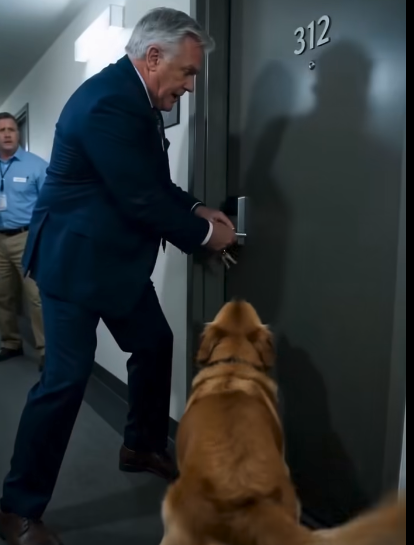
He was a lean, gray-muzzled shepherd mix with one torn ear and eyes so human they made people uncomfortable. We called him Captain, though nobody knew where he came from. He appeared every evening as the fog rolled in from the water, walked straight through the lobby like he owned the building, ignored every hand extended toward him, then climbed the grand staircase to the third floor.
Room 312.
Always Room 312.
He never scratched at 311.
Never sniffed at 314.
Never wandered.
He sat outside 312 and knocked his paws against the door.
Three years.
Every single night.
Guests found it heartbreaking at first.
“Oh, poor thing,” they would whisper. “Maybe his owner died in there.”
The staff made jokes until the jokes stopped feeling funny.
Because Room 312 was not rented.
Room 312 had not been rented in years.
At least that was what we were told.
The hotel manager, Gerald Pike, kept the key in his private office and snapped at anyone who asked about it. He was a thin, nervous man with slick hair, expensive shoes, and a smile that vanished the moment he thought no guests were watching.
“It’s under renovation,” he would say.
But there was never any renovation.
No workers.
No paint.
No noise.
Just a locked door, a stray dog, and three knocks every night.
Tap.
Tap.
Tap.
I should have quit long before the storm came.
But I needed the job.
My name is Nora Bell, and by the time I started working at the Whitmore Grand, I had learned how expensive grief could be.
My mother had died two years earlier, leaving behind medical bills and a small house with a roof that leaked every November. The night shift paid more. So I took it. I told myself strange sounds were just old wood settling. I told myself the hotel’s history was none of my business.
Then Captain proved me wrong.
The storm arrived on a Thursday.
Not rain.
Not wind.
A monster.
By nine at night, the ocean had turned black and violent below the cliffs. Waves slammed into the rocks with such force that the chandeliers trembled. Guests gathered in the lobby, pretending to enjoy the drama while secretly glancing at the windows.
Captain appeared at 10:17.
Early.
That was the first warning.
He pushed through the revolving door soaked to the skin, dripping rain across the marble floor. His eyes were wild. His ribs heaved. He didn’t pause at the fireplace or shake himself dry.
He ran.
Straight up the staircase.
A second later, the barking began.
Not the usual knocking.
Not the sad, patient tapping.
This was terror.
I left the desk before I knew I was moving.
“Captain?” I called, climbing the stairs.
His barking grew louder.
By the time I reached the third floor, guests had opened their doors. A woman in a silk robe clutched her husband’s arm. A child cried into a pillow. Captain threw his body against Room 312 again and again.
Bam.
Bam.
Bam.
“Stop that dog!” someone shouted.
I crouched beside him. “Captain, hey. Hey, boy.”
He didn’t even look at me.
His paws scraped the door until one nail split and left a red streak on the white paint.
That was when Gerald Pike arrived.
His tie was crooked. His face was flushed.
“What is going on?” he snapped.
“The dog,” I said. “Something’s wrong.”
“There is nothing wrong except a filthy animal disturbing paying guests.”
Captain turned his head toward Gerald.
And growled.
Low.
Deep.
The sound rolled through the hallway like thunder.
Gerald froze.
I had never seen Captain growl at anyone before.
Not drunk guests.
Not children pulling his tail.
Not delivery men stepping over him.
Only Gerald.
“Open the room,” I said.
Gerald’s eyes flicked toward me. “Absolutely not.”
“He’s hurt himself trying to get in.”
“That room is closed.”
“Then open it and prove there’s nothing inside.”
The hallway went silent.
Guests watched from cracked doorways.
Gerald understood the danger immediately. Refusing now would create questions. And Gerald Pike hated questions.
His jaw tightened.
“Fine.”
He pulled a master key from his pocket.
Captain immediately stopped barking.
He stepped back.
Not like a dog being ordered away.
Like someone who had been waiting for the right person to finally do what should have been done years ago.
The lock clicked.
Gerald opened the door.
A breath of stale air rolled out.
Cold.
Dusty.
Wrong.
I stepped inside behind him and felt my skin prickle.
Room 312 looked untouched by time.
White sheets covered the furniture. Heavy curtains blocked the storm-lit windows. Dust coated the carpet so thickly our footprints appeared behind us. The air smelled of mildew, old paper, and something metallic beneath it.
“Nobody has been in here for years,” whispered a guest behind me.
Gerald shot him a look. “Everyone return to your rooms.”
Nobody moved.
Captain squeezed past us and ran straight to the wardrobe.
It stood against the far wall, huge and antique, carved from dark wood. Captain shoved his nose beneath it and began scratching at the floor.
Wildly.
Desperately.
“Move it,” I said.
Gerald turned on me. “You don’t give orders here.”
“Then call maintenance.”
His face tightened.
“Now,” I added.
Maybe it was my tone.
Maybe it was the watching guests.
Maybe it was the dog’s blood on the floor.
But Gerald finally grabbed his phone.
Maintenance arrived ten minutes later.
Two men shoved the wardrobe aside.
Beneath it was a rectangular wooden panel, slightly darker than the surrounding floor.
Loose.
Hidden.
Captain whined.
One of the maintenance workers pried it open with a crowbar.
Inside was a metal box.
Old.
Blackened with age.
Its lid bore an engraving.
ELEANOR WHITMORE.
The former owner of the hotel.
The woman everyone believed had died thirty years earlier.
Gerald Pike turned pale.
Not surprised.
Terrified.
Before anyone could speak, Captain stiffened.
His head snapped toward the opening beneath the loose panel.
Then came the sound.
Footsteps.
From below the room.
Slow.
Dragging.
Human.
Someone screamed.
Gerald stumbled backward.
Captain stood over the opening, growling into the darkness.
And from somewhere underneath the hotel, a woman’s voice whispered:
“Is he finally gone?”
Nobody moved.
The storm battered the windows.
My heart slammed against my ribs.
Gerald whispered, “That’s impossible.”
The voice came again.
Weak.
Hoarse.
“Please. Don’t let Pike close the door.”
Every eye in that hallway turned toward Gerald.
His mouth opened.
No sound came out.
I looked at the maintenance worker. “Get the police.”
Gerald lunged for the box.
Captain attacked.
Not to hurt him.
To stop him.
The dog slammed into Gerald’s legs, knocking him sideways. The metal box skidded across the floor and hit my shoe.
I grabbed it.
Gerald’s face twisted.
“Give that to me.”
“No.”
“You stupid girl, you have no idea what you’re holding.”
That was when I understood.
He knew.
He had always known.
The police arrived through sheets of rain twenty minutes later. By then, half the hotel had gathered on the third floor, whispering and filming with their phones. Officers sealed the room while firefighters cut through the hidden passage under the floor.
It led to a narrow service tunnel.
The Whitmore Grand had been built during Prohibition. Old tunnels ran beneath the hotel, down toward the cliffs, once used for storing liquor and moving supplies without disturbing wealthy guests.
And inside that tunnel, wrapped in blankets beside a small battery lamp, they found her.
Not Eleanor Whitmore.
Not at first glance.
She looked too frail.
Too thin.
Too ghostly.
Her white hair fell over her shoulders. Her hands trembled as paramedics lifted her out. But when the light touched her face, the older employees began crying.
Because some faces do not disappear with age.
They only become echoes.
Eleanor Whitmore was alive.
Thirty years after her funeral.
Alive.
And Captain, the stray dog nobody owned, crawled beside her stretcher and rested his bloody paw against her hand.
She opened her eyes.
“Good boy,” she whispered.
The old dog closed his eyes as if those two words were everything he had lived for.
Gerald tried to leave through the service elevator.
Police stopped him before he reached the lobby.
The metal box stayed in my arms until Detective Mara Sullivan asked me to open it in front of witnesses.
Inside were letters.
Photographs.
A hotel deed.
A stack of old newspaper clippings.
And a cassette tape labeled:
IF I DISAPPEAR, PLAY THIS.
Detective Sullivan found an old player in Gerald’s office.
The tape crackled.
Then Eleanor’s voice filled the room, young and strong.
“My name is Eleanor Whitmore. If you are hearing this, it means someone finally found what Gerald Pike and my husband buried.”
Her husband.
The room fell silent.
Eleanor continued.
“My husband did not die in 1991 as the papers claimed. He changed his name. He stayed close. He chose a new face in the hotel records. Gerald Pike is not my manager. Gerald Pike is Arthur Whitmore.”
I looked through the glass wall toward the lobby.
Gerald stood handcuffed between two officers.
His head lowered.
The truth spread like fire.
Gerald Pike was Arthur Whitmore.
Eleanor’s husband.
The man who had supposedly drowned thirty years earlier.
The man who inherited her fortune after her “death.”
The man who returned under a false identity and ran the hotel he had stolen from her.
But the tape had more.
Arthur had tried to force Eleanor to sign over the hotel after she discovered he was selling hidden coastal land to developers. When she refused, he staged her death, locked her in the service tunnels, and told the world she had vanished during a storm.
Everyone believed him.
Because everyone trusted him.
For years, Eleanor survived because one loyal housekeeper secretly brought food through the old tunnels.
When the housekeeper died, Eleanor nearly starved.
Then Captain found her.
He had been a puppy then, abandoned near the cliffs. Somehow, he discovered the tunnel entrance below the hotel. Somehow, he reached Eleanor.
For years, the dog carried scraps to her.
Bread stolen from breakfast carts.
Meat from trash bags.
Wrapped muffins dropped by tourists.
He kept her alive.
But as the hotel was modernized, tunnel entrances were sealed one by one.
Only Room 312 remained.
And every night, Captain knocked.
Waiting for someone to open the door.
Waiting for someone to listen.
No one did.
Until the storm loosened part of the passage and Eleanor found the strength to crawl closer to the room.
Until Captain heard her.
Until he refused to be ignored.
I cried when I heard that.
So did half the officers.
Even Detective Sullivan wiped her eyes.
Arthur Whitmore said nothing.
Not when they led him past the front desk.
Not when reporters shouted questions.
Not when Eleanor, lying on a stretcher, opened her eyes and looked at him.
Only then did he stop.
For a moment, his face shifted.
The manager mask vanished.
The monster underneath looked old.
Small.
Afraid.
Eleanor stared at him calmly.
“You should have let the sea take you,” she said.
Arthur flinched.
Then police took him away.
The weeks that followed felt unreal.
The Whitmore Grand became national news.
Reporters camped outside.
Guests canceled reservations, then begged to book the infamous Room 312.
Detective Sullivan returned often, uncovering more documents, more tunnels, more evidence.
Arthur had stolen identities, forged death records, bribed officials, and built a life on Eleanor’s grave.
But the most shocking discovery came two months later.
Eleanor asked to see me.
She had been recovering in a private rehabilitation center overlooking the coast. When I entered her room, Captain was asleep beside her bed, wearing a clean blue bandage over his paw.
Eleanor looked stronger now.
Still thin.
Still fragile.
But her eyes were bright.
“Nora Bell,” she said. “The night clerk who opened the door.”
“I didn’t open it,” I said softly. “Captain did.”
She smiled. “Captain opened many doors. You were the first human to walk through one.”
I sat beside her.
She studied me for a long moment.
“You look like your mother.”
The words struck something deep in me.
“My mother?”
“Rose Bell.”
My breath caught.
“You knew her?”
Eleanor reached for a folder.
My hands went cold.
Inside was a photograph of my mother as a young woman, standing in the Whitmore lobby beside Eleanor.
Smiling.
Alive.
Happy.
“She worked for me,” Eleanor said. “Not officially. She helped me after Arthur trapped me.”
I couldn’t speak.
“My mother never mentioned this hotel.”
“She couldn’t. She was terrified. Arthur threatened her. But she kept helping me until she became ill.”
Tears blurred my vision.
All those years, my mother’s strange warnings came back.
Never trust beautiful places with locked doors.
Never ignore an animal that keeps returning.
And the strangest one:
If the dog knocks three times, answer.
I had thought grief made memories strange.
But she had been trying to tell me.
Eleanor squeezed my hand.
“Your mother saved my life for thirteen years.”
A sob broke from me.
“She never told me.”
“She wanted to protect you.”
Then Eleanor opened the final envelope.
It was addressed in my mother’s handwriting.
To my Nora, when the door finally opens.
I covered my mouth.
The letter inside was short.
My darling Nora,
If you are reading this, it means Captain found someone brave enough to listen.
I am sorry I carried this secret without telling you.
I thought silence would keep you safe.
But silence only protects the guilty.
Eleanor is the rightful owner of the Whitmore Grand.
If you ever work there, trust the dog.
He knows where the truth is buried.
Love,
Mom
By the time I finished reading, I was shaking.
Eleanor let me cry.
Captain woke, placed his head in my lap, and sighed like an old soldier finally relieved from duty.
One year later, the Whitmore Grand reopened.
Not as a haunted hotel.
As a restored landmark.
The tunnels were preserved beneath glass flooring in one wing, with plaques honoring those who had suffered and those who had helped.
Arthur Whitmore was sentenced to life in prison.
Eleanor regained ownership of everything.
But she did something nobody expected.
At the reopening ceremony, she stood before the crowd with Captain beside her.
Reporters raised cameras.
Guests leaned closer.
Eleanor adjusted the microphone.
“This hotel was stolen from me,” she said. “But it was preserved by courage. Not mine alone. A housekeeper’s courage. A daughter’s courage. And the loyalty of a dog who knocked until the world finally answered.”
Then she turned toward me.
“Nora Bell is the daughter of Rose Bell, the woman who kept me alive when everyone else believed I was dead.”
The room erupted in whispers.
Eleanor smiled.
“So today, I am placing the Whitmore Grand into a trust. Its director will be Nora Bell.”
I froze.
“What?”
She laughed softly.
“Don’t look so frightened. You already ran this hotel better at night than Arthur ever did in daylight.”
The crowd applauded.
I cried in front of everyone.
Captain barked once.
Just once.
As if approving the decision.
That evening, after the guests had gone and the storm clouds turned pink over the Pacific, I walked to Room 312.
The door was no longer locked.
Inside, the dust was gone. The wardrobe had been restored. The loose panel remained visible beneath a glass cover.
Captain followed me in slowly.
He was older now.
Tired.
But peaceful.
He walked to the wardrobe, sniffed the floor, then looked at me.
For the first time in three years, he did not knock.
He simply lay down in the sunlight.
I sat beside him and rested my hand on his back.
“You did it,” I whispered.
His tail moved once against the floor.
Outside, the ocean roared.
Not like a warning anymore.
Like applause.
And for the first time since I had started working nights at the Whitmore Grand, the hotel felt quiet.
Truly quiet.
Not because it had no secrets left.
Because the most important one had finally been set free.
