PART 2 — THE PHOTOGRAPH
The auditorium was so quiet that I could hear my own heartbeat.
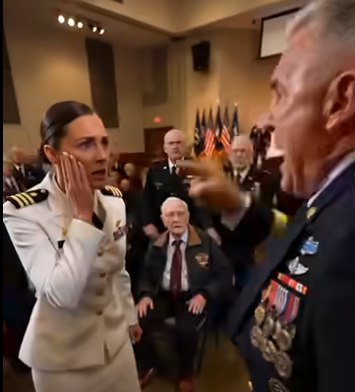
My cheek still burned from the slap.
The retired Marine kept a firm grip on my father’s arm while dozens of veterans stared in stunned silence.
The elderly veteran slowly stepped forward.
His hands trembled with age as he removed an old black-and-white photograph from his jacket.
“I know that name,” he said quietly.
Nobody interrupted him.
The military historian looked interested.
“What name?” he asked.
The veteran pointed toward the medal.
“The soldier attached to that serial number.”
The room seemed to lean forward.
The veteran carefully held up the photograph.
It showed three young servicemen standing beside a military transport vehicle overseas.
One of them was smiling broadly.
On the back of the photograph was a handwritten note.
The veteran read it aloud.
“To my brothers. If I don’t make it home, tell my family I was proud to serve.”
A chill swept through the auditorium.
Then he revealed the signature.
The exact name connected to the medal.
Gasps erupted.
The military historian immediately compared the photograph to the archived records.
“It matches.”
The veteran nodded.
“I served with him.”
Everyone turned toward my father.
His face had become completely pale.
Not nervous.
Terrified.
And for the first time, I realized this wasn’t simply about a fake medal.
It was about something much bigger.
PART 3 — THE NAME HE NEVER EXPECTED TO HEAR
The elderly veteran stared directly at my father.
“Where did you get that medal?”
My father remained silent.
The question hung heavily in the air.
The historian asked again.
“Mr. Walker, where did you obtain it?”
Still nothing.
The veteran slowly approached.
His eyes narrowed.
Then he said something that made my father’s knees nearly buckle.
“I remember someone else.”
The room froze.
“Someone who survived the attack that killed the medal’s owner.”
My father looked away.
The veteran continued.
“He disappeared shortly afterward.”
A murmur spread through the audience.
The historian frowned.
“Disappeared?”
The veteran nodded.
“There were rumors.”
My pulse quickened.
“What rumors?”
The old man looked directly at me.
Then he answered.
“That someone left with personal belongings belonging to the dead.”
The room exploded with whispers.
Several veterans stood.
Others exchanged shocked looks.
The implication was obvious.
The medal might not have been purchased.
It might have been taken.
My father suddenly shouted.
“That’s enough!”
The outburst startled everyone.
The veteran didn’t flinch.
Instead, he quietly replied:
“No. It’s finally time.”
PART 4 — THE LETTER
The military historian requested a short recess.
But before anyone moved, the elderly veteran revealed one more item.
An envelope.
Yellowed with age.
Folded dozens of times.
Protected inside a plastic sleeve.
My father stared at it as if he’d seen a ghost.
The veteran carefully opened it.
“This was found among the personal effects returned after the attack.”
The room fell silent.
The letter had belonged to the fallen soldier.
The soldier whose medal my father had displayed for decades.
The veteran unfolded the paper.
Then stopped.
His expression changed.
The historian noticed immediately.
“What is it?”
The old veteran swallowed hard.
“The letter isn’t addressed to his family.”
The audience waited.
“Then who is it addressed to?” someone asked.
The veteran looked up.
Straight at my father.
“It’s addressed to him.”
The room erupted.
My stomach dropped.
My father closed his eyes.
The veteran began reading.
The letter revealed that the fallen soldier and my father had known each other.
Very well.
Closer than anyone realized.
The soldier wrote about trust.
Friendship.
Sacrifice.
And one final request.
If anything happened to him, he wanted my father to deliver several personal items to his parents.
The veteran lowered the letter.
A terrible silence followed.
Because everyone suddenly understood.
My father had known the soldier personally.
For decades.
PART 5 — THE CONFESSION
The historian carefully approached my father.
“Is this true?”
My father sat heavily in a chair.
For the first time in my life, he looked old.
Not angry.
Not defensive.
Just exhausted.
Several minutes passed.
Finally he nodded.
“Yes.”
The room held its breath.
My father slowly began speaking.
The story spilled out in fragments.
Broken memories.
Regret.
Shame.
The attack had happened exactly as records described.
The soldier attached to the medal had died.
My father had survived.
He had been the last person to see him alive.
When recovery teams arrived later, my father was entrusted with several personal belongings.
Including the medal.
Including the letter.
Including family photographs.
The mission afterward became chaotic.
Transfers.
Reassignments.
Medical treatment.
The items were never delivered.
Years passed.
Then decades.
My father admitted he intended to return everything eventually.
But eventually never came.
And the longer he waited, the harder it became.
Until the truth became buried beneath a lie.
A lie that consumed his entire life.
PART 6 — THE REAL SHOCK
The confession seemed devastating enough.
Then the elderly veteran asked one final question.
“Did you ever read the rest of the letter?”
My father frowned.
“What do you mean?”
The veteran carefully unfolded another page.
A page nobody knew existed.
The room gasped.
Apparently the original letter contained an attachment hidden between folded sections.
The veteran began reading.
As he spoke, tears appeared in his eyes.
Then in mine.
Then in many others throughout the auditorium.
The fallen soldier had written about a newborn child.
A daughter.
He feared he would never meet her.
He asked my father for something extraordinary.
If he didn’t survive, he wanted his daughter to know who he was.
The soldier trusted my father completely.
Trusted him with his family’s future.
Trusted him with his memory.
Trusted him with his legacy.
My father broke down.
The entire room watched.
Not because of the medal.
But because of the betrayal of that trust.
The weight of fifty years suddenly crashed down on him.
Yet the biggest surprise was still coming.
The historian had been reviewing additional records during the confession.
Then he looked up.
Stunned.
Absolutely stunned.
PART 7 — THE DAUGHTER
The historian slowly stood.
His voice trembled.
“We located the daughter.”
The room froze.
“What?” someone whispered.
The historian nodded.
The fallen soldier’s daughter was alive.
She had spent most of her life searching for information about her father.
Military records.
Archives.
Veteran organizations.
Anything.
She wanted to know who he had been.
The historian continued.
“She’s here.”
The auditorium erupted.
People looked everywhere.
Then a woman near the back slowly stood.
Perhaps in her late fifties.
Tears streamed down her face.
The elderly veteran immediately recognized her.
The room parted as she walked forward.
Every step seemed impossibly heavy.
My father couldn’t even look at her.
The woman stopped directly in front of him.
For several seconds nobody spoke.
Then she quietly asked:
“Did he suffer?”
My father began crying.
Openly.
Completely.
“He wasn’t afraid.”
The woman covered her mouth.
My father continued.
“He talked about you.”
The woman collapsed into tears.
So did many people watching.
The next several minutes felt unreal.
The daughter finally learned details about her father.
Not from records.
Not from reports.
From the last surviving witness.
The man who had carried the burden for half a century.
PART 8 — THE END
Three months later, another gathering took place.
This one was much smaller.
No media.
No public ceremony.
No speeches.
Just veterans.
Families.
And truth.
The medal was formally returned to the fallen soldier’s daughter.
Along with every photograph.
Every letter.
Every personal item my father had preserved all those years.
The transfer was emotional.
Painful.
Necessary.
And healing.
Many expected my father to disappear afterward.
Instead, he did something unexpected.
He spent months speaking publicly about honesty, accountability, and stolen valor.
He admitted his mistakes.
Accepted responsibility.
And encouraged others to correct historical inaccuracies before they became lifelong burdens.
The daughter eventually forgave him.
Not immediately.
Not easily.
But genuinely.
As for me, my relationship with my father took time to rebuild.
The slap hurt.
The betrayal hurt more.
But I eventually understood something.
His anger that day wasn’t truly directed at me.
It was directed at the truth he had spent fifty years avoiding.
A truth he could no longer escape.
One evening, months later, we sat together on his porch.
Neither of us spoke for a while.
Then he looked at me.
“You were right to investigate.”
The words were difficult for him.
I nodded.
He stared toward the sunset.
“I should have faced this years ago.”
I didn’t disagree.
Then he surprised me.
“Thank you.”
I looked at him.
“For what?”
He smiled sadly.
“For finally making me keep a promise.”
And in that moment, I realized the ceremony had never been about exposing a fake medal.
It had been about restoring a forgotten soldier’s legacy.
Returning a father’s memory to his daughter.
And forcing one man to confront a truth that had haunted him for half a century.
The medal was never the real story.
The promise was.
And sometimes the hardest act of honor is finally telling the truth.
