The Detective Asked About the Missing Family. What We Learned Next Changed Our Lives Forever.
The first time Cooper dug the hole, I laughed.
The hundredth time, I stopped laughing.
The two-hundredth time, I started losing sleep.
Because no matter what we did, our dog always returned to the exact same patch of dirt.
Not near the fence.
Not beneath the maple tree.
Not beside the garden.
Always the same place.
Exactly the same place.
Every morning before breakfast.
Every evening before bed.
Every single day.
For six months.
And by the time the police arrived at our house, I realized Cooper had been trying to tell us something all along.
Something buried far deeper than dirt.
Something nobody had ever expected to find.
Our house sat at the edge of Cedar Creek, a quiet town where excitement usually involved a raccoon knocking over trash cans.
My husband Mark and I had moved there two years earlier.
After years in the city, we wanted peace.
A backyard.
A dog.
A place where children could someday grow up safely.
The property seemed perfect.
Large yard.
Old oak trees.
Quiet neighborhood.
Friendly neighbors.
The previous owners had sold the house through an estate company.
We were told the elderly couple had moved away years ago.
Simple.
Ordinary.
Nothing suspicious.
Nothing strange.
Until Cooper started digging.
He was a Labrador.
Four years old.
Loyal.
Gentle.
Smart.
Almost frighteningly smart.
Sometimes he seemed less like a dog and more like a person trapped inside one.
The first hole appeared near the center of the yard.
I filled it.
The next morning it was back.
Deeper.
I filled it again.
The cycle repeated.
Weeks passed.
Then months.
Eventually the hole became a neighborhood joke.
“Maybe he’s looking for pirate gold.”
“Maybe there’s oil under there.”
“Maybe your dog knows something you don’t.”
Everyone laughed.
Including us.
At first.
But Cooper wasn’t acting playful.
He was acting desperate.
He ignored squirrels.
Ignored rabbits.
Ignored every distraction.
Only the hole mattered.
When we fenced it off, he squeezed through.
When we covered it with rocks, he moved them.
When Mark poured gravel into it, Cooper dug through the gravel.
Nothing stopped him.
Nothing.
One evening I found blood on his paws.
I immediately drove him to the veterinarian.
Dr. Harper examined him carefully.
“Physically he’s fine,” she said.
“Then why is he doing this?”
She shrugged.
“Sometimes dogs fixate.”
But Cooper wasn’t fixated.
He was obsessed.
And there was a difference.
I could feel it.
The way mothers sense something wrong with a child before doctors do.
Something in my gut whispered that Cooper wasn’t digging because he wanted to.
He was digging because he needed to.
The panic began on a Saturday morning.
I woke before sunrise.
At first I thought I was dreaming.
Then I heard the barking.
Loud.
Sharp.
Relentless.
Not excitement.
Not warning.
Fear.
Pure fear.
I rushed outside.
The cold morning air hit my face.
Cooper stood beside the hole.
Frozen.
Staring downward.
His body trembled.
His tail remained completely still.
And for the first time in six months, he wasn’t digging.
He was waiting.
“Mark!”
My husband came running.
“What happened?”
I pointed.
Something reflected sunlight beneath the dirt.
Metal.
A curved edge.
Buried deep underground.
Mark grabbed a shovel.
We carefully widened the hole.
More metal appeared.
Then more.
The object was enormous.
Far larger than either of us expected.
An hour later we still couldn’t identify it.
It seemed connected to something even deeper.
Something extending beneath the yard.
Then Cooper started whining.
A sound I’d never heard before.
Almost like grief.
That’s when Mark stopped digging.
“I think we should call somebody.”
I nodded.
For once, I agreed immediately.
Officer Daniel Reeves arrived twenty minutes later.
Young.
Relaxed.
Clearly expecting a routine call.
That attitude vanished the moment he looked into the hole.
His expression changed instantly.
“What is it?” Mark asked.
The officer didn’t answer.
Instead, he crouched beside the excavation.
Studied the exposed metal.
Then stood up.
“I need to make a call.”
Five minutes later, three additional vehicles arrived.
Then six.
Then ten.
Police tape surrounded our property.
Detectives appeared.
Forensic technicians appeared.
Neighbors gathered across the street.
News traveled fast in Cedar Creek.
Nobody would tell us what was happening.
The atmosphere changed from curiosity to something darker.
Something heavy.
Something dangerous.
Cooper sat quietly beside me.
Watching.
Waiting.
As if he’d reached the end of a journey.
Hours later, a detective climbed from the excavation pit.
Everyone stopped talking.
Every single person.
The silence felt unnatural.
The detective carried something sealed inside an evidence bag.
A rusted metal object.
Rectangular.
About the size of a notebook.
Another detective immediately called for additional units.
A third began speaking urgently into a radio.
Then the lead investigator approached us.
His face looked pale.
Almost shaken.
“Mr. and Mrs. Carter,” he said carefully.
“How long ago did the previous owners disappear?”
The question hit like ice water.
“Disappear?” I repeated.
“We were told they moved.”
The detective exchanged a glance with another officer.
Then he sighed.
“That’s not what our records show.”
My stomach dropped.
“What records?”
“The Henderson family was reported missing twenty years ago.”
The world seemed to tilt sideways.
“What?”
“The husband, wife, and teenage daughter vanished without explanation.”
Mark stared.
“No one told us that.”
“I believe that.”
The detective looked toward the excavation.
“Because somebody worked very hard to make sure nobody knew.”
That night, neither of us slept.
Police remained on our property.
Floodlights illuminated the backyard.
Excavation equipment arrived.
The entire neighborhood watched from behind barricades.
The story reached local news.
Then state news.
Then national media.
Everyone wanted answers.
So did we.
The next morning the excavation expanded.
By afternoon the truth began emerging.
The metal object wasn’t a container.
It wasn’t a safe.
It wasn’t treasure.
It was part of an underground bunker.
A hidden structure buried beneath our backyard.
Built decades earlier.
Completely concealed.
Large enough for several people.
Nobody understood why.
Until they opened it.
The entrance appeared beneath six feet of soil.
Workers carefully removed debris.
Then investigators descended.
Hours passed.
Nobody came back up.
The tension became unbearable.
Finally the lead detective emerged.
His face had changed.
He looked stunned.
Not horrified.
Not disgusted.
Stunned.
As if reality itself had shifted.
“What did you find?” I asked.
He hesitated.
Then said three words.
“A living space.”
“What?”
“There are beds.”
Silence.
“Food storage.”
More silence.
“Clothing.”
My heart pounded.
“Human remains?”
He shook his head.
“No.”
Relief swept through me.
Then confusion replaced it.
If nobody died there…
What exactly had Cooper found?
The answer arrived two days later.
And it was stranger than anything anyone imagined.
Inside the bunker investigators discovered journals.
Boxes of photographs.
Letters.
Receipts.
Maps.
Personal belongings.
Hundreds of items.
All belonging to the missing Henderson family.
But there was one detail that changed everything.
The journals continued for years after the family disappeared.
Not days.
Not weeks.
Years.
The final entry was dated seventeen years after they vanished.
The family hadn’t been murdered.
They had been hiding.
Voluntarily.
The revelation shocked the country.
Why would an entire family fake their disappearance?
Why live underground?
Why abandon their lives?
The journals slowly revealed the answer.
And it sounded insane.
At first.
Three decades earlier, Robert Henderson worked as an accountant.
One night he discovered financial records connecting powerful local businessmen to a massive fraud scheme.
Millions of dollars.
Illegal transactions.
Corruption reaching into government offices.
Robert reported it.
That decision destroyed his life.
Threats followed.
Then harassment.
Then violence.
His car exploded.
His house was vandalized.
Police investigations mysteriously stalled.
Witnesses disappeared.
Friends stopped returning calls.
Robert became convinced someone wanted his family dead.
Nobody believed him.
Until someone fired a bullet through his daughter’s bedroom window.
That changed everything.
The bunker was built shortly afterward.
Secretly.
Quietly.
Desperately.
When another threat arrived, Robert made a decision.
He staged his family’s disappearance.
And vanished underground.
For seventeen years.
The story was unbelievable.
Yet every journal supported it.
Every detail matched old unsolved crimes.
Old corruption cases.
Old missing evidence.
Investigators reopened dozens of files.
Then another bombshell emerged.
Several people named in Robert’s journals were still alive.
Still wealthy.
Still influential.
And suddenly very nervous.
The investigation exploded nationwide.
Arrests began.
Federal agencies became involved.
The bunker became evidence.
The journals became evidence.
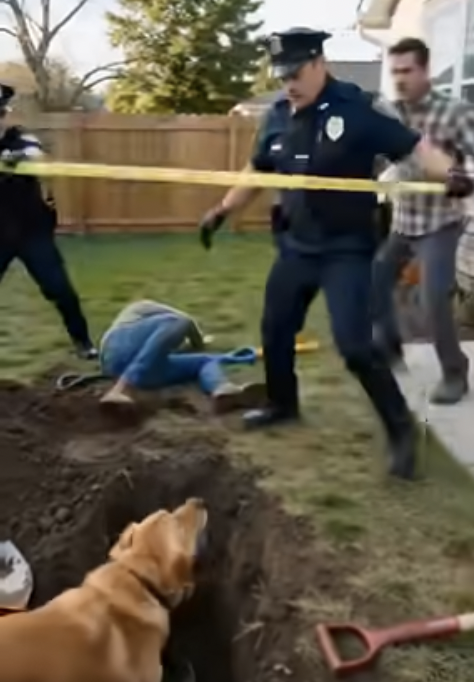
Everything changed.
But one question remained unanswered.
Where was the Henderson family now?
Because although the bunker proved they had survived, there was no indication of what happened after the final journal entry.
No trace.
No destination.
Nothing.
It was as if they had vanished twice.
Then Cooper found something else.
Three weeks later.
After police removed most excavation equipment.
After reporters left.
After life almost returned to normal.
I noticed Cooper sitting beside the hole again.
Not digging.
Just watching.
The same way he had before.
A chill ran through me.
“Mark.”
He came outside.
“What?”
“He’s doing it again.”
We approached cautiously.
Cooper nudged a section of exposed concrete.
Repeatedly.
Tap.
Tap.
Tap.
Almost intentionally.
Mark knelt beside it.
“There’s something here.”
Investigators returned.
The concrete section was removed.
Hidden underneath was a waterproof metal box.
Inside lay a single envelope.
And a key.
Nothing else.
The envelope was addressed to whoever found the bunker.
My hands shook as detectives carefully opened it.
Inside was a letter.
Written by Robert Henderson.
The room fell silent as it was read aloud.
If you found this, then our guardian finally succeeded.
Guardian?
Everyone looked confused.
The letter continued.
You probably believe we abandoned this place years ago.
You’re wrong.
We’ve been watching.
Waiting.
Hoping.
And if Cooper led you here, then the promise was kept.
My heart stopped.
Cooper?
How could Robert know our dog?
The next sentence answered everything.
Cooper wasn’t our dog.
At least not originally.
Twenty years earlier, when the Henderson family first disappeared, they had owned a Labrador puppy.
His name was Ranger.
When they fled, they couldn’t take him.
Too dangerous.
Too noticeable.
So Robert entrusted Ranger to his younger brother.
The dog remained with the family for years.
Then had puppies.
Then grandchildren.
Then great-grandchildren.
One bloodline.
One family.
Generation after generation.
Until eventually one puppy was born.
A puppy later adopted by us.
Cooper.
The letter explained that Ranger had been trained from birth to recognize specific scents buried near the bunker entrance.
A bizarre precaution.
A final backup plan.
If nobody found them.
If Robert never returned.
If the truth remained hidden.
Perhaps one day Ranger’s descendants would.
The investigators thought it sounded impossible.
Until canine behavior specialists reviewed Cooper’s actions.
The scent markers buried underground contained compounds that could survive decades.
Theoretically, a dog carrying inherited scent-driven behaviors might indeed become obsessed with locating them.
Against all odds…
Cooper had followed a trail created before he was born.
But the greatest twist was still coming.
At the bottom of the letter was an address.
Current.
Recent.
And a final message.
If justice finally exists, come find us.
We’re ready to come home.
Three days later, a convoy traveled to a remote lakeside community hundreds of miles away.
Detectives.
Federal agents.
Reporters.
And us.
Because somehow Cooper had become part of the story.
When we arrived, an elderly man waited on a porch.
Beside him stood a woman.
And a middle-aged daughter.
The Henderson family.
Alive.
All three.
Twenty years older.
Twenty years hidden.
Twenty years waiting.
The reunion stunned the nation.
Robert cried openly.
His wife embraced investigators.
Their daughter held Cooper’s face between her hands.
Then she began laughing through tears.
“He has Ranger’s eyes.”
The entire crowd laughed.
And cried.
At the same time.
Months later, the corruption case led to convictions.
Millions of dollars were recovered.
Victims received compensation.
The Henderson family finally returned publicly.
Their names were cleared.
Their story became known across the country.
And Cooper?
Cooper became a legend.
Schools invited him.
Television shows featured him.
People called him a hero.
But none of that seemed to matter to him.
He was still happiest chasing tennis balls.
Still happiest sleeping on our couch.
Still happiest stealing sandwiches whenever nobody looked.
One evening, nearly a year later, I sat beside him in the backyard.
The excavation site had become a memorial garden.
Flowers bloomed where the hole once stood.
The sunset painted everything gold.
Cooper rested his head on my lap.
I scratched behind his ears.
“You knew something was there, didn’t you?”
His tail thumped softly.
Maybe it was instinct.
Maybe it was training buried deep within generations.
Maybe it was something nobody could fully explain.
But I knew one thing.
For six months, while everyone laughed, Cooper never gave up.
He dug through rain.
Through heat.
Through pain.
Through doubt.
Because somewhere beneath that dirt lay a family waiting for the truth to find them.
And in the end, the dog everyone thought was digging a pointless hole turned out to be the one who solved a twenty-year mystery, reunited a lost family, exposed a criminal empire, and proved that sometimes the smallest voice in the room is the one we should listen to most.
As the sun disappeared beyond the trees, Cooper closed his eyes.
Peaceful.
Content.
His job was finally finished.
And for the first time since we had moved into that house, the backyard felt quiet again.
