PART 2 — THE DENIAL LETTER NO ONE WAS SUPPOSED TO SEE
—the admissions review committee had identified evidence that Savannah Blake’s application contained falsified community service records, altered recommendation letters, and an essay suspected of being written by someone else.
For one breathless moment, the entire Harvard courtyard turned completely still.
The old brick buildings stood around us like silent judges. The tour guide’s red folder hung frozen in her hand. Parents who had been smiling seconds earlier now stared at Savannah as if she had become a stranger in front of them.
The admissions counselor, Mr. Alvarez, held Savannah’s phone carefully, as though even touching it made him uncomfortable.
Savannah’s face lost every trace of anger.
“No,” she whispered. “You can’t read that.”
Mr. Alvarez looked at her, then at the teachers beside us.
“This notification appeared during a public altercation,” he said carefully. “Miss Blake, we need to speak with you and your guardian immediately.”
“My father is a United States senator,” Savannah snapped, but her voice shook. “You don’t understand what you’re doing.”
The words did not sound powerful.
They sounded desperate.
Someone in the crowd gasped when the counselor read the sender name aloud.
“Harvard College Admissions Review.”
Savannah lunged for the phone, but one of our teachers, Mrs. Bennett, stepped between them.
“Savannah,” she said, stunned, “did you know about this?”
Savannah’s eyes darted across the crowd. Phones were raised everywhere. Students whispered. Parents exchanged looks. The slap had already been recorded. Now the denial email was becoming part of something much larger.
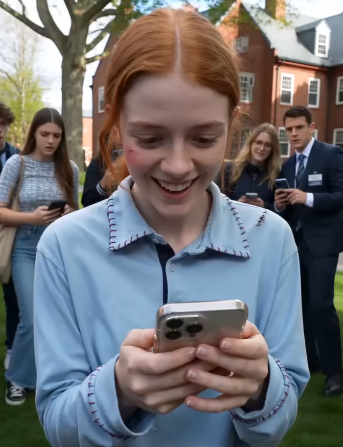
I stood there with my cheek burning and my acceptance email still glowing in my own hand.
My name was Maya Reyes.
Until ten minutes earlier, I had been the girl nobody really noticed unless they needed homework help, a flyer delivered, or a scholarship essay edited. I lived with my mother and little brother in a subsidized apartment where the heat failed every winter and the elevator smelled like old rain. I owned one formal blouse, two pairs of school shoes, and a phone with a cracked screen I protected like it was made of gold.
And somehow, Harvard had said yes to me.
Savannah Blake, whose father appeared on television every Sunday talking about excellence and opportunity, had just found out Harvard had said no to her.
But the denial wasn’t what destroyed her.
It was why.
Mr. Alvarez’s expression hardened as he scrolled through the attached explanation.
“The committee cites irregularities in submitted documents,” he said. “Miss Blake, this cannot be discussed further in the courtyard. But because you struck another admitted student, campus security has already been notified.”
“Another admitted student?” Savannah laughed once, sharp and ugly. “She shouldn’t be admitted. She probably wrote some sob story about being poor.”
The words landed harder than the slap.
My mother, standing beside me in her faded coat, stiffened.
She had taken the morning off from cleaning offices to come on this tour. She had spent two hours pressing my repaired uniform so carefully that no one would notice the old stitching. She had smiled all day like the campus itself was a miracle.
Now I saw her face change.
Not into anger.
Into hurt.
That hurt made something rise inside me.
“I wrote about my mother,” I said quietly.
Savannah looked at me with wet, furious eyes.
“Of course you did.”
I stepped forward, my cheek still throbbing.
“I wrote about how she sleeps four hours a night and still asks if I ate before she eats. I wrote about my brother learning multiplication at our kitchen table while our neighbor’s baby cries through the wall. I wrote about wanting to study public policy because I know what it feels like when laws are written by people who never stood in a food pantry line.”
The courtyard had gone silent again.
My voice shook, but I kept going.
“I didn’t write a sob story. I wrote the truth.”
Savannah opened her mouth, but no words came.
Then a deep voice cut through the crowd.
“What is going on here?”
Everyone turned.
Senator Charles Blake strode across the courtyard in a navy coat, surrounded by two aides and a security officer. He looked exactly like he did on campaign posters: silver hair, straight shoulders, perfect smile. But the smile vanished when he saw Savannah crying, me holding my cheek, and admissions staff standing around her phone.
“Savannah,” he said. “What happened?”
She ran to him like a child.
“Dad, they’re humiliating me.”
His eyes moved to me.
Then to Mr. Alvarez.
Then to the phones recording everything.
His face became calm in a terrifying way.
“This tour is over,” he said.
Mr. Alvarez did not move.
“Senator Blake, your daughter assaulted an admitted student.”
The senator looked at me again, as if only now understanding that I mattered.
“Maya Reyes,” he said.
The fact that he knew my name sent a chill through me.
My mother stepped in front of me.
“How do you know my daughter?”
The senator’s smile returned.
But this time it was not charming.
It was sharp.
“Mrs. Reyes,” he said. “I believe we all need to be very careful about what we say next.”
PART 3 — THE SENATOR KNEW MY NAME
My mother’s hand found mine.
Her fingers were cold.
“Why do you know my daughter’s name?” she repeated.
Senator Blake adjusted his cufflinks, buying a second before answering.
“She and my daughter attend the same school. Naturally, I know the top students.”
But he had said my name too quickly.
Too personally.
Like it had already been in his mouth before today.
Mrs. Bennett, our history teacher, stepped forward. “Senator Blake, I think it’s best if school officials handle this.”
The senator smiled at her.
“Of course. And I’m sure everyone here wants to avoid turning a misunderstanding into a scandal.”
A misunderstanding.
The word made my cheek burn hotter.
Savannah wiped her tears and pointed at me again, though her hand trembled.
“She provoked me.”
A dozen students shouted at once.
“No, she didn’t!”
“You slapped her!”
“We recorded it!”
The senator’s eyes flicked toward the raised phones.
His aides immediately began whispering to parents, asking people to stop filming, saying minors were involved, warning about privacy. But no one lowered their phones.
Not this time.
Mr. Alvarez kept Savannah’s phone in his hand.
“Senator, your daughter’s admissions status and related review are confidential. However, the physical assault occurred publicly, on university grounds, during an official tour.”
The senator leaned closer to him.
“And you are comfortable handling a senator’s child this way?”
Mr. Alvarez did not blink.
“I am comfortable protecting a student who was struck.”
For the first time, Senator Blake’s mask slipped.
Only for a second.
But I saw it.
So did Savannah.
His jaw tightened, and his eyes turned cold.
Then my phone buzzed again.
I looked down, expecting another congratulations message.
Instead, there was an email from Harvard Financial Aid.
Subject:
URGENT: DOCUMENT VERIFICATION REQUIRED
My heart dropped.
I opened it with shaking fingers.
The message said that my aid file had been flagged because of an anonymous report claiming my household income information was incomplete and that I had failed to disclose outside financial support.
Outside financial support?
We barely had grocery money by Thursday.
My mother read over my shoulder. Her face went pale.
“What is this?”
Mrs. Bennett looked too.
“That doesn’t make sense,” she said. “Maya’s documents were verified through the school counselor.”
Savannah saw my expression change.
And for one tiny, horrible moment, relief flashed across her face.
Senator Blake noticed too.
His voice softened with false sympathy.
“Ah. These processes can be difficult for families unfamiliar with elite admissions.”
My mother looked as if he had slapped her too.
I felt the courtyard tilt.
Minutes ago, I had been floating.
Now my acceptance felt like a glass ornament someone had already thrown against a wall.
Mr. Alvarez asked gently, “Maya, may I see that message?”
I handed him my phone.
He read it, and his expression changed in a different way than before.
Not shocked.
Suspicious.
“This flag was entered this morning,” he said.
Mrs. Bennett frowned.
“During the tour?”
“Yes.”
He scrolled carefully. “And the anonymous report references details from her confidential scholarship file.”
My stomach twisted.
“Who could see that?”
Mr. Alvarez did not answer immediately.
But Senator Blake did.
“Admissions offices receive many reports,” he said smoothly. “Sometimes people exaggerate. Sometimes applicants misrepresent circumstances.”
My mother straightened.
“My daughter did not lie.”
“I didn’t say she did,” he replied.
But he had.
Everyone heard it.
Savannah looked at me, tears still shining in her eyes, and whispered, “Now you know what it feels like.”
That was when I understood.
She wasn’t just angry that I had been accepted.
She wanted me removed.
Mr. Alvarez quietly passed my phone to another administrator.
“We need to secure both messages,” he said. “Something is wrong.”
Senator Blake’s aide stepped forward.
“My office will be contacting university counsel.”
Mr. Alvarez nodded.
“I’m sure they will.”
Then he looked at me.
“Maya, your acceptance has not been revoked. Do you understand? This is a verification request, not a reversal.”
I tried to breathe.
But all I could think was that someone powerful had reached into my dream within minutes of seeing me hold it.
My mother squeezed my hand.
“Look at me,” she whispered.
I did.
Her eyes were wet, but fierce.
“You earned this.”
I nodded, but fear had already crawled into my chest.
Then another sound cut through the courtyard.
Savannah’s phone, still in Mr. Alvarez’s hand, received a new message.
The screen lit up again.
This time, the sender was saved as:
DAD — PRIVATE
The preview read:
I told you not to confront her until the aid complaint processed.
The courtyard fell into a silence so complete it felt impossible.
Savannah stopped breathing.
Senator Blake’s face went white.
Mr. Alvarez slowly looked up.
And every camera turned toward the senator.
PART 4 — THE MESSAGE THAT TRAPPED HIM
The senator moved faster than anyone expected.
“That phone contains privileged family communications,” he said sharply. “Return it immediately.”
Mr. Alvarez took one step back.
“Campus security is on the way.”
“That is my daughter’s property.”
“It is also evidence related to a possible coordinated interference with another student’s admission and financial aid file.”
The words struck the courtyard like a bell.
Coordinated interference.
My mother gasped.
I stared at Senator Blake, barely able to understand what had just happened.
He had known.
He had filed the complaint.
Or ordered someone to do it.
Savannah turned toward him slowly.
“Dad?”
He did not look at her.
That told her everything.
Her face crumpled, but not from shame this time. From realization.
“You said it was just a review,” she whispered. “You said they’d notice she didn’t belong.”
The senator’s eyes flashed.
“Be quiet.”
She flinched.
I knew that flinch.
I had seen it before in neighbors when landlords pounded on doors. In my little brother when grown men shouted in the hallway. In myself when bills arrived with red letters.
It was the body learning fear before the mind could object.
Mr. Alvarez signaled to campus security, who had just arrived near the gate. Two officers approached, calm but firm.
“Senator Blake,” one said, “we need everyone to come with us to the admissions office.”
The senator smiled again, but now it looked painted on.
“I will not be marched anywhere like a criminal.”
A student near the front muttered, “Then stop acting like one.”
No one laughed.
The senator heard.
His face darkened.
My teacher guided me and Mom toward the admissions building. The walk felt endless. Students parted as we passed. Some whispered encouragement. Others simply stared at me like I was a headline forming in real time.
Inside the admissions office, the air smelled of polished wood and old books. We were placed in a conference room with Mr. Alvarez, Mrs. Bennett, my mother, two administrators, and a university attorney who introduced herself as Ms. Chen.
Savannah and her father were taken into another room.
For the first time all day, the noise stopped.
My mother sat beside me and touched my cheek gently.
“I’m sorry,” she whispered.
“For what?”
“For bringing you here and watching them hurt you.”
I almost broke then.
“You didn’t hurt me.”
She looked at the conference table, ashamed.
“I wanted you to have one perfect day.”
I leaned into her shoulder.
“I got in, Mom.”
Her face crumpled.
“Yes,” she whispered. “You did.”
Ms. Chen entered with a laptop.
“Maya, I need to explain what we know so far. Your admission remains valid. The financial aid verification was triggered by an anonymous submission through a secure reporting portal. That report included information that should not have been publicly available.”
“Like what?” Mom asked.
“Your housing status, tax filing details, and scholarship documents uploaded through your school portal.”
Mrs. Bennett looked horrified.
“That means someone accessed her school records.”
Ms. Chen nodded.
“We are investigating.”
A cold memory surfaced.
Two weeks earlier, our school counselor, Mr. Darden, had called me into his office. He said a senator’s education foundation wanted to highlight low-income college applicants and asked me to sign a release. I felt uneasy and said I wanted my mother to read it first.
He seemed annoyed.
I mentioned this now.
Mrs. Bennett went rigid.
“Mr. Darden gave you a release?”
“Yes.”
“For Senator Blake’s foundation?”
“I think so.”
Ms. Chen typed quickly.
My mother turned to me.
“Why didn’t you tell me?”
“I forgot,” I said, then shook my head. “No. I didn’t forget. I thought it didn’t matter because I didn’t sign.”
Mrs. Bennett’s voice was tight.
“It matters.”
The door opened.
Mr. Alvarez stepped inside, holding a printed page.
His expression was grave.
“We found the origin of the aid complaint.”
My heart pounded.
He placed the page on the table.
“It was submitted using an IP address associated with Blake Civic Education Foundation.”
My mother covered her mouth.
Mrs. Bennett whispered, “My God.”
Ms. Chen looked at me.
“Maya, did you ever authorize Senator Blake, his foundation, or anyone representing him to access your financial records?”
“No.”
“Did you ever provide documents to Savannah Blake?”
“No.”
She nodded.
“Then this may go beyond admissions misconduct.”
Before anyone could say more, shouting erupted in the hallway.
The conference room door was not fully closed.
We heard Savannah screaming.
“You used me!”
Then the senator’s voice, low and furious.
“You ruined everything because you couldn’t control yourself.”
Savannah sobbed.
“You told me Harvard would fix it. You told me she would be disqualified before anyone knew.”
My blood turned cold.
Ms. Chen stood immediately.
Mr. Alvarez opened the door.
Savannah was in the hallway, shaking, mascara streaked down her face.
The senator stood over her, one hand gripping her arm.
“Let go of her,” my mother said.
Everyone froze.
My mother was small. She wore a secondhand coat. Her shoes were cracked at the edges.
But in that hallway, she sounded stronger than every powerful person in the building.
The senator released Savannah.
Savannah looked at me through tears.
“I’m sorry,” she said. “I didn’t know about the records. I thought he was just going to report you for exaggerating.”
My chest tightened.
“That’s supposed to make it better?”
“No,” she whispered. “It doesn’t.”
Then she looked at Ms. Chen.
“I’ll tell you everything.”
The senator’s face changed.
“Savannah, if you say another word—”
She stepped away from him.
“You already got denied,” she said, voice breaking. “You can’t take my future and hers too.”
PART 5 — SAVANNAH’S CONFESSION
Savannah’s confession did not come all at once.
It came in pieces, each one uglier than the last.
She sat across from me in the conference room, wrapped in a university staff member’s cardigan because she had started trembling so badly. Her father was no longer in the room. University police had escorted him to a separate office after Ms. Chen warned him that interfering with witness statements would be documented.
Savannah stared at her hands.
“My dad hired a college consultant,” she began. “Everyone does it. At least, everyone I know.”
No one interrupted.
“At first it was normal. Essay coaching. Interview prep. Resume building. Then he said my application needed to be stronger because political families are judged more harshly.”
Mrs. Bennett’s mouth tightened.
Savannah swallowed.
“The consultant rewrote my essay. My dad said it still counted because it was based on my ideas. Then my service hours were expanded. I did volunteer, but not as much as they wrote. I told him it felt wrong.”
“What did he say?” Ms. Chen asked.
“That winning requires polish.”
I looked down at my own hands.
There was nothing polished about me. My nails were short from opening stacks of flyers. My palms had tiny paper cuts. My life had not been expanded to look better.
It had been compressed so tightly I sometimes couldn’t breathe.
Savannah continued.
“After early admissions interviews, my dad heard from someone that Maya was a serious candidate.”
I looked up.
“How?”
Savannah shook her head.
“I don’t know. He wouldn’t say. He just said Harvard wanted a story like hers.”
“A story like mine?” I repeated.
She flinched.
“I know how that sounds.”
“Do you?”
Her eyes filled again.
“No. Maybe I didn’t.”
She took a shaky breath.
“He started asking about you. Your grades. Your family. Whether you really lived where people said. Whether your scholarship essays were exaggerated. I told him you were smart. I told him teachers liked you. He got angry.”
My mother whispered, “Why would he care so much about one girl?”
Savannah looked at her.
“Because he needed me at Harvard.”
The room fell quiet.
“My father is running for president in two years,” she said. “He wanted a campaign video about family, merit, excellence. His daughter at Harvard was part of the image.”
The words sat there, poisonous and absurd.
My acceptance had not just bruised Savannah’s pride.
It had threatened a campaign story.
Savannah wiped her face.
“When my denial came this morning, I didn’t know at first. My dad knew before I did. He told me there had been a complication, but he was handling it. Then on the tour, Maya got accepted, and everyone was congratulating her, and I just—”
“You slapped me,” I said.
Her voice broke.
“Yes.”
“Because I had what you thought belonged to you.”
She looked at me, shattered.
“Yes.”
It should have felt good to hear her admit it.
It didn’t.
It felt like watching a beautiful dress catch fire and discovering there was a person inside it.
Ms. Chen typed notes.
“Savannah, who accessed Maya’s school records?”
Savannah hesitated.
Then she whispered, “Mr. Darden.”
Mrs. Bennett stood so fast her chair scraped the floor.
Our school counselor.
The man who had submitted my recommendation packet.
The man who knew which students had unstable housing, which families needed fee waivers, which kids worked after school and lied about being tired.
My mother gripped the edge of the table.
Savannah kept going.
“My dad’s foundation donated to the school. Mr. Darden helped identify students for mentoring programs. He sent files sometimes. My dad said it was legal because the foundation supported college access.”
“It wasn’t legal without consent,” Ms. Chen said.
Savannah nodded miserably.
“I know.”
A university officer entered and handed Ms. Chen a tablet.
She read it, and her expression sharpened.
“Maya, we need to ask you something sensitive.”
My stomach tightened.
“Okay.”
“Did anyone recently offer your family money, housing assistance, or scholarship support connected to withdrawing or changing an application?”
My mother and I looked at each other.
Then I remembered.
A month earlier, a woman from Blake Civic Education Foundation had visited our apartment building. She said I had been nominated for a community leadership grant. She asked if I had applied early to any colleges. When I said yes, she smiled and said students like me often did better at excellent state schools closer to home.
Then she left a brochure.
My mother still had it in a drawer.
I told them.
Ms. Chen’s face darkened.
Savannah whispered, “I didn’t know about that.”
I believed her.
I hated that I believed her.
Then Mr. Alvarez returned, looking shaken.
“We just received confirmation from Harvard IT. The anonymous aid complaint included an attachment.”
He turned the laptop toward us.
My vision blurred as I read the file name.
MAYA_REYES_WITHDRAWAL_DRAFT.pdf
My mother made a sound like someone had punched her.
The document was a forged letter.
It claimed I wished to withdraw my early admission application because I had misrepresented my financial circumstances and no longer wanted to attend.
At the bottom was my name.
A fake signature.
My fake signature.
Savannah covered her mouth.
Mrs. Bennett began crying silently.
I stared at the screen, unable to move.
They had not wanted to compete with me.
They had wanted to erase me.
PART 6 — THE GIRL THEY TRIED TO ERASE
The forged withdrawal letter changed everything.
Within an hour, Harvard suspended all communication with outside parties regarding my file. Ms. Chen contacted federal authorities. Our school district was notified. Mr. Darden was placed on administrative leave before the afternoon ended.
But none of that fixed the feeling inside me.
The feeling that my dream had been touched by dirty hands.
By evening, the video of Savannah slapping me had spread everywhere. News outlets picked it up. Then someone leaked the message from Senator Blake’s phone. By dinner, reporters were outside our apartment building.
My little brother, Mateo, watched from behind the curtains.
“Are they here because you’re famous?” he asked.
I sat on the couch, exhausted.
“No.”
“Because that girl hit you?”
“Kind of.”
He frowned. “Did you hit her back?”
“No.”
He looked disappointed.
Mom gave him a warning glance.
He climbed beside me and leaned his head on my shoulder.
“You still get to go to Harvard, right?”
I closed my eyes.
“I think so.”
“You better,” he said. “I already told Luis my sister is going there and he said I was lying.”
That made me laugh for the first time all day.
A small laugh.
A cracked laugh.
But real.
Then Mom’s phone rang.
She looked at the screen and froze.
“It’s your school principal.”
She answered on speaker.
Principal Harris sounded nervous.
“Mrs. Reyes, Maya, first, I want to say how deeply sorry we are for what happened.”
Mom’s voice was cold.
“What did happen?”
A pause.
“The district has begun an internal investigation into Mr. Darden’s handling of student records.”
“And?”
Another pause.
“We found evidence that Maya’s confidential documents were accessed multiple times from his account over the past six weeks.”
My hands went numb.
Principal Harris continued, “There may be other affected students.”
Mom stood.
“Other students?”
“Yes. Students who applied for scholarships, fee waivers, or selective programs.”
I thought of my classmates. Kids who trusted Mr. Darden because counselors were supposed to open doors, not sell keys.
Then Principal Harris said something that made my stomach drop.
“Maya, we also found a scheduled email in your school account.”
“My account?”
“It was set to send tomorrow morning to Harvard Admissions. It stated you wished to withdraw due to family pressure.”
Mom whispered, “No.”
I felt suddenly cold all over.
They had a backup plan.
If the forged PDF failed, they would use my own school email.
“How did they get into my account?” I asked.
“We are investigating.”
But I already remembered.
Mr. Darden had reset my password last month when I couldn’t access a scholarship portal. He told me to keep the temporary password until the application cycle ended so he could help upload documents.
I trusted him.
That was the part that hurt.
Not just that Senator Blake tried to steal my future.
But that someone at my own school opened the door.
The next morning, I returned to school with Mom beside me.
Every hallway turned silent when I walked through it.
Some students clapped.
Some looked guilty because they had watched Savannah mock my clothes for years and said nothing.
Mrs. Bennett hugged me so tightly I could barely breathe.
Then Savannah arrived.
The hallway split around her.
She looked awful.
No makeup. Hair pulled back. Eyes swollen. For the first time, she walked without her usual crowd.
Students whispered cruel things.
“Fraud.”
“Denied.”
“Daddy’s project failed.”
She heard them.
I saw her face tighten.
Part of me thought, Good.
Then she stopped in front of me.
The hallway held its breath.
“I’m leaving school for a while,” she said.
I didn’t answer.
“I gave investigators access to my messages. All of them. I also told them which students my father asked about.”
“Why are you telling me?”
“Because one of them was your friend.”
My heart stumbled.
“Who?”
Savannah looked down.
“Jasmine Lee.”
Jasmine was quiet, brilliant, and undocumented. She never spoke about college in public because every form terrified her.
“What about her?”
“My dad’s foundation flagged her scholarship file too.”
The hallway noise disappeared.
I turned and ran.
I found Jasmine in the library, hunched over a computer, crying quietly into her sleeve.
She already knew.
Her application to a major scholarship program had been frozen because an anonymous source questioned her residency and family information.
I sat beside her.
She whispered, “I thought I was careful.”
Rage filled me so completely I could taste metal.
This wasn’t just about me.
It had never been just about me.
Senator Blake’s foundation had been collecting vulnerable students like files in a drawer.
Poor students.
Immigrant students.
Students without lawyers.
Students who would get scared and disappear quietly.
I took Jasmine’s hand.
“They picked the wrong girls.”
That afternoon, something began that no one expected.
Students started coming forward.
A boy whose scholarship application had mysteriously vanished.
A girl whose fee waiver documents were sent to a private foundation without permission.
A student whose personal essay had been quoted in a political speech without consent.
By sunset, there were seventeen of us.
By the next day, thirty-one.
And by the end of the week, Senator Blake’s education foundation was no longer a charity story.
It was an investigation.
PART 7 — THE HEARING THAT CHANGED EVERYTHING
Three months later, I sat in a public hearing room wearing the same repaired uniform blouse I had worn on the Harvard tour.
Mom wanted to buy me a new one.
I said no.
This blouse had survived the slap.
It could survive the Senate ethics committee.
Cameras lined the back of the room. Reporters filled every seat. At the witness table sat Senator Charles Blake, no longer smiling like a campaign poster. His hair was still perfect, his suit still expensive, but his power looked thinner under fluorescent lights.
Savannah sat two rows behind him.
She had agreed to testify.
No one knew whether she would actually do it until she walked in.
When my name was called, Mom squeezed my hand.
I stood.
My legs trembled, but I kept walking.
The oath felt strange on my tongue.
Do you swear to tell the truth?
The truth had nearly cost me everything.
“Yes,” I said.
The committee chair, Representative Leland, spoke gently.
“Miss Reyes, can you describe what happened on the Harvard campus?”
I told them.
Not dramatically.
Not like a victim begging to be believed.
I told them the facts.
The acceptance email.
The slap.
The denial letter on Savannah’s phone.
The message from Senator Blake.
The financial aid complaint.
The forged withdrawal letter.
The scheduled email from my school account.
Then Representative Leland asked, “How did this affect you?”
That question was harder.
I looked at the microphones.
Then at my mother.
Then at Jasmine, sitting behind her with other students who had come forward.
“It made me feel like my future was breakable,” I said. “Like everything I worked for could be taken by someone who had never met my mother, never seen our apartment, never watched me study under a flickering kitchen light while my little brother slept beside a space heater.”
The room was silent.
I continued.
“But then I learned they were counting on shame. They thought poor students would stay quiet because we’re used to being questioned. Used to proving we deserve help. Used to feeling grateful for crumbs.”
My voice grew stronger.
“I am grateful for opportunities. But I am not grateful for being investigated because I am poor. I am not grateful for being treated like my honesty is suspicious because my family needs financial aid. And I am not going to apologize for earning a place someone else thought money could reserve.”
A murmur moved through the room.
Representative Leland nodded.
“Thank you, Miss Reyes.”
Then came Savannah.
She walked to the witness table like someone approaching a cliff.
Her father did not look at her.
She took the oath.
Her hands shook.
At first, her voice barely carried.
“My father told me admissions was a game and that powerful families only lost when they followed rules meant for other people.”
Senator Blake’s lawyer objected.
The chair overruled him.
Savannah kept going.
“I let people lie for me because I wanted to win. I let myself believe Maya didn’t deserve Harvard because admitting she did meant admitting I didn’t earn what I had.”
Tears slipped down her face.
“I slapped her because I was angry at the wrong person. But my father’s foundation did more than hurt Maya. It targeted students whose private information made them vulnerable.”
She turned toward us.
“I helped investigators because I was part of the lie. I can’t undo that. But I can stop protecting it.”
Then Ms. Chen, now representing Harvard’s internal inquiry, submitted the final evidence.
Emails.
Foundation memos.
Donor lists.
Access logs from Mr. Darden’s school account.
And one campaign strategy document titled:
EDUCATION MERIT NARRATIVE — BLAKE FAMILY LAUNCH PLAN
The document outlined how Savannah’s expected Harvard acceptance would anchor her father’s presidential campaign announcement.
But buried on page twelve was the sentence that changed the room:
Potential obstacle: Maya Reyes, high-performing low-income Latina applicant with compelling narrative overlap. Recommend external verification pressure if admitted.
Compelling narrative overlap.
That was what they called my life.
Not hunger.
Not work.
Not love.
Not survival.
A narrative overlap.
My mother began to cry.
Jasmine held her hand.
Senator Blake finally looked at me.
For the first time, he seemed afraid.
Not sorry.
Afraid.
By the end of the hearing, his campaign had collapsed before it officially began. His foundation’s assets were frozen. Mr. Darden faced criminal charges. Harvard announced new protections for applicant privacy and emergency review systems for students targeted by outside interference.
And Savannah Blake walked out of the hearing alone.
No aides.
No father.
No crowd.
Just a girl who had lost the future built for her and finally begun facing the truth of who paid for it.
PART 8 — THE END — THE ACCEPTANCE LETTER THAT COULD NOT BE STOLEN
On move-in day at Harvard, my mother cried before we even reached the dorm.
“Mom,” I said, dragging one suitcase with a broken wheel, “you promised you wouldn’t start until after we got upstairs.”
“I lied,” she said, wiping her face. “Mothers are allowed.”
Mateo carried my pillow like it was a royal object.
“Do Harvard people have bunk beds?” he asked.
“Some do.”
“Do they have pizza?”
“Yes.”
“Then you’ll survive.”
I laughed.
The campus looked different from the tour day.
Less like a dream.
More like a place I had fought my way into.
Every brick seemed to remember what had happened, but the memory no longer owned me. Students crossed the yard carrying boxes and lamps. Parents argued over parking. Someone dropped a laundry basket and socks rolled everywhere.
It was ordinary.
That made it beautiful.
Harvard had increased my financial aid after the investigation. A legal fund created from penalties against Blake Civic Education Foundation covered costs for affected students. Jasmine received her scholarship. Seventeen other students had records corrected, applications restored, or opportunities reopened.
For once, the system had not swallowed us quietly.
Inside my dorm room, Mom unpacked my sheets with sacred seriousness. Mateo taped a drawing to my wall. It showed me wearing a cape, standing in front of a building labeled “HARVIRD.”
“You spelled it wrong,” I said.
“It’s my version,” he said proudly.
I hugged him.
Later, after the room was mostly settled, there was a knock at the open door.
Savannah stood in the hallway.
Mom stiffened.
Mateo narrowed his eyes.
“That’s the slapper,” he announced.
Savannah winced.
“Fair.”
I stepped into the hallway.
“What are you doing here?”
She held out an envelope.
“I’m not enrolling,” she said quickly. “Obviously. I’m attending community college in D.C. this semester. I came because I wanted to give you this in person.”
I didn’t take it at first.
“What is it?”
“A letter. And a check, but not from me exactly. The restitution office said it belongs to you. I didn’t want it mailed like paperwork.”
I opened the envelope.
Inside was a formal notice confirming that I had been awarded additional restitution for emotional harm, privacy violations, and attempted admissions interference.
Behind it was a handwritten letter.
Savannah’s handwriting was smaller than I expected.
Maya, I used to think acceptance meant a school choosing you. Now I think it also means choosing who you refuse to become. Thank you for refusing to become cruel, even when I gave you every reason. I am sorry. I will keep being sorry in ways that require action, not applause. — Savannah
I read it twice.
My anger was still there.
But it had changed shape.
It was no longer a fire burning me from the inside.
It was a boundary.
A reminder.
A scar with a lesson.
“I’m not ready to be friends,” I said.
Savannah nodded.
“I know.”
“But I’m glad you testified.”
Her eyes filled.
“Thank you.”
Mateo appeared beside me and folded his arms.
“If you slap my sister again, I’m telling Harvard security.”
Savannah almost laughed, then wisely stopped.
“I won’t.”
He considered this.
“Good.”
She turned to leave.
Then I said, “Savannah.”
She looked back.
“Community college is still college,” I said. “Don’t waste it.”
Her face crumpled in a way that was almost a smile.
“I won’t.”
That evening, Mom, Mateo, and I walked through Harvard Yard together. The sky turned soft purple above the trees. Bells rang somewhere in the distance. Students sat on the grass, laughing like the future was not heavy at all.
Mom stopped near the same courtyard where Savannah had slapped me months earlier.
She touched my cheek gently, though the mark was long gone.
“I was so scared that day,” she whispered.
“Me too.”
“I thought rich people could take anything.”
I looked at the old buildings, the glowing windows, the students passing under arches carved before any of us were born.
“They can take a lot,” I said. “But not everything.”
Mom smiled through tears.
“No. Not everything.”
My phone buzzed.
For a second, my body remembered fear.
Then I looked at the screen.
It was an email from Harvard.
Subject:
Welcome, Maya Reyes.
No hidden accusation.
No anonymous complaint.
No forged withdrawal.
Just welcome.
I showed Mom.
She pressed her hand over her mouth.
Mateo shouted, “She’s officially Harvird!”
People nearby laughed.
I laughed too, and this time nothing in me cracked.
Weeks later, I began classes. I got lost twice, cried once in the library bathroom, and learned that even brilliant people forgot to do laundry. I worked part-time, joined a student group for first-generation students, and called Mom every night until she told me I was allowed to have a life.
In my public policy seminar, our professor asked each of us why we were there.
When it was my turn, I thought about the flyers I used to hand out in the rain. I thought about Mom cleaning office floors beneath framed degrees. I thought about Jasmine, about the other students, about every file opened without permission and every dream treated like a threat.
Then I said, “I’m here because opportunity should not depend on who can afford to sabotage someone else.”
The room went quiet.
Then someone nodded.
That was enough.
Near the end of the semester, a package arrived at my dorm. Inside was a framed copy of my original acceptance email. Mom had printed it, saved it, and placed it behind glass.
At the bottom, she had taped a note.
They tried to turn this email into a weapon. You turned it into a door.
I hung it above my desk.
Not because Harvard was everything.
It wasn’t.
But because that email reminded me of the day I learned that being underestimated is not the same as being defeated.
Savannah’s denial letter exposed a lie.
My acceptance letter exposed a system.
And the slap meant to shame me became the sound that woke everyone up.
No senator could erase my name.
No forged letter could withdraw my future.
No powerful family could turn my poverty into proof that I didn’t belong.
Because I did belong.
Not quietly.
Not accidentally.
Not as someone’s diversity story, campaign obstacle, or “narrative overlap.”
I belonged because I had earned every step across that courtyard.
And when I finally walked through Harvard Yard as a student, with my repaired uniform folded safely in my suitcase and my mother’s prayers stitched into everything I owned, I understood the truth no acceptance committee could ever write for me:
A dream guarded by courage cannot be stolen by power.
