PART 2 — THE NAME ON THE AUTHORIZATION FORM
The coordinator’s voice seemed to disappear under the noise of my own heartbeat.
He stared at the final page tucked behind the plastic employee badge. His hand tightened around the documents until the paper bent slightly.
Then he looked up.
Straight at Vanessa Beaumont.
“The student beneficiary listed here,” he said slowly, “is Vanessa Beaumont.”
The entire walkway went silent.
Even the music from the restaurant speakers seemed to fade into the background. Around us, the neon lights of Universal CityWalk kept flashing purple, blue, and gold, as if the world hadn’t just cracked open.
Vanessa’s face lost all color.
“That’s fake,” she snapped.
But her voice shook.
The coordinator, Mr. Hale, did not move. He was the kind of person who looked calm even when chaos surrounded him. Before that moment, I had only known him as the man who had smiled politely while presenting certificates. Now his expression looked like steel.
“This badge belongs to an employee of Meridian Academic Assessment,” he said. “Meridian supervised the leadership evaluation used to select finalists for the statewide charity ambassador program.”
A murmur spread through the crowd.
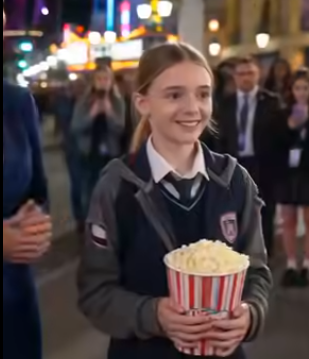
My butter-soaked jacket clung to my sleeve. Pieces of popcorn were caught in my hair and stuck to the front of my uniform. A few minutes earlier, I had felt humiliated beyond words.
Now no one was looking at the popcorn.
They were looking at Vanessa.
She laughed once, too loudly. “So what? Anyone could have dropped that.”
A reporter stepped closer. “Then why was it in your pocket?”
Vanessa’s eyes flashed. “It wasn’t.”
Dozens of students shouted at once.
“We saw it fall!”
“It came from her jacket!”
“Everyone recorded it!”
Phones lifted higher.
Vanessa turned toward her friends, expecting rescue.
They stared back at her with frightened faces.
None of them moved.
Then Principal Morgan stepped forward. “Vanessa, do not say another word until we understand what this is.”
Vanessa’s father appeared from behind the VIP seating area.
Darren Beaumont.
Owner of Beaumont Adventure Park, the largest amusement park in the state. The man whose company sponsored half the school events. Tall, polished, smiling in every billboard.
He wasn’t smiling now.
“Mr. Hale,” he said tightly, “perhaps we should discuss this privately.”
Mr. Hale looked at the reporters, the students, the teachers, then at me standing there covered in butter and popcorn.
“No,” he said. “This became a public matter when your daughter assaulted the announced ambassador in front of the press.”
Assaulted.
The word made Vanessa flinch.
It made me flinch too.
Because until someone said it clearly, part of me had still been trying to shrink what happened. To call it embarrassing. To pretend it was just popcorn. Just a scene. Just another moment where someone rich and admired decided someone like me should lower her head.
But Mr. Hale had named it.
The document in his hand trembled slightly in the evening breeze.
He continued, “These records show an emergency evaluation override request, private scoring notes, and access credentials assigned to a Meridian employee named Caleb Price.”
At the name, one of the teachers gasped.
Vanessa whispered, “Stop.”
Mr. Hale turned another page.
“The override appears to have been requested after Vanessa Beaumont failed the ethics simulation portion of the leadership assessment.”
The crowd erupted.
Failed?
Vanessa Beaumont, the girl whose face was on every student council poster, every charity gala photo, every prom court announcement, had failed the ethics section.
The irony was so sharp it almost hurt.
Mr. Hale raised his voice. “The documents further indicate that a second response file was uploaded under restricted employee access and attached to Vanessa Beaumont’s candidate profile.”
Principal Morgan took the papers. Her eyes moved quickly over the page.
Then her face changed.
“Vanessa,” she said, “did someone complete part of your leadership assessment for you?”
Vanessa’s mouth opened.
No answer came.
Her father stepped forward. “This is absurd. My daughter has earned everything she has.”
A laugh escaped someone in the crowd.
Then another.
Not joyful laughter.
Disbelieving laughter.
The kind people make when a lie has become too obvious to respect.
Vanessa suddenly pointed at me.
“This is her fault!”
My stomach dropped.
“Mine?” I whispered.
Vanessa’s eyes were bright with panic. “She set me up! She was jealous! She probably planted that badge!”
For a second, all the old fear rushed back.
I was used to being doubted.
Used to teachers asking if I had “really” completed an assignment without help because I worked late packing orders for my online shop. Used to classmates joking that my clothes looked secondhand because they were. Used to feeling like every mistake I made would confirm what people already thought.
But before I could defend myself, a voice cut through the crowd.
“Vanessa, shut up.”
Everyone turned.
Her best friend, Brielle, stepped forward.
Vanessa stared at her. “What did you just say?”
Brielle’s face was pale, but her voice was clear.
“I said shut up. You didn’t get set up. You bragged about it.”
The crowd went still again.
Vanessa looked like she had been slapped.
Brielle swallowed hard. “You told us your dad’s assessment guy fixed your score. You said the ambassador title was basically yours because the program needed Beaumont sponsorship.”
Darren Beaumont’s jaw tightened.
Principal Morgan stared at Brielle. “Do you have proof?”
Brielle looked down at her phone.
Then she lifted it.
“Yes,” she whispered. “Messages.”
Vanessa lunged.
A teacher grabbed her arm before she reached Brielle.
“Give me that!” Vanessa screamed.
But the cameras were already recording.
And the badge, the documents, and the messages had all begun telling the same story.
PART 3 — THE GIRL COVERED IN POPCORN WHO DIDN’T RUN
The celebration was suspended.
No one called it canceled, but the joy had cracked wide open.
Security moved Vanessa away from the center of the walkway. Her father followed, speaking urgently into his phone. Brielle was taken aside by Principal Morgan and two administrators. Mr. Hale placed the badge and documents into a clear evidence envelope from the event security team.
And I stood under neon lights with popcorn stuck to my shoes.
My hands had stopped shaking, but my chest still felt tight.
A reporter approached gently. Her name tag read Nina Reyes.
“Are you okay?” she asked.
I almost said yes.
That’s what I always said.
When Dad asked if I was tired after school and work, I said yes because he already looked exhausted enough.
When customers complained online because a used jacket had a tiny flaw I had clearly photographed, I apologized politely because every sale mattered.
When classmates laughed at my repaired bag, I pretended not to hear.
But tonight, with butter dripping from my sleeve and the biggest moment of my life scattered across the pavement, I couldn’t force the lie out.
“No,” I said. “But I’m standing.”
Nina’s expression softened.
“Would you like to step away from the cameras?”
I looked toward the stage where the charity ambassador banner still hung behind the microphone.
Then I saw my father.
He stood near a railing at the edge of the crowd, wearing his only dress shirt. The collar was slightly frayed. His hands were curled at his sides like he wanted to protect me but knew I had to decide for myself.
Dad had raised me alone since Mom died when I was nine.
He fixed air conditioners during the day, delivered groceries at night, and still asked about every math quiz like it was breaking news. When bills piled up after his back injury, I started selling used items online—old books, shoes, jackets, toys, whatever we could find at garage sales and clean enough to give a second life.
Some people called it embarrassing.
Dad called it resourceful.
His eyes met mine now.
He gave the smallest nod.
Not pushing.
Just believing.
I turned back to Nina.
“I want to finish the announcement,” I said.
Mr. Hale heard me. “Sofia, are you sure?”
My name sounded different from him now.
Sofia Ramirez.
Not the girl with the secondhand backpack.
Not the girl who sold used items after school.
The statewide charity ambassador.
“I’m sure,” I said.
A staff member offered me napkins. Another tried to brush popcorn from my jacket. I stopped them.
“Leave it,” I said.
Principal Morgan looked surprised. “Sofia?”
I stepped toward the microphone.
The crowd quieted slowly.
Every phone was still raised. Every reporter leaned in.
I could have pretended I was fine. I could have made a joke. I could have thanked everyone and escaped.
Instead, I looked down at the butter stain across my uniform.
Then I looked at the crowd.
“When I was announced tonight,” I began, “I thought the hardest part would be not crying.”
A few people laughed softly.
“Then popcorn happened.”
More nervous laughter.
I smiled faintly, but it disappeared fast.
“I know some people look at me and see someone who shouldn’t be here. Someone whose family struggles. Someone whose clothes are repaired. Someone who sells used things online because new things cost money we don’t always have.”
My father lowered his head.
“I used to feel ashamed of that,” I said. “But selling used things taught me something. Nothing loses its value just because someone else stops seeing it.”
The walkway went silent.
“I’ve mailed winter coats to families who couldn’t afford store prices. I’ve sold prom shoes to girls who wanted one beautiful night without ruining their parents’ rent. I’ve found second homes for things people were ready to throw away.”
My throat tightened.
“So when this program asked applicants to explain charity, I didn’t write about galas or photo opportunities. I wrote about dignity. Because help should never make people feel small.”
Nina Reyes wiped her eye with the back of her hand.
I continued.
“Tonight, someone tried to make me feel small in front of everyone. But I’m not small. My father isn’t small. Every student who works, saves, repairs, resells, volunteers, and keeps going is not small.”
The applause started near the back.
Then it spread.
Louder.
Stronger.
Students clapped. Teachers clapped. Strangers clapped. Even workers at the popcorn stand clapped.
I looked toward Dad.
He was crying openly now.
And smiling.
That was when the night changed for me.
Not because Vanessa was exposed.
Because I realized humiliation only works if you accept the person throwing it as the judge of your worth.
And Vanessa Beaumont had lost that right.
PART 4 — THE ASSESSMENT GUY
The next morning, my phone was impossible to use.
Messages flooded in.
Some from classmates I barely knew.
Some from local families who had bought items from my online shop.
Some from strangers who had seen the video.
The clip of Vanessa throwing popcorn had gone everywhere. But surprisingly, so had my speech. People kept repeating one line:
Nothing loses its value just because someone else stops seeing it.
Dad printed it and taped it to the refrigerator.
I pretended to be embarrassed.
Secretly, I stared at it every time I passed.
At school, everything felt unreal.
Students stopped talking when I entered classrooms. Some smiled. Some whispered. Some apologized for things they had laughed at months ago. I didn’t know what to do with all that sudden kindness.
Vanessa was not there.
Her locker remained closed. Her prom queen photo had been removed from the student leadership display. A blank space sat where her smile used to be.
By noon, Principal Morgan called me to her office.
Dad was already there, still in his work uniform, cap in his hands. Mr. Hale sat beside a woman in a gray suit who introduced herself as Dana Whitaker, an investigator for the statewide leadership program.
On the desk lay the employee badge.
The name on it was Caleb Price.
Dana folded her hands. “Sofia, we’re very sorry for what happened last night. We need to ask you a few questions.”
I nodded.
She explained that Meridian Academic Assessment had supervised leadership evaluations for multiple prestigious student programs. The badge Vanessa dropped belonged to Caleb Price, a Meridian employee with access to private test materials and scoring systems.
“Was Caleb at the event?” Dad asked.
Dana’s expression tightened. “He was listed as a contractor for event logistics, but he disappeared shortly after the badge was recovered.”
Dad swore under his breath.
Principal Morgan said, “We have contacted authorities.”
Dana looked at me. “Sofia, did anyone ever contact you about changing your assessment responses, paying for coaching, or withdrawing from the program?”
“No.”
“Did Vanessa ever threaten you before?”
I hesitated.
That hesitation answered too much.
Dad turned toward me. “Sof?”
I looked down.
“She made comments,” I said. “About my clothes. My shop. Dad’s truck. Stuff like that.”
Principal Morgan closed her eyes briefly.
Dana asked, “Did you report it?”
“No.”
“Why not?”
I gave a tired little smile. “Because people like Vanessa don’t get in trouble. People like me get called dramatic.”
No one spoke for a moment.
Then Dad said, very quietly, “Not anymore.”
Dana showed us printed copies of Brielle’s messages. In them, Vanessa wrote that “Caleb handled the ethics disaster” and that “the ambassador title was locked as long as Beaumont sponsorship stayed happy.”
Another message made my stomach turn.
Vanessa had written:
Sofia’s application is cute but poor-girl charity stories are getting old. If she places above me, I’ll make sure everyone remembers she sells trash online.
Dad’s face darkened.
I touched his arm before he could speak.
“I’m okay,” I whispered.
He looked at me. “You shouldn’t have had to be.”
The investigation expanded quickly.
By evening, Meridian suspended Caleb Price.
By the next day, reporters discovered he had previously worked as a private admissions consultant for families connected to Beaumont Adventure Park.
By Friday, Vanessa’s father released a statement denying knowledge of wrongdoing.
It sounded professional.
Careful.
Empty.
Then Brielle asked to meet me.
I almost refused.
Brielle had laughed at Vanessa’s jokes for years. She had never thrown popcorn, but she had stood close enough to the person who did. Sometimes that hurt almost as much.
We met in the library with Mrs. Patel, the guidance counselor, present.
Brielle looked exhausted.
“I’m sorry,” she said immediately.
I said nothing.
She twisted her fingers together. “I know that’s not enough.”
“No,” I said. “It isn’t.”
She nodded, eyes filling.
“I stayed friends with her because being near Vanessa felt safer than being against her. She had secrets about everyone. Screenshots. Rumors. Things people told her when they thought she cared.”
My stomach tightened. “Did she have something about me?”
Brielle looked away.
“What?” I demanded.
“She found your shop.”
I froze.
“She bought something under a fake account,” Brielle whispered. “A jacket. Then she complained it was damaged and threatened to report you for fraud unless you—”
“Unless I what?”
Brielle’s tears spilled over.
“Unless you withdrew from the ambassador program.”
My mind flashed back.
Three weeks earlier.
A customer named StarlingRose had bought a denim jacket. The listing clearly showed a repaired pocket. After delivery, the buyer sent furious messages claiming I had scammed her. She threatened to get my account shut down. I had cried for an hour and refunded the money even though it meant our electric bill was late.
That had been Vanessa.
Dad’s back medicine had been delayed because I refunded Vanessa Beaumont.
My hands went cold.
Mrs. Patel looked horrified. “Brielle, do you have proof?”
Brielle pulled out her phone.
“Yes,” she said. “And there’s more.”
PART 5 — THE FAKE CUSTOMER
The fake account changed everything for me.
Not because it was the worst thing Vanessa had done.
It wasn’t.
But it was the thing that reached into my home.
Into our bills.
Into Dad’s medication.
Into the little system I had built to keep us floating.
I had always known Vanessa was cruel at school. I hadn’t known she was willing to follow me into the one place where I felt useful.
My online shop was small, but it mattered. Every cleaned pair of sneakers, every repaired jacket, every bundle of old children’s books represented time, patience, and hope.
Vanessa had called it trash.
Then she had tried to destroy it.
Brielle gave the messages to Mrs. Patel, who gave them to Principal Morgan, who forwarded them to Dana Whitaker. Within twenty-four hours, the leadership program added harassment, coercion, and financial interference to the complaint file.
That night, Dad sat at the kitchen table reading the printed messages.
His face looked older under the yellow light.
“I should have known,” he said.
“No, Dad.”
“You were upset that week. You said it was a difficult customer.”
“It was my business. I thought I should handle it.”
He put the pages down.
“You’re seventeen, Sofia. You shouldn’t have to be stronger than adults.”
I didn’t know how to tell him that sometimes I felt like being strong was the only thing I could afford.
The next day, something unexpected happened.
Orders poured into my shop.
Not a few.
Hundreds.
People bought jackets, books, shoes, handmade keychains I had sewn from fabric scraps, even a cracked ceramic mug I had listed for two dollars because the flower painted on it was pretty.
Messages came with the orders.
For my daughter’s first job interview.
For a student who needs a winter coat.
For someone who believes repaired things are beautiful.
One woman bought every remaining scarf and wrote, Please donate these through your charity ambassador program.
I sat on my bedroom floor surrounded by inventory bins and cried.
Dad leaned in the doorway. “Good crying or bad crying?”
“Yes,” I said.
He laughed, then cried too.
But the biggest surprise came two days later, when a package arrived with no return address.
Inside was the denim jacket Vanessa had bought under the fake account.
The repaired pocket was still perfect.
Folded with it was a note.
I lied about the damage. I lied about a lot. I don’t expect you to forgive me. — Vanessa
I stared at the note for a long time.
Dad read it over my shoulder.
“What do you want to do with it?” he asked.
I touched the repaired pocket.
“Sell it again,” I said.
This time, I listed it as:
The Jacket That Was Never Broken.
It sold in four minutes.
The buyer paid five hundred dollars and left a message:
Please use this for your father’s bills. Also, keep the story attached. Some repairs deserve witnesses.
I printed that too and put it beside the refrigerator quote.
Then came the formal hearing.
It was held in a conference room at the district office. Vanessa arrived with her father, a lawyer, and no crown of friends. Her hair was pulled back. Her face was pale. She didn’t look at me.
Dana Whitaker presented the evidence.
The badge.
The documents.
The messages.
The fake customer account.
The altered assessment file.
The emergency override.
Caleb Price had not yet been found, but his access logs showed someone using his credentials from a Beaumont Adventure Park office the night Vanessa’s score changed.
Darren Beaumont’s lawyer argued that Vanessa was under pressure. That Caleb had exploited the family. That young people made mistakes.
Dana listened without expression.
Then she played a voice memo Brielle had provided.
Vanessa’s voice filled the room.
“If the ethics score matters, Caleb will fix it. My dad says the program needs Beaumont more than Beaumont needs them.”
Darren Beaumont stood abruptly.
“That recording is illegal.”
Dana looked at him. “It was recorded by a participant in the conversation in a state where one-party consent applies.”
His face went red.
Vanessa finally looked at me.
Her eyes were wet.
I expected hatred.
Instead, I saw something worse.
Fear.
Not fear of being caught.
Fear of having no one left to blame.
The decision came an hour later.
Vanessa was stripped of her student leadership titles, removed from prom court honors, disqualified permanently from the charity ambassador program, and referred for disciplinary action.
Meridian Academic Assessment lost its contract pending investigation.
Caleb Price became the subject of a criminal inquiry.
And the statewide program confirmed my title publicly.
But then Dana turned to me.
“Sofia,” she said, “after reviewing your application, your service record, and recent events, the board has approved an additional initiative.”
My heart pounded.
“The Reclaimed Value Fund will support student-led projects that reduce waste, expand access, and restore dignity through reuse. We would like you to serve as the first youth adviser.”
I couldn’t breathe.
Dad grabbed my hand.
For years, I had sold used things to survive.
Now someone was calling it leadership.
PART 6 — THE PARK BEHIND THE BILLBOARDS
Two weeks after the hearing, Beaumont Adventure Park announced a charity day.
The timing was shameless.
Their statement said the park wanted to “reaffirm its commitment to youth service and community joy.” Reporters called it damage control. Students called it desperate.
I tried not to care.
Then Dana called.
“Sofia, you may want to see this.”
She sent me a leaked internal memo from Beaumont Adventure Park.
My stomach tightened as I read.
The memo discussed using the charity day to “restore positive coverage” after the Vanessa scandal. It suggested inviting low-income families for a controlled photo opportunity, then limiting actual free admissions to “manageable numbers.”
Manageable numbers.
Like kindness had a guest limit.
At the bottom was a list of community groups to invite.
Our neighborhood center was listed under:
High visual impact. Limited cost exposure.
I felt sick.
Dad read it and slammed his hand on the table.
“They don’t get to use people like props.”
For the first time, I saw not just Vanessa’s cruelty, but the machinery that had taught it to her.
A few days later, I received a message from an unknown number.
Meet me outside the old carousel entrance. I know where Caleb’s files are. — V
Dad said no.
Dana said absolutely not without supervision.
So we went with Dana, Principal Morgan, and a security officer.
The old carousel entrance sat behind Beaumont Adventure Park, away from the bright billboards and cheerful music. At sunset, the service road looked tired and gray.
Vanessa was already there.
She wore jeans, a plain hoodie, and sneakers. No makeup. No jewelry. No prom queen shine.
She looked like a girl who had run out of costumes.
Dana stepped forward. “Vanessa, where are the files?”
Vanessa looked at me first.
“I didn’t know about the charity day memo until yesterday,” she said.
I crossed my arms. “But you knew about Caleb.”
“Yes.”
The word was quiet.
“I knew he helped. I knew my dad arranged things. I told myself everyone did it. I told myself it didn’t matter because I deserved to win anyway.”
Her voice cracked.
“Then I saw the jacket listing.”
I frowned.
“What?”
“The Jacket That Was Never Broken.” She swallowed. “I bought it to hurt you. You turned it into help for your father. I hated you for that. Then I realized I hated you because you could make value out of what I tried to ruin.”
No one spoke.
Vanessa wiped her face quickly, angry at her own tears.
“Caleb kept backup files in the park education office. My dad told him to erase everything after the hearing. I copied what I could.”
She handed Dana a small drive.
Dana examined it. “Why give this to us?”
Vanessa looked toward the glowing rides beyond the fence.
“Because my father told me I was a liability,” she said. “Not his daughter. A liability.”
The word hit harder than I expected.
She had spent her life believing she was priceless.
Now the empire that made her cruel had priced her as damage.
Dana took the drive.
The files revealed more than altered assessments.
Beaumont Adventure Park had quietly influenced student charity awards for years, steering recognition toward children of sponsors while using community programs for publicity. Caleb Price had provided private evaluation materials to several wealthy families. Meridian staff had flagged concerns and been ignored.
The scandal became statewide news.
Darren Beaumont resigned from the charity ambassador board. Meridian’s director stepped down. The state education department opened an inquiry into private assessment companies used for student awards.
Vanessa did not return to school for a month.
When she did, she was no longer prom queen.
Not officially.
Not socially.
Her friends had scattered. Some claimed they had always disliked her. Brielle transferred to another school halfway through the semester.
I didn’t celebrate.
I thought I would.
But watching someone fall is not the same as healing from what they did.
The Reclaimed Value Fund launched in spring. Our first project collected formalwear, shoes, and accessories for students who couldn’t afford prom expenses. We called it Second Chance Closet.
The name was Dad’s idea.
Students donated dresses, suits, ties, purses, and jewelry. Volunteers cleaned, repaired, and displayed everything in the gym like a boutique. No one had to prove need. No one had to explain family bills. They just chose something beautiful.
I was hemming a silver dress one afternoon when Vanessa appeared in the doorway carrying a garment bag.
The room went quiet.
She looked at me.
“I brought my prom dress,” she said.
Everyone stared.
The dress inside was pale gold, custom-made, probably worth more than our rent.
A girl near the racks whispered, “Is she serious?”
Vanessa’s cheeks flushed. “It should go to someone who actually wants prom to be happy.”
I looked at the dress.
Then at her.
“You can hang it there,” I said.
She nodded and did.
Later, I found her sitting alone on the bleachers.
“Why are you still here?” I asked.
She looked at the students choosing clothes below.
“Because I don’t know how to become better somewhere nobody remembers what I was.”
That answer stayed with me.
PART 7 — PROM NIGHT WITHOUT A QUEEN
Prom night arrived warm and bright, with sunset spilling gold across the school courtyard.
I had never planned to go.
Tickets cost money. Dresses cost money. Even pretending not to care cost energy.
But Second Chance Closet changed that.
A senior named Amara chose Vanessa’s gold dress. She was quiet, brilliant, and had spent most of high school caring for younger siblings after school. When she stepped out of the fitting area wearing it, everyone clapped.
She looked stunned.
“Is it too much?” she whispered.
I shook my head. “No. It finally looks right.”
Vanessa was there helping sort shoes.
She heard me.
Her eyes filled, but she looked away.
I wore a blue dress someone donated with a broken zipper. Dad fixed the zipper because he said air conditioners and formalwear were basically the same if you believed hard enough.
He took photos of me in the living room until Mateo, my cousin, threatened to charge him storage fees for all the pictures.
“You look like your mother,” Dad said.
That almost ruined my makeup.
At prom, everything glittered.
String lights. Music. Flowers. Students laughing in outfits that had lived other lives before becoming theirs.
No one announced Vanessa as queen.
The title had been retired that year.
Instead, the school created a new tradition: the Community Star recognition, honoring students who served others quietly.
The first recipient was Amara.
When she walked onto the stage in the gold dress, Vanessa stood near the back of the room and applauded with everyone else.
No spotlight on her.
No crown.
No cameras waiting for her reaction.
Just her hands clapping for someone else.
That was when I knew something had changed.
Not fixed.
Changed.
After the dance, I stepped outside for air.
Vanessa was standing near the fountain.
“I’m not here to ruin your night,” she said quickly.
“I didn’t think you were.”
She gave a small, sad laugh. “That’s progress.”
We stood in silence while music pulsed behind the doors.
Then she said, “I’m sorry for the popcorn. For the fake account. For the assessment. For all the things I said before that you probably heard and pretended not to.”
“I heard them.”
“I know.”
The fountain water moved softly behind us.
“I thought winning meant no one could leave me,” Vanessa said. “My dad only noticed me when I was impressive. My mom planned my outfits like brand campaigns. Every trophy felt like proof I was worth keeping.”
Her voice cracked.
“That doesn’t excuse anything.”
“No,” I said. “It explains why the crown was heavier than it looked.”
She looked at me in surprise.
I wasn’t forgiving her.
Not exactly.
But I was tired of pretending villains came from nowhere.
Vanessa wiped her cheek.
“What happens now?” she asked.
“For you?”
She nodded.
“You keep showing up when no one is clapping,” I said.
She laughed softly through tears. “That sounds terrible.”
“It is, at first.”
“And after?”
I thought of Dad fixing my zipper. Of Amara in the gold dress. Of the jacket that was never broken. Of people buying old things and giving them new stories.
“After,” I said, “it starts to feel real.”
The summer after graduation, the investigation ended with public consequences.
Beaumont Adventure Park paid penalties and created an independent community access program. Meridian Academic Assessment shut down its student leadership division. Caleb Price pleaded guilty to unauthorized access and fraud-related charges.
Darren Beaumont stepped away from company leadership.
Vanessa’s family sold one of their mansions.
The headlines called it a downfall.
But the part that mattered to me happened in a warehouse downtown.
The Reclaimed Value Fund opened its first permanent location: a bright, welcoming space where students could get clothing, school supplies, refurbished laptops, interview outfits, and help starting small resale or repair projects.
We called it The Worth House.
On opening day, reporters came again.
This time, I wasn’t covered in popcorn.
Dad stood beside me wearing a new shirt I bought him from my shop profits. He kept tugging at the collar and whispering, “Too fancy.”
I whispered back, “You look expensive.”
He whispered, “Return me.”
I nearly laughed during the ribbon cutting.
Then I saw Vanessa across the room carrying boxes of donated shoes.
She wasn’t part of the ceremony.
She hadn’t asked to be.
But she was there.
Working.
PART 8 — THE END: THE BADGE THAT OPENED THE WRONG DOOR
Two years later, Universal CityWalk glittered again under a summer sky.
The same lights. The same music. The same rush of students, families, performers, reporters, and tourists moving beneath giant signs and glowing screens.
But this time, I returned as a speaker.
Not as a surprised student ambassador.
Not as a butter-stained girl trying not to cry.
As the founder of The Worth House.
The statewide charity ambassador program had been rebuilt from the ground up. No private scoring company. No sponsor influence. No secret access. Students were selected through transparent review, community references, and verified service.
This year’s celebration honored young people who created practical projects in their neighborhoods.
A student who repaired bicycles for kids whose parents couldn’t afford transportation.
A girl who organized free laundry days for families in shelters.
A boy who started a tool library from his grandfather’s garage.
A team that turned old amusement park uniforms into backpacks.
That last project made everyone glance at Vanessa.
She stood near the back, wearing a black staff shirt with Worth House Volunteer printed on the sleeve.
Her employee badge hung from a blue lanyard.
A real one.
With her own name.
No stolen access. No hidden documents. No false score behind it.
Just permission earned by showing up for two years.
She caught me looking and gave a nervous half-smile.
I smiled back.
Before the ceremony, I walked past the popcorn stand.
The employee behind the counter recognized me immediately and held up both hands.
“I swear I’m keeping all tubs pointed away from you.”
I laughed.
Dad laughed harder than necessary.
He had become impossible since my story went public. He told everyone I built a career after being attacked by a snack. I told everyone he cried during appliance commercials. We were both right.
The host stepped onto the stage.
“Tonight,” he said, “we celebrate students who prove that value is not measured by price, polish, or privilege, but by what we repair, share, and build together.”
The crowd applauded.
Then he called my name.
As I walked to the microphone, I saw everything at once.
The spot where Vanessa had thrown the popcorn.
The place where the badge had fallen.
The path where reporters had gathered.
The stage where I had decided not to hide my stains.
For a second, the past stood beside me.
Then it stepped back.
I began.
“Two years ago, I stood here in a uniform covered with popcorn and butter, wondering if the whole state was laughing at me.”
A few people laughed gently.
“I thought that night was the worst thing that could happen during the biggest moment of my life. But sometimes, when someone tries to throw shame at you, they accidentally knock loose the truth.”
The audience quieted.
“An employee badge fell from the wrong pocket. It exposed cheating, sponsor influence, and a system that had forgotten the difference between charity and image.”
I looked toward the students in the front row.
“But the badge did something else too. It forced us to ask what leadership really looks like. Not perfect scores. Not famous parents. Not crowns. Leadership looks like repairing a zipper so your daughter can go to prom. It looks like donating a dress and not asking who wears it. It looks like giving old things new homes instead of deciding they are worthless.”
Dad wiped his eyes.
I pretended not to notice.
“The Worth House began with one belief: people are not disposable just because someone powerful overlooks them. Neither are dreams. Neither are skills. Neither are second chances.”
My eyes found Vanessa again.
She stood very still.
“So tonight, when we honor these students, we are not rewarding charity as performance. We are honoring work. Real work. The kind done with tired hands, honest records, and no guarantee of applause.”
The applause came slowly, warmly, deeply.
After my speech, the new ambassadors received their certificates. No one looked like Vanessa used to look—certain the world owed them admiration. They looked nervous, proud, overwhelmed, human.
Then the host surprised me.
“We also want to recognize a volunteer who has completed over six hundred service hours at The Worth House repairing donations, organizing student access days, and mentoring new volunteers.”
My heart jumped.
Vanessa’s eyes widened.
The host smiled. “Vanessa Beaumont, please come forward.”
For a moment, she didn’t move.
People turned toward her.
I could see the panic rise in her face. The old instinct to flee from any spotlight she couldn’t control.
Then I nodded once.
She walked slowly to the stage.
No crown.
No designer gown.
Just a volunteer shirt and a real badge.
The host handed her a small certificate. “For sustained service and accountability.”
The applause was not thunderous.
Some people clapped hard. Some politely. Some not at all.
That was fair.
Redemption did not erase memory.
Vanessa held the certificate like it might break.
When she reached the microphone, she looked at me.
I didn’t know she planned to speak.
Maybe she didn’t either.
“I used to think attention was love,” she said softly.
The crowd settled.
“I thought winning meant I mattered. And when Sofia was chosen two years ago, I felt like something had been stolen from me. So I tried to humiliate her. Then the badge fell. And everyone saw what I had done.”
She swallowed.
“But the worst part was realizing the badge didn’t create who I was. It only revealed who I had allowed myself to become.”
Her hands shook around the certificate.
“Sofia did not owe me a place to change. The Worth House did not owe me trust. Every box I carried, every zipper I repaired, every hour no one praised me taught me something I should have learned sooner.”
She looked out at the students.
“Value is not what people clap for. It is what remains when they stop.”
My throat tightened.
Vanessa stepped back quickly, cheeks wet.
This time, I was the first to clap.
Others followed.
Not everyone.
Enough.
After the ceremony, a freshman girl approached me with a torn backpack.
“My strap broke,” she said. “My mom says you know how to fix things.”
I smiled. “Usually.”
Vanessa stepped beside me. “I can do that repair.”
The girl looked unsure.
Vanessa crouched slightly. “Only if you want. Sofia taught me the reinforced stitch.”
The girl handed her the backpack.
Vanessa took it carefully, as if being trusted with something sacred.
Dad leaned toward me. “Look at that.”
“What?”
He nodded toward Vanessa, kneeling near a bench, threading a needle through the torn strap.
“The prom queen became the repair girl.”
I smiled.
“No,” I said. “She became Vanessa.”
He thought about that.
Then nodded.
Later that night, after the crowds thinned and the lights reflected on the polished walkways, Vanessa found me near the place where the badge had fallen.
“I still hate popcorn,” she said.
I laughed. “Understandable.”
She looked down at her volunteer badge.
“Sometimes I wonder who I would’ve become if it hadn’t fallen.”
I followed her gaze.
“That badge opened the wrong door,” I said. “But maybe you walked through the right one after.”
She blinked back tears.
“I’m still sorry, Sofia.”
“I know.”
“Do you forgive me?”
The question was quiet.
Careful.
I looked around at the glowing signs, the laughing students, the new ambassadors taking photos with their families. I thought about the fake account, the popcorn, the humiliation, the systems that protected her, the years she spent repairing what she could without asking me to pretend nothing happened.
“I don’t forgive what you did,” I said.
She nodded, accepting it.
“But I believe what you’re doing now.”
Her face crumpled.
That was enough.
Not a perfect ending.
A real one.
The best ones usually are.
The Worth House grew after that night. We opened two more locations. Dad became our unofficial repair supervisor, though he insisted his title should be “Director of Zippers and Emotional Support.” Amara became our formalwear coordinator. Brielle eventually wrote me a letter from college, apologizing again. I kept it, unanswered but not thrown away.
And Vanessa kept volunteering.
Some days people recognized her and whispered.
Some days they thanked her.
Some days no one noticed her at all.
Those were the days she seemed proudest.
As for me, I still sold used things online. Not because we needed every dollar anymore, but because I loved the work. I loved finding what others missed. I loved cleaning, mending, photographing, listing, packing, and sending something repaired into a new life.
The denim jacket Vanessa once lied about hung framed near the entrance of The Worth House.
Below it was a small plaque:
THE JACKET THAT WAS NEVER BROKEN.
Beside it, in a clear case, was a copy of my first ambassador badge.
Mine.
Earned.
Not perfect.
Not polished.
Real.
The employee badge that destroyed the prom queen did not just expose Vanessa Beaumont’s cheating.
It exposed a world where power had been passing itself off as merit, where charity had been staged, and where students like me were expected to feel grateful for being overlooked.
But the ending no one predicted was not Vanessa ruined forever or me standing above her with a crown of my own.
It was better.
It was a building full of repaired dresses, working laptops, polished shoes, stitched backpacks, and students walking in without shame.
It was my father teaching volunteers how to fix zippers.
It was Vanessa Beaumont wearing an honest badge.
It was me learning that being thrown into humiliation does not make you worthless.
Sometimes it reveals what was valuable all along.
And sometimes, when the wrong thing falls out of the wrong pocket, it opens a door wide enough for everyone who had been left outside to finally walk in.
