PART 2 — THE NAME THAT SILENCED THE ENTIRE STREET
The orange bottle rolled across the pavement and stopped beside the Labrador’s paw.
The old veteran stared at it.
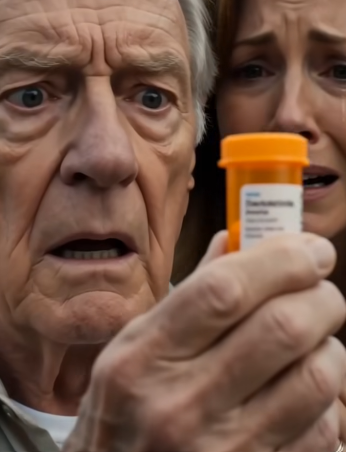
His name was printed clearly on the label:
WALTER HALE
For several seconds, Walter did not move. His face remained distant, as though he were standing somewhere far away from the angry neighbors, the torn garbage bags, and the scattered containers.
Then the Labrador nudged the bottle toward him.
Walter’s eyes filled with sudden recognition.
He lowered one trembling hand and touched the dog’s head.
“Major,” he whispered.
The woman beside him collapsed to her knees.
She was Walter’s daughter, Claire. She had recently moved into his house after his memory problems became more serious. Most of the neighborhood had seen her carrying groceries or guiding her father gently back inside when he became confused.
Now she stared at our dog as though the ground had vanished beneath her.
“What did you call him?” she asked.
Walter did not answer.
The Labrador sniffed through the scattered trash, found another prescription bottle, and carried it carefully toward Walter.
He placed it beside the first one.
Then another.
And another.
Not chewing them.
Not playing with them.
Retrieving them.
Claire covered her mouth.
“Major,” she said softly.
Our Labrador turned toward her immediately.
My younger sister grabbed my arm.
“Why did Cooper look at her like that?”
I did not have an answer.
We had adopted Cooper from a shelter three months earlier. He had arrived with no collar, no history, and an old microchip containing a disconnected telephone number. He was gentle, patient, and strangely serious for a Labrador.
He rarely barked.
He never chased bicycles.
But every morning, he slipped beneath our garden gate and began tearing through the neighborhood trash.
We tried new locks.
We repaired the fence.
We apologized to neighbors almost daily.
Nothing stopped him.
Everyone believed Cooper was searching for food.
Now he sat beside Walter’s medication bottles with his tail resting quietly against the pavement.
Claire slowly reached toward his left ear.
Beneath the fur was a small crescent-shaped patch where the hair had never grown back.
The moment she saw it, tears spilled down her cheeks.
“My son found him when he was a puppy,” she said. “He had the same scar.”
She looked toward us.
“This dog’s name was not Cooper.”
Walter lowered himself carefully onto the front step.
The Labrador walked toward him and rested his head against the veteran’s knee as though he had done it a thousand times before.
Claire’s voice broke.
“His name was Major. He belonged to my father.”
PART 3 — THE DOG HAD BEEN TRYING TO COME HOME FOR SIX YEARS
Nobody spoke.
A few minutes earlier, people had been shouting.
Some had demanded that the dog be taken away immediately. Others had thrown small stones toward him when he ripped open the trash bag.
Now those same neighbors stood frozen among the scattered bottles and food wrappers.
A small white van pulled up near the curb.
Someone had already called animal control.
A uniformed welfare officer stepped out and looked at the torn bags, the crowd, and the Labrador resting beside Walter.
“I received a report about an aggressive stray,” she said cautiously.
“He is not aggressive,” I said quickly.
The officer glanced toward the dog.
Major lifted his head but remained seated.
Claire wiped her eyes.
“Could you scan his microchip?”
The officer crouched beside him and moved a handheld scanner carefully across his shoulders.
The device beeped.
She checked the screen.
Then she looked at Walter’s house.
“Registered name: Major Hale,” she read aloud. “Registered address: 18 Willow Lane.”
Every face turned toward the number beside Walter’s front door.
18 Willow Lane.
Across the street from our house.
The officer continued reading.
“The contact number is no longer active. The registration has not been updated in six years.”
Claire sat beside her father.
“Our old telephone number,” she said. “We changed it after my mother passed away.”
Walter looked at Major and stroked the dog’s head with both hands.
For one brief moment, the confusion faded from his expression.
“You took your time,” he told the Labrador.
Major’s tail thumped gently against the pavement.
Claire closed her eyes.
“When Dad was first diagnosed with Alzheimer’s, my son Evan brought home a Labrador puppy,” she explained. “He wanted to train Major to help Dad find important things.”
She pointed toward the prescription bottles.
“Medication. Keys. His wallet. His identification card. Anything he misplaced regularly.”
My mother stepped closer.
“What happened to the dog?”
“A storm hit the neighborhood six years ago,” Claire replied. “A tree damaged part of the fence. Major disappeared during the night.”
Walter lowered his head.
“We searched everywhere,” Claire continued. “My son printed hundreds of posters. We visited shelters in three counties. We checked every report we could find.”
Her voice grew quieter.
“We never found him.”
The welfare officer studied the microchip records.
“He was probably found much farther away later,” she said. “The shelter that transferred him to your county attempted to contact the registered number. When nobody answered, he eventually became eligible for adoption.”
I looked at Major.
Three months earlier, I had seen him sitting silently behind the shelter gate while the other dogs barked excitedly.
He had not jumped against the fence.
He had not begged for attention.
He had simply watched us with those serious brown eyes.
My sister had knelt in front of him.
Major walked forward and placed one paw against the wire.
That was the moment we chose him.
Or perhaps it was the moment he chose us.
“I do not understand,” one neighbor said. “How did he find his way back here after six years?”
Claire looked toward our house.
“You adopted him from the county shelter?”
My mother nodded.
“We moved here four months ago.”
The answer slowly became clear.
Major had not crossed cities or followed an impossible trail across hundreds of miles.
By pure chance, the family who adopted him had moved into the house directly opposite the home he had lost years earlier.
The first morning he escaped through our gate, he must have recognized Walter’s scent.
The second morning, he found the first discarded bottle.
After that, he never stopped searching.
Major had spent six years trying to return home.
When he finally found Walter again, the old veteran no longer remembered how much he needed the dog.
But Major remembered enough for both of them.
PART 4 — THE NEIGHBORS OPENED THE OTHER BAGS AND DISCOVERED WHAT THEY HAD ALMOST DESTROYED
Claire began checking the remaining trash bags.
The crowd watched quietly.
Walter had started throwing away important belongings without realizing it. Sometimes he placed ordinary rubbish in drawers. Sometimes he put unopened mail inside the refrigerator. Sometimes he carried objects outside and could not remember why.
Claire had been trying to keep him safe, but nobody could watch another person every minute of every day.
Major had noticed what everyone else missed.
One bag contained Walter’s wallet.
Another held a small wooden box filled with military ribbons.
A third contained an old silver watch, carefully wrapped in a handkerchief.
Claire picked it up and began to cry again.
“My mother gave him this on their wedding anniversary,” she said.
Near the bottom of another torn bag, my sister found a photograph inside a cracked frame.
A much younger Walter stood beside his wife on the front steps of the same house. Claire stood between them as a little girl, smiling with several missing teeth.
The photograph had nearly disappeared into a garbage truck.
Major had saved it.
The neighbors started moving.
Mrs. Patel from the corner house brought clean boxes from her garage.
Mr. Rivera collected the prescription bottles carefully and handed them to Claire.
Two teenagers who had laughed when Major tore open the trash began separating Walter’s belongings from the rubbish.
Mr. Grant stood near the curb with his hands inside his coat pockets.
He had been the angriest person on the street.
Every morning, he complained about the mess.
That afternoon, one of the small stones had come from his direction.
He walked slowly toward Major.
The Labrador watched him approach.
Mr. Grant lowered his head.
“I am sorry,” he said.
Major stared at him for a moment.
Then he leaned forward and sniffed the man’s hand.
His tail moved once.
Mr. Grant’s eyes filled with tears.
“Dogs forgive faster than people deserve,” Claire whispered.
We spent the rest of the afternoon cleaning the street.
Nobody complained.
Nobody rushed home.
As the sun lowered behind the rooftops, Major continued examining every bag that carried Walter’s scent.
He found an envelope containing family photographs.
He found a house key.
He found a folded birthday card Claire had written weeks earlier.
Then he stopped beside a black trash bag near the side gate.
The dog became completely still.
He sniffed the plastic.
Once.
Twice.
Then he began pulling.
The bag ripped open.
Newspapers spilled onto the pavement.
Beneath them was a battered red notebook held shut by an old elastic band.
Walter looked at it and frowned.
Claire picked it up carefully.
“What is this, Dad?”
Walter stared at the notebook.
For several seconds, he seemed lost.
Then his lips moved.
“Evan,” he whispered.
Claire gripped the notebook against her chest.
Her face turned pale.
“My son,” she said. “Evan trained Major.”
She looked toward the house.
“He needs to see this.”
PART 5 — THE BOY WHO TRAINED THE LABRADOR HAD NEVER FORGIVEN THE NIGHT HE DISAPPEARED
Evan arrived the following morning.
He was 24 years old now, tall and tired-looking, with a travel bag hanging from one shoulder. He worked several hours away and had driven through the night after Claire called him.
Our entire family watched from our front window as he stepped onto Walter’s driveway.
Major stood beside the veteran’s porch chair.
The dog saw Evan.
His ears lifted.
Evan stopped breathing.
For a moment, neither of them moved.
Then Evan placed two fingers against his lips and whistled three soft notes.
Major ran.
He crossed the driveway so quickly that his paws slipped against the pavement. Evan dropped his bag and fell to his knees.
The Labrador crashed into him.
Evan wrapped both arms around the dog’s neck.
Major licked his face, barked twice, and pressed his entire body against him as though he were trying to recover six lost years in a single embrace.
Claire turned away, crying.
Walter watched from the porch.
A smile appeared slowly on his face.
“There you are,” he said.
Evan looked up.
“Grandpa?”
Walter nodded toward Major.
“You found your dog.”
Evan laughed through his tears.
“No, Grandpa. I think he found all of us.”
Later, we gathered inside Walter’s living room.
The house was filled with photographs, old books, and carefully labeled cabinets. Claire had already contacted Walter’s healthcare team so the recovered medications could be handled safely.
Major lay on the rug between Walter’s chair and my sister’s feet.
He seemed unwilling to choose one family over the other.
Evan opened the red notebook.
The first pages were filled with training notes written in his teenage handwriting.
MAJOR’S IMPORTANT JOBS
Find Grandpa’s keys.
Find the orange bottles.
Bring the wallet home.
Stay beside Grandpa if he gets confused outside.
There were drawings of paw prints beside each task.
Evan ran one hand across the page.
“I trained him with a game,” he explained. “Whenever Grandpa misplaced something, I taught Major to locate it and carry it to the living room rug.”
He turned another page.
“I used orange stickers for the medication bottles. Major learned the routine faster than I expected.”
My sister looked toward the dog.
“So when he saw the bottles inside the trash bags, he knew they were important?”
Evan nodded.
“But that does not explain everything.”
He flipped toward the middle of the notebook.
The handwriting changed.
The letters were larger and shakier.
Walter had written these pages himself.
Major checks the bins.
Major finds what I forget.
Do not stop him when he is working.
Evan swallowed.
“Grandpa must have continued practicing with him before he disappeared.”
Walter stared out the window.
“The dog knew,” he said softly.
Claire sat beside him.
“Knew what, Dad?”
Walter tapped one finger against his chest.
“When my mind dropped something.”
The room became quiet.
Major raised his head and rested it against Walter’s knee.
I looked at the dog we had called Cooper for three months.
Part of me was happy.
Another part of me felt as though I were already losing him.
Major belonged to Walter.
He belonged to Evan.
He had belonged to them long before he walked into our lives.
My sister seemed to feel the same thing. She sat on the rug and stroked the dog’s back without speaking.
Claire noticed.
She moved closer to us.
“You gave him a home when he needed one,” she said. “We will never forget that.”
Her words were kind.
But they did not make the question disappear.
Where did Major belong now?
Before anyone could answer, the Labrador stood abruptly.
His ears turned toward the window.
A garbage truck rumbled somewhere near the end of the street.
Major barked once.
Then he ran toward the front door.
PART 6 — THE LAST TRASH BAG WAS ALREADY INSIDE THE TRUCK
By the time we reached the sidewalk, the garbage truck had turned the corner.
Major sprinted after it.
“Major!” Evan shouted.
The Labrador did not slow down.
We ran behind him.
Neighbors stepped outside as the dog raced past their houses. Some recognized what was happening immediately and joined us.
At the end of the street, the garbage truck stopped beside a row of bins.
Major reached the vehicle and barked furiously.
The driver leaned out of the cab.
“What is wrong?”
“Please stop!” Claire shouted. “A bag from my father’s house may contain something important.”
The driver shut down the machinery immediately.
Major circled the back of the truck, whining.
Several bags had already been collected from Walter’s curb earlier that morning before anyone realized how many belongings had been discarded.
The driver contacted his supervisor and followed safety procedures before carefully retrieving the most recent bags.
Major sniffed each one.
He ignored the first.
Then the second.
At the third bag, he scratched the pavement.
“That one,” Evan said.
The bag was placed on the ground.
Claire opened it slowly.
Inside were old magazines.
A broken umbrella.
Two empty cereal boxes.
A faded sweater.
Then Major pushed his nose deeper into the bag and pulled out a small metal tin.
The container was dented and covered in scratches.
Walter’s initials were engraved on the lid.
Claire carried it toward her father, who had arrived slowly with my mother beside him.
“Dad,” she said. “Do you recognize this?”
Walter touched the tin.
His expression shifted.
He looked older suddenly.
And younger.
Both at once.
“Field box,” he whispered.
Inside were military photographs, identification tags, letters, and a small compass.
Near the bottom rested a yellowed envelope.
The handwriting on the front belonged to Walter.
FOR EVAN — AND FOR WHOEVER FINDS MAJOR
Evan stared at his grandfather.
“When did you write this?”
Walter shook his head.
“I do not know.”
Evan opened the envelope carefully.
The letter was several pages long.
His voice trembled as he read aloud.
Evan,
Some days I remember everything. Some days I stand in my own kitchen and wonder who moved the walls. I am writing while today is still a good day.
You worry that you will not know how to help me when my memory becomes unreliable. But you already helped more than you understand. You brought Major into this house. You gave him patience. You gave him a job. You gave me a friend who never becomes angry when I ask the same question twice.
Evan paused and wiped his eyes.
Claire held Walter’s hand.
He continued reading.
If Major ever gets lost and finds his way back with another family, do not take him away from people who love him. A dog is not a medal locked inside a box. A good dog can belong to every person who keeps his heart safe.
My sister covered her mouth.
Evan’s voice broke as he read the final lines.
Let Major have two homes if he needs them. Let him cross the street. Let him sit on both porches. Let him be loved twice.
And when my memory drops something important, trust him.
Major always brings the important things home.
Nobody spoke.
Even the garbage truck driver turned away to wipe his eyes.
Major sat beside Walter, his tail moving gently against the pavement.
The dog had spent days tearing open trash bags.
He had recovered medication.
Photographs.
A wedding watch.
A veteran’s memories.
But the final bag held something none of us expected.
Walter had already answered the question we were too frightened to ask.
PART 7 — THE STREET THAT ONCE THREW STONES BUILT A PATH BETWEEN TWO PORCHES
The neighborhood changed after that morning.
Nobody wanted Walter to lose another important belonging.
Mrs. Patel created a simple checklist for anyone helping at the house.
Mr. Rivera repaired Walter’s side gate.
Mr. Grant bought sturdy bins and apologized again for shouting at Major.
This time, he brought dog treats.
Major accepted the apology immediately.
He accepted the treats even faster.
Claire arranged additional support for her father. Evan visited more often and updated Major’s microchip details so the old disconnected number would never become a problem again.
Our families spoke carefully about the dog.
Nobody wanted Major to feel pulled in different directions.
Nobody wanted my sister to lose the Labrador who slept beside her bed.
Nobody wanted Walter to lose the companion who understood his routines better than anyone expected.
In the end, Major made the decision himself.
The first evening, he ate dinner at our house.
Then he walked across the street and slept beside Walter’s chair until bedtime.
The next morning, he waited outside our door so my sister could take him on his usual walk.
Afterward, he crossed the road and sat proudly beside Walter on the porch.
Within a week, everyone understood the arrangement.
Major had two water bowls.
Two favorite rugs.
Two families.
And exactly one street to patrol.
The neighborhood children painted small wooden signs and attached them to the fences.
One sign read:
MAJOR’S HOUSE
The sign across the road read:
ALSO MAJOR’S HOUSE
Between the two porches, Mr. Grant placed a row of smooth stepping-stones through the grass near the safest crossing point.
Each stone had a painted paw print.
Walter watched from his porch while the neighbors worked.
Some days, he recognized everyone.
Some days, he asked why so many people were standing in his yard.
Nobody became impatient.
Evan answered every question gently.
Major stayed close.
One afternoon, Walter looked at me as I carried groceries toward his door.
“You are the boy with the dog,” he said.
“Yes, sir.”
He glanced toward Major.
The Labrador sat between us, watching carefully.
Walter frowned.
“Good dog,” he said. “What is his name?”
For a second, I did not know what to say.
Then my sister smiled.
“Cooper at our house,” she replied. “Major at yours.”
Walter considered this.
“Two names?”
“He has two homes.”
Walter nodded slowly.
“That seems fair.”
He reached down and touched Major’s head.
The dog closed his eyes.
Walter looked toward the painted paw prints leading across the street.
“Smart dog,” he whispered.
Then he looked at us.
“Smart neighbors too.”
The words hurt more than anger would have.
Because only days earlier, we had not been smart.
We had seen a dog making a mess and assumed we understood the entire story.
We had seen an elderly man standing silently on his porch and assumed his life was none of our business.
We had seen torn bags.
We had not seen what Major was trying to save.
PART 8 — THE LABRADOR FOUND THE ONE THING NO PRESCRIPTION BOTTLE COULD RESTORE
Months passed.
Major continued checking Walter’s curb every morning.
Most days, there was nothing unusual.
Sometimes he found an envelope that had slipped into the wrong bin.
Once, he recovered Walter’s favorite wool hat.
Another time, he carried an empty food container toward Claire with such seriousness that everyone laughed.
The street remained cleaner now.
But nobody complained when Major inspected the bags.
People waved.
Drivers slowed down when he crossed between the two houses.
Children stopped to scratch behind his ears.
The Labrador once blamed for every mess had become the most trusted neighbor on Willow Lane.
Walter’s memory did not magically return.
There were difficult days.
There were afternoons when he became quiet and uncertain.
There were mornings when he looked at Major with no visible recognition at all.
But the dog never seemed disappointed.
He sat beside Walter patiently.
He rested his head against the veteran’s knee.
He waited.
One bright autumn afternoon, our neighborhood gathered in Walter’s front yard for his birthday.
Claire placed photographs along the porch railing.
Evan brought a small cake.
My sister tied a blue ribbon loosely around Major’s collar.
Walter sat in his favorite chair, watching everyone with a puzzled but peaceful expression.
Then Evan handed him the dented field box.
Inside were the photographs Major had rescued from the final trash bag.
Walter lifted one picture slowly.
It showed a much younger version of himself wearing a military uniform. Beside him stood several friends, all smiling beneath the sun.
Walter studied the photograph for a long time.
Then he noticed Major sitting at his feet.
The veteran leaned forward.
His hands trembled slightly as he touched the blue ribbon.
“Major,” he whispered.
Claire looked toward Evan.
Walter’s eyes moved across the faces around him.
He saw his daughter.
His grandson.
Our family.
The neighbors who once shouted at the dog and now stood quietly beside the porch.
For one precious moment, the fog inside his mind seemed to lift.
“Everybody came home,” Walter said.
Claire knelt beside his chair and placed her arms around him.
“Yes, Dad.”
Walter looked toward Major again.
The Labrador placed one paw gently against his shoe.
Walter smiled.
“Good work, soldier.”
Major’s tail thumped against the porch boards.
Nobody pretended the moment would last forever.
Nobody needed it to.
Later that evening, after the guests had gone home, Major walked across the street with us.
He stopped halfway between the two porches and turned around.
Walter was still sitting beneath the porch light.
The old veteran raised one hand.
Major watched him for a second.
Then the Labrador returned to Walter’s side and settled beside the chair.
My sister smiled.
“He is staying over there tonight.”
I nodded.
Across the street, Walter lowered one hand onto the dog’s head.
The torn bags had contained medication he could not afford to lose.
They had contained photographs, letters, and pieces of a life becoming harder to hold.
But Major had been searching for something even more important.
Not a bottle.
Not a watch.
Not a field box.
A way home.
And in the end, the faithful Labrador did not simply recover the belongings Walter had forgotten.
He reminded an entire neighborhood that when someone’s memory begins to loosen its grip on the world, kindness must hold on tighter.
Because Major always brought the important things home.
THE END
