Part 2: The Findings Nobody Wanted Read Aloud
The event director stepped toward the microphone.
His expression had completely changed.
The confidence Quinn Hartington had worn moments earlier began to crack.
Students leaned forward.
Sponsors exchanged uneasy glances.
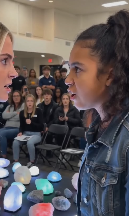
The fluorescent rocks displayed across the hall cast faint blue and green glows beneath the exhibition lights.
The director lifted the mineral analysis sheet.
“These records show that Leticia Morales processed, identified, and cataloged eighty-seven percent of the collection displayed tonight.”
A ripple of shock spread through the audience.
The director continued.
“Every fluorescent classification. Every contamination correction. Every identification error that was fixed.”
He paused.
Then added quietly.
“Without her work, this exhibit would not exist.”
Applause erupted.
Not polite applause.
Real applause.
The kind that comes when people suddenly realize they have ignored someone important.
Quinn’s face flushed red.
“Those reports are incomplete.”
The director slowly turned another page.
“No.”
His voice remained calm.
“They are not.”
Then he froze.
Something attached to the back of the analysis sheet caught his attention.
A supplemental report.
One that had never been mentioned during preparation meetings.
His eyes widened.
“What is this?”
Nobody answered.
The title alone made several sponsors sit upright.
Rare Mineral Fluorescence Anomaly Report.
And suddenly the ceremony was no longer about a student project.
Part 3: The Sample Hidden In The Wrong Box
The anomaly report contained photographs.
Dozens of them.
Each focused on a small mineral fragment.
At first glance it looked ordinary.
Then ultraviolet imaging appeared.
The mineral glowed with colors none of the experts expected.
Deep violet.
Silver-white.
Brilliant electric blue.
The geology professor reviewing the file nearly dropped the report.
“Impossible.”
The room fell silent.
One sponsor stood.
“What is it?”
The professor pointed toward the images.
“This fluorescence pattern should not exist in this mineral family.”
Whispers spread immediately.
I stared at the screen.
I recognized the sample.
I had found it weeks earlier mixed inside a box of common specimens.
Nobody had cared when I flagged it.
Nobody except me.
The professor flipped through the pages.
Chemical analysis.
Spectral data.
Microscopic imaging.
Every result confirmed the same thing.
The sample represented a previously undocumented mineral variation.
And the discovery paperwork listed only one person.
Leticia Morales.
Then the professor reached the final page.
His expression darkened.
Because another name appeared beside mine.
Quinn Hartington.
Not as a contributor.
As someone who had attempted to reclassify the sample and remove my findings.
Part 4: The Letter Buried Inside The Records
The investigation began immediately.
Judges postponed the awards.
Reporters surrounded the organizers.
Meanwhile, the geology department reviewed every related file.
That was when another document surfaced.
A sealed letter hidden inside the archive.
The timestamp dated back almost six months.
Long before tonight’s ceremony.
The letter came from a private mining company.
One connected to the Hartington family.
The professor opened it carefully.
His face changed after reading only three paragraphs.
“What does it say?” someone asked.
The professor looked stunned.
“It requests that unusual fluorescence findings remain confidential.”
The room erupted.
Several sponsors stood.
One reporter immediately began recording.
The professor continued reading.
The letter specifically referenced unidentified mineral samples recovered from a remote Nevada site.
Including the exact sample I had analyzed.
Then came the shocking sentence.
Public disclosure may affect pending acquisition negotiations.
The room became silent.
Because everyone understood what that meant.
The sample wasn’t merely scientifically valuable.
It might be worth an enormous amount of money.
And someone had tried to bury it.
Part 5: The Mine Nobody Mentioned
Over the next week, experts examined the mineral.
The results became national news.
Its unusual properties showed potential applications in advanced imaging systems.
Research organizations became interested.
Universities requested access.
Government laboratories offered assistance.
Then investigators visited the Nevada site where the sample originated.
What they found stunned everyone.
The mine contained an entire vein of the unusual material.
Not one specimen.
Thousands.
Possibly millions.
The discovery transformed the location into one of the most important mineral sites in the region.
Questions immediately followed.
Who knew?
When?
And why had information been hidden?
The answers emerged faster than anyone expected.
Internal company emails showed executives discussing the mineral months earlier.
Several messages included Quinn.
Then one email changed everything.
It contained a direct instruction.
Delay publication until acquisition is complete.
The sender wasn’t Quinn.
It was someone much higher.
Someone whose name nobody expected to see.
Her grandfather.
The founder of the Hartington mining empire.
Part 6: The Secret Quinn Had Protected For Years
Investigators soon uncovered the truth.
The Hartington family had known about the unusual mineral long before students ever saw it.
Independent researchers had submitted early reports.
Those reports disappeared.
Additional findings were delayed.
Public announcements were postponed.
Everything pointed toward one goal.
Securing ownership before competitors learned the site’s value.
But Quinn’s role proved more complicated.
During interviews, she finally admitted the truth.
She had discovered the suppression effort months earlier.
At first she tried to stop it privately.
Her family ignored her.
She argued.
They dismissed her.
Then she made a terrible decision.
Instead of exposing the truth openly, she tried to control the discovery herself.
She believed she could force recognition later.
Instead, she targeted me.
Stole credit.
Manipulated records.
And humiliated me publicly.
None of it helped.
It only made everything worse.
When the interview ended, even investigators looked disappointed.
Because the truth revealed both wrongdoing and regret.
Then another discovery emerged.
One that nobody had anticipated.
Part 7: The Property Map That Changed The Story
A historical survey team reviewed old land records connected to the mine.
Their goal was simple.
Verify ownership boundaries.
Instead, they found something extraordinary.
The most valuable section of the mineral deposit wasn’t actually inside Hartington property lines.
An old mapping error had hidden the truth for decades.
The richest portion lay beneath land donated years earlier to a public educational trust.
A trust that funded student science programs.
Including the very geology program where I worked.
Lawyers reviewed the documents repeatedly.
The conclusion never changed.
The educational trust legally owned the most significant portion of the discovery.
News stations exploded with coverage.
The value of the deposit reached hundreds of millions of dollars.
Yet the money would not flow into private hands.
It would support schools.
Scholarships.
Research centers.
Laboratories.
Students.
The irony stunned the entire country.
The discovery someone tried to monopolize was about to benefit thousands of young scientists instead.
But one final surprise remained.
Part 8: The Award Nobody Could Buy
One year later, Reno hosted another mineral science celebration.
The hall looked different.
New laboratories had been funded.
Scholarships had been created.
Students from small towns across the state attended.
Many wore clothes just as worn as mine had been.
And nobody cared.
When the keynote ceremony began, the audience stood.
Not for a wealthy sponsor.
Not for a business executive.
For the students.
The educational trust announced the creation of the Morales Discovery Fellowship.
I nearly cried.
Then something unexpected happened.
Quinn walked onto the stage.
The audience became quiet.
She approached the microphone.
“I spent years believing influence could control recognition.”
Her voice shook.
“I was wrong.”
She turned toward me.
Then publicly handed over the original specimen notebook she had once tried to suppress.
Every page.
Every note.
Every discovery.
Exactly as it had been written.
The audience erupted into applause.
Not because she was forgiven instantly.
But because she finally chose honesty.
As the ceremony ended, sunlight streamed through the exhibition windows and illuminated the glowing minerals one last time.
And I realized the most valuable thing hidden inside that fluorescent rock was never the fortune beneath the ground—it was the proof that truth shines brightest when powerful people can no longer keep it in the dark.
