Part 2: The First Page That Changed Everything
The event director held the page higher.
The spotlight reflected off the plastic sleeve protecting the document.
For a moment, nobody moved.
Not the reporters.
Not the sponsors.
Not even Valerie Ashford.
The entire hall inside the historic archive center in Edinburgh seemed frozen.
Then Director Malcolm Reeves adjusted his glasses and began reading.
“Origin Log Entry One.”
His voice echoed through the room.
“Initial postcard sorting project launched eight weeks ago.”
Valerie crossed her arms.
Her confidence hadn’t vanished yet.
She still believed the room belonged to her.
Then Malcolm continued.
“Volunteer assigned to inventory unsorted postcards: Mira Novak.”
My throat tightened.
Whispers immediately spread through the audience.
The director turned another page.
“Week One: Mira Novak sorted 1,846 postcards.”
Another page.
“Week Two: Mira Novak identified and categorized 2,103 postcards.”
Another.
“Week Three: Mira Novak recovered damaged origin labels and restored missing records.”
A reporter near the front lowered her camera.
“Wait,” she said.
The room quieted.
“That’s over six thousand postcards.”
Malcolm nodded.
“By the third week.”
The reporter stared at me.
I looked down at my worn boots.
I remembered every dusty box.
Every evening spent alone.
Every paper cut.
Every stack that seemed endless.
Nobody had noticed then.
Now everyone was listening.
Valerie laughed.
The sound felt forced.
“So she sorted postcards.”
Malcolm slowly looked up.
“No.”
He flipped another page.
“She rebuilt the archive.”
The room exploded into murmurs.
And suddenly Valerie stopped laughing.
Part 3: The Discovery Hidden Inside The Boxes
Malcolm removed a second document from the folder.
This one was older.
Much older.
The paper itself looked yellowed.
Fragile.
The audience leaned forward.
“What is that?” one sponsor asked.
Malcolm glanced toward me.
Then answered.
“It is the reason this project still exists.”
My pulse quickened.
I had never seen that document before.
The director carefully unfolded it.
“Six weeks ago,” he said, “Mira discovered a mislabeled shipment buried beneath the oldest storage shelves.”
I remembered that day instantly.
The dust.
The broken crates.
The collapsed storage rack nobody wanted to inspect.
I had only checked it because I was looking for empty sorting trays.
Malcolm continued.
“The shipment contained postcards believed lost for nearly fifty years.”
The audience gasped.
Several local historians exchanged shocked looks.
Valerie’s mother shifted uneasily in her chair.
The director lifted the faded inventory sheet.
“The collection includes original correspondence from early immigrant families throughout Scotland.”
The room erupted.
Reporters began typing furiously.
Historians whispered excitedly.
Sponsors suddenly looked less interested in Valerie.
And much more interested in the folder.
Malcolm pointed toward the inventory record.
“This discovery increased the archive’s historical value dramatically.”
Valerie stepped forward.
“That has nothing to do with today.”
The director looked directly at her.
“It has everything to do with today.”
Then he revealed the signature at the bottom of the page.
The person credited with discovering the collection.
Mira Novak.
Valerie’s face lost color.
But Malcolm wasn’t finished.
Because another page waited beneath it.
And this one carried a name nobody expected.
Part 4: The Signature That Should Not Exist
The next page stunned even Malcolm.
I could see it happen.
His eyes widened.
His hands paused.
The audience immediately noticed.
“What is it?” someone asked.
The director slowly turned the document around.
A signature appeared across the bottom.
The room fell silent.
Because the signature belonged to Theodore Ashford.
Valerie’s grandfather.
The founder of the Ashford Foundation.
The man whose portrait hung in the entrance hall.
The man everyone credited for preserving historical archives.
Valerie immediately straightened.
“There,” she said triumphantly.
“My family created this project.”
But Malcolm kept reading.
And the confidence vanished from her face.
“Theodore Ashford recommendation, dated forty-eight years ago.”
He paused.
Then continued.
“Archive preservation should remain independent from sponsor ownership.”
The audience blinked.
Malcolm read the next sentence.
“Historical discoveries belong to the archivists who uncover them.”
The room became deathly quiet.
Valerie’s mother went pale.
Because the statement directly contradicted everything they had been arguing.
Malcolm lowered the page.
“Your own grandfather wrote that recognition must go to the worker, not the donor.”
The crowd erupted into applause.
Valerie looked stunned.
The family legacy she kept invoking had just turned against her.
Then one elderly historian stood up from the audience.
And everything became even worse for the Ashfords.
Part 5: The Historian Who Remembered The Truth
Professor Eleanor Whitmore was ninety years old.
Most students didn’t know who she was.
But every archivist in the room did.
She had worked alongside Theodore Ashford decades earlier.
The crowd immediately fell silent.
Professor Whitmore slowly approached the stage.
She accepted the document from Malcolm.
Then smiled sadly.
“I remember this meeting.”
Valerie stared.
“You do?”
“Oh yes.”
The professor adjusted her glasses.
“Theodore argued constantly with wealthy donors.”
The room laughed softly.
“He hated when money claimed ownership over historical work.”
Valerie’s mother looked horrified.
Professor Whitmore pointed toward me.
“He would have been proud of that young woman.”
My chest tightened.
The elderly historian continued.
“Because she did exactly what he valued.”
She held up the origin log.
“Patience.”
Another page.
“Service.”
Another.
“Truth.”
Then she looked directly at Valerie.
“Your grandfather never believed sponsorship created achievement.”
The applause grew louder.
Valerie’s hands curled into fists.
Because the family name she relied on was now supporting me.
Then Professor Whitmore discovered a folded note tucked inside the final pages.
Her expression changed immediately.
“What is this?”
The room fell silent again.
Because the note wasn’t historical.
It was recent.
Very recent.
And it carried Valerie’s name.
Part 6: The Note Hidden Inside The Archive
Professor Whitmore unfolded the paper.
The audience watched in complete silence.
Her eyes narrowed.
Then she handed it to Malcolm.
The director read it.
His expression darkened instantly.
“Where did this come from?”
Nobody answered.
Malcolm raised the note toward the cameras.
The handwriting was unmistakable.
It belonged to Valerie.
The note contained only one instruction.
“Remove Mira from recognition materials before ceremony.”
Gasps filled the hall.
Then Malcolm flipped the page over.
Another note appeared.
“Replace volunteer acknowledgment with sponsor representative.”
The audience erupted.
Reporters surged forward.
Cameras flashed.
Valerie’s mother immediately stood.
“There must be some misunderstanding.”
“No,” Malcolm said quietly.
“There isn’t.”
The note had dates.
Initials.
Verification marks.
Everything.
The evidence was overwhelming.
Then a volunteer coordinator stepped forward carrying a tablet.
“I have the emails too.”
The room froze.
Valerie looked terrified.
The coordinator connected the tablet to the presentation screen.
Email after email appeared.
Each one requested changes.
Each one attempted to remove my name.
Each one came from Valerie or her family office.
The crowd shifted from surprise to outrage.
Then Malcolm opened the final email.
The subject line appeared across the giant screen.
“Ensure Mira Receives No Public Credit.”
The room exploded.
And for the first time all day, Valerie looked completely defeated.
Part 7: The Confession Nobody Expected
The shouting lasted several minutes.
Judges.
Sponsors.
Students.
Reporters.
Everyone wanted answers.
Then Valerie suddenly stepped forward.
“Stop.”
The room quieted.
Her voice shook.
But she kept speaking.
“I wrote the notes.”
Her mother grabbed her arm.
“Valerie—”
“No.”
Valerie pulled away.
Tears filled her eyes.
“I was angry.”
The audience watched in stunned silence.
She looked directly at me.
“When they chose you instead of me, I couldn’t stand it.”
The honesty shocked everyone.
Valerie swallowed hard.
“I kept telling myself the project belonged to my family.”
She glanced toward her grandfather’s document.
“But it didn’t.”
The room remained silent.
“I saw how much work you did.”
Her voice cracked.
“And I hated that people were finally noticing.”
For the first time all day, she looked less like an entitled sponsor daughter and more like a frightened teenager.
“I wanted the recognition.”
She lowered her eyes.
“So I tried to erase yours.”
Nobody spoke.
Because there was nothing left to argue.
The truth stood exposed.
Then Director Malcolm announced a decision that nobody expected.
Part 8: The Stamp That Belonged To Everyone
The ceremony resumed an hour later.
But everything had changed.
The sponsor banners were removed.
The recognition board was corrected.
The archive records were restored.
Most importantly, the origin log remained displayed at the center of the hall.
Open for everyone to see.
Director Malcolm stepped to the microphone.
“The honor of stamping the first postcard belongs to Mira Novak.”
The audience rose to its feet.
The applause felt endless.
Not because people felt sorry for me.
Because they finally understood.
Professor Whitmore smiled from the front row.
Then she revealed one final surprise.
The archive board had voted unanimously to create a scholarship for student preservation volunteers.
Students who worked behind the scenes.
Students who sorted.
Cataloged.
Restored.
Protected history without expecting attention.
The scholarship would carry a permanent name.
The Mira Novak Preservation Award.
I nearly forgot how to breathe.
The applause grew louder.
Then Malcolm handed me the ceremonial stamp.
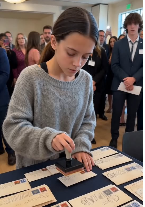
I walked toward the display table.
The room fell silent.
Hundreds of people watched.
The postcard beneath the glass represented every forgotten piece of history the project had saved.
I pressed the stamp down firmly.
The mark appeared clean and perfect.
The audience erupted.
Months later, archive programs across Edinburgh, Glasgow, Dublin, and Cardiff adopted the new origin-log verification system.
No sponsor could claim volunteer discoveries.
No student could be erased from official records.
And inside the archive entrance, a framed copy of the origin log hung beneath Theodore Ashford’s original statement.
Visitors stopped to read it every day.
The inscription below it became famous among student volunteers:
History remembers the names written in the records, but truth remembers the hands that created them.
