Part 2: The Name Engraved Beneath The Silver Badge
The chairman’s voice did not rush.
That made every second unbearable.
Chocolate slid down my sleeve in thick streaks. My hands shook beneath the tablecloth. The ballroom lights made the stain shine, and every phone in the room seemed pointed at the ruined version of me Madison wanted everyone to remember.
The chairman held the badge higher.
“The name engraved on the recipient record is…” He looked directly at me. “Elena Marlowe.”
My breath stopped.
For one second, nobody moved.
Then whispers broke loose across the ballroom.
“Elena?”
“The library girl?”
“She’s the recipient?”
Madison’s face changed slowly, like the room had turned around without warning and left her behind.
“No,” she said. “That is impossible.”
The chairman, Victor Havel, glanced at the document beside the velvet box. “It is not impossible. It is official.”
I stared at the badge. Silver. Small. Bright enough to hurt.
My name was there.
Not written in pencil. Not typed on a schedule where someone could erase it.
Engraved.
Victor spoke into the microphone. “This honor badge is awarded only when a student completes a preservation achievement that changes the institution’s historical record. Elena Marlowe recovered and cataloged the missing alumni archive that had been lost for twenty-three years.”
The room erupted in murmurs.
My throat tightened.
I had spent months in the basement archive, sorting damp boxes, repairing labels, scanning photographs, and matching handwritten names to old graduation books. I had done it after library shifts, still wearing my faded uniform, because nobody else wanted to breathe dust for four hours after school.
Madison laughed sharply.
“She shelved boxes. That is not achievement.”
Victor’s expression hardened. “She restored the scholarship ledger.”
The trustees at the front table went still.
A woman with pearl earrings whispered, “The original ledger?”
Victor nodded.
“The one containing the founding scholarship records, donor restrictions, and student award history.”
Madison’s father, Alistair Beaumont, stood.
“Chairman, this is not the moment for archival technicalities.”
Victor looked at the chocolate across my dress, then back at him.
“On the contrary,” he said. “This is exactly the moment.”
Security volunteers moved closer to Madison, but she did not seem to notice. She was staring at the badge like it had insulted her.
Victor turned another page.
“Elena did not merely find the ledger. She identified altered award entries, including one connected to tonight’s gala.”
The ballroom changed.
It was subtle at first. A breath held. A chair creaking. A trustee lowering his wineglass.
Madison’s eyes snapped toward her father.
Alistair’s face became dangerously calm.
Victor placed the document beneath the camera on the stage. The giant screen behind him filled with a scanned ledger page.
There were names, dates, scholarship notes.
Then one line highlighted in pale gold.
Original recipient: Elena Marlowe.
Beside it was a recent edit request.
Replace with Madison Beaumont for gala presentation.
Someone gasped.
Madison whispered, “Daddy?”
Alistair did not answer.
Victor looked toward the crowd and said, “The chocolate on Elena’s dress did not expose her. It exposed the person who needed her humiliated before this page was read.”
Part 3: The Ledger Madison Thought Was Gone
Madison stepped backward as if the screen itself had moved toward her.
“That is fake,” she said.
Her voice was loud, but it no longer sounded powerful.
Victor Havel closed the velvet box with a quiet click. “The ledger was authenticated by three independent archivists.”
Madison pointed at me. “She had access. She could have changed it.”
I stood slowly.
My chair scraped the polished floor, a small ugly sound in a room built for elegance. Chocolate clung to the skirt of my borrowed dress. I could feel it cooling against my knees.
“I cataloged the damage,” I said. “I did not create it.”
Madison’s eyes flashed. “You expect everyone to believe the poor library girl just happened to find a record that makes her special?”
I felt the words hit where she aimed them.
Poor.
Library girl.
Special.
But before I could answer, a voice came from the alumni table.
“She did not happen to find it.”
An elderly woman rose carefully, leaning on a carved cane. Her name was Ingrid Vale, class of 1969, former headmistress, and the kind of woman whose silence had more authority than other people’s speeches.
“I asked Elena to check the basement archive,” Ingrid said.
Alistair Beaumont turned sharply. “You?”
Ingrid smiled faintly. “You sound surprised that old women still remember where things are buried.”
A few guests shifted uncomfortably.
Victor stepped aside as Ingrid approached the stage.
“For years, rumors followed the missing ledger,” she said. “Scholarships redirected. Honors reassigned. Donor conditions ignored. Every time someone asked questions, the archive was called incomplete.”
She looked at me.
“Elena was the first student who treated the ruined boxes as if the people inside them still mattered.”
My eyes burned.
Madison folded her arms. “This is sentimental nonsense.”
Ingrid turned toward her.
“No, child. Sentiment is what your family sells. Records are what your family fears.”
The ballroom went silent.
Alistair’s expression tightened. “Be careful, Ingrid.”
She lifted one eyebrow. “I am eighty-one. Careful has bored me for years.”
A nervous laugh moved through the room, but it died when Victor opened another file on the screen.
“This is the digital access log from the restored archive room,” he said.
A list appeared.
My student ID.
My scan entries.
My preservation notes.
Then another name.
Madison Beaumont.
Accessed at 4:18 p.m.
Deleted folder: Marlowe_Badge_Recommendation.
Restored from backup: 5:02 p.m.
Madison’s mouth opened.
Nothing came out.
I remembered 5:02 p.m. exactly. I had been in the staff bathroom, trying to fix the loose hem of my dress with a safety pin before the gala started. I had no idea someone was trying to erase me while I was praying not to look out of place.
Victor clicked again.
A recovered message appeared.
Make sure Elena is not seated near the front before dessert. If she causes sympathy, redirect attention to family legacy.
The sender was not Madison.
It was Alistair Beaumont.
Madison turned toward her father, stunned.
“You told me she was trying to steal my place.”
Alistair’s jaw tightened. “You wanted the badge.”
Madison whispered, “You said it was already mine.”
Victor looked at him coldly.
“It was never hers.”
Then Ingrid placed a sealed envelope on the podium.
“There is another reason Elena was chosen,” she said. “And this one is much older than Madison’s tantrum.”
Alistair went pale.
Part 4: The Scholarship That Vanished Before I Was Born
The envelope was yellowed at the edges, sealed with old library tape.
Ingrid touched it like it was fragile enough to contain a heartbeat.
“Elena,” she said, “I need you to understand something before I open this.”
My stomach tightened.
The room blurred around the chandeliers and silverware and chocolate-stained linen. I wanted to sit down, but standing felt like the only way to keep from disappearing.
“What is it?” I asked.
Ingrid looked at Victor.
He nodded gently.
She opened the envelope and removed a folded letter.
“This was written twenty-two years ago by a scholarship finalist named Clara Marlowe.”
My mother’s name struck the room before I understood it.
Clara Marlowe.
My mother, who cleaned offices in the evening and kept old school papers in a shoebox beneath her bed. My mother, who never came to alumni events because she said places like this made her hands feel too rough.
I whispered, “My mother?”
Ingrid’s eyes softened. “Yes.”
She unfolded the letter.
“Clara discovered irregularities in the scholarship ledger when she worked as a student assistant. She reported that several awards meant for low-income students were being redirected to donor families.”
Alistair said, “This is ancient gossip.”
Ingrid ignored him.
“She wrote three statements. Two disappeared. This one survived because she hid it inside a misfiled library catalogue.”
My hands went cold.
Victor placed the letter under the document camera.
My mother’s handwriting filled the screen.
Careful. Slanted. Familiar.
If this ledger disappears, someone meant to erase more than paper.
I covered my mouth.
The room was silent now in a way that no insult could break.
Ingrid continued. “Clara Marlowe was awarded the original Founders’ Access Scholarship. The record was altered before the ceremony. The public recipient became a Beaumont cousin.”
Madison stared at her father.
Alistair looked away.
That tiny movement broke something in her face.
“You knew?” she whispered.
He snapped, “You do not understand what families like ours are expected to maintain.”
Victor’s voice hardened. “Control?”
Alistair smiled coldly. “Continuity.”
Ingrid turned another page.
“The altered ledger bears the authorization mark of Alistair Beaumont’s father.”
Alistair’s face flushed. “My father is dead.”
“And his fraud is not,” Ingrid said.
A sound moved through the trustees. Shock. Shame. Calculation.
I could barely breathe.
My mother had never told me. She had never said she once stood close to a future that was stolen. She had only told me to keep copies of every important paper. To write dates on everything. To never hand over original documents without making a scan.
I thought she was cautious.
She had been wounded.
Victor looked at me. “Elena, we called your mother this afternoon after authenticating the letter.”
My heart lurched.
“You what?”
“She is here.”
The doors at the back of the ballroom opened.
My mother stepped inside wearing her work coat over a simple navy dress. Her hair was pinned badly, and her face looked pale under the chandelier light.
For a moment, she did not look at the trustees, or the donors, or the screen.
She looked only at me.
Then she saw the chocolate on my dress.
Her expression changed.
“Who did that?”
Madison lowered her eyes.
My mother walked down the aisle slowly.
When she reached me, she touched my stained sleeve, then looked at Alistair Beaumont.
Her voice was quiet.
“Your family already took one ceremony from me. You do not get to take hers.”
Part 5: The Mother Who Kept The Final Proof
The ballroom had no idea what to do with my mother.
She did not arrive like a guest.
She arrived like evidence.
Alistair Beaumont recovered first. Men like him always did. He adjusted his cuff and gave her the kind of smile meant to make working people feel suddenly aware of their shoes.
“Clara,” he said. “This is an emotional moment. Perhaps we should speak privately.”
My mother laughed once.
It was not loud.
It was not kind.
“I spoke privately twenty-two years ago,” she said. “That is why no one heard me.”
Madison looked from my mother to me, then to the screen where the old letter still glowed.
Her face was wet now, though I had not seen her start crying.
Victor stepped toward my mother. “Mrs. Marlowe, do you have the supporting material you mentioned?”
She nodded.
From inside her work coat, she removed a flat brown folder. The edges were worn soft, as if it had been opened and closed hundreds of times in rooms where nobody else could see.
“I kept copies,” she said.
She looked at me.
“Because I hoped you would never need them, and feared you would.”
My throat closed.
She opened the folder.
Inside were photocopied ledger pages, scholarship notices, a rejection letter issued after the award was changed, and one small photograph of my mother at seventeen standing beside the same silver badge.
Not wearing it.
Just standing near it.
Smiling like she still believed fairness was coming.
I touched the photo with one finger.
“You never told me.”
Her face crumpled. “I did not want your life to begin inside my bitterness.”
“It began inside your warnings.”
She closed her eyes.
That landed harder than I intended, but it was true.
Every backup drive. Every dated notebook. Every receipt tucked into drawers. Every time she said, “Proof is not distrust, Elena. Proof is protection.”
Now I knew whose hands had taught her.
Victor placed my mother’s documents under the camera one by one.
The room watched the old theft rebuild itself.
Then came a page with a signature.
Alistair Beaumont’s.
Not his father’s.
He had been a young alumni board member then, barely twenty-five, but his signature sat beneath a memo authorizing the “family legacy adjustment.”
Madison whispered, “No.”
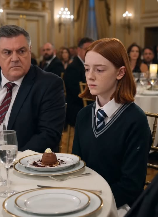
Alistair went still.
Victor looked up slowly. “You were involved.”
Alistair’s voice lowered. “I was following board advice.”
“You signed it.”
“I signed many documents then.”
My mother stepped forward.
“You signed the one that told me I was no longer the proper image for the scholarship.”
Several trustees looked away.
She continued, voice steady now.
“I was told the school needed a recipient who reflected donor confidence. I was told I should be grateful for a small private stipend and silence.”
Ingrid’s cane struck the floor once.
“Who told you?”
My mother looked at Alistair.
“He did.”
Madison covered her mouth.
Alistair’s face hardened. “You accepted the stipend.”
My mother’s eyes flashed.
“I accepted rent money after your family stole my scholarship.”
The words split the room open.
Then she looked at me, her voice softening.
“But I did not accept the lie.”
She removed the final item from the folder: a cassette tape in a cracked plastic case.
Alistair’s face drained.
My mother held it up.
“And neither did the admissions officer who recorded you.”
Part 6: The Tape Beneath The Chandelier
No one breathed while Victor accepted the tape.
For a moment, the whole gala became strangely old-fashioned: chandeliers above, silver badge on velvet, a cassette tape in the chairman’s hand like a ghost from another life.
Alistair stepped forward. “That cannot be played without legal review.”
Ingrid smiled. “Then sue me after dessert.”
Victor handed the tape to an assistant, who hurried to the sound table. Madison stood frozen, one hand pressed against her necklace.
I watched her face.
There was no triumph left in it. No polished cruelty. Just the horror of discovering that the family story she had used as a crown was stitched from theft.
The speakers crackled.
A younger version of my mother’s voice filled the ballroom.
“I earned the scholarship.”
Then a man’s voice, smooth and unmistakably Alistair’s, replied, “You earned consideration. The board determines representation.”
My mother’s younger voice shook. “My name is already in the ledger.”
“That can be corrected.”
Corrected.
The word made several alumni flinch.
Then another voice spoke, older, weary. “Alistair, this is improper.”
The admissions officer.
Alistair’s voice sharpened.
“What is improper is risking donor confidence over a library assistant with no family standing.”
I felt my mother’s hand find mine.
On the tape, she said, “I have grades. Recommendations. Service hours.”
Alistair replied, “You have no name anyone at that gala will respect.”
A sound moved through the ballroom, low and furious.
Madison started crying openly.
The tape continued.
The admissions officer said, “This will destroy her future.”
Alistair answered, “No. It will preserve ours.”
Victor stopped the tape.
Not because it was over.
Because no one needed more.
The silence afterward felt like judgment made physical.
Alistair stood beneath the chandeliers with every privilege still on him—tailored suit, family name, donor table, polished shoes—but none of it fit quite right anymore.
Madison turned to him.
“You told me people hated us because they were jealous.”
He said nothing.
“You told me Elena wanted what belonged to me.”
His jaw tightened. “This family has obligations you cannot understand.”
Madison’s voice broke. “I threw dessert at her.”
Alistair looked annoyed now, not ashamed.
“That was your lack of control.”
She recoiled as if he had slapped her.
Even then, he would not carry the blame he had packed into her hands.
I hated her.
I did.
But in that second, I saw the machine behind her.
Still, machines did not throw mousse. People did.
Madison turned toward me.
“I am sorry,” she whispered.
I looked at the chocolate on my dress.
“Not yet,” I said.
Her face crumpled, but she nodded.
Good.
Victor lifted the silver badge again.
“This honor was nearly stolen twice,” he said. “Once from Clara Marlowe. Tonight, from Elena Marlowe.”
Alistair barked, “This award is now compromised.”
Ingrid answered before anyone else could.
“No, Alistair. For the first time in decades, it is clean.”
Applause began in the back.
Then the front tables joined.
Then former graduates stood.
But before Victor could pin the badge on me, Madison stepped toward the microphone.
Her hands shook.
“I need to say what I did.”
Part 7: The Confession At The Honor Table
Madison’s voice almost disappeared under the applause.
Then the room quieted, not because they trusted her, but because scandal had trained everyone to listen.
She stood beside the stage with chocolate mousse still visible on my sleeves, her own hands clean and trembling.
“I threw dessert at Elena Marlowe,” she said.
No one gasped this time.
Everyone already knew.
“I did it because I wanted her humiliated before the badge was announced. I knew my father wanted her removed from the honorary table.”
Alistair snapped, “Madison.”
She flinched.
For one second, she looked like she might stop.
Then she gripped the microphone harder.
“And I knew enough to understand that if she looked small, people might believe she did not belong.”
My mother’s hand tightened around mine.
Madison turned toward the trustees.
“I accessed the archive folder today. I deleted her recommendation file. My father told me it was a mistaken nomination and that I was protecting the family from embarrassment.”
Victor’s face hardened.
Ingrid closed her eyes.
Madison looked at me.
“I wanted to believe him because I wanted the badge.”
Her honesty did not soften the stain on my dress.
But it changed the room again.
Alistair’s control finally cracked.
“Give me that microphone.”
Security moved closer.
Madison stepped back.
“No.”
It was a small word.
For her, maybe the first real one.
Alistair looked around the ballroom, searching for allies among trustees who had happily eaten beside him an hour earlier. Most looked down. Some stared back coldly. The room had learned enough to become dangerous.
Victor spoke into his own microphone.
“Alistair Beaumont is suspended from all alumni board duties pending investigation.”
A roar of whispers followed.
Ingrid added, “And every scholarship awarded under Beaumont family recommendation for the last twenty-five years will be audited.”
Alistair went pale.
“That will ruin reputations.”
My mother’s voice was quiet but clear.
“Only the false ones.”
Then something unexpected happened.
A young waiter near the side wall raised his hand.
Victor looked over. “Yes?”
The waiter swallowed. “My sister applied for the Access Scholarship three years ago. She was told the fund had been discontinued.”
Another woman stood from a rear table. “My son too.”
Then a former graduate.
“My roommate lost hers after a donor review.”
Names began rising.
Not all at once. Not dramatically. One by one, like lights turning on in rooms that had been locked.
Madison stared at them, horrified.
“How many?” she whispered.
Ingrid looked at Alistair.
“That is what we are going to find out.”
Victor handed the badge to my mother.
The room hushed.
My mother looked startled. “No, this is Elena’s.”
Victor shook his head. “It should have been yours first.”
My mother stared at the silver badge as if it might vanish.
Then she turned to me.
I understood before she spoke.
“No,” I whispered.
She smiled through tears.
“Yes.”
She took my hand and placed the badge between both of our palms.
“Then we hold it together.”
Victor’s voice trembled when he announced it.
“By authority of the alumni association, the Honor Badge is awarded tonight to Elena Marlowe, with formal restoration of Clara Marlowe’s original scholarship recognition.”
The ballroom stood.
I did not feel triumphant.
I felt rooted.
Like my mother and I had both been pushed for years, and finally the floor had decided to hold.
Then Ingrid leaned toward the microphone.
“There remains one final matter,” she said.
Alistair looked at her with dread.
Ingrid opened the original ledger to its last restored page.
“The scholarship fund was never empty.”
Part 8: The Badge That Belonged To Two Generations
The sentence confused the room before it shocked it.
Victor stepped closer to the ledger. “What do you mean, it was never empty?”
Ingrid’s finger rested on the final column.
“The Founders’ Access Scholarship was not discontinued. It was diverted into a private alumni excellence account controlled by donor families.”
Alistair closed his eyes.
That was confession enough.
The chandeliers glittered above a room full of people realizing how expensive silence had become.
Ingrid continued. “The restored ledger shows more than two million dollars in restricted scholarship money was redirected over twenty-two years.”
The waiter near the wall sat down hard.
My mother whispered, “Two million?”
Victor’s face had gone gray.
Madison looked physically sick.
She turned toward her father. “How could you?”
Alistair finally lost the last of his polish.
“Because everyone wanted the school to shine!” he shouted. “Because donor families keep institutions alive, not girls shelving books after class!”
The words echoed.
There he was.
Not misunderstood.
Not traditional.
Just revealed.
My mother stepped forward, still holding one side of the badge with me.
“You keep confusing buildings with schools,” she said. “A school is the students you tried to erase.”
No one spoke after that.
Security escorted Alistair out while trustees avoided his eyes. Madison watched him go, crying silently, and for once nobody rushed to comfort her. She would have to learn what pain felt like without applause.
The gala did not end.
It transformed.
Dessert plates were cleared away. The chocolate stain remained on my dress because I refused to hide it. Victor called an emergency vote of the alumni board. Ingrid chaired it from the stage, cane across her lap like a silver sword.
By midnight, the redirected fund was frozen.
By morning, the school announced a full public audit.
By the end of the week, the Founders’ Access Scholarship was restored under a new rule: no donor family could influence eligibility, and every recipient record would be publicly archived.
Madison gave a written statement confirming she had deleted my file and attacked me. She was removed from the junior alumni ambassador program. Later, she testified against her father in the audit hearings.
She did not become my friend.
That mattered.
Not every apology deserves closeness.
But she did something useful with the wreckage. She told the truth when lying would have protected her comfort. Some days, that is the first honest brick a person lays.
My mother’s recognition ceremony happened one month later, in the school library instead of the ballroom.
She asked for that.
No chandeliers. No mousse. No donor champagne.
Just rows of wooden shelves, old reading lamps, and the restored ledger displayed in a glass case.
I wore the same repaired uniform I used for library shifts. My mother wore her navy dress again. This time, her hair was pinned neatly, because I did it for her in the staff bathroom while she laughed and told me I was fussing.
Victor stood beside the case and read Clara Marlowe’s name into the record.
My mother did not cry until Ingrid gave her the scholarship letter she should have received twenty-two years earlier.
The paper was newly printed, but the words were old justice.
Then Victor turned to me.
“Elena Marlowe,” he said, “for restoring the archive, exposing altered records, and preserving the truth of this institution, we confirm your Honor Badge.”
My mother squeezed my hand.
The badge was pinned not to my stained dress, not to a borrowed gown, but to my faded library uniform.
That felt right.
The room applauded, but the sound did not swallow me.
It lifted something my mother had been carrying alone.
Afterward, a first-year student approached the glass case. She had ink on her fingers and a school blazer with sleeves too short at the wrists.
“What if someone changes the record again?” she asked.
I looked at the ledger.
Then at my mother.
Then at the badge shining against my repaired cuff.
“They will have to get past all of us,” I said.
The girl smiled and wrote her name in the new archive volunteer book.
By spring, dozens of students joined her. We scanned every scholarship file, every award list, every donor condition. Names returned. Letters were sent. Families who had been told there was no money learned there had always been money—just not always honesty.
The Honor Badge stayed in the library display most days.
Not because I did not want it.
Because I wanted everyone to see the engraving beneath mine.
Clara Marlowe — Recognition Restored
Elena Marlowe — Archive Restored
On the last day of term, my mother and I stood before the case after closing. Sunlight crossed the floor in long gold rectangles. The library smelled of dust, paper, and the quiet miracle of things kept safe.
She touched the glass lightly.
“I used to think they took my future,” she said.
I leaned my shoulder against hers.
“They tried.”
She smiled.
Below the badge, the restored ledger lay open to the page they had failed to bury.
For the first time, my mother’s name and mine rested in the same record, not as proof of what had been stolen, but as proof of what had survived.
And no one in that room would ever again mistake silence for belonging.
