Part 2: The Deleted File With My Initials
The microphone hissed before I could answer.
That tiny sound filled the whole room, sharper than Savannah’s insult, louder than the splash still dripping from my sleeves. I stood beside the pool with water running down my face, my shoes heavy, my hands shaking so badly I had to press them against my sides.
The engineer looked at me like he was trying to hold the room together with his eyes.
“Binta,” he said gently, “tell them what was removed.”
Savannah snapped, “She doesn’t know anything.”
Her voice cracked on the last word.
Everybody heard it.
Her father, Conrad Covington, stood in the sponsor row with his phone still halfway to his ear. His mouth was tight. His eyes were not on me, or even on Savannah. They were on the screen behind us, where the project history glowed in neat blue lines.
B.M. Upload.
B.M. Correction.
B.M. Emergency recalculation.
B.M. Final load point revision.
Those were my initials. My tired, invisible initials from nights when the school janitor had turned off half the lights and I kept working by the glow of the control booth monitor.
The engineer, Mr. Henrik Vale, turned toward the crowd. “The deleted file was not decorative. It contained the revised load distribution that prevented the model from twisting under stress.”
A murmur rolled across the bleachers.
Parents leaned forward. Phones lifted higher. The booster-club banners trembled in the air-conditioning, bright and cheerful above a room that no longer felt cheerful at all.
Savannah laughed, but it sounded forced. “It was a student model. You’re acting like she saved a real bridge.”
Mr. Vale’s face hardened.
“This competition is funded by the state engineering initiative,” he said. “Students are awarded scholarships based on documented contribution. Deleting her file would have erased her eligibility.”
The word scholarship made my throat close.
Savannah knew.
She had known exactly where to hit.
I looked at the screen again, at the file path now displayed across the top.
FinalSpan_LoadCorrection_BM_deleted.
Deleted.
Not misplaced. Not forgotten.
Deleted.
The volunteer from the control booth, a retired math teacher named Mrs. Dalia Price, stepped forward holding a printed log. Her glasses sat crooked on her nose, and her hand shook with anger.
“The deletion happened this morning at 8:13,” she said.
Savannah’s father barked, “Enough.”
Mrs. Price did not flinch. “From the sponsor access terminal.”
Every head turned toward the Covington banner.
Savannah’s friends lowered their phones a little, like they had suddenly realized they might be recording the wrong person.
Mr. Vale asked, “Who signed into that terminal?”
Mrs. Price looked down at the paper, then up at Savannah.
Savannah went pale.
Mrs. Price read the line slowly. “Savannah Covington.”
The room erupted.
Savannah stepped backward, water from the pool shining on the floor between us like a line she could not uncross.
“That’s not proof,” she said. “Anyone could have used my login.”
Then the screen changed.
A security still appeared.
Savannah stood at the sponsor terminal that morning, one hand on the keyboard, the other holding a nacho tray from the concession table.
Her face was perfectly clear.
So was mine in the background, kneeling near the bridge model, checking the span pins without knowing she was deleting me.
Mr. Vale’s voice dropped.
“Savannah,” he said, “why did you remove Binta’s file?”
She looked at her father.
He looked away.
And in that moment, everyone saw it.
Savannah was not untouchable.
She was alone with what she had done.
Part 3: The Sponsor Terminal Hid More Than One Lie
Savannah’s lips moved before any sound came out.
“I didn’t delete it,” she whispered.
The screen behind her disagreed.
Her own image stayed frozen above the poolside stage, glowing larger than life: Savannah Covington, sponsor daughter, perfect curls, perfect jacket, perfect hand reaching for the key that erased my work.
My wet clothes clung to me. A strip of nacho cheese from the tray table had stuck to my sleeve when I hit the pool edge, and I peeled it away with shaking fingers because my body needed something small to do.
Mr. Vale turned to Mrs. Price. “Can you restore the deleted file?”
“I already did,” she said. “That is why the bridge still passed the load test.”
Savannah’s head snapped up. “What?”
Mrs. Price’s mouth tightened. “I keep backups.”
A few people clapped once, then stopped, unsure if applause belonged in a moment this ugly.
Conrad Covington pushed into the aisle. “My daughter is a minor. You will not interrogate her publicly.”
“She publicly assaulted Binta,” someone called from the bleachers.
A father near the back stood. “And called her a poverty-case prop.”
Savannah’s face burned red.
Conrad pointed toward the control booth. “Turn off that screen.”
Nobody moved.
Mr. Vale said, “The screen stays on.”
Conrad’s voice went low. “You are making a mistake.”
“No,” Mr. Vale said. “The mistake was letting sponsors near student records.”
That sentence changed the room.
Not loudly. Not like the gasp when Savannah pushed me. This was quieter, deeper. Teachers looked at each other. Parents looked at the sponsor banners. The booster club president slowly lowered her clipboard.
Mrs. Price clicked another tab.
“Since the terminal was accessed,” she said, “I checked the revision history for the entire project.”
Savannah’s eyes widened. “Why would you do that?”
Mrs. Price looked at her over the rims of her glasses. “Because guilty people rarely do only one thing.”
The screen filled with entries.
Student names. File names. Edits. Replacements.
My stomach tightened.
There were more initials than mine.
A.J. removed from deck-stability worksheet.
M.R. removed from cable-tension model.
T.L. removed from material cost report.
Beside each deletion, a replacement credit had been added.
S.C.
Savannah Covington.
A boy in the front row whispered, “That’s my cable model.”
He stood slowly.
His name was Aaron Jacobs, quiet, freckled, always carrying graph paper folded into his back pocket. He looked at Savannah like he had just found a bruise he didn’t remember getting.
“You told me my file corrupted,” he said.
Savannah shook her head. “I didn’t—”
Another student stood. Mara Reed. “You said the judges didn’t need cost analysis.”
Then Theo Lewis rose from the third row. “You put your name on mine?”
Savannah’s friends backed away from her.
The bridge model sat under the lights beside the pool, delicate and white, its final span still waiting to be placed. It looked innocent, almost fragile. But the files behind it told another story.
Mr. Vale clicked on the access report.
One folder appeared at the bottom.
It had no student initials.
It was named Sponsor Outcome Plan.
Conrad Covington moved fast.
Too fast.
He lunged toward the control booth stairs, but two school security officers stepped into his path.
“Do not open that,” he said.
Mr. Vale looked at him.
His voice was calm.
That made it worse.
“What exactly is in this folder, Mr. Covington?”
Conrad’s jaw clenched.
Savannah whispered, “Dad?”
For the first time all day, she sounded like a scared kid.
Mr. Vale opened the folder.
The first document appeared on the screen.
Scholarship Announcement Draft.
Winner: Savannah Covington.
Date prepared: three weeks before final judging.
Part 4: The Scholarship They Had Already Stolen
Nobody breathed.
The scholarship announcement draft filled the screen behind us, polished and ready, with Savannah’s name placed in bold at the top like the competition had never existed.
Three weeks before judging.
Three weeks before the load test.
Three weeks before I stayed late enough that my hands cramped around the calculator and Mrs. Price brought me a vending-machine granola bar because she said numbers needed fuel.
I stared at the date until the digits blurred.
Savannah whispered, “I didn’t know it was already written.”
Aaron Jacobs gave a bitter laugh. “But you knew our files disappeared.”
She turned on him. “I was supposed to win.”
The sentence slipped out with such raw certainty that the whole room seemed to tilt.
Not “I worked hard.”
Not “I deserved it.”
Supposed to.
Mr. Vale closed his eyes for half a second.
Then he opened the next document.
Sponsor Messaging Notes.
The first bullet point read: Emphasize Savannah Covington as future female engineering leader.
The second read: Limit visibility of low-income team members to group photos.
The third read: Avoid centering Binta Morgan; background may distract from donor narrative.
I felt the words before I understood them.
Background.
Distract.
As if my old shoes were louder than my work. As if my patched clothes could damage a bridge more than stolen credit ever could.
My breath came too fast.
Mrs. Price stepped down from the control booth and reached me. Without asking, she wrapped a dry booster-club sweatshirt around my shoulders. It smelled like detergent and cardboard boxes.
“You stand right where you are,” she said quietly. “Do not let them move you.”
Savannah stared at the messaging notes. Tears gathered in her eyes, but they did not soften me. Not yet. Maybe not ever.
Conrad Covington spoke into his phone. “Get legal here now.”
The microphone near the sponsor table picked up every word.
Several parents shouted at once.
“Legal?”
“You planned this?”
“You used our kids?”
A local reporter who had come to film the ceremony stepped forward. “Mr. Covington, did your company prepare the scholarship winner before the judging process?”
Conrad smiled the way people smile when they believe money is stronger than truth.
“All youth events require promotional drafts.”
Mr. Vale said, “Not with final names.”
Conrad’s eyes sharpened. “Careful, Henrik.”
Mr. Vale did not move. “No. You be careful. These are students.”
The reporter lifted the microphone higher. “Were student records altered to support a sponsor outcome?”
Conrad looked away.
That silence did more damage than any confession.
Then Mrs. Price returned to the keyboard. “There are attached emails.”
Savannah flinched.
Conrad snapped, “Dalia.”
Mrs. Price stopped with her finger over the mouse.
She looked at him, and something old passed between them. Recognition. History. A fear she had once known and had decided not to obey anymore.
“You always say names like they belong to you,” she said.
Then she clicked.
An email appeared.
From: Conrad Covington.
To: Savannah Covington.
Subject: Final Bridge Optics.
The message was short.
Binta’s recalculation is useful, but she cannot be the face of the award. Make sure her file is removed before the ceremony. The scholarship board will follow the packet we prepared.
Savannah covered her mouth.
The bleachers erupted.
But I kept staring at one word.
Useful.
Not talented. Not chosen. Not a student.
Useful.
Mr. Vale turned to me.
“Binta,” he said softly, “do you still want to place the final span?”
My hands trembled.
Savannah whispered, “You can’t let her.”
I looked at the bridge model.
Then at the screen.
Then at every student whose name had been stolen beside mine.
“Yes,” I said. “But not alone.”
Part 5: The Students Step Onto The Stage
Aaron came first.
He stepped out from the front row with his graph-paper notebook pressed against his chest. His face was pale, but he walked straight toward the bridge model and stood beside me.
Then Mara Reed joined us, jaw tight, eyes shining.
Then Theo Lewis.
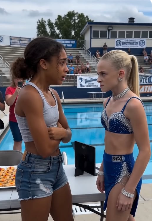
Then two more students from the side bleachers whose files had not yet appeared but whose faces said they already knew.
The pool water still dripped from my hair onto the floor. The sweatshirt hung too large on my shoulders. I probably looked nothing like the person a sponsor wanted in a brochure.
Good.
I was tired of trying to look acceptable to people who could only recognize talent once it wore their last name.
Mr. Vale looked at us, then nodded.
“This bridge,” he said into the microphone, “was never one student’s work. It was a team project. But a team cannot exist where credit is stolen.”
Mrs. Price printed the restored contribution report. The paper came out page by page with a soft mechanical hum that somehow sounded like justice being made physical.
She handed the stack to Mr. Vale.
He read the first name.
“Aaron Jacobs: deck-stability worksheet.”
Aaron’s shoulders shook once.
“Mara Reed: material cost analysis and compression estimates.”
Mara pressed her lips together.
“Theo Lewis: cable tension model.”
Theo looked toward his mother in the bleachers. She was crying openly now.
Then Mr. Vale paused.
“Binta Morgan: emergency load-point recalculation, final span stability correction, and complete late-stage structural review.”
The applause started before he finished.
It was not polite. It was not confused. It rose from the bleachers and rolled across the poolside room until the booster-club banners fluttered above us.
I looked down because the sound was too much.
Mrs. Price touched my elbow. “Look up.”
I did.
My mother was not there. She worked double shifts at the clinic and had texted me that morning with three heart emojis and a prayer. My little brother was at school. My grandmother was probably watching the livestream on a cracked tablet if the internet held.
But my father was there.
I had not seen him come in.
He stood near the back doors in his work uniform from the bus depot, cap in his hands, face wet though he had not been in the pool.
“Daddy?” I whispered.
He pushed through the crowd, and nobody stopped him.
When he reached me, he looked at the soaked clothes, the trembling hands, the sauce stain still streaked near my collar.
His face folded.
Then he pulled me into his arms so carefully it almost hurt.
“I saw,” he said against my hair. “Baby, I saw everything.”
For one moment, I let myself lean into him.
Then Savannah spoke behind us.
“This is so dramatic.”
The applause died.
My father released me slowly and turned.
He was not a loud man. He fixed engines, drove buses, saved receipts, and taught me that anger needed direction or it would eat its own house.
He looked at Savannah with a sadness that made her take a step back.
“You pushed my daughter into water,” he said. “You mocked her clothes. You stole her work. And you still think the problem is drama?”
Savannah’s lips trembled.
Conrad moved beside her. “Do not speak to my daughter.”
My father looked at him. “Then teach her before strangers have to.”
A sound moved through the room, half gasp, half agreement.
Mrs. Price suddenly bent over the keyboard again.
“Oh,” she said.
Mr. Vale turned. “What is it?”
She stared at the screen.
“There’s another folder hidden behind the scholarship packet.”
Conrad went still.
Mrs. Price opened it.
The folder name appeared.
Morgan Family Risk.
My father’s hand tightened around mine.
Part 6: The Folder With My Father’s Name
The room blurred around the edges.
Morgan Family Risk.
My father stared at the screen like the letters had reached across the room and touched him.
“Why is our name in their files?” I asked.
He did not answer right away.
That scared me.
My father always answered. Even when he did not know, he gave me honesty shaped like comfort. “We’ll figure it out.” “Let’s look again.” “Hard things still have handles.”
Now he looked at Conrad Covington, and his face had gone very still.
Conrad’s phone was no longer at his ear.
Savannah whispered, “Dad, what is that?”
He said nothing.
Mrs. Price turned toward Mr. Vale. “Should I open it?”
Mr. Vale looked at my father. “Mr. Morgan?”
My father swallowed. “Open it.”
The first file was a scanned complaint.
Fifteen years old.
Filed by Daniel Morgan.
My father.
Against Covington Infrastructure.
My heart began beating hard enough to hurt.
I looked up at him. “Daddy?”
He closed his eyes.
The document filled the screen.
It described a pedestrian bridge design submitted to a city apprenticeship program years earlier. A low-cost modular support method meant for flood-prone neighborhoods. The complaint alleged that Covington Infrastructure had used the design without credit after rejecting the apprentice team that created it.
At the bottom of the complaint was my father’s signature.
Daniel Morgan.
The same careful handwriting that signed my permission slips.
A whisper moved through the bleachers.
Conrad’s face darkened. “That claim was dismissed.”
My father’s voice came out quiet. “Because your lawyers buried us.”
Savannah looked between them, confused now. “What is he talking about?”
My father looked at me, and the grief in his eyes made me feel suddenly younger.
“Before you were born,” he said, “I wanted to be an engineer.”
I could not speak.
He had never told me that.
I knew he could fix anything. Our sink. A neighbor’s heater. My science fair motor when I cried because it sparked and died the night before judging. I knew he read old engineering magazines at the kitchen table after work.
But I had never known why he looked at bridges like they were old friends he had lost.
He nodded toward the screen. “I was part of a city apprentice team. We designed a support system. Covington rejected us, then used it in a contract later.”
Mrs. Price opened the next file.
A Covington internal memo appeared.
The apprentice concept is viable. Remove Morgan attribution before municipal pitch.
I felt the room tilt.
Remove Morgan.
Again.
My father’s work first.
Then mine.
Savannah stared at the memo, her face stripped bare.
“You knew?” she whispered to Conrad.
Conrad’s jaw tightened. “This is old business.”
Old business.
My father laughed once.
It sounded like something breaking.
“You stole my chance,” he said. “And when my daughter built one of her own, you tried to steal hers too.”
Mr. Vale opened another document attached to the folder.
Current risk note: Binta Morgan may draw attention to prior Morgan complaint if centered in ceremony. Recommend minimizing visibility.
My lungs stopped.
That was why.
Not just my clothes. Not just my background. Not just Savannah wanting the spotlight.
My name itself had frightened them.
Morgan.
A name they had buried once and recognized when it rose again.
Savannah turned toward me, tears spilling now. “I didn’t know about your father.”
I looked at her.
“But you knew about me,” I said.
She flinched.
The screen changed again as Mrs. Price clicked the final attachment.
It was a draft legal notice addressed to my father’s employer.
Concern regarding Daniel Morgan’s conduct at school engineering event.
My father understood before I did.
“They were going to get me fired,” he whispered.
Conrad looked away.
My hands went cold.
Savannah covered her mouth.
And then my father stepped toward the microphone.
Part 7: The Man Who Finally Told The Truth
My father had never liked microphones.
At family barbecues, he handed speeches to my aunt. At church fundraisers, he clapped from the back row. At school events, he stood where he could see me but never blocked anyone’s view.
Now he stood beneath the sponsor banners with his work cap in his hands and fifteen years of stolen silence shining in his eyes.
The room waited.
Even Savannah stopped crying.
My father leaned toward the microphone.
“My name is Daniel Morgan,” he said. “When I was nineteen, I believed hard work was enough.”
His voice was steady, but I saw his fingers tighten around his cap.
“I joined a city engineering apprenticeship because I wanted to build bridges in neighborhoods like mine. Places where people walked across flooded streets with grocery bags held over their heads. Places where children learned which sidewalks cracked first after rain.”
The room listened differently now.
Not like a crowd waiting for scandal.
Like people realizing a man had carried a story right past them for years.
“My team designed a modular support system. Covington Infrastructure rejected our proposal. Months later, their company used the same core design. When we complained, we were told we misunderstood. Then we were told to be grateful for the experience.”
Conrad said, “This is defamatory.”
My father turned toward him.
“No,” he said. “Defamation is a lie. This is memory with paperwork.”
A sharp sound rose from the bleachers—someone clapping once before catching themselves.
Then more joined.
My father lifted one hand, asking them to stop.
“I let it go because I had a family to feed. Because fighting people with lawyers costs money poor people need for rent. Because every time I looked at my baby girl, I told myself losing my dream was worth it if she got to keep hers.”
His voice cracked on baby girl.
My eyes burned.
He looked at me.
“But today, they tried to teach her the same lesson they taught me. Stay quiet. Be useful. Let someone with the right last name stand in front.”
He turned back to the room.
“I am done with that lesson.”
Mr. Vale walked to the bridge model and lifted the final span carefully from its velvet-lined tray.
He held it out to me.
My hands shook as I took it.
Then I turned to Aaron, Mara, and Theo.
“Together,” I said.
We placed our fingers along the span, each of us holding one small edge. The piece was lighter than I expected, but the room seemed to lean under its weight.
Mr. Vale guided us to the model.
“On three,” he said.
“One.”
Savannah watched us with tears streaking her perfect makeup.
“Two.”
Conrad’s attorney whispered urgently into his ear.
“Three.”
We lowered the final span into place.
For one terrifying second, the model trembled.
Then it held.
The screen behind us flashed green.
LOAD DISTRIBUTION STABLE.
The applause exploded.
Not polite sponsor applause.
Real applause.
The kind that made the floor vibrate and the banners shake and my father cover his mouth with one hand because he could not hold all of it in.
Then Mrs. Price gasped.
The screen had changed automatically after the test.
A hidden video file began playing.
It showed Conrad Covington in the empty room the night before, standing beside Savannah.
His voice filled the speakers.
“Tomorrow, Binta goes in the pool if she gets called up. Make her look unstable. After that, no board will award her anything.”
Savannah’s face crumpled.
On the video, she whispered, “What if people see?”
Conrad answered, “People see what we tell them to see.”
The applause died.
And police sirens sounded outside.
Part 8: The Bridge That Carried Both Our Names
One year later, nobody called it the Fair Bridge Engineering ceremony anymore.
The Covington banners were gone.
So were the booster-club signs with their company logo printed in the corner. After the investigation, Covington Infrastructure lost its youth contracts, then its municipal review privileges, then the naming rights it had used like a throne.
The new banner above the gym entrance read:
MORGAN STUDENT ENGINEERING FELLOWSHIP
Building What Others Tried To Bury.
My father said it was too fancy.
My grandmother said he should hush and let God be dramatic.
I stood beside the same pool where Savannah had shoved me, though now a clear safety rail separated the water from the stage. My shoes were still not new, but they were polished. My dress was simple. My hair was pinned back by my mother’s careful hands that morning while she tried not to cry into my collar.
The bridge model had been rebuilt in the center of the stage.
Not as a prop.
As evidence of what a team could do when nobody was erased.
Aaron’s deck-stability notes were displayed beside it. Mara’s cost analysis. Theo’s cable model. My load-point recalculation.
And next to mine, in a glass case that still made my father uncomfortable, was a copy of his apprentice design from fifteen years earlier.
Daniel Morgan: modular support concept.
Restored attribution.
Those two words had changed him.
Not all at once. Pain never left just because truth arrived. But he stood taller now. He had begun consulting with a nonprofit that rebuilt damaged walkways in flood-prone neighborhoods. Sometimes I caught him sketching at the kitchen table again, pencil moving like an old song remembered.
Mr. Vale stepped to the microphone.
“This year’s fellowship recipient,” he said, “was selected by an independent engineering board, with all contribution records publicly archived.”
He smiled at me.
“Binta Morgan.”
The applause rose.
This time, I walked forward dry.
My father stood in the front row, both hands pressed together beneath his chin. My mother had one arm looped through his. My little brother bounced on his toes like applause was something he could jump into.
I accepted the certificate, but Mr. Vale did not let go right away.
“There is one more announcement,” he said.
The screen changed.
A rendering appeared: a real pedestrian bridge planned for a flood-prone neighborhood on the east side of town.
The design used my father’s modular support method.
And my updated load distribution model.
The title across the top read:
MORGAN SPAN PROJECT.
My father went completely still.
I turned toward him. “Daddy?”
Mr. Vale’s voice softened. “The city approved construction this morning. Daniel and Binta Morgan will be credited as co-design contributors.”
My father sat down hard, like his knees had forgotten their job.
Then he laughed and cried at the same time.
The whole room stood for him.
Near the back, Savannah Covington stood too.
She had come quietly, with no cameras around her, no friends filming, no glittering sponsor jacket. Her father was awaiting trial. Her family name no longer opened doors the same way. She looked smaller, but not polished smaller. Human smaller.
After the ceremony, she approached me with a folder in both hands.
My mother stiffened. My brother glared like a tiny security guard.
Savannah stopped several feet away.
“I found more files,” she said. “Old apprentice complaints. Not just your father’s.”
I looked at the folder.
She swallowed. “I’m giving them to the review board. I’m testifying again next month.”
“Good,” I said.
She nodded, tears in her eyes. “I’m sorry, Binta.”
The words did not fix the pool. They did not erase the video or the name-calling or the years my father had spent thinking his dream had died because he was not good enough.
But they did not sound like performance.
They sounded like work beginning.
I took the folder.
“Then keep going,” I said.
Savannah nodded once and stepped back.
Later, when the gym emptied, my father and I stood alone beside the bridge model. He touched the tiny final span with one finger.
“You know,” he said, voice thick, “I used to think bridges were about getting away from where you started.”
I looked at our names on the display.
“Maybe they’re about bringing what was left behind with you.”
He smiled through tears and put his arm around my shoulders.
Outside, rain tapped softly against the windows, and for once, every bridge in the city felt like it knew our name.
