Part 2: The Page Kennedy Tried To Hide
“Do not let her leave,” the staff member said.
Kennedy Prescott stopped with one hand already reaching for the glass door.
The security guard in front of her did not touch her. He did not have to. His body blocked the exit, and for the first time since I had seen her walking through that park opening like a crown had been placed on her head at birth, Kennedy looked unsure of what the world was allowed to do to her.
Water ran down my face and into my mouth. It tasted like chlorine, metal, and humiliation. My jacket clung to my arms. My shoes squelched when I shifted my weight beside the pool.
People kept filming.
Nobody knew whether to comfort me or keep their cameras steady.
The staff member, a thin man named Otto Bauer, held the report like it had burned him. His rain jacket was half-zipped, his glasses fogged, and his voice shook when he said, “The final approval documents show Ximena Wright identified the irrigation pressure fault before the public launch.”
Kennedy spun around. “So what? She noticed a leak.”
Otto turned the page.
“No,” he said. “She noticed the leak, traced it to the north valve, stopped a root-bed flood, and documented the repair before the sponsor inspection. Without her work, the native plant beds would have been destroyed during the ceremony.”
The room changed.
The paper coffee cups stopped moving. The PTA volunteers stopped whispering. Even the gray daylight beyond the glass doors seemed to hold still.
Kennedy’s father, Aldric Prescott, stood from the sponsor row with a careful smile that never reached his eyes.
“This is very dramatic,” he said. “But this is a family-friendly opening, not a courtroom.”
Otto looked at him. “It may become one.”
Kennedy’s face sharpened. “Excuse me?”
Otto lifted the second page.
At the bottom was a signature.
Her signature.
Kennedy Prescott.
Beside it was a typed instruction: Remove Ximena Wright from technical recognition list. Replace with Kennedy Prescott for donor continuity.
The words seemed too clean for what they did. Too flat. Too easy.
I stared at them while water dripped from my sleeves onto the polished floor.
My name had been removed while I was still standing there. While I was smiling for photos. While I was trying not to look ashamed of my clothes.
Kennedy laughed once, but it came out wrong. “That’s not what that means.”
Otto’s hand trembled. “Then explain what it means.”
Aldric stepped forward. “My daughter signs many event forms.”
“Then she should remember this one,” Otto said, voice gaining strength. “It was attached to the credit sheet revision sent from the sponsor office at 6:12 this morning.”
Kennedy looked at her father.
He did not look back.
That was when I understood something awful. She had expected him to save her before anyone even finished accusing her.
Instead, he was calculating.
A woman from the local press raised her microphone. “Miss Prescott, did you request that Ximena’s name be removed?”
Kennedy’s lips parted.
Then the lights above the control table flickered.
Otto turned sharply.
A man in a dark Prescott Foundation jacket had moved behind the table. His hand was already under the console, fingers wrapped around a storage cable.
Otto shouted, “Stop!”
But the man pulled.
The screen went black.
And Kennedy smiled.
It was small. It was quick. But I saw it.
She thought the proof had just died.
Part 3: The Backup Beneath The Glass Doors
I moved before I knew I was moving.
My wet shoes slipped against the floor, and pain shot through my knee as I caught myself on the edge of the table. Someone cried out behind me, but I kept going, one hand braced on the console, the other reaching for the red emergency lock switch I had used the night before.
The man in the foundation jacket grabbed my wrist.
“Get away from that,” he snapped.
His fingers were tight enough to hurt.
I looked at his hand, then at Kennedy.
She was watching me now with open hatred, not embarrassment, not panic. Hatred.
And something in me finally hardened.
“You already pushed me once,” I said. “Nobody gets to pull me away from my own work too.”
I slammed my palm down on the switch.
The console screamed.
A red warning flashed across the small side monitor.
SYSTEM LOCKED. EXTERNAL REMOVAL RECORDED.
The man dropped my wrist as if the machine had bitten him.
Otto reached the table and pushed between us. “Move back.”
Aldric’s voice cut through the room. “This has gone far enough.”
“No,” I said.
It surprised everyone, including me.
My voice was hoarse. My hair was dripping. My clothes were ruined. But the word came out clean.
“No,” I repeated. “It went too far when she shoved me into the pool because my name was on a page she wanted.”
Kennedy’s cheeks flushed bright red. “You are insane.”
A grandmother in a yellow raincoat said, “We all saw you do it.”
That broke something open.
People began speaking at once.
“I recorded it.”
“She pushed her.”
“That girl could have hit her head.”
“She laughed after.”
Kennedy looked around as if the witnesses had betrayed her by having eyes.
Otto crouched beneath the table, opened the lower panel, and exhaled shakily. “The backup is still here.”
Aldric’s calm cracked. “What backup?”
I wiped water from my chin. “The independent garden-system recorder. I installed it after the irrigation monitor kept dropping timestamps.”
He stared at me. “Who authorized that?”
“The city manual,” I said. “And the plant preservation grant required independent documentation.”
Otto pulled out a small black drive sealed in a plastic case. “She’s right.”
A local official named Maren Weiss stepped forward. “Play it.”
Aldric snapped, “You do not have consent to display private foundation footage.”
Maren turned toward him. “This is a public city event in a municipal building. Your foundation paid for banners, not silence.”
Otto connected the drive.
The large screen above the stage flickered.
For a moment, there was only gray static.
Then the recording appeared.
There I was beside the pool, trying to smooth my old jacket, trying to pretend I belonged under the buzzing spotlight.
Kennedy moved behind me.
Her shove was clear.
Gasps rippled through the room even though everyone had already seen it with their own eyes. Somehow, watching it again made it worse. The video removed every excuse. No stumble. No accident. No misunderstanding.
Then the recording rewound to earlier that morning.
The room dimmed on the screen.
Kennedy stood at the control table in a cream coat, speaking to a tall man with silver hair.
My stomach dropped.
The man was Tomasz Keller, the committee advisor who had told me he believed in quiet workers.
On-screen, Kennedy slid a folder toward him.
“She cannot be the face of this,” Kennedy said. “My father promised the opening moment would stay with the Prescott name.”
Tomasz glanced toward the native plant beds.
“The irrigation fault is already repaired,” he said. “Her log proves she found it first.”
Kennedy leaned closer.
“Then lose the log.”
My chest tightened so hard I could barely breathe.
Tomasz whispered, “And if she talks?”
Kennedy smiled.
“Then make everyone think she ruined the launch.”
Part 4: The Advisor Who Let Her Break Me
Tomasz Keller was standing near the back wall when the recording ended.
I had not noticed him before. He had made himself small between a coat rack and a table of folded programs, his silver hair damp from the rain, his face the color of paper.
Everyone turned toward him.
He looked at me once.
Then he looked away.
That hurt more than Kennedy’s shove.
Because Kennedy had always looked at me like I was something under her shoe. Tomasz had smiled. Tomasz had told me to keep good notes. Tomasz had watched me kneel in damp soil by the north valve the evening before, my fingers muddy and raw while I traced the pressure problem through the irrigation line.
He had said, “You have a careful mind, Ximena.”
Now I knew he had only been measuring how much of that mind could be stolen.
Maren Weiss stepped toward him. “Mr. Keller, is that you in the footage?”
Tomasz opened his mouth.
Kennedy snapped, “Don’t say anything.”
The command was too sharp. Too practiced.
Tomasz flinched.
Maren saw it. So did Otto. So did I.
Aldric Prescott moved beside his daughter. “This is an edited clip taken out of context.”
Otto pointed to the screen. “The timestamp is continuous.”
“Then the conversation is misunderstood,” Aldric said.
I laughed.
It was not a happy sound.
“Misunderstood?” I said. “She told him to lose my log.”
Kennedy turned on me. “You were never supposed to be chosen.”
The sentence came out before she could stop it.
The whole room heard.
Aldric closed his eyes for half a second, and that was how I knew she had just damaged something money could not easily repair.
I stepped closer. Water still dripped from the hem of my jacket. “Why?”
Kennedy’s jaw tightened.
I asked again, softer this time. “Why wasn’t I supposed to be chosen?”
She looked me up and down.
My worn clothes. My patched sleeve. My cheap shoes. The wet hair stuck to my cheeks.
Her answer was already on her face.
But Otto was moving through the files now, clicking fast, breath uneven. “There are more documents.”
Aldric said, “Stop touching foundation property.”
“These were submitted to the municipal portal,” Otto said. “They are city records now.”
The screen changed.
A spreadsheet appeared.
Not just my name.
Names.
Dozens of them.
Lena Hoffmann. Removed from Freiburg green roof project.
Mila Novak. Replaced in Prague school garden launch.
Elsa Moreau. Credit reassigned in Lyon seed conservation event.
Ingrid Dahl. Marked unsuitable for donor-facing role.
My hands went cold despite the blankets someone had wrapped around my shoulders.
“This is not only about me,” I whispered.
Kennedy’s eyes darted toward the exit again.
Security did not move.
Maren’s voice was low. “What is this list?”
Otto swallowed. “Sponsor visibility adjustments.”
The phrase made my stomach turn.
Then he clicked on my row.
A note box opened.
The text was short.
Too short for how deeply it cut.
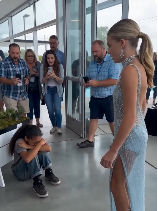
“Remove Ximena Wright. Appearance and background weaken campaign image.”
Nobody spoke.
Kennedy lifted her chin, but her eyes were wet now. Not from guilt. From being exposed.
I walked toward her until only a few feet separated us.
“Say it without the spreadsheet,” I said.
She stared at me.
“Say what you thought was wrong with me.”
Her lips trembled.
Aldric said, “Kennedy, do not answer.”
But she already had.
Her silence said every word.
Part 5: The Girls Whose Names Were Taken
By nightfall, the rain had turned the city streets silver.
I sat in a municipal conference room with a towel around my shoulders, staring at a cup of coffee I did not want. The room smelled like wet wool, printer ink, and the kind of fear adults tried to hide behind official folders.
Maren Weiss was on the phone with someone from the city legal office. Otto sat at the far end of the table, copying files onto a secured drive while his hands shook every few minutes. He kept apologizing under his breath, though none of this had been his fault.
My phone would not stop buzzing.
Clips of Kennedy shoving me had spread first.
Then the spreadsheet spread.
Then people began searching the names.
Lena Hoffmann messaged me from Germany.
I was told my roof sensors failed. They didn’t.
Mila Novak messaged from Prague.
They said donors changed the program last minute. I knew they lied.
Elsa Moreau wrote only six words.
I thought I was the only one.
I pressed my hand over my mouth.
A woman beside me touched my shoulder. I had seen her earlier handing out programs in a green raincoat. Her name was Klara Voss, and she had given me a dry scarf without making a speech about kindness.
“Breathe,” she said.
I tried.
It came out broken.
“I thought I was embarrassed,” I whispered. “But this is worse. They didn’t just want me humiliated. They wanted me erased.”
Klara’s eyes hardened. “Then we make them read every erased name out loud.”
Across the glass wall, Kennedy sat with her father and two attorneys. Her hair was still perfect. Her clothes were still dry. But she looked smaller now, trapped under the fluorescent lights with no crowd left to admire her.
Aldric leaned toward her, speaking through his teeth.
She kept shaking her head.
At one point, she looked through the glass and met my eyes.
For the first time all day, she did not smirk.
I looked away first because I hated that some part of me could still see the girl beneath the cruelty. The spoiled, frightened girl who had been taught that sharing a spotlight was the same as losing oxygen.
Then the door opened.
Aldric Prescott stepped into the conference room.
Every adult stiffened.
He carried no folder. No attorney followed him. That made him more frightening.
“Ximena,” he said gently, as if he had earned the right to use my name.
Klara stood. “You can speak through counsel.”
He ignored her. “What happened today was regrettable.”
My fingers tightened around the coffee cup.
He continued, “My daughter behaved emotionally. She will apologize privately. We are prepared to offer clothing replacement, educational support, and a foundation scholarship.”
Otto looked up sharply.
Maren said, “Mr. Prescott.”
Aldric raised one hand. “I am trying to resolve this before the attention harms everyone involved.”
Everyone.
As if harm had arrived only when the cameras turned toward him.
“What would you want from me?” I asked.
His smile softened. “No more interviews. No public accusations. Let the adults review the documents properly.”
I thought of Lena. Mila. Elsa. Ingrid. Names sitting in a spreadsheet like weeds pulled before anyone could see them bloom.
Then my phone buzzed again.
A message from Lena:
I am coming tomorrow. Do not stand alone.
I looked up at Aldric.
“No.”
His smile faded.
I stood, towel slipping from my shoulders. “No scholarship. No private apology. No silence.”
His eyes turned cold.
I said, “You do not get to buy back the names your family stole.”
For one second, he looked exactly like Kennedy.
Then he whispered, “You have no idea how much worse this can become.”
The door behind him opened.
Kennedy stood there, pale.
And she said, “Yes, she does.”
Part 6: The Hearing That Broke The Prescott Name
The emergency hearing took place two days later in Strasbourg because the project funding had crossed borders, and that meant the Prescott Foundation could no longer keep the matter inside one friendly city office.
The building had tall windows, pale stone walls, and floors so polished I could see the scuffs on my borrowed shoes. Klara had found me a navy dress from her niece, but it hung loose at the waist, and I kept tugging the sleeves down over my hands.
Lena Hoffmann sat behind me.
So did Mila Novak.
Elsa Moreau had arrived from Lyon before sunrise with her father and a folder tied shut with red string.
More girls came too. Some older now. Some still teenagers. Some with mothers who looked furious. Some with teachers who looked ashamed.
All of them had once been told a softer version of the same lie.
There was a mistake.
The program changed.
The committee chose another face.
You should be grateful you were included at all.
Kennedy arrived with Aldric and three attorneys. She wore black, and her hair was pulled back so tightly it made her cheekbones look sharp. She did not look at me.
A hearing officer named Elise Hartmann opened the file.
“This session concerns allegations of sponsor interference, falsified youth recognition records, attempted evidence removal, and retaliation against a student participant.”
Aldric leaned toward his microphone. “We reject that characterization entirely.”
Elise Hartmann did not blink. “Your rejection has been noted. The evidence will still be reviewed.”
Otto testified first.
He described the water-system fault. The north valve. My repair log. The signed removal page. The backup recording. His voice trembled only once, when he admitted he had almost ignored the first discrepancy because the Prescott name made people careful.
Then Tomasz Keller was called.
He looked older than he had two days before.
His hands shook as he sat down.
Elise asked, “Did Kennedy Prescott instruct you to remove Ximena Wright’s repair log?”
Tomasz closed his eyes.
“Yes.”
Kennedy’s shoulders tightened.
“Did Aldric Prescott or the Prescott Foundation maintain a practice of altering youth project credit for donor-facing purposes?”
Aldric’s attorney objected.
Elise allowed Tomasz to answer.
He stared at the table. “Yes.”
The room went still.
Tomasz continued, voice barely above a whisper. “It was called alignment. We were told certain students could do the work, but not represent the campaign. If a donor child was available, the credit was adjusted.”
My throat burned.
Elise asked, “Was the irrigation malfunction at the plant park deliberately allowed to continue?”
Tomasz swallowed hard. “It was meant to fail during Ximena’s demonstration, so Kennedy could step in with the correct solution.”
A sound of disgust moved through the room.
Kennedy suddenly lifted her head. “I didn’t know it could damage the plant beds.”
Her attorney whispered urgently, but Kennedy kept talking.
“I thought it would just make her look unprepared.”
The words struck me strangely.
Not because they were enough. They were not.
But because Kennedy had finally said the ugly part out loud.
I stood before anyone called me.
Elise looked toward me. “Miss Wright?”
I faced Kennedy across the room.
“You thought public humiliation was a harmless outcome,” I said.
Kennedy’s lips parted, but no answer came.
Behind me, Elsa Moreau rose.
“My project was seed preservation,” she said. “They replaced my name after I spent two years collecting samples from flood-damaged fields.”
Lena stood next. “My roof sensors were used in three schools. Prescott Foundation credited a donor’s son.”
Mila stood too. “They told me I should be proud to help from behind the curtain.”
One by one, the girls stood.
The sound of chairs scraping became louder than any applause I had ever heard.
Then Elsa untied the red string around her folder.
“There is something else,” she said.
Aldric’s face changed.
Elsa placed an old photograph on the evidence table.
“This did not begin with us.”
Part 7: The Old Garden Notebook Revealed Everything
The photograph showed a young woman standing in a greenhouse in Barcelona, holding a notebook against her chest.
She had dark hair pinned messily at the back of her head, tired eyes, and a smile so careful it looked like she had been taught not to take up too much space.
Beside her stood a younger Aldric Prescott.
He was smiling broadly, one hand on a model irrigation unit, the other resting possessively on the notebook.
Elsa pointed to the woman.
“Her name was Beatriz Serrano,” she said. “She was a botanist and water-systems designer. She created the native-root irrigation method that made Prescott Foundation famous.”
Aldric’s voice was ice. “This is irrelevant.”
Elsa removed another page.
A signed letter.
A grant application.
A rejected complaint.
A transfer agreement dated seventeen years earlier.
“This is my grandmother’s archive,” Elsa said. “Beatriz Serrano was her research partner. She accused Aldric Prescott of stealing her system after he refused to fund her unless she signed over public rights.”
The room did not explode.
It did something worse.
It listened.
Elise Hartmann leaned forward. “Are you alleging the Prescott Foundation’s first environmental patent was obtained through coercion?”
Elsa met her eyes. “I am proving it.”
Aldric stood. “This hearing is over.”
“No,” Elise said. “It has expanded.”
Two security officers moved closer to the doors.
Kennedy looked at her father.
“Is that true?” she asked.
He did not answer.
That silence was the first crack.
Kennedy’s face shifted with a pain so naked I almost looked away. She had spent her whole life wearing his name like armor. Now she was realizing it might have been made from stolen things.
“Father,” she whispered.
He turned on her so sharply she flinched.
“Sit down.”
The command was quiet. Brutal. Familiar.
And suddenly, I saw the shape of her cruelty. It had not appeared from nowhere. It had been fed, polished, rewarded, dressed in sponsor colors, and taught to call fear superiority.
But understanding was not forgiveness.
Kennedy slowly sat.
Then she stood again.
Her attorney grabbed her wrist. She pulled free.
“There is an archive,” she said.
Aldric’s head snapped toward her.
Kennedy’s voice shook, but she kept going. “In Geneva. Private donor records. My father keeps older files there. Credit adjustments, settlement drafts, original complaints.”
Aldric said, “Kennedy, stop.”
She looked at him, tears shining now but not falling.
“You told me people like Ximena wanted to take what belonged to us,” she said. “But it never belonged to us, did it?”
He said nothing.
Kennedy turned toward Elise.
“The access phrase is Rootwater.”
Aldric lunged toward her, but security stepped between them.
The room erupted.
I stayed still.
Kennedy looked at me across the chaos.
This time, there was no smirk. No crown. No cold delight.
Only a girl holding a key she should have used sooner.
Then Elise Hartmann said the words that changed everything.
“Seal the Geneva archive.”
And Aldric Prescott finally looked afraid.
Part 8: The Name Beneath The First Patent
The Geneva archive was not hidden in a dramatic basement or behind a steel vault door.
It was in a quiet office above a private bank, with soft carpets, white walls, and a view of the lake so beautiful it felt insulting. The files were stored in climate-controlled cabinets with neat labels and polished handles, as if theft became respectable when organized well.
Three months had passed.
The Prescott Foundation had been suspended from public projects. Aldric Prescott was under criminal investigation. Tomasz Keller had lost his advisory position and agreed to testify fully. Kennedy had disappeared from every sponsor event, which people called disgrace, though I suspected it was the first useful silence of her life.
I entered the archive with Elise Hartmann, Klara Voss, Otto Bauer, and a legal observer.
Kennedy came too.
She stood near the doorway in a plain gray coat, hands clasped in front of her, looking nothing like the girl who had shoved me into the pool. She had asked to be present because she was the one who had given the access phrase.
Nobody thanked her.
She did not ask us to.
The first cabinets contained what we expected.
Credit adjustments.
Settlement offers.
Donor image rankings.
Student names crossed out and replaced with brighter, richer, safer names.
Then Otto found a sealed brown file marked Original Rootwater Development.
He placed it on the table.
Elise opened it carefully.
Inside was Beatriz Serrano’s notebook, scanned page by page.
Then came patent drafts.
Then letters.
Then a hospital record.
My name appeared on the next page.
Ximena Wright.
For a moment, I did not understand.
Klara touched my back. “Ximena?”
I leaned closer.
There was another name beneath mine.
Birth surname: Serrano.
My breath stopped.
Elise read softly, “Mother: Lucía Serrano. Daughter of Beatriz Serrano.”
The room blurred.
I gripped the edge of the table.
Klara whispered, “Oh, sweetheart.”
I had grown up with broken pieces of my family story. A mother who died when I was young. A father who had vanished into paperwork and grief. Foster homes. Changed records. Adults who said some histories were too complicated to explain to children.
But there it was.
Not complicated.
Hidden.
My grandmother had designed the irrigation system Prescott stole.
My mother had tried to reopen the complaint.
And seventeen years later, I had found the water-system problem in a native plant park because the stolen design had always made sense to me in a way I could never explain.
The repair I made had not just saved the public launch.
It had completed a circle they had tried to bury.
Kennedy covered her mouth.
“I didn’t know,” she whispered.
I believed her.
It did not make the pool disappear. It did not erase the spreadsheet or the note about my background or the way she had smiled when I fell.
But it made the room quieter.
Elise turned another page.
There was a handwritten instruction from Aldric Prescott authorizing the suppression of Lucía Serrano’s complaint after her death.
Klara began to cry.
Otto removed his glasses and wiped his face.
Kennedy stepped forward and placed a small envelope on the table. “There is one more thing.”
Nobody moved.
She opened it herself.
Inside was a signed transfer order for a private trust Aldric had created years ago to protect family assets if the foundation ever collapsed.
Kennedy’s voice trembled. “It is in my name. I am transferring it to the students whose work was stolen.”
Her attorney had clearly told her not to do this. Her father would have forbidden it. The girl she used to be would have called it weakness.
But she signed the document anyway.
A year later, the Prescott Foundation name was gone from the park.
A new bronze plaque stood near the entrance, rain shining on its surface.
THE SERRANO ROOTWATER GARDENS
For Beatriz Serrano, Lucía Serrano, and every young inventor whose name was almost removed.
Lena designed the roof sensors for the greenhouse wing. Mila led the flood-monitoring project in Prague. Elsa became the first director of the student archive.
And I returned on opening morning in a simple green jacket, my old shoes cleaned but not hidden.
Kennedy stood at the back of the crowd. She did not come forward until the ceremony ended. Then she handed me a folder of recovered names and said, “I am still finding what my family buried.”
I took it.
Not as forgiveness.
As evidence.
Then I walked to the first garden bed, pressed my hands into the dark soil, and felt water move quietly beneath the roots exactly where my grandmother had always meant it to go.
