Part 2: The Signature That Froze Her Father
Madison’s father did not answer right away.
He stared at the tablet like the screen had become a mirror and he hated what it showed him.
I stood soaked beside the pool steps, water dripping from my sleeves onto the blue tile. My worn shirt clung to my skin. My shoes squished every time I shifted my weight. Somewhere behind me, an owl gave a low, restless sound from the shaded rescue enclosure, like even the birds knew the room had turned dangerous.
The supervisor, Lukas Meier, held the tablet steady.
“Mr. Ashford,” he said, louder this time, “your daughter’s name appears over Kaya Rivera’s original medical brace redesign. I am asking why.”
Madison folded her arms. “Because it was my project.”
My throat tightened.
She said it so easily.
Like stealing my work was just another accessory.
Lukas swiped the screen. “The revision history says otherwise.”
Madison’s perfect smile flickered.
Her father, Edmund Ashford, finally looked up. He had the kind of face rich people use when they want the world to believe control is the same thing as innocence.
“This is obviously a clerical mistake,” he said.
A few donors nodded, relieved to be given permission to doubt me.
Then Lukas tapped the tablet again.
The projector behind the podium lit up.
There it was, huge on the screen: the brace file, the measurements, the pressure notes, the safety warnings, and my name in the first draft.
Kaya Rivera — original redesign submitted 11:37 p.m.
Then came a second entry.
Name changed by Madison Ashford — 7:12 a.m.
The murmurs sharpened.
Madison’s face went pale beneath her makeup.
“That proves nothing,” she snapped.
I looked at her from beside the pool, still shaking. “It proves you knew my name was there before you erased it.”
For the first time, she had no instant reply.
A woman near the front rose slowly. She was small, elderly, and dressed in a plain gray linen suit that looked almost severe among the floral dresses and donor blazers. Her silver hair was pinned tight at the back of her head.
“Show the medical test footage,” she said.
Edmund Ashford turned so fast his chair scraped. “Dr. Voss, that is not necessary.”
The woman’s eyes stayed on the screen.
“It is extremely necessary.”
Lukas hesitated.
Madison whispered, “Dad?”
But Edmund was staring at Dr. Voss like she had just opened a grave.
The supervisor pressed play.
A video filled the screen.
A little boy sat in a clinic room in Salzburg, his arm resting carefully inside the brace I had redesigned. He flexed his fingers once. Then again. His mother covered her mouth and started crying.
And the boy smiled.
The whole courtyard went silent.
Dr. Voss turned to Madison and said, “That child could only use it because Kaya changed the design you claimed as yours.”
Part 3: The Child In The Clinic Video
I had watched that video once before.
Alone.
At two in the morning.
I had cried into my sleeve because the boy’s smile felt like proof that all those late nights mattered. His name was Emil. He was eight. The first prototype had pinched his wrist so badly he could barely keep it on for ten seconds. The medical team had said it was too rigid, too heavy, too dangerous for a child with limited strength.
I was supposed to file parts.
That was all.
But I had seen the problem.
So I stayed after the others left. I used scrap foam, a borrowed caliper, and a broken hinge from a bird transport crate. I softened the pressure points. I shifted the weight away from the wrist. I changed the locking angle so Emil could release it himself if he panicked.
No one had watched me then.
Now everyone was.
Madison’s friends had lowered their phones completely. One of them, Clara, looked like she might be sick.
Madison pointed at the screen. “I supervised the team.”
Lukas shook his head. “You missed every build night.”
“I had donor obligations.”
“You had spa appointments in Innsbruck,” Clara blurted.
Madison whipped around. “Shut up.”
The words cracked across the courtyard.
Clara stepped back, frightened by herself.
Edmund rose. “Enough. My daughter will not be insulted at an event funded by our family.”
Dr. Voss lifted one thin hand. “Your family funded the banners. Kaya funded the solution with unpaid labor.”
My face burned.
I hated that part being said out loud.
Not because it was false.
Because it was true in a way that made people look at me with pity, and I hated pity almost as much as Madison’s cruelty.
Then Emil’s mother appeared at the edge of the courtyard.
She must have been waiting near the clinic tent. Her dark blue dress was simple, her hair pulled back, her expression trembling with anger.
She held Emil’s hand.
The boy wore the brace.
The redesigned brace.
My brace.
His little fingers opened and closed around a soft cloth owl someone had given him.
Madison stared at the floor.
Emil’s mother walked toward the podium, not fast, not dramatic, but with a force that made people move out of her way.
She looked at me first.
“Are you Kaya?” she asked.
I nodded, suddenly unable to speak.
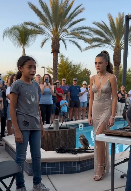
Her eyes filled.
“My son slept with that brace beside his pillow,” she said. “He said someone finally made a machine that listened.”
My chest folded inward.
Madison whispered, “This is ridiculous.”
Emil’s mother turned to her.
“No,” she said. “What is ridiculous is that you wanted applause for a kindness you did not do.”
Then Emil lifted his braced arm and pointed at the screen.
“That’s her,” he said softly. “That’s the girl who fixed it.”
Part 4: The Old Blueprint Under The Table
That was the moment Madison stopped looking angry and started looking trapped.
Her father noticed too.
He stepped closer to her, not to comfort her, but to control her. His hand closed around her shoulder with a grip too tight to be gentle.
“Madison,” he said quietly, “say nothing else.”
But the damage had already learned how to breathe.
Lukas swiped to the next section of the file. “There is another issue.”
Edmund’s eyes narrowed. “Careful.”
Lukas ignored him, though I could see fear in the way his thumb hovered over the screen.
“The brace redesign includes a hinge pattern that was archived under the Ashford Medical Foundation twelve years ago.”
Madison jumped on that instantly. “Exactly. Our foundation owned the base design.”
Dr. Voss looked at her with open disgust. “No. Your foundation archived it after rejecting it.”
A cold breeze moved through the courtyard. The sunscreen smell mixed with wet tile and coffee from the donor tables. I hugged my arms around myself, suddenly shivering.
Lukas tapped the file.
An old blueprint appeared.
The paper was yellowed. The ink was blue. The hinge looked almost identical to mine, except older, rougher, hand-drawn.
At the bottom was a name.
Elena Rivera.
My mother.
The courtyard tilted under me.
“No,” I whispered.
My mom cleaned offices at night. She repaired torn bags with fishing line. She could fix a toaster, a zipper, a chair leg, anything, but she always said it like a joke.
“Your grandmother taught me enough to survive.”
She had never told me she designed medical equipment.
Edmund Ashford’s mouth tightened. “That blueprint was legally transferred.”
Dr. Voss turned slowly toward him. “It was never paid for.”
Lukas looked at me, softer now. “Kaya, did you know your mother submitted a brace concept to the Ashford Foundation years ago?”
I shook my head.
The answer hurt because everyone saw it.
Madison looked at me with confusion for the first time, like I had become more than the girl she wanted pushed out of the spotlight.
Then a voice cut through from behind the palm planters.
“She did not know because I asked her mother not to tell her.”
Everyone turned.
A tall man stood beside the service entrance, leaning heavily on a cane. He wore a worn brown jacket and had white hair tied back at his neck. His face looked familiar in a way I could not place.
Dr. Voss covered her mouth.
“Matthias,” she whispered.
The man looked at Edmund Ashford and said, “I was there the day you stole Elena Rivera’s design.”
Part 5: The Witness Ashford Thought Was Gone
Edmund Ashford went completely still.
Not shocked.
Not confused.
Still.
Like a man who had spent years rehearsing every possible disaster except the one walking toward him with a cane.
Madison stared at the old man. “Who is he?”
Dr. Voss answered without looking away. “Matthias Keller. Former clinical engineer for the Ashford Foundation.”
Edmund’s voice was flat. “Former, yes. Disgruntled, certainly.”
Matthias smiled faintly. “Alive, unfortunately for you.”
The courtyard rippled with whispers.
Lukas stepped aside as Matthias approached the podium. Every step looked painful, but he did not stop. His cane tapped the tile with a sound that seemed to count down Edmund’s calm.
He reached into his jacket and removed a sealed envelope.
“I kept copies,” Matthias said. “I kept everything.”
Edmund gave a short laugh. “Copies of old disputes mean nothing.”
Matthias placed the envelope on the podium.
“Then you will not mind if Dr. Voss reads them.”
Edmund’s face darkened.
Madison touched his sleeve. “Dad, what is he talking about?”
He did not answer her.
Dr. Voss opened the envelope carefully. Inside were letters, medical diagrams, rejection notices, and photographs of my mother standing in a workshop I had never seen. She was younger, thinner, wearing safety goggles pushed up into her hair.
My mother looked happy.
That hurt most.
Dr. Voss read the top page.
“Elena Rivera submitted an adaptive brace concept to the Ashford Foundation in Vienna. Rejected as impractical. Six months later, a modified design was registered under Edmund Ashford’s research subsidiary.”
My pulse pounded.
I looked down at the water still dripping from my cuffs.
Madison had not only taken my work.
Her father had taken my mother’s.
Matthias turned to me. “Your mother fought. Quietly at first. Then louder. Edmund threatened to blacklist her from every clinical workshop in Europe.”
I swallowed hard. “Why did she stop?”
His eyes softened.
“Because she had you.”
A sound broke out of me before I could stop it.
All those years my mother had worked herself thin, letting people think she had never wanted more.
She had wanted more.
Someone had taken it.
Edmund slammed his hand on the table. “This is a charity event, not a tribunal.”
Emil’s mother stepped forward. “My child’s medical device is not your reputation shield.”
Several donors murmured agreement.
Madison’s face crumpled. “Dad, tell me it is not true.”
He looked at her then, and his silence was awful.
Matthias opened the final page.
“This is the consent form Edmund forged,” he said. “And Madison’s stolen signature tonight used the same internal account.”
Part 6: The Account That Connected Them Both
The projector screen split into two images.
On the left was my mother’s old consent form.
On the right was the file Madison had changed that morning.
The same administrator account marked both edits.
E.Ashford.Foundation-Control.
The room inhaled.
Madison shook her head. “No. I used my login. I didn’t know—”
Lukas checked the tablet. “Your login requested the change. The control account approved it.”
Slowly, Madison turned to her father.
“You approved it?”
Edmund adjusted his cuff, but his hand trembled once.
“That file contained sensitive intellectual property.”
“It contained Kaya’s name,” she said.
“It contained a threat to this foundation.”
Madison looked like he had shoved her into the pool instead.
For a second, I almost felt sorry for her.
Almost.
Then I remembered the water closing over my head. Her voice telling me I belonged in the back. The way people had looked away because humiliation is easier to ignore when it happens to someone poor.
Dr. Voss lifted another document. “There is more.”
Edmund snapped, “You have no authority to continue.”
“I have every authority,” she said. “I chair the independent medical ethics board that you tried to dissolve last month.”
His mouth shut.
Matthias looked at the donors. “The Ashford Foundation has used unpaid student and volunteer designs for years. Most were buried. A few were registered under donor family names.”
The courtyard erupted.
Madison’s friends stared at one another. Clara began crying silently.
Lukas looked sick. “How many files?”
Matthias handed over a small drive. “Forty-three.”
Madison whispered, “Forty-three?”
Edmund’s face hardened into something ugly. “Innovation requires structure. These children submit fragments. We turn them into usable systems.”
I stepped forward.
My wet clothes felt heavy, but my voice did not shake this time.
“You turned our work into your names.”
He looked at me like I had forgotten my place.
“That brace would have gone nowhere without us.”
“Emil could use it before you touched it,” I said. “That is why Madison wanted my name gone.”
Madison flinched.
Then Emil walked forward, small and brave, his mother hovering beside him. He held out the cloth owl with his braced hand.
He offered it to me.
I knelt carefully, ignoring the sting of wet tile against my knees.
“Thank you,” he said.
I took the owl like it was made of gold.
Behind me, Madison started sobbing.
Her father did not look at her.
That told everyone who he really loved.
Not his daughter.
Not the foundation.
Only the version of himself the stolen files protected.
Part 7: The Daughter Who Finally Spoke
Security arrived first.
Then the police.
Nobody had called them loudly. No dramatic announcement. They just appeared through the side entrance near the rescue enclosures, two officers in dark uniforms and a woman in a navy suit with a badge clipped to her belt.
The woman introduced herself as Inspector Ingrid Weiss.
Edmund Ashford smiled at her like this was a scheduling problem.
“Inspector, I am sure we can discuss this privately.”
She looked at the screen, then at the soaked girl holding a cloth owl, then at Madison, who was crying beside the podium.
“No,” she said. “I think privacy has done enough damage.”
A strange silence followed.
Dr. Voss handed her the envelope. Lukas gave her the tablet. Matthias passed over the drive with the forty-three files.
Inspector Weiss listened without interrupting.
Edmund’s face grew colder with every transfer.
Finally, he said, “My daughter is emotional. These claims are being exaggerated by staff who do not understand foundation ownership.”
Madison lifted her head.
For one second, I saw the battle in her face. The girl who had humiliated me. The daughter terrified of losing everything. The rich sponsor’s child who had been taught that consequence was something poor people got.
Her father gave her a warning look.
“Madison,” he said softly.
She wiped her face with both hands.
Then she stepped away from him.
It was only one step.
But the whole courtyard felt it.
“I knew Kaya’s name was on the file,” Madison said.
Edmund’s eyes flashed. “Stop.”
Madison kept going, voice shaking. “I changed it because I wanted the ceremony. I wanted the cameras. I wanted him to be proud of me.”
Her father’s expression did not soften.
That hurt her more than anything anyone else had said.
She looked at Inspector Weiss.
“But I did not know about her mother. I did not know about the old files. I did not know he had been doing this to other people.”
Edmund hissed, “You ungrateful child.”
Madison recoiled like he had struck her.
Then Clara stepped forward.
“I saw Madison change the name,” she said. “And I heard Mr. Ashford tell her that girls like Kaya only get opportunities when families like ours allow it.”
One by one, Madison’s friends began to speak.
Not bravely at first.
But truth does not always arrive brave.
Sometimes it arrives trembling.
Inspector Weiss turned to Edmund.
“Mr. Ashford,” she said, “you are coming with us.”
Part 8: The Brace That Carried My Mother’s Name
By sunset, Community Day Owl Rescue looked nothing like a celebration.
The banners still hung between the palms. The pool still reflected the stage lights. Tourists still hovered near the entrance, whispering over their phones, but the fake brightness had drained out of everything.
Edmund Ashford left through the side gate with Inspector Weiss.
Not in handcuffs, not yet, but without his speech, without his applause, and without a single donor rushing after him.
Madison sat alone near the empty podium.
Her expensive dress was dry and perfect.
Mine was still damp.
Somehow, she looked colder.
My mother arrived just after the police left.
Lukas must have called her, because she ran into the courtyard in her work shoes, face white, hair coming loose, breathing like the world had ended before she could stop it.
“Kaya.”
I stood.
She saw my wet clothes, the towel around my shoulders, the red marks on my palms where I had caught the pool edge.
Then she saw the blueprint on the screen.
Her blueprint.
Her hand flew to her mouth.
For a long moment, she did not move.
I walked to her first.
“Why didn’t you tell me?” I whispered.
Her eyes filled.
“Because I thought if you knew what they took from me, you might stop believing work could save you.”
I looked back at Emil, who was showing his brace to Dr. Voss.
“It did save someone.”
My mother broke then.
Not loudly. She just folded me into her arms and held on so tightly I could feel how many years she had spent carrying silence.
Three months later, the investigation froze the Ashford Foundation’s disputed patents.
Six months later, the Rivera Adaptive Design Fund opened its first workshop in Ljubljana, inside an old stone building with wide windows, owl carvings over the doorway, and workbenches low enough for children to use.
My mother’s original blueprint hung at the entrance.
My brace design hung beside it.
Under both, Dr. Voss placed a plaque:
Elena Rivera imagined the hinge. Kaya Rivera made it move.
Madison came once.
Not with cameras. Not with friends. Not with excuses.
She brought a box of files from her father’s private archive and set it on the workshop table.
“I found seventeen more names,” she said.
I looked at the box.
Then at her.
“You do not get to be the hero for returning what never belonged to you.”
She nodded, crying quietly. “I know.”
But she stayed for six hours, sorting every page.
At closing time, Emil arrived with his mother. He raised his braced arm and waved at me through the workshop window.
The motion was small.
Smooth.
Safe.
My mother stood beside me, her hand over her mouth, crying again.
This time, I smiled.
Because the world had not fixed itself.
The stolen years had not magically returned.
But the brace worked. The names were back. The file stayed open.
And for the first time in my life, the thing my family built carried us forward instead of being carried away.
