Part 2: The Tablet Nobody Was Supposed To See
The donor’s question hit the room harder than the splash had.
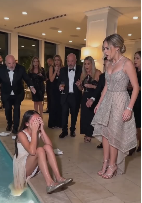
For one frozen second, all I heard was water dripping from my hair onto the stone tiles around the courtyard pool. My thrifted evening dress clung to my knees. The careful stitches I had made along the waist pulled tight and crooked. One of my clean flats floated near the pool steps like it had given up before I could.
Helena Carrington stood above me with one hand still lifted, her bracelet glittering under the terrace lights.
She looked beautiful.
That made it worse.
Not because beauty mattered, but because everyone had been trained to forgive it first.
The donor who had spoken was an older man with silver hair, a dark green dinner jacket, and a voice calm enough to scare people. His name card read Lord Adrian Whitcombe. He pointed at the staff tablet in the coordinator’s hands.
“Why,” he repeated, “did Helena Carrington try to bury this?”
The coordinator, Marta Eder, swallowed hard. Her eyes flicked toward Helena’s father, then back to the screen.
“The repair journal confirms,” Marta said, voice trembling, “that Isla Moreau restored the antique projector’s timing wheel after midnight. Without her correction, tonight’s ceremonial screening could not have happened.”
My name.
Not Ivy. Not the wrong name printed on the volunteer badge someone had lazily handed me at check-in.
Isla Moreau.
The name I had written at the bottom of the repair journal with my own shaking hand.
Helena laughed.
It was a brittle sound, polished and cruel. “She tightened a wheel. Are we applauding maintenance now?”
A few guests shifted uncomfortably.
Marta turned the tablet outward, and the screen glowed in the dim courtyard. There were my notes. My sketches. The final calibration numbers. The time stamp from 12:43 a.m.
And under them, in the official archive app, a red warning banner:
Unauthorized deletion attempt blocked. User: Helena Carrington.
The courtyard changed.
Not loudly. Not honestly.
But the air turned.
Helena’s smile cracked at one corner. “That is a system error.”
Lord Whitcombe stepped closer. “Then you will not mind if we open the full file.”
Helena’s mother, Vivienne Carrington, rose from the nearest table so fast her chair scraped the stone.
“There is no need to humiliate anyone,” Vivienne said.
I almost laughed.
I was standing soaked in a ruined dress while her daughter’s fingerprints were still fresh on my humiliation.
Marta hesitated with her finger over the tablet.
Then a quiet voice spoke from beside the old projector display.
“Open it.”
Everyone turned.
An elderly woman stood near the velvet ropes. She wore a plain black gown, no diamonds, no pearls, only a small bronze brooch shaped like a key.
Helena went pale.
Vivienne whispered, “Elspeth.”
The old woman looked straight at me.
Her eyes were gray and steady.
“Open the file,” she said again. “The girl in the pool is the only one here who earned the truth.”
Part 3: The Name Hidden Inside The Archive
Marta tapped the screen.
The file opened.
At first, it was just more proof of the repair: photographs of the antique projector’s brass housing, a scan of the cracked timing wheel, a message from the technician saying the ceremony would be canceled unless the fault was corrected before dawn.
Then Marta scrolled lower.
A second folder appeared beneath my repair notes.
It was labeled:
Carrington Private Transfer — Restricted Provenance File.
Helena stepped forward. “That is not part of the ceremony.”
Lord Whitcombe blocked her path without touching her. “It appears to be part of the evidence.”
Vivienne’s face sharpened. “Adrian, do not involve yourself in family matters.”
Elspeth gave a soft, humorless laugh. “You involved the whole room when your daughter shoved a girl into a pool to protect a lie.”
Water ran down my sleeve and dripped from my fingertips. I wanted to climb out with dignity, but dignity is hard when people are staring at your soaked dress and your bare foot on a pool step.
A young waiter named Tomas rushed forward with a linen tablecloth. He wrapped it around my shoulders like it was a royal cloak instead of someone’s emergency kindness.
“Thank you,” I whispered.
He nodded, jaw tight, eyes refusing to look away from Helena.
Marta opened the restricted folder.
The screen asked for a secondary confirmation.
Elspeth reached into a small velvet purse and removed an old metal token, flat and dark with age. “Use this.”
Marta looked stunned. “Madam, that is an archive key.”
“It belonged to my sister,” Elspeth said.
Vivienne whispered, “Stop.”
But Marta pressed the token against the tablet scanner.
The file unlocked.
A photograph filled the screen.
Three women stood in front of a workshop in Florence, their sleeves rolled up, their hands stained with oil and brass dust. Behind them sat the same antique projector, younger and gleaming.
The woman on the left looked like Elspeth.
The woman on the right looked like she belonged to another century.
The woman in the middle had my eyes.
My stomach dropped.
Marta read the caption aloud.
“Florence, 1989. Restoration team: Elspeth Vale, Beatrice Carrington, and Amara Moreau.”
My grandmother’s name slammed into me so hard I gripped the pool edge.
Amara Moreau.
My mother rarely spoke of her. Only that she had been brilliant, stubborn, and gone too soon.
Elspeth looked at me with tears in her eyes.
“Your grandmother did not just repair that projector,” she said. “She built the restoration method that made the Carrington collection famous.”
Helena’s voice came out thin. “No.”
Elspeth turned toward her. “Yes.”
Vivienne reached for Helena’s arm, but Helena jerked away.
Lord Whitcombe leaned toward the tablet. “Why was this file restricted?”
Elspeth’s face hardened.
“Because the Carringtons did not buy the projector,” she said. “They stole the credit attached to it.”
Part 4: The Mother Who Arrived Too Late
The ballroom doors opened behind the courtyard, and my mother stepped into the light.
She was still wearing her work coat.
Not a gala coat. Not something dramatic or expensive. Just the navy wool coat she wore to the museum gift shop when the morning air was cold. Her hair had come loose from its clip, and her cheeks were flushed like she had run from the tram stop.
“Isla.”
I had never been more relieved and more embarrassed at the same time.
She saw me wrapped in a tablecloth, soaked and shaking by the pool.
Then she saw Helena.
My mother’s face changed in a way I had never seen before. The softness vanished. The tiredness vanished. What remained was grief sharpened into a blade.
“What did you do to my daughter?”
Helena opened her mouth.
Nothing came out.
Vivienne stepped between them. “Clara, please. This has become unnecessarily dramatic.”
My mother stared at her. “You know my name now?”
Vivienne’s lips pressed together.
Elspeth moved closer to my mother. “Clara.”
My mother looked at the old woman with an expression that nearly broke me. Recognition. Pain. A locked room opening.
“Aunt Elspeth,” she whispered.
The room erupted in whispers.
Aunt.
Helena looked from Elspeth to my mother, then to me. “That is impossible.”
“No,” my mother said. “It was inconvenient. That is different.”
Lord Whitcombe turned to Vivienne. “You knew who Isla was.”
Vivienne’s silence answered before she did.
My mother walked to the tablet and touched the edge of the screen like it might burn her.
“My mother worked for the Carrington foundation when she was young,” she said. “She believed restoration was a form of memory. She trusted Beatrice Carrington with her designs.”
Elspeth’s eyes filled. “And Beatrice signed them away.”
“Not signed,” my mother said.
She reached into her coat and removed a folded plastic sleeve.
Inside was an old letter, yellowed along the creases.
“My mother kept the rejection notice,” she said. “The foundation said her work was unoriginal and terminated her contract. Three months later, the same restoration method appeared under the Carrington name.”
Vivienne’s voice turned icy. “Old disappointments do not prove theft.”
My mother slid another page from the sleeve.
“This does.”
Marta took it, scanned it with shaking hands, and connected it to the projector screen beside the stage.
A signature appeared in enormous black script above the courtyard.
Beatrice Carrington.
Then below it, faint but clear, another signature had been scraped away.
Amara Moreau.
Elspeth covered her mouth.
My mother looked at Vivienne and said, “Your family erased my mother before you tried to erase my daughter.”
Part 5: The Projector Showed The Missing Minute
Vivienne Carrington did not crumble.
That was the frightening thing.
Her daughter looked shaken. The donors looked horrified. Even Lord Whitcombe had gone pale under the terrace lamps.
But Vivienne only adjusted the cuff of her ivory sleeve.
“You are emotional,” she said to my mother. “That is understandable. But this event concerns a charitable screening, not your family’s old resentment.”
My mother’s hand found mine under the damp tablecloth.
Her fingers were cold.
I squeezed them.
Elspeth stepped toward the antique projector. It stood on its velvet platform, brass polished bright, reels mounted like two watchful eyes.
“The screening has not begun,” she said. “Perhaps it should.”
Marta looked alarmed. “The ceremony is suspended.”
“No,” Elspeth replied. “The ceremony has finally started.”
She took the bronze archive key and fitted it into a narrow slot hidden beneath the projector’s side panel.
A small click sounded.
Helena whispered, “What is that?”
Elspeth did not look at her. “The missing minute.”
The machine hummed.
The courtyard lights dimmed automatically. Guests turned toward the white screen behind the podium. I stood barefoot on cold stone, damp hair sticking to my neck, unable to breathe.
The projector flickered.
At first, the film showed only grainy light. Then a workshop appeared: Florence, decades earlier. Brass tools. Wooden drawers. A younger Elspeth laughing silently at something off camera.
Then my grandmother stepped into frame.
Amara Moreau.
She was younger than my mother was now, wearing a work apron, her dark hair pinned back messily. She held the projector casing open and pointed to the exact timing wheel I had repaired.
The room watched as she demonstrated the mechanism, her hands quick and confident.
Then Beatrice Carrington entered the frame.
The smile on her face looked almost kind.
The film jumped.
The image changed.
Now Beatrice stood alone at the workbench at night. She removed pages from Amara’s notebook. She folded them into her coat.
A sound passed through the guests.
The film flickered again.
A man appeared in the doorway behind Beatrice, catching her in the act. He was tall, with a narrow face and a worker’s cap tucked under one arm.
My mother made a terrible sound.
“Papa.”
My grandfather.
Beatrice turned.
The film cut to darkness for one second.
Then came audio, scratchy but clear.
Beatrice’s voice filled the courtyard.
“No one will believe a Moreau over a Carrington.”
My mother’s grip on me tightened until it hurt.
The film ended on a freeze-frame of my grandfather standing in the doorway, his face full of fear.
Then the screen went white.
Elspeth whispered, “He disappeared the next morning.”
Part 6: The Letter Beneath The Brass Plate
The silence after the film was worse than shouting.
My mother stood so still that I thought she might stop breathing. All my life, my grandfather’s absence had been shaped like a quiet family wound. A closed subject. A photograph in a drawer. A birthday never mentioned.
Now he was on a screen in front of strangers, trapped forever in the last recorded minute before he vanished.
Helena looked at her mother. “Did you know?”
Vivienne’s face remained controlled, but her eyes moved too quickly.
“Do not be childish,” she said.
That answered everything.
Helena stepped back from her like Vivienne had become something poisonous.
Lord Whitcombe spoke first. “Where is the original notebook?”
Vivienne laughed softly. “You cannot possibly expect me to know that.”
Elspeth turned to me. “Isla, when you repaired the timing wheel, did you remove the lower brass plate?”
I wiped water from my cheek, confused. “Yes. It was warped.”
“Did you see anything beneath it?”
“No. Just old glue and a manufacturer’s stamp.”
Elspeth’s eyes sharpened. “Not glue.”
She moved to the projector, but her hands trembled too badly to manage the screws.
I stepped forward.
My dress was ruined. My hair was wet. My legs were shaking.
But the machine was familiar.
The one thing in that room that did not scare me.
Tomas brought the tool roll from the display table without being asked. I took the smallest screwdriver and knelt beside the projector. The stone bit cold into my knees.
Helena watched me from a few feet away, tears shining on her face now.
Not pretty tears.
Real ones.
I removed the brass plate.
Under the edge, where I had thought there was dried adhesive, sat a thin strip of folded oil paper, flattened against the base.
My hands went numb.
Marta crouched beside me with an evidence sleeve.
I lifted the paper carefully.
Elspeth whispered, “Amara always hid things where only repairers would look.”
Marta unfolded the paper.
The writing was small, cramped, and faded, but it was there.
My grandfather’s hand.
Marta read aloud.
“If I do not return, Beatrice Carrington has taken Amara’s notebook and threatened to ruin the Moreau name. I have hidden the duplicate microfilm beneath the rear counterweight. Clara must know her mother’s work was not lost.”
My mother covered her mouth.
I looked at the machine.
Rear counterweight.
I knew exactly where it was.
I reached inside the projector housing and felt along the dark metal curve until my fingers brushed a tiny ridge.
Something clicked loose.
A metal capsule rolled into my palm.
Inside was a strip of microfilm.
Vivienne finally lost her calm.
“Take that from her.”
No one moved.
So Helena did.
She stepped between her mother and me.
“No,” she said, voice shaking. “Not again.”
Part 7: The Daughter Who Turned The Key
Vivienne stared at Helena as if she had slapped her.
Maybe she had.
Not with a hand, but with something worse.
Choice.
“You do not understand what you are doing,” Vivienne said.
Helena’s chin trembled. “I understand enough.”
“You understand nothing. You were raised by the name that protects you.”
Helena looked at me, then at my ruined dress, my wet hair, my mother kneeling beside me with tears running silently down her face.
“No,” Helena said. “I was raised by a name that protected itself.”
The courtyard doors opened again, and two officers entered with a woman in a dark suit. She introduced herself as Inspector Renata Weiss from the financial crimes unit.
Marta must have called them before any of us noticed.
Vivienne’s face hardened instantly. “This is a private event.”
Inspector Weiss looked around at the cameras, donors, staff, and a soaking girl holding evidence beside an antique projector.
“Not anymore.”
Lord Whitcombe handed over the tablet. Marta gave the inspector the letter. Elspeth surrendered the archive key. I placed the metal capsule into an evidence tray with hands that would not stop shaking.
Inspector Weiss studied Vivienne. “We have an emergency preservation order from the Viennese court regarding the Carrington Foundation’s continental holdings.”
Vivienne blinked.
For the first time all night, she looked afraid.
“You cannot have that already,” she said.
Elspeth’s mouth curved faintly. “I requested it this morning.”
Vivienne turned on her. “You bitter old woman.”
“No,” Elspeth said. “I am the last witness you forgot to frighten.”
The inspector nodded to one officer.
Vivienne’s gaze snapped to Helena. “Say nothing.”
Helena flinched.
For a second, I thought she would obey. She had the look of someone trained to shrink behind beauty, manners, and family money. Someone who knew punishment without needing it explained.
Then she bent down and picked up the donor speech from the podium.
The one she was supposed to give after ruining me.
She turned the pages with trembling fingers.
“This speech says my family preserved forgotten art,” she said. “It says we protect legacy.”
Vivienne’s voice was low and sharp. “Helena.”
Helena tore the speech in half.
The sound was small.
The effect was enormous.
She looked at Inspector Weiss.
“I tried to delete the repair file,” she said. “My mother told me to. She said if Isla’s name stayed in the log, people would ask why a Moreau knew the machine better than any Carrington technician.”
Vivienne whispered, “You foolish girl.”
Helena’s face crumpled.
But she kept going.
“And I shoved her because I was jealous that the truth chose her first.”
Part 8: The Girl The Machine Remembered
By dawn, the gala had become a room of evidence.
The flowers drooped in their silver bowls. Candle wax hardened on white linen. The pool lights glowed beneath the water where my flat had finally been rescued and set beside its match to dry.
Vivienne Carrington left through the side corridor between two officers, her ivory gown still perfect, her face still lifted.
No one clapped.
No one defended her.
That was the first justice the night gave us.
Helena stayed behind.
She sat alone on the lowest terrace step, wrapped in a gray coat someone had thrown over her shoulders. Without her perfect posture, she looked younger. Not innocent. Not harmless. Just young enough to finally understand she had broken something she could not buy back.
My mother and I sat beside the projector.
Elspeth placed the bronze key in my palm.
“This belongs with your family now.”
I stared at it. “I do not even know what that means.”
“It means you get to decide.”
My mother brushed damp hair away from my face. Her fingers paused near my cheek, where Helena’s shove had left a faint mark against my skin.
“I am sorry,” she whispered.
I turned to her. “For what?”
“For hiding the name. For thinking silence was safer than truth.”
I looked at the projector, its brass plate still open, its hidden chamber exposed.
“Maybe silence only works until someone opens the machine.”
My mother gave a broken laugh and pressed her forehead against mine.
Three months later, the court froze the Carrington Foundation’s disputed collection.
Six months later, the Moreau Restoration Trust reopened my grandmother’s old workshop in Florence, not as a private archive for wealthy families, but as a training studio for students who could not afford to enter rooms like the one where I had been humiliated.
Elspeth taught documentation.
My mother taught conservation ethics.
Tomas became the studio assistant after admitting he had always wanted to repair old cameras more than carry champagne.
And Helena came on the first Monday of every month.
Not as a donor.
Not as an heiress.
As the person assigned to catalog every stolen credit line the Carringtons had buried.
She never asked me for forgiveness in public. That mattered. Public apologies are too often performances, and she had already performed enough.
One evening, after everyone left, she placed a typed page on my workbench.
It listed my grandmother’s name beside the projector.
Original restoration method: Amara Moreau.
Recovered by: Clara Moreau and Isla Moreau.
Witnessed by: Helena Carrington.
Her voice shook when she said, “I wanted my name on everything.”
I looked at the page for a long time.
Then I said, “Now it is on the truth.”
On the opening day of the workshop, we displayed the repaired antique projector in the front hall. Not behind velvet ropes. Not above anyone. Just under a warm lamp, with its brass plate open enough for visitors to see where the hidden letter had waited for years.
Beneath it, we framed one page from the repair journal.
The final entry.
My entry.
The one Helena had tried to delete.
And under my signature, Elspeth added a bronze plaque with seven words:
The machine remembered what power tried to erase.
