THE BOOT PRINT BEHIND HIM
I reached through the fence, and that was when I saw the second muddy boot print behind him.
It was not Michael’s.
I knew that before my brain had time to argue with me.
Michael’s boots were government-issued, worn down at the heel from the way he walked, one side always scuffed worse than the other because he dragged his right foot when he was tired. I had teased him about it a hundred times.
This print was sharper.
Bigger.
Fresh.
It was pressed deep into the mud behind the loading dock, pointing away from Michael’s body and toward the back gate.
My hand froze against the fence.
Ranger made a sound I had never heard from him before. Not a bark. Not a whine. Something low and broken, like he was trying to tell every person in the alley that he had already done everything he could.
Michael’s fingers tightened around the bracelet from my baby shower.
It was blue and white, plastic beads with one tiny silver charm shaped like a star. He had kept it in his pocket since the party, saying he wanted to carry “proof that somebody good was coming.”
Now that bracelet was muddy in his hand.
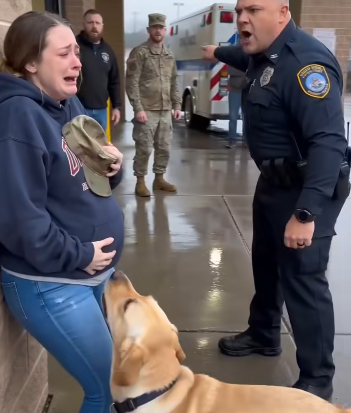
And his Army cap was at my feet.
“Michael,” I said, my voice shaking so badly it barely sounded like me. “Baby, stay with me.”
His eyes moved just a little.
Not enough.
But enough.
The security guard finally stopped yelling about rules and started yelling for help.
“Medic! We need a medic behind loading!”
He grabbed his radio with one hand and the bent fence with the other, trying to pull the panel up.
“Ma’am, step back.”
“No.”
“Ma’am, you’re pregnant. Step back now.”
I looked at him through tears.
“My husband is under that fence.”
The guard’s face changed.
Not soft.
Serious.
He stopped talking to me like I was a problem and started talking like every second mattered.
“Okay. Stay where I can see you. Do not crawl through. Help is coming.”
Ranger ignored him.
He flattened himself and pushed his body halfway under the bent panel, trying to get back to Michael. The guard grabbed his collar.
“Dog, no.”
Ranger fought him for one second, then stopped when Michael whispered something.
It was barely a breath.
“Ranger.”
The dog dropped instantly.
Right there in the mud.
He laid his head beside Michael’s shoulder and didn’t move again.
I pressed my fingers through the fence until they touched Michael’s sleeve.
“I’m here,” I said. “I’m right here.”
His eyes flickered.
“Cap,” he whispered.
I looked back.
His muddy Army cap lay by my foot, brim bent, the embroidered name dark with dirt.
“I have it,” I said.
“No,” he breathed. “Inside.”
The guard looked at me.
“What did he say?”
I reached down with shaking fingers and picked up the cap.
At first I thought he meant the lining, maybe some note, maybe his ID. My hands were slick with fear and sweat. My belly tightened hard enough that I had to stop and breathe through it.
“Ma’am?” the guard said.
“I’m okay,” I lied.
I turned the cap over.
Inside, tucked under the sweatband, was a folded piece of paper.
Not old.
Not something Michael had forgotten.
It was damp and muddy at the edges, but still readable.
I pulled it out carefully.
The first thing I saw was a name.
Not Michael’s.
Sergeant Dale Whitaker.
Below it, in Michael’s handwriting, were three words:
He followed me.
My stomach dropped.
The alley tilted.
I looked through the fence at my husband, and suddenly the second boot print behind him was not just a boot print.
It was a sentence.
A warning.
A witness.
The guard saw my face.
“What is that?”
I handed him the paper without letting go of Michael’s sleeve.
“He said it was in the cap.”
The guard read it once.
Then again.
His jaw hardened.
He spoke into the radio, voice lower now.
“Possible assault behind loading. Need police response. Preserve scene. Repeat, preserve scene.”
Possible assault.
The words landed beside me like heavy stones.
Until that moment, part of me had been trying to make it anything else.
A fall.
A medical emergency.
A terrible accident.
Something awful, but clean.
But Ranger had not come running with the cap because Michael misplaced it.
Michael had hidden a name in that cap.
And someone had left a boot print behind him.
Two medics came through the loading dock doors with a stretcher. One of them ducked under the fence after the guard lifted the bent panel just enough. The other looked at me and immediately said, “Ma’am, sit down.”
“I’m fine.”
“You’re eight months pregnant and shaking. Sit.”
I almost argued.
Then Michael made a weak sound, and every argument left my body.
A nurse appeared behind me with a wheelchair, the same kind they had offered me inside the hospital when I first arrived and I had refused because sitting down made everything feel too real.
This time I sat.
Not because I was calm.
Because I needed my hands free to hold the cap.
The medics worked around Michael quickly. No panic. No wasted motion. Ranger stayed where he was until one medic gently said, “Buddy, we need space.”
Ranger looked at Michael.
Then at me.
“Come here,” I whispered.
He crawled backward from under the fence and came to me with mud all over his chest. He put his head in my lap, right on Michael’s cap, and I broke.
Not loudly.
Not dramatically.
Just one ugly, silent sob that came from somewhere below my ribs.
“You found him,” I whispered into Ranger’s ear. “You found him.”
The medic closest to Michael looked up.
“Ma’am, he’s conscious. We’re taking him inside now.”
“Is he—”
“He’s alive. That’s what I can tell you right now.”
Alive.
The word was small.
The word was everything.
As they lifted Michael onto the stretcher, his hand opened just enough for the bracelet to slip against his palm. A medic tried to move it aside, but Michael’s fingers closed again.
“He wants that,” I said.
The medic nodded.
“Then he keeps it.”
Ranger stood when they rolled him past us. He didn’t bark. He didn’t jump. He just followed, close enough that the guard had to walk beside him and say, “Okay, okay, I get it, you’re family.”
Inside the hospital, everything became bright and too cold.
The cap stayed in my hands.
The note went into an evidence bag.
The guard, whose name tag said Harris, stood near the hallway while a hospital police officer arrived and asked me questions I could barely answer.
“When did you last see your husband?”
“This morning.”
“Was he here for an appointment?”
“Yes. Follow-up. VA paperwork. He said he had to talk to someone after.”
“Did he mention Sergeant Whitaker?”
My fingers tightened on the cap.
“Yes.”
The officer looked up.
I swallowed.
“He said Whitaker had been pushing him to change something in his statement. Something about an incident during deployment. Michael said he wasn’t going to lie.”
The officer’s pen paused.
“Did he say that today?”
“Last night. And again this morning before we left.”
Ranger leaned against my leg.
I looked down at him.
“He was nervous. Michael doesn’t get nervous like that. He gets quiet. He kept checking the doors.”
Harris, the security guard, stepped forward.
“I saw the dog come from the loading area with the cap. The dog led her to the fence. There was another boot print near the victim. I called it in.”
The officer nodded.
“We’ll secure the area.”
I looked toward the doors where they had taken Michael.
“Can I see him?”
“Not yet,” the nurse said gently. “They’re assessing him. As soon as they can, someone will update you.”
Waiting again.
That same useless word.
Only now waiting had mud on it.
Waiting had a boot print.
Waiting had my husband’s handwriting folded inside an Army cap.
I lowered my head and pressed the cap against my chest.
That was when I saw something else.
A smear under the brim.
Not mud.
Ink.
I turned the cap slightly.
There, along the inside seam, Michael had written another line. Smaller. Rushed.
If I don’t come back, trust the dog.
I stared at it until the letters blurred.
Trust the dog.
He knew.
Maybe not everything.
Maybe not how bad it would get.
But he knew enough to put the truth in the one place he believed would find me.
Not a locker.
Not a file.
Not a phone someone could take.
Ranger.
Our muddy, stubborn, soft-eyed Labrador who had never once let Michael leave the house without bringing him one shoe, one sock, one ridiculous offering like he was sending him into battle properly equipped.
Today he had brought me an Army cap.
Not as a gift.
As evidence.
The hallway doors opened, and a doctor came out.
I stood too fast.
The nurse caught my elbow.
The doctor looked tired, serious, but not hopeless.
“Mrs. Hayes?”
“Yes.”
“Your husband is stable for now. He’s asking for you.”
My knees almost gave out.
Ranger rose with me.
The doctor looked at him.
“Service animal?”
“He’s our dog.”
Harris said from behind me, “He’s also the reason we found the patient.”
The doctor hesitated.
Then looked at my face.
“Two minutes. Dog stays calm.”
“Ranger,” I whispered, “heel.”
He walked beside me like he had trained his whole life for that hallway.
Michael looked smaller in the hospital bed.
That was the first thing that hurt.
My Michael, who filled doorways, who laughed too loud at Longhorns games, who put jars on the top shelf just so I would call him into the kitchen and he could kiss my forehead.
He looked smaller.
But his eyes opened when I came in.
“Em,” he whispered.
I bent over him carefully, one hand on my belly.
“I’m here.”
His gaze moved down.
“Baby?”
“Still kicking. Still stubborn.”
A tiny smile touched his mouth and disappeared.
“Ranger?”
The dog came up beside the bed and rested his chin near Michael’s hand. Michael’s fingers moved just enough to touch his head.
“Good boy,” he breathed.
Ranger closed his eyes.
I held up the cap.
“I found the note.”
Michael’s face changed.
Fear.
Not for himself.
For me.
“Whitaker,” he whispered.
“I told them.”
He closed his eyes.
“He wanted the bracelet.”
I looked at the blue and white beads still around his fingers.
“The bracelet?”
Michael swallowed with effort.
“USB charm.”
The room went still.
I looked closer.
The tiny silver star on the baby shower bracelet.
The charm.
I had thought it was just decoration.
Michael had carried it for weeks.
My hand shook as I touched it.
The doctor stepped forward.
“Mrs. Hayes, don’t remove anything yet.”
Michael’s eyes opened.
“Evidence,” he whispered.
The doctor nodded slowly.
“I understand.”
I looked at my husband.
“What is on it?”
He stared at me with everything he had left.
“Recording. Statement. Names.”
A chill moved through me.
“About Whitaker?”
He blinked once.
Yes.
Footsteps sounded outside the room. Harris spoke in the hallway. Another voice answered, deeper, sharper.
Then the door opened.
A man in a pressed uniform stood there with two hospital administrators.
He was tall, clean-cut, and dry.
Too dry.
His boots were polished except for one dark smear near the sole.
My eyes dropped to it.
Mud.
Ranger saw him and changed instantly.
The dog did not bark.
He stood.
Shoulders tense.
Body between the man and Michael.
The man looked at Ranger, then at me.
“Mrs. Hayes,” he said. “I’m Sergeant Whitaker. I heard there was an incident.”
Michael’s hand tightened around the bracelet.
The doctor looked from Michael to the man in the doorway.
I felt my whole body go cold.
“You should leave,” I said.
Whitaker’s expression barely moved.
“I’m here to check on a soldier.”
“No,” I said. “You’re here because he wrote your name in his cap before he ended up behind a dumpster.”
The administrators froze.
Harris stepped into the doorway behind Whitaker.
“Officer is on the way back,” he said.
Whitaker smiled lightly, like I was emotional.
Like I was pregnant and frightened and easy to dismiss.
“I’m sure there’s confusion.”
Ranger growled.
Low.
Final.
The room heard it.
Whitaker’s eyes flicked to the dog.
That was his mistake.
Not looking at Michael.
Not looking at me.
Looking at Ranger like he remembered him.
I saw it.
So did Harris.
“You’ve seen my dog before,” I said.
Whitaker’s smile thinned.
“This is a hospital. Lots of dogs come through.”
“Not behind the loading dock.”
The room went quiet.
The doctor stepped closer to the bed.
“Sergeant, I’m going to ask you to step outside.”
Whitaker looked at him.
“That won’t be necessary.”
Harris moved into the doorway.
“It is now.”
For a second, nobody moved.
Then Whitaker stepped back.
One step.
Not surrender.
Calculation.
Harris followed him into the hall.
The doctor closed the door.
I heard voices outside, low and tense.
Michael’s eyes were on me.
“Cap,” he whispered.
“I have it.”
“Dog knew.”
“I know.”
“Trust him.”
I looked down at Ranger.
His body was still facing the door.
Still guarding.
“I do,” I said. “I trust him more than anyone in this building right now.”
The doctor called in a nurse and hospital police. The bracelet was removed carefully, documented, and placed in evidence only after Michael nodded. The silver star charm opened with pressure from a tiny seam none of us would have noticed.
Inside was a micro drive.
The officer took it like it weighed a hundred pounds.
I watched it leave the room with the same terror I felt watching Michael vanish behind exam doors.
Because that little star was not just a charm anymore.
It was the reason Michael had held on.
It was why he had crawled close enough to the fence for Ranger to find him.
It was why someone had followed him.
The next hour came in pieces.
A detective arrived.
The loading dock was taped off.
The muddy boot print was photographed.
The cap was bagged after I kissed the brim.
Whitaker was asked to remain on site and then escorted away for questioning when the officer compared the mud on his boot to the scene.
I was not told everything.
Adults in uniforms love saying “ongoing investigation” like it is supposed to comfort you.
It did not comfort me.
Michael breathing did.
Ranger sitting beside his bed did.
The baby moving when I pressed my hand against my belly did.
At some point, a nurse brought me water and a blanket.
“You need to sit,” she said.
“I am sitting.”
“You need to breathe like you are sitting.”
I almost laughed.
Instead, I cried again.
Quietly.
Ranger came to me then, leaving Michael only after Michael whispered, “Go.”
He put his head against my belly.
The baby kicked.
Ranger lifted his eyes.
For the first time all day, his tail moved once.
Just once.
Michael saw it and gave the smallest smile.
“That’s our boy,” he whispered.
I didn’t know if he meant Ranger or the baby.
Maybe both.
Later, when the detective came back, his voice was careful.
“The drive contains audio and documents. Your husband’s statement appears to match what we found.”
I gripped Michael’s hand.
“And Whitaker?”
The detective paused.
“He is not allowed near this room. That is what I can tell you right now.”
It was not enough.
But it was something.
Michael turned his head toward me.
“I tried to call.”
“I know.”
“He took my phone.”
I closed my eyes.
Of course.
“But you had the bracelet.”
His fingers brushed mine.
“And Ranger.”
The dog’s ears lifted at his name.
Michael looked at him.
“Smartest soldier I ever served with.”
Harris, standing near the doorway, said, “No argument here.”
The room softened for one second.
Just one.
But I needed it.
That evening, after they moved Michael to a monitored room, the rain started outside. Big Texas rain. Loud against the hospital windows. The kind that makes streets shine and mud spread.
Ranger lay under Michael’s bed like he had been assigned there.
I sat beside them in Michael’s hoodie, my iced coffee long gone, his muddy cap replaced in my lap by a clean towel and a printed evidence receipt.
I stared at that receipt for a long time.
It listed the cap.
The note.
The bracelet.
The drive.
The boot print photographs.
Objects.
Just objects.
But each one told part of the truth.
The cap said Michael tried to warn me.
The note said he knew who followed him.
The bracelet said he protected the proof with the same hand that held our baby’s future.
The boot print said he had not fallen alone.
And Ranger…
Ranger said the truth can still find its way home with mud on it.
Michael woke near midnight.
“Em?”
“I’m here.”
“Cap?”
“They have it.”
“Good.”
He closed his eyes.
I thought he had drifted off again, but then he whispered, “Didn’t want you scared.”
I leaned close, anger and love twisting together in my chest.
“You sent our dog around a hospital with your muddy Army cap and a hidden note inside it.”
His mouth twitched.
“Okay. Bad plan.”
“The worst plan.”
“Worked.”
I looked at Ranger.
Then at him.
“Yeah,” I whispered. “It worked.”
Michael’s hand moved to my belly.
Our baby kicked under his palm.
His eyes filled.
“He’s okay?”
“He’s okay.”
“You’re okay?”
I took longer to answer.
Because okay felt too small and too far away.
“No,” I said honestly. “But I’m here.”
Michael nodded.
“That counts.”
I covered his hand with mine.
Outside the room, footsteps passed. Radios murmured. Somewhere down the hall, a machine beeped steadily.
Inside, my husband breathed.
My dog guarded.
My baby moved.
And the muddy Army cap that had started the whole nightmare was locked away as proof.
By morning, everyone would have questions.
Investigators.
Command.
Hospital administrators.
People who wanted timelines and statements and clean explanations for a dirty alley behind a VA hospital.
But I already knew the truth that mattered most.
Someone had tried to bury Michael’s warning behind a fence.
Ranger dug it out without digging at all.
He brought it home in his teeth.
And when the world told me to wait, my dog told me to follow.
So I did.
