Part 2: The Signature Blair Could Not Explain
Blair’s father did not answer the supervisor.
He stared at the tablet like the screen had personally insulted him.
The silence around the stage grew thick and strange. A moment earlier, everyone had been looking at my cheek, at my worn sleeves, at the place where Blair’s hand had made me feel smaller than the boxes I had carried all morning. Now every face had turned toward the official record.
My name glowed on the tablet.
Calliope Collins — final repair submitted 6:42 a.m.
Blair Kensington — duplicate signature added 7:18 a.m.
I heard someone whisper, “Duplicate?”
Blair’s father, Lord Adrian Kensington, stood beside the sponsor banner with one hand still resting on the back of his chair. His silver cufflinks caught the light. He looked polished, expensive, and completely cornered.
“That must be a clerical error,” he said.
The project supervisor, Mr. Soren Vale, did not move. “It is a locked contribution file.”
Blair found her voice. “She must have used my login.”
I almost laughed, but nothing came out.
My cheek burned. My throat hurt. My hands were still shaking so badly I had to press them against my skirt. I had spent three weeks repairing the handwriting-recognition archive after the scanner failed to read old letters written in fading ink. I had stayed late with cold fingers, labeled damaged pages, rebuilt the matching system, and fixed the final index before sunrise.
Blair had walked in wearing pearls and signed over it.
Mr. Vale tapped the screen again. “Your login was used after Calliope’s fix had already been saved.”
Blair lifted her chin. “Then she staged it.”
The room shifted.
Not all at once.
Just enough for me to feel the old fear return. Rich girls could slap you, lie about you, and still make people wonder whether you had somehow caused it.
Then a woman stepped out from the side of the museum floor.
She was elderly, thin, and dressed in a dark green coat with a brooch shaped like a folded envelope. Her white hair was pinned low at her neck, and when she walked, even Blair’s father straightened.
“Open the audit trail,” she said.
Mr. Vale looked relieved. “Lady Maren.”
Blair went pale.
Lady Maren Elvik stopped beside me, not Blair. She looked at my torn confidence like it was something physical on the ground and said softly, “Child, did you preserve the letter index?”
I nodded once.
She turned to the tablet.
“Then let us see who tried to bury the hand that saved it.”
Part 3: The Audit Trail Under The Letter Glass
Mr. Vale connected the tablet to the main screen above the stage.
The cheerful Community Day logo vanished. In its place appeared a plain audit trail, every entry stripped of decoration. No sponsor colors. No family crest. No donor photo. Just time, name, action.
Blair crossed her arms, but her fingers dug into the silk of her sleeves.
Lady Maren read the first line aloud. “Calliope Collins uploaded corrected ink-pattern model.”
The screen scrolled.
“Calliope Collins restored missing letter cluster.”
Another line.
“Calliope Collins marked final archive ready.”
The volunteers in matching T-shirts looked at me differently now. Some with guilt. Some with surprise. One girl near the school bus doors wiped her eyes. She had watched me carry boxes and never asked my name.
Then came the line everyone had been waiting for.
Blair Kensington changed contributor field.
The room seemed to shrink.
Blair laughed too loudly. “That does not prove I did anything wrong. My family paid for this entire project.”
Lady Maren’s cane struck the floor once. “Your family funded the hall. The work is not yours by purchase.”
Blair’s father stepped forward. “Maren, this is not appropriate for children and guests.”
“You should have thought of children,” Lady Maren said, “before your daughter struck one in public.”
The words landed cleanly.
Blair looked at her father, waiting for him to defend her. He did not look back. He was staring at the screen now because Mr. Vale had opened a second tab.
“Why is there a deleted note?” Mr. Vale murmured.
My heart tightened.
“What note?” I asked.
The screen changed again.
A small internal message appeared, recovered from the project dashboard.
Keep Calliope off the opening stage. Blair needs the family-facing moment.
Blair’s lips parted.
Lord Kensington said sharply, “Who authorized showing internal communications?”
Lady Maren turned on him. “Who wrote them?”
No one spoke.
Mr. Vale enlarged the sender line.
Adrian Kensington.
A sound moved through the room, low and stunned.
My face went hot again, but this time it was not humiliation. It was the awful feeling of understanding that the slap had only been the visible part. The rest had been planned quietly in offices where people like me were called complications.
Blair whispered, “Father?”
He said, “I was protecting your future.”
Lady Maren’s expression hardened. “No. You were protecting a lie.”
Then the screen flickered.
A third folder appeared beneath the audit trail, one I had never seen before.
Recovered Correspondence — Collins Family Letters.
Lady Maren stopped breathing.
And Blair’s father finally looked afraid.
Part 4: The Letters My Mother Never Received
Mr. Vale hesitated before opening the folder.
Lord Kensington did not.
He moved toward the laptop fast, his polished shoes striking the museum floor with hard, desperate clicks. A security volunteer stepped in front of him before he reached the stage.
“This is outrageous,” he snapped.
Lady Maren did not take her eyes off the screen. “Open it.”
The folder unfolded into scanned letters, old and cream-colored, their edges darkened by time. My name was not on them. Not at first.
The first was addressed to Emilia Collins.
My mother.
My stomach dropped.
“That is my mum,” I said.
The words sounded too small for the room.
Lady Maren gripped the top of her cane. “I wrote to her.”
I turned toward her. “You know my mother?”
Her eyes filled, but she did not cry. “I knew your grandmother.”
The screen showed letter after letter. Some were from Lady Maren. Some were from a trust office in Bergen. Some were marked returned. Others were stamped undelivered, though the addresses were correct.
One line had been highlighted in red.
The Collins descendant must be contacted before the handwritten-letter archive is publicly launched.
I stepped back.
The stage lights suddenly felt too bright. I had come to place the first handwritten letter on the podium, not to watch my mother’s name appear in a hidden file in front of strangers.
Blair stared at the letters like she had stumbled into a room in her own house she had never known existed.
“What is this?” she asked.
Lady Maren’s voice was quiet. “The archive was not founded by the Kensington family.”
Lord Kensington said, “Do not.”
She continued anyway.
“It was founded by Isolde Collins, a schoolteacher who carried refugee letters across borders when governments and families tried to erase them.”
The old museum floor seemed to tilt beneath me.
My grandmother had told stories about folded paper hidden in coat linings. My mother had always said they were family legends, beautiful but impossible to prove. We had been too busy surviving rent increases and broken heaters to chase history across countries.
Lady Maren pointed to the file. “The launch required a Collins representative. We searched for Emilia, but the letters disappeared.”
Mr. Vale opened the final scan.
It was not old.
It was recent.
A note from Lord Kensington to the archive office.
Do not contact Emilia Collins. Her daughter is already volunteering. Keep her useful, not visible.
The room went silent.
Blair looked at me.
For the first time, she looked ashamed.
Then the display case beside the podium gave a sharp electronic beep.
The glass lock opened by itself.
And the original letter inside began sliding out of its protective frame.
Part 5: The Original Letter Nearly Vanished
Everyone moved at once.
Mr. Vale lunged toward the display case. Lady Maren cried out. A security volunteer grabbed the velvet rope, but the case mechanism had already released the inner tray.
The original handwritten letter—the one I was supposed to place on the podium—tilted forward.
My body reacted before my brain caught up.
I ran.
The floor blurred beneath my worn shoes. I reached the case just as the letter slipped from its support. It fluttered down, fragile and pale as a moth. I caught the lower edge with both hands, barely breathing.
“Do not fold it,” Lady Maren warned.
“I know,” I whispered.
Because I did know.
I had spent days training myself to handle scanned copies without pressure marks. I knew the paper had been weakened by old damp. I knew the ink at the center line could flake if touched wrong. I knew this letter had survived too much to be ruined because a rich man panicked.
The room watched me hold history between trembling fingers.
Mr. Vale brought a flat preservation board. Together, we lowered the letter onto it.
Lady Maren came close enough to read the first line. Her mouth trembled.
“It is the first Isolde letter,” she said.
Lord Kensington’s face was gray.
Blair whispered, “Father, did you trigger the case?”
He did not answer.
A security volunteer checked the console behind the display. “Remote release was activated from the sponsor tablet.”
Every eye moved to the front table.
Lord Kensington’s tablet sat beside his untouched champagne.
Lady Maren looked at him with open disgust. “You would damage the founding letter rather than let her name be spoken?”
“I would protect this institution from chaos,” he said.
“No,” I said.
The word escaped before I knew I had chosen it.
Everyone looked at me.
The letter lay safe on the preservation board. My cheek still hurt. My clothes still marked me as the girl Blair thought belonged in the back. But the fear inside me had changed. It had become something steadier.
“You were willing to destroy proof,” I said, “because proof did not flatter you.”
Lord Kensington’s mouth tightened.
Blair stepped away from him.
Then Mr. Vale lowered his gaze to the letter and frowned.
“There is writing on the inside fold,” he said. “It was hidden by the frame.”
Lady Maren’s breath caught.
Mr. Vale lifted the magnifying camera above the page.
The screen filled with faded ink.
If the Collins line returns, the archive must be placed in their care.
Part 6: The Clause That Changed The Ceremony
Nobody clapped.
Nobody gasped.
The truth had gone past entertainment.
It had become responsibility.
Lady Maren read the hidden line twice, then pressed one hand over her heart. “Isolde wrote the same clause into the founding trust.”
Lord Kensington snapped, “That letter is not a legal document.”
A man from the back of the hall stepped forward, carrying a leather folder. “No, but this is.”
He was younger than the other trustees, with tired eyes and a loosened tie. He introduced himself as Henrik Madsen, legal counsel for the archive. His voice shook just slightly as he opened the folder.
“I was instructed to keep this sealed unless a Collins descendant was verified.”
My mouth went dry.
“I am seventeen,” I said.
Henrik nodded gently. “Then stewardship cannot transfer to you fully tonight. But an interim board can be appointed with your family represented.”
“My family does not even know this is happening,” I said.
Lady Maren’s eyes softened. “Where is your mother?”
“At work.” My voice cracked. “She thought this was just a community ceremony.”
Mr. Vale immediately handed his phone to a volunteer. “Call her.”
Lord Kensington laughed coldly. “You cannot hand a historic archive to a child and a woman who cleans hotel rooms.”
The sentence split the room.
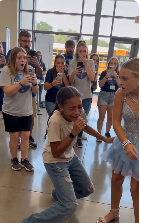
Blair flinched as if he had slapped her too.
I saw, suddenly, where she had learned it all. The cruelty. The certainty. The way she looked at people and sorted them into useful or embarrassing.
But she was looking at him now like she was seeing the machinery behind her own voice.
Lady Maren turned to Lord Kensington. “Isolde Collins was a schoolteacher. She founded this archive with borrowed shelves and repaired ink. Do not mistake wealth for qualification.”
Henrik placed the trust document under the camera.
The screen showed the clause in black ink, formal and undeniable.
Upon verified return of the Collins line, the Handwritten Letter Archive shall be governed for public education, never private prestige.
Mr. Vale looked at me. “Calliope, tonight’s ceremony cannot continue under the Kensington program.”
The sponsor banners suddenly looked ridiculous behind him.
Blair’s name on the printed schedule looked like a stain.
The announcer approached carefully. “What should we do?”
Everyone looked at me.
My heart pounded.
Then the side doors opened.
My mother entered in her work uniform, hair coming loose, face pale with panic.
“Calliope?” she called.
I turned toward her.
And the whole room saw my mother stop beneath a banner bearing the name of the family that had tried to erase ours.
Part 7: The Apology Blair Could Barely Say
My mother crossed the hall faster than I had ever seen her move.
She did not look at the trustees. She did not look at Lord Kensington. She did not look at the screen filled with old clauses and family history. She looked only at my face.
Her hand lifted toward my cheek, then stopped just before touching the red mark.
“Who did this?” she asked.
The room went colder.
I did not have to answer.
Blair made a small sound near the podium.
My mother turned.
Blair Kensington, who had walked toward me like royalty twenty minutes earlier, now looked smaller than anyone in the hall. Her perfect hair had loosened around her face. Her friends stood several steps behind her, no longer brave enough to hold their phones up.
“I did,” Blair said.
My mother’s jaw tightened. “Why?”
Blair looked at me.
For a second, I expected another lie. Some polished version. Some excuse about pressure or misunderstanding or feeling threatened.
Instead, she swallowed hard.
“Because I thought she was taking something from me,” Blair said. “But it was never mine.”
Lord Kensington barked, “Blair, stop.”
She turned on him with tears in her eyes. “No.”
That word sounded painful coming out of her, like it had scraped past years of obedience.
“I signed my name over hers,” Blair said, louder now. “I knew she fixed the archive. I knew the launch would fail without her. I told myself it did not matter because my family paid for the room.”
She looked at my mother.
“I am sorry.”
My mother did not soften.
“Do not apologize to me first,” she said.
Blair faced me.
The whole hall waited.
“I am sorry, Calliope,” she said. “For hitting you. For stealing your work. For thinking your silence meant I could take more.”
The apology did not undo the sting on my cheek. It did not erase the weeks I had spent doubting whether I should be grateful just to be allowed near the project. But it did something unexpected.
It made Lord Kensington furious.
“You foolish girl,” he hissed. “You have no idea what you are giving away.”
Blair wiped her face. “Good.”
Then she took the printed ceremony program from the podium and tore out the page with her name at the center.
“The launch should be hers.”
I shook my head. “Not mine alone.”
Everyone looked at me.
I turned toward the preservation board holding Isolde Collins’s letter.
“It should belong to every person whose words were kept when powerful people wanted silence.”
Henrik’s phone buzzed.
He read the message, then went pale.
“The police have arrived,” he said. “And they have a warrant for Lord Kensington’s archive office.”
Part 8: The First Letter Finally Reached Us
Lord Kensington did not run.
People like him rarely run at first.
They stand very still and expect the world to remember who they are.
Two officers entered through the museum doors, quiet and formal. They spoke to Henrik, reviewed the warrant, then approached Lord Kensington while the school buses waited outside and the volunteer banners sagged above a room that no longer belonged to him.
He smiled at them. “This is a misunderstanding.”
One officer said, “Then we will clear it up with the documents.”
His smile thinned.
They escorted him out past the sponsor table. No one applauded. No one jeered. The silence was better. It forced every person there to hear his shoes leave the museum floor.
Blair watched him go.
Then she sat down on the stage steps and covered her face with both hands.
My mother stood beside me, still in her work uniform, still breathing like she had run all the way from another life. Lady Maren approached her slowly.
“Emilia,” she said, voice breaking. “I wrote so many letters.”
My mother looked at the screen, then at the scanned envelopes bearing her name.
“I never got them,” she whispered.
“I know that now.”
Lady Maren opened a small case and removed one final envelope. Unlike the others, this one was not scanned. It was real, softened by age but carefully preserved.
“This was written by your grandmother to any Collins child who found the archive again.”
My mother’s hands shook as she took it.
“Read it,” I whispered.
She opened the letter with the kind of care grief teaches.
Her voice trembled over the first line, then steadied.
To the one who arrives late: you are not late. You are the proof the letter survived.
My mother stopped reading and pressed the page to her chest.
That was when I understood what the ceremony should be.
Not a sponsor launch.
Not a polished donor moment.
A delivery.
I looked at Mr. Vale. “Can we change the program?”
He nodded. “Tell us how.”
So we did.
The banners came down. The Kensington crest was removed from the screen. Volunteers carried the display table to the center of the hall. Blair stood silently and helped stack chairs, not asking anyone to praise her for finally doing work without a camera.
When the doors opened again, the students from the buses came inside.
This time, they were not watching a rich family unveil a project.
They were watching my mother place our ancestor’s letter onto the podium while Lady Maren stood beside her, crying openly.
Then Mr. Vale handed me the microphone.
My cheek still hurt.
My clothes were still worn.
But my voice did not shake.
“This archive was built because handwriting proves someone existed,” I said. “Tonight, my family found letters that were kept from us. So from now on, this project will not hide names to protect powerful people.”
I looked at Blair.
She lowered her head.
Then I looked at the students.
“The first public moment belongs to everyone who was told to stay in the back.”
My mother placed Isolde’s letter under the glass.
The screen behind us filled with the names of volunteers, restorers, students, cleaners, translators, and every person whose quiet labor had saved the archive.
My name appeared among them.
Not above them.
Among them.
Weeks later, the interim board made my mother its first community chair. Lady Maren funded a mobile letter lab that traveled to schools across Europe. Blair applied to volunteer and was assigned the least glamorous job: sorting damaged envelopes in the cold storage room under supervision. She showed up every Saturday, quiet, careful, and never once asked to touch the microphone.
On the wall of the archive, Mr. Vale framed the audit entry that had started everything.
Calliope Collins — final repair submitted 6:42 a.m.
But underneath it, my mother added Isolde’s line in her own handwriting.
You are not late. You are the proof the letter survived.
