Part 2: The Tablet Everyone Was Forbidden To Touch
The donor’s question fell across the buffet like a dropped blade.
Madison Ashford’s smile did not vanish all at once. It cracked slowly, starting at one corner of her painted mouth, then traveling through her cheeks until her whole face looked too stiff to belong to a living person.
“Turn that off,” she said.
The staff member holding the tablet, a nervous young man named Elias Berg, froze with both hands around the glowing screen. His bow tie sat crooked. His eyes darted toward the senior event director, then toward me, then back to Madison.
Nobody moved.
The fruit salad was cold against my skin. A piece of pear slid from my cheek onto the ruined turquoise fabric I had stitched by hand over three sleepless nights. I wanted to wipe my face. I wanted to hide. But the donor was still pointing at the tablet, and something in his voice had changed the room.
It was no longer gossip.
It was evidence.
“Why,” he repeated, quieter this time, “was this file not included in the printed program?”
Madison laughed once. It sounded sharp and fake. “Because it’s obviously a draft.”
The screen said otherwise.
At the top was the restoration journal, stamped with the seal of the European Cultural Heritage Trust. Under it were dates, photographs, notes, and my initials beside task after task. Fabric stabilization. Archive labeling. Donor exhibit sequencing. Emergency repair of the ceremonial gown.
The gown I was supposed to unveil.
The one Madison had told everyone her family had saved.
Elias swallowed. “Miss Ashford, this is the official archive copy.”
Madison spun toward him. “You are staff.”
He flinched.
Then the donor beside me, Lord Alistair Voss, stepped closer to the screen. He had white hair, a black velvet jacket, and the kind of calm that made rich people nervous.
“Staff,” he said, “are often the only people in a room who know the truth.”
A murmur passed through the gala.
Madison’s mother, Lady Camilla Ashford, rose from the head table. Diamonds flashed at her throat. Her expression was colder than the silver trays behind her.
“This is a private matter,” she announced. “The ceremony will continue.”
I finally wiped fruit from my face with the back of my hand. My fingers came away sticky. Across the room, a photographer lowered his camera as if even he understood that something uglier than humiliation had just happened.
Lady Camilla turned to me. “Farah, dear, go clean yourself up.”
Dear.
The word landed worse than the fruit.
I looked at her, then at Madison, then at the tablet still glowing in Elias’s shaking hands.
“No,” I said.
It was not loud. It did not need to be.
Madison’s eyes narrowed. “Excuse me?”
I took one step forward. My flats made almost no sound on the polished marble floor, but people shifted away as if I were carrying fire.
“I said no.”
Lady Camilla’s nostrils flared. “You are upset. Understandably. But you should not embarrass yourself further.”
Something inside me stopped trembling.
“My dress is already ruined,” I said. “So I don’t have much left to lose.”
Lord Voss looked at me, and in his eyes I saw something I had not expected.
Permission.
Not pity. Not kindness.
Permission.
I turned to Elias. “Open the attached video.”
Madison lunged.
Not far. Not enough to reach him. But enough for everyone to see panic beat manners out of her.
“Do not open that file.”
The room inhaled as one.
Elias stared at her.
Then he touched the screen.
Part 3: The Video Hidden Beneath The Archive Seal
The video began without music, without polish, without any of the expensive drama the gala had been built to sell.
It showed the back archive room in Vienna.
I knew it before anyone else did. The narrow shelves. The green-shaded desk lamps. The old wooden drawers with brass label plates. The cracked window where winter air always slipped through, no matter how tightly we sealed it.
And there I was on the screen.
Not dressed for a gala. Not smiling for donors. Just me in an oversized cardigan, hair pinned badly, bent over the ceremonial gown with a magnifying visor pushed low over my eyes.
A timestamp glowed in the corner.
Three months earlier.
Someone whispered, “That’s her.”
My throat tightened.
The video showed me lifting a piece of torn embroidered silk with tweezers, my hands moving carefully, patiently, like the gown could feel pain. Beside me, an older curator named Greta Weiss dictated notes.
“Farah Stone,” Greta’s voice said from the tablet speaker, “completed the stabilization plan after the Ashford file was found incomplete.”
Incomplete.
Madison made a sound under her breath.
The video cut to another clip. Me sleeping with my head on folded arms beside the archive table. A half-eaten sandwich sat near my elbow. Spools of turquoise thread lined the desk.
Then another clip.
Greta holding up the original donor registry.
“This proves the gown was not purchased by the Ashford family,” Greta said. “It was placed in trust by Countess Eliska Maren of Prague in 1932, under the condition that no private family could claim ownership.”
The room changed.
Not loudly.
It changed in the way people’s eyes sharpened when money smelled threatened.
Lady Camilla’s face went pale beneath her makeup.
Lord Voss turned toward her. “Camilla.”
She did not answer.
Madison’s voice sliced through the silence. “This is ridiculous. Some dusty old condition from ninety years ago has nothing to do with tonight.”
Greta’s recorded voice continued.
“If the trust condition is violated, stewardship transfers to the restoration worker named in the emergency preservation clause, provided that worker saved the object from preventable loss.”
My heart slammed so hard I almost missed the next line.
“Current named worker: Farah Stone.”
The tablet speaker crackled.
Then Greta’s face filled the screen, grave and tired.
“If this file is being played publicly, it means someone tried to remove Farah from the ceremony. I recorded this because I feared the Ashford family would erase her contribution after the restoration was complete.”
A chair scraped backward.
Madison’s mother whispered, “Enough.”
But Greta was not finished.
“She did not just mend the gown. She saved the trust from legal collapse.”
The words seemed to echo off the chandeliers.
Everyone looked at me.
I wished they would not. My dress was sticky. My cheek still burned from shame. My hands were shaking so badly I clasped them together in front of me.
Madison suddenly smiled again.
It was smaller now. Meaner.
“How touching,” she said. “A charity student with a helpful old woman. But Greta Weiss is dead, isn’t she?”
The room went cold.
I felt the sentence hit me in the ribs.
Greta had died six weeks earlier after sending me one final message: Do not let them rush the ceremony. Make them open the file.
Madison took one slow step toward me.
“So convenient,” she said, “that the only person supporting your story cannot answer questions.”
Lord Voss frowned. “Miss Ashford, be careful.”
Madison ignored him. Her eyes shone with something reckless.
“My family funded that archive for years. My mother knows the documents. Farah was a temporary assistant who got sentimental over old fabric.”
She turned to the donors with a wounded little laugh.
“Are we really going to let a girl in a stained homemade dress steal a historic European artifact because of a video?”
The first few guests looked uncertain.
That was all Madison needed.
She lifted her chin.
“Show them the contract,” she said to her mother.
Lady Camilla hesitated.
Madison’s smile trembled. “Mother. Show them.”
For the first time that night, I saw fear pass between them.
Then Lady Camilla reached into her clutch and removed a folded paper.
And my name was printed at the bottom.
Part 4: The Signature That Made Farah Look Guilty
Lady Camilla unfolded the paper as if she had been waiting all evening to cut my throat with it.
“This,” she said, holding it high enough for the nearest camera to catch, “is a release signed by Miss Stone.”
The whispers came back.
They were worse now because they carried doubt.
Elias looked at me helplessly. Lord Voss lowered his brows. Madison stepped aside like an actress making room for the final scene.
Lady Camilla read aloud.
“Farah Stone acknowledges that all research, repair notes, visual materials, and ceremonial rights produced during her temporary archive placement belong exclusively to the Ashford Cultural Foundation.”
My stomach dropped.
I had never signed that.
She lowered the paper toward me.
At the bottom, in blue ink, was my name.
Farah Stone.
A signature that looked almost like mine.
Almost.
Madison’s voice softened, poisonous and sweet. “You probably forgot. People like you sign things without understanding them all the time.”
Heat rose behind my eyes, but I refused to cry in front of her.
“That isn’t my signature.”
Lady Camilla sighed. “Of course.”
“It isn’t.”
“Then perhaps,” she said, “you would like to accuse a respected foundation of forgery in front of half its donors?”
I stared at the paper, at the curve of the F, the long line under Stone. Whoever had copied it had studied me. They had known how I wrote when I was tired.
A terrifying thought slid through me.
Someone had access to my notebooks.
Madison leaned closer, speaking just softly enough that only I could hear.
“You should have cleaned yourself up when my mother told you to.”
My fingers curled.
Then Lord Voss spoke.
“May I see the document?”
Lady Camilla hesitated for half a breath too long.
He noticed.
So did I.
“This is unnecessary,” she said.
“So was throwing fruit at the appointed presenter,” Lord Voss replied.
A few guests murmured approval.
Lady Camilla handed him the paper.
He examined it without touching the ink. Then he looked at the bottom corner.
“There is no notary mark.”
“It was an internal release.”
“No witness line either.”
“Our legal office—”
“Your legal office,” he interrupted, “is not a court.”
Madison’s confidence flickered, then hardened again. “Fine. Bring in the legal office.”
Lady Camilla turned sharply toward her daughter. “Madison.”
But Madison had gone too far to stop.
“Bring them in,” she repeated. “Let everyone see she signed it.”
The side doors opened.
A man in a dark suit entered with a leather folder under his arm. He was thin, balding, and sweating despite the cold air blowing from the vents.
I recognized him.
Niklas Bauer.
He had visited the archive twice. He had smiled at Greta. He had once offered me tea and asked where I kept my restoration notes.
My knees nearly gave.
Niklas walked to Lady Camilla’s side and bowed his head slightly.
“This is an unfortunate misunderstanding,” he said.
Lord Voss held up the paper. “Did you prepare this release?”
Niklas adjusted his cuffs. “Yes.”
“Did Miss Stone sign it in your presence?”
Niklas looked at me.
His eyes were empty.
“Yes.”
The room tilted.
Madison’s smile returned fully.
“There,” she said. “Can we please stop entertaining this little performance?”
I heard someone near the buffet whisper, “Poor girl. She really tried.”
Poor girl.
I looked at Niklas.
He looked away.
Then a memory struck me so hard I almost gasped.
Greta’s final message had not only said to open the file.
It had said: Trust the blue thread.
At the time, I thought grief had made her strange.
Now my gaze dropped to the ruined turquoise dress I had altered myself.
The dress I had repaired using leftover archival thread Greta had insisted I take.
Blue thread.
My hand flew to the hem.
Madison noticed.
“What are you doing?”
I found the tiny hidden pocket stitched inside the lining.
My fingers closed around something flat and hard.
A key card.
Greta had sewn it into the dress.
On its back, in her small careful handwriting, were four words.
Cabinet seven. Bottom drawer.
Part 5: The Drawer In Vienna Opened From Philadelphia
The key card felt warm in my palm, though that was impossible.
Everyone was staring at me now, but for once I did not care how I looked. Fruit on my cheek. Stain down my bodice. Hair slipping loose. None of it mattered.
Greta had left me a door.
I held up the card.
Niklas Bauer went gray.
Madison saw his face and snapped, “What is that?”
“A mistake,” Niklas said too quickly.
Lord Voss turned to him. “Yours?”
Niklas’s mouth opened. No sound came out.
Elias leaned toward me. “That’s an archive access card.”
Lady Camilla stepped forward. “Give it to me.”
I closed my fingers around it.
“No.”
Her eyes flashed. “That card belongs to the foundation.”
“Not anymore,” Lord Voss said. “Not until we understand why a deceased curator hid it in Miss Stone’s dress.”
Madison’s breathing had changed. The perfect rhythm of her cruelty was gone. She looked from her mother to Niklas, waiting for someone to regain control.
Nobody did.
Then an elderly woman at the second table lifted her phone. “My nephew works at the Vienna archive. I can call him.”
Lady Camilla’s head snapped toward her. “Please do not interfere.”
The woman smiled thinly. “I funded your east wing, Camilla. I will interfere where I like.”
Her name was Baroness Marta Keller, and within two minutes her nephew was on video call, squinting into the bright gala room from a dim archive office in Vienna.
Elias connected the call to the event screen.
The giant display above the stage lit up.
A young archivist named Tomas Keller appeared, surrounded by shelves. “Aunt Marta, what exactly is happening?”
Lord Voss answered before anyone else could. “We need cabinet seven, bottom drawer, using the emergency access card assigned to Greta Weiss.”
Tomas’s face changed.
“Greta’s card was reported missing after her death.”
“Not missing,” I said, stepping toward the screen. “Hidden.”
Tomas looked at me, then softly said, “You’re Farah.”
My breath caught.
“You know me?”
He nodded. “Greta talked about you. She said you were the only one who listened when the seams started telling the truth.”
The seams.
I almost smiled through the ache in my chest.
Tomas disappeared from view. We heard keys, footsteps, the groan of old metal. The gala watched a dark screen as if it were a verdict.
Madison whispered to her mother, “Stop this.”
Lady Camilla did not move.
Then Tomas returned holding a narrow archival box.
Dust clung to its edges.
The label read: Maren Gown Transfer Condition — Sealed Addendum.
Niklas backed away one step.
Lord Voss saw it. “Mr. Bauer?”
Niklas’s face shone with sweat.
Tomas opened the box.
Inside was a wax-sealed envelope, several photographs, and a smaller black drive taped beneath a card.
He lifted the card first.
His voice shook as he read.
“To Farah Stone, if they try to make your hands disappear from the history you saved.”
The room went utterly still.
The card continued.
“Inside this drive is the security copy of the meeting held in Prague, where Camilla Ashford and Niklas Bauer discussed replacing Farah’s authorship page with Madison’s name.”
Madison staggered backward as if the floor had moved.
Lady Camilla whispered, “Greta, you old fool.”
The microphone near the podium picked it up.
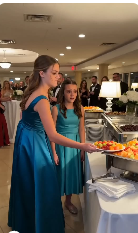
Every donor heard.
Every camera caught it.
Lord Voss’s voice was very quiet.
“Play the drive.”
Lady Camilla lunged for the tablet.
But this time, I moved first.
I stepped between her and the screen.
Part 6: The Prague Recording That Broke Her Mother
For one heartbeat, Lady Camilla and I stood so close I could see the tiny cracks in her pearl foundation.
She was taller than me. Richer. Protected by names carved into museum walls and donor plaques. But her hand stopped inches from my shoulder because every person in the ballroom was watching.
“Move,” she said.
“No.”
“You have no idea what you are damaging.”
I looked at Madison.
Her eyes were wet now, but not with remorse. With rage. With the fury of someone watching a mirror shatter.
“I know exactly what was damaged,” I said.
Behind me, Elias connected Tomas’s drive through the archive system. The screen flickered.
The Prague recording opened on a conference room with tall windows and rain sliding down the glass.
Lady Camilla sat at the head of the table.
Niklas sat beside her.
Madison was there too.
Younger by a few months. Same polished hair. Same expensive boredom. She was scrolling on her phone while her mother spoke.
Camilla’s recorded voice filled the gala.
“Farah Stone cannot be the face of this ceremony. She has no lineage, no public value, and no donor appeal.”
A few guests gasped.
The recording continued.
Niklas said, “The journal entries are already locked.”
“Then unlock them.”
“That creates a trail.”
Camilla leaned forward. “Then create a better trail.”
On the screen, Madison looked up from her phone.
“Just put my name on it,” she said. “Nobody cares who fixed the old dress.”
I felt the sentence go through me like cold water.
Not because it surprised me.
Because it did not.
Lord Voss’s jaw tightened.
Then came the worst part.
Niklas opened a folder and placed a scanned copy of my notebook on the table.
Madison laughed.
“She writes like she’s begging the paper to forgive her.”
The room around me blurred.
I had written those notes in cheap blue ink during winter mornings when my fingers were too stiff to bend. I had written them while Greta slept in the chair beside me, while radiators clicked, while snow turned Vienna quiet outside the windows.
They were not elegant.
They were work.
The recording showed Niklas tracing my signature with a pen.
Camilla said, “Make it close. Not perfect. Perfect looks forged.”
Madison leaned back in her chair.
“And if she complains?”
Camilla smiled.
“Then we remind her what girls without money look like when they accuse women like us.”
A chair crashed backward in the real ballroom.
Baroness Keller was on her feet.
“You venomous woman.”
Lady Camilla stood frozen, one hand still lifted, as if she had forgotten how to lower it.
The recording ended with Greta’s voice from somewhere near the door.
“You should be ashamed.”
The screen shook. Someone shouted. The video cut out.
Back in the gala, Niklas suddenly bolted toward the side exit.
Two security guards stopped him before he reached the curtain.
Madison whispered, “Mother.”
It was the first time she sounded young.
Lady Camilla did not look at her.
Lord Voss walked to the podium and removed the ceremony card from its golden stand. He tore it cleanly in half.
“The program is void,” he said.
Then he turned to me.
“Miss Stone, the ceremony belongs to the person who saved the gown.”
My whole body went still.
Madison made a broken sound.
“No,” she said. “No, you cannot just hand it to her.”
Lord Voss looked at her stained hands, still sticky from the fruit she had thrown.
“I am not handing it to her,” he said. “You did.”
Part 7: The Gown Revealed A Second Hidden Name
They gave me ten minutes to clean my face.
Not my dress.
I refused to change it.
A volunteer named Anika brought towels and whispered that she could find a spare gown from wardrobe, something black and respectable enough for photographs. She meant it kindly. I could see that.
But I looked down at the turquoise fabric, at the stain spreading across the front like a bruise, at the crooked hem I had stitched myself, at the hidden pocket Greta had made.
“No,” I said. “This one stays.”
When I returned to the ballroom, nobody whispered.
That was worse and better at once.
Madison stood near the back with her mother. Security had not removed them yet. Perhaps Lord Voss wanted them to witness what they had tried to steal. Perhaps the donors did. Perhaps I did.
The ceremonial gown waited beneath a white cloth on the stage.
For months, I had handled it only with gloves. I knew every fragile bead, every repaired seam, every secret place where old thread met new. It had once belonged to Countess Eliska Maren of Prague, a woman I had imagined as distant and elegant and unknowable.
Now the gown stood in front of me like a question.
Lord Voss offered me the microphone.
My fingers closed around it.
The ballroom blurred again, but this time I forced myself to breathe through it.
“My name is Farah Stone,” I said. “I was not supposed to be important tonight.”
A ripple moved through the guests.
“I was supposed to make something beautiful survive, then disappear quietly so someone else could be praised for it.”
Madison looked away.
I swallowed.
“But the gown survived because many hands protected it. Greta Weiss taught me that restoration is not about making damage invisible. It is about telling the truth carefully enough that the future can believe it.”
My voice trembled on her name.
Then I set down the microphone and lifted the cloth.
The gown emerged under the lights.
Silver embroidery caught the chandelier glow. Turquoise silk shimmered beneath the repaired lace. Tiny seed pearls curved around the bodice like frozen rain.
The room exhaled.
Even Madison stared.
For one moment, beauty overpowered everything.
Then I saw it.
Near the inner lining, just below the waist, a thread had loosened.
Impossible.
I had checked that seam six times.
I stepped closer, heart thudding. Under the light, the loose thread glinted dark blue.
Greta’s blue.
My hands went cold.
“Elias,” I whispered. “Bring the magnifier.”
Lord Voss leaned in. “What is it?”
“I don’t know.”
The magnifier arrived. I lifted the lining carefully, and there, beneath a strip of old silk that should have been flat, was a hidden embroidered line.
Not decorative.
Words.
Tiny. Faded. Almost swallowed by time.
Elias read them aloud, his voice barely above breath.
“To my daughter, Amelie, hidden from the men who sold our name.”
A murmur spread.
Lord Voss stiffened.
“Amelie?” he said.
Baroness Keller covered her mouth.
The gown had not belonged only to Countess Eliska Maren.
It had carried a secret child.
I followed the line of stitching downward and found a symbol: a small stone tower beneath three stars.
My own breath stopped.
Because I had seen that symbol before.
Not in the archive.
On the back of the old silver pendant my father left me before he died.
I pulled it from beneath my stained dress with shaking fingers.
The tower and stars caught the light.
Lord Voss stared at it.
Then at me.
“Where did you get that?”
“My father.”
His face lost all color.
“What was his name?”
“Julian Stone.”
Baroness Keller whispered something in German.
Lord Voss gripped the edge of the display table.
“Julian Stone was not his original name,” he said.
The ballroom seemed to fall away beneath me.
He looked at the pendant like it had resurrected a ghost.
“His grandmother was Amelie Maren.”
Part 8: The Girl In The Ruined Turquoise Dress
No one spoke for several seconds after Lord Voss said the name.
Amelie Maren.
The hidden daughter.
The erased branch.
The child stitched into the lining because paper could be burned, names could be bought, and women with money could still be made to vanish if the wrong men wanted their inheritance.
But thread endured.
My fingers closed around the pendant until its edges pressed into my palm.
Madison’s voice came from the back of the room, thin and disbelieving.
“That’s impossible.”
For once, nobody answered her.
Lord Voss moved slowly, like the years had become heavy on his shoulders.
“Eliska Maren had a daughter before her arranged marriage,” he said. “The child disappeared from the records after 1933. My father searched for proof for decades.”
He looked at the gown.
“Your father must have carried the proof without knowing what it meant.”
I thought of my father at our kitchen table, rubbing the pendant between his thumb and forefinger whenever bills piled up. He had called it an old family trinket. A useless pretty thing. He had never known it was a door.
Lady Camilla suddenly spoke.
“This changes nothing.”
Everyone turned.
She stood rigid, stripped of softness, stripped of performance. Only hunger remained.
“It changes everything,” Lord Voss said.
“No.” Her voice sharpened. “Even if this girl is connected to the Maren line, blood does not grant stewardship.”
I looked at the gown.
Then at Greta’s hidden blue thread.
“No,” I said. “Work does.”
The room quieted.
I walked back to the microphone, pendant still in my hand.
“I don’t want to own this gown,” I said. “I don’t want a title. I don’t want a family story turned into another rich person’s weapon.”
Lord Voss watched me carefully.
“What do you want?”
The answer came before fear could stop it.
“I want the trust rewritten so no family can ever claim it again. Not mine. Not hers. Not anyone’s.”
Lady Camilla stared at me as if I had spoken nonsense.
I kept going.
“I want the gown returned to Prague for public exhibition. I want Greta Weiss named as its protector. I want every restoration worker credited by name. And I want the scholarship fund that was supposed to polish Madison’s reputation turned into paid archive apprenticeships for students who cannot afford to work for free.”
The silence after that was different from all the others.
It was not shock.
It was decision.
Baroness Keller stood first.
“My foundation will fund the first five placements.”
Lord Voss rose beside her. “Mine will fund ten.”
Another donor stood. Then another.
Within minutes, the gala that had been built to erase me became something the Ashfords could not control.
Madison looked smaller with every pledge.
Finally, she stepped forward.
For one wild second, I thought she might apologize.
Instead, she looked at my ruined dress and whispered, “You think this makes you better than me?”
I looked at her carefully.
At the girl who had thrown humiliation because she had been taught that attention was survival. At the daughter whose mother had given her everything except a conscience.
“No,” I said. “It just means you missed your chance to become better than this.”
Her face crumpled, not beautifully, not dramatically, but like something inside had finally run out of air.
Lady Camilla reached for her arm. Madison pulled away.
That was the first surprising thing.
The second came when Madison walked to the stage, stood before the microphone, and looked out at the room she had tried to command.
“My mother ordered the file buried,” she said, voice shaking. “Niklas forged the release.”
Lady Camilla hissed her name.
Madison closed her eyes.
“And I knew.”
The confession did not save her. It did not erase what she had done. But it broke the Ashford wall so completely that even Lady Camilla could not pretend there was anything left standing.
Security escorted Niklas out. Lady Camilla followed later between two trustees, her diamonds flashing like trapped ice.
Madison stayed until the end, alone at the back, while the new trust agreement was drafted on the same staff tablet she had tried to silence.
At midnight, Lord Voss handed me a clean copy.
Farah Stone, Lead Restorer and Founding Steward of the Greta Weiss Apprenticeship Archive.
My name did not look borrowed anymore.
Outside, rain had begun to fall over the city streets. The gala lights shimmered in the wet pavement, gold and turquoise and silver. I stood under the awning with the stained dress clinging cold against my knees, the pendant resting over my heart.
Elias appeared beside me with a small archive box.
“What’s that?”
He smiled. “Greta’s last instruction.”
Inside was a folded piece of fabric.
Turquoise silk.
Old, delicate, exact.
A missing scrap from the gown’s original lining.
Pinned to it was a note in Greta’s handwriting.
For Farah. Not because she comes from history. Because she listens to it.
I pressed the fabric to my chest and finally cried, not from shame, but from the terrible, beautiful relief of being seen.
By morning, every newspaper would show the ruined dress.
Not as a scandal.
As proof.
And for the first time in my life, the stain they tried to leave on me became the mark that led everyone to the truth.
