THE BROKEN BRAKE
The doctor did not say sabotage.
Not at first.
He just held the snapped piece of metal between two gloved fingers and stared at it like it had said something out loud.
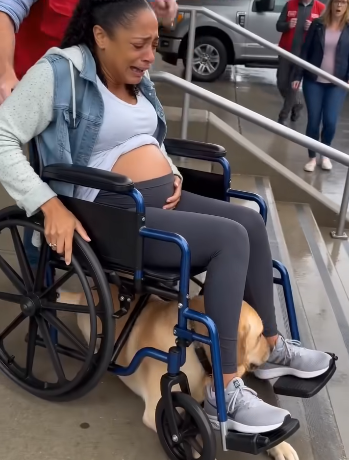
Rainwater dripped from the hospital awning behind him. Buddy lay on the pavement with his yellow fur darkened at the shoulder, breathing hard but watching everyone like he still had one more job to do. My hands were locked around the wet rims of my wheels, even though the chair had finally stopped moving.
I could hear my own breathing.
Too fast.
Too loud.
The hospital volunteer took one step back.
—That dog caused a scene —she said, but her voice had changed.
A minute earlier, she had sounded angry.
Now she sounded scared.
The doctor looked up at her.
—No. That dog stopped one.
The people near the entrance went silent.
A man in scrubs crouched beside Buddy, checking his legs with careful hands. Buddy did not growl. He did not snap. He just turned his head toward me, as if asking whether I was still there.
I tried to say his name.
Nothing came out.
The doctor moved closer to my chair.
—I need you to stay still for a second, ma’am.
—I’m fine.
My voice cracked on the word fine so badly that nobody believed it, including me.
The doctor’s eyes moved from my face to the brake, then to the stairwell behind me.
There were twelve steps.
I counted them because I could not stop looking.
Twelve wet concrete steps leading down to the ambulance bay service hall.
Twelve chances for everything to go wrong.
My phone buzzed weakly on my lap.
Two percent.
Then one.
Jake’s last message was still on the screen.
Landed for refuel. Call when you’re done at the hospital. Love you.
I stared at that message until the letters blurred.
The doctor followed my gaze.
—Is there someone we can call for you?
—My husband is deployed.
The words came out automatically.
I had said them so many times in the past seven months that they felt like a label someone had stuck to my forehead.
My husband is deployed.
I’m handling it.
I’m fine.
I can get home.
I can carry the food.
I can manage the chair.
I can smile when strangers ask what happened to my legs like they are asking about the weather.
I can pretend the brakes are fine until they are not.
The volunteer crossed her arms.
—She should not have had a dog blocking the entrance.
Buddy lifted his head again.
This time, several people looked at her instead of him.
A nurse in navy scrubs stepped forward.
—Ma’am, the dog just saved her from going down the stairs.
The volunteer’s mouth tightened.
—You don’t know that.
The doctor held up the metal piece.
—I know this does not belong wedged inside a wheelchair brake.
That was when the air changed.
Not loudly.
Not dramatically.
But all at once, everyone understood that the story had moved from accident to something uglier.
The nurse looked at the piece.
—Could it have snapped off naturally?
The doctor’s jaw tightened.
—Not like this. Not placed like this.
The volunteer’s eyes dropped to the brake.
Just for a second.
But I saw it.
So did the doctor.
—What is your name? —he asked her.
She blinked.
—Excuse me?
—Your name.
—Donna.
—Donna, did you touch this chair?
Her face went red.
—Absolutely not.
Too fast.
The answer came too fast.
I knew that kind of fast. Jake used to call it “the speed of a lie.” Not because every quick answer was false, but because guilty people sometimes answered before the question had even settled.
I looked down at my chair.
At the brake handle.
At the place where the little broken wedge had been hidden.
Then I remembered something that made my stomach turn cold.
A hand on my shoulder.
A soft voice near the hospital entrance.
A woman saying, “Let me help you with that, sweetheart,” while I balanced the DoorDash bag and tried to scan the delivery address.
Donna.
She had stood behind me.
Only for a few seconds.
Long enough to “help” by touching the back of my chair.
Long enough to ask whether I was alone.
Long enough for me to say, without thinking, “My husband’s overseas.”
My mouth went dry.
—You were behind me earlier.
Donna looked at me.
—I help a lot of people.
—You asked if anyone was coming to pick me up.
—That’s normal.
—You touched my chair.
—I steadied it.
The doctor’s face sharpened.
—When?
Donna gave a thin laugh.
—This is ridiculous. She was rolling backward because she didn’t lock her own brakes, and now everyone wants someone to blame.
My fingers tightened around the ticket stapled to the DoorDash bag.
The order was still sitting on my lap.
Cold by now.
Room 417.
Chicken noodle soup, ginger ale, crackers, and a slice of lemon cake.
I had come to deliver soup.
That was all.
I had not come to become a scene outside a hospital.
I had not come to watch strangers decide whether my fear was convenient enough to believe.
The doctor turned to the nurse.
—Get security.
Donna stepped back.
—For what?
—For footage.
Her face changed again.
There it was.
A tiny crack.
A flash of panic.
The nurse hurried inside.
Buddy tried to push himself up.
—No, baby, stay down —I whispered.
This time my voice worked.
He looked at me and thumped his tail once against the pavement.
Once.
Like a promise.
The man in scrubs smiled gently.
—He’s sore, but I don’t feel anything obviously broken. We should still get him checked properly.
—He’s my husband’s dog —I said.
Then I corrected myself.
—Our dog.
Buddy had been Jake’s idea after the accident. I had resisted at first. I hated needing help. I hated the idea of being watched by an animal trained to notice every weakness I tried to hide.
Then Buddy came home, all paws and gold fur and terrible breath, and decided I was his mission before I had agreed to be anyone’s mission.
Now he was lying under a hospital awning because he had thrown himself between me and twelve steps.
I reached for him, but the doctor stopped me with a soft hand in the air.
—Let us move you first.
—I’m not leaving him.
—We’ll move you together.
That was when a deep voice behind the gathering crowd said:
—What happened to my wife?
Everything inside me stopped.
For half a second, I thought the fear had finally split me open and made me hear things.
Then the people near the entrance turned.
Jake stood there in camouflage pants and a damp gray hoodie, his duffel bag hanging from one shoulder, rain caught in his hair.
My husband.
Not on a screen.
Not in a time zone I had to count backward from.
There.
Real.
Breathing hard like he had run from the parking lot.
I stared at him.
—Jake?
He dropped the duffel.
Buddy’s tail hit the pavement again.
This time harder.
Jake took one look at Buddy, one look at me, one look at the doctor holding the metal piece, and something in his face went still.
Not calm.
Worse than calm.
—Who touched her chair?
Nobody answered.
Donna looked at the automatic doors like she was measuring the distance.
Jake saw that too.
He moved to my side, but he did not crowd me. He knelt on the wet pavement, his hand hovering near my knee until I nodded. Only then did he touch me.
—Are you hurt?
—I don’t think so.
His eyes searched my face.
—Your cheek’s white.
—I’m scared.
His jaw flexed.
—I know.
The doctor stepped in.
—Sir, she nearly went backward down the stairs. Her dog stopped the chair. We found this wedged in the brake mechanism.
Jake looked at the metal.
The color drained from his face so fast that my own fear shifted shape.
—Where did you get that?
The doctor blinked.
—From the brake.
Jake took the piece carefully.
He knew it.
I could see that he knew it.
—Jake?
He looked at the snapped metal, then at the underside of my chair.
—That’s from my old toolkit.
Donna suddenly turned away.
Pilar, the nurse, had just come back with two security guards.
—Ma’am —one guard said to Donna—, please stay where you are.
Donna froze.
Jake stood slowly.
—What do you mean your old toolkit? —I asked.
His face twisted with guilt.
—Before I deployed, I marked some spare pieces with a notch. Dumb habit. This has the mark.
He turned the small piece so I could see it.
A tiny cut near the edge.
A mark I would never have noticed.
—Why would your toolkit piece be in my brake?
He did not answer fast.
And that scared me more.
—Jake.
He swallowed.
—Because someone’s been in our garage.
The rain seemed to get louder.
I stared at him.
—What?
He looked toward Donna, then back at me.
—I came home early. Didn’t want to tell you until I was sure I could get here. My flight changed. When I got to the house, the side door to the garage was open.
My hands went cold on the wheels.
—You were home?
—For ten minutes. I saw the workbench open. Some chair parts moved. Buddy’s backup leash gone. I called you, but it went straight to voicemail.
My dead phone.
One percent.
I looked at Buddy.
—So he knew.
Jake’s eyes softened.
—He must have smelled something wrong on the chair. Or on whoever touched it.
Donna’s voice cut in, too high.
—This is insane. You people are acting like I attacked a stranger in broad daylight.
Jake looked at her.
—Did anyone say attacked?
She shut her mouth.
The security guard’s radio crackled.
—We’ve got footage from entrance camera B.
Donna went pale.
The doctor glanced at me.
—Do you want to see it?
I did not.
Every part of me wanted to say no.
I wanted to go home. I wanted Buddy wrapped in towels. I wanted Jake’s arms around me and a phone charger and a world where wheelchair brakes only failed because things got old, not because people made choices.
But my chair was still there.
The stairwell was still there.
Donna was still standing ten feet away, pretending nothing had happened.
So I said:
—Yes.
They brought us just inside the lobby, away from the rain. The air-conditioning hit my wet sleeves and made me shiver. Jake pushed my chair slowly, one hand light on the handle, as if he was afraid the whole thing might betray us again.
Buddy was lifted onto a folded blanket by two staff members. He protested only when they moved him too far from me, so they carried him close.
The security office was small, crowded, and smelled like coffee that had been sitting too long.
On the monitor, the footage rewound.
There I was.
Small on the screen.
DoorDash bag on my lap.
Wheelchair angled near the entrance because the automatic doors had jammed for a moment.
Donna appeared behind me in her volunteer vest.
She leaned down.
She smiled.
She touched the handles.
My stomach rolled.
On the screen, I looked up at the delivery sign.
Donna’s right hand dipped low.
Not to steady me.
Not to help.
To the brake.
It happened quickly.
Too quickly for anyone walking past to notice.
But the camera saw it.
The doctor saw it.
Jake saw it.
I saw it.
Donna stepped away.
I rolled forward an inch.
Then back.
Then faster.
And then Buddy came into frame like a streak of sunlight.
He hit the front of the chair so hard everyone in the tiny room flinched, even though we had already lived it.
The video stopped.
No one spoke.
Donna was no longer in the room with us. A guard had kept her near the lobby desk, but I could see her through the glass, arguing with another security officer.
Jake’s hand was on the back of my chair.
His knuckles were white.
—Why? —I whispered.
The guard looked uncomfortable.
—There’s more.
I turned toward him.
—More?
He clicked another file.
This one was from the parking garage entrance.
A woman in a raincoat stood near our van.
Donna.
She was talking to someone on the phone.
The audio was not clear at first, just rain and distant tires. Then the guard adjusted it.
Donna’s voice came through thin but understandable.
—She’s alone. Husband’s still gone. Dog’s with her, though.
A pause.
Then:
—I can make it look like brakes. But I want the rest of the money first.
The room tilted.
Jake grabbed the back of my chair.
—Rest of what money? —he asked, voice low.
The guard did not answer.
He let the video continue.
Donna listened to whoever was on the phone.
Then she said:
—No, I don’t care about your brother. You said if she got scared enough, she’d sign the house papers.
My heart stopped in a completely different way.
House papers.
I looked at Jake.
He looked just as lost as I felt.
—What house papers? —I asked.
Jake shook his head.
—I don’t know.
But then his phone rang.
He looked at the screen and went still.
I saw the name before he could hide it.
Mom
His mother.
My mother-in-law, Denise.
The woman who had spent seven months telling me the house was too much for me alone.
The woman who said Jake needed “stability” when he came home.
The woman who kept bringing up power of attorney forms and “temporary transfers” and “military families have to be practical.”
Jake answered without saying hello.
He put it on speaker.
His mother’s voice came sharp and breathless.
—Where are you?
Jake stared at the security monitor.
—At the hospital.
Silence.
Then Denise said:
—With her?
Her.
Not my name.
Never my name when she was angry.
Jake’s voice changed.
—Why would Donna say house papers?
The silence after that was so long I heard the rain against the office window.
—Jake, listen to me—
—Why would a hospital volunteer know anything about my wife signing house papers?
Denise exhaled shakily.
—You don’t understand what I’ve been trying to prevent.
My whole body went cold.
The doctor stepped closer to the door, signaling security with his eyes.
Jake’s voice dropped.
—Mom.
Denise began to cry.
Or pretended to.
It was hard to tell with her.
—That house is in both your names, and she is not capable of handling it while you’re away. She’s reckless. She’s delivering food in a wheelchair. She keeps that dog everywhere. She refuses help. I was trying to protect your future.
I gripped the armrests.
My future was apparently something everyone else wanted to protect by taking it away from me.
Jake closed his eyes.
—What did you do?
—Nothing that couldn’t be fixed if she would just sign.
—What did you do?
His voice cracked this time.
Denise stopped crying.
When she spoke again, she sounded colder.
—Donna was supposed to scare her. Not hurt her.
The doctor inhaled sharply.
I did not move.
For a second, I felt like I had rolled backward again, only this time there were no stairs. Just the sick drop of realizing someone had measured your vulnerability and called it strategy.
Jake looked at me.
His face broke.
—Mara…
That was my name.
Mara.
He said it like an apology.
I lifted one hand, not to comfort him, but to stop him from stepping into guilt that did not belong to him.
—Let her finish.
Denise heard me.
—Mara, you are making this uglier than it needs to be.
There it was.
Even now.
Even after the footage.
Even after Buddy on the pavement.
Even after the broken brake.
I was the one making things ugly.
—Your friend put metal in my wheelchair brake —I said.
Denise’s voice sharpened.
—She is not my friend.
Jake looked at the phone.
—Then what is she?
Another pause.
Then the answer came.
—She used to work with your father.
Jake’s father had been gone five years.
A quiet man.
A mechanic.
A veteran.
A man who loved Buddy before Buddy was even ours.
Jake looked like he had been struck.
—Dad knew her?
—That is not the point.
—That is exactly the point.
Denise’s voice became desperate.
—Your father promised me that house would stay in the family.
I stared at the phone.
—It is in the family. I’m Jake’s wife.
—You are not blood.
The room went silent.
Even the guard looked away.
Jake stared at the phone like he no longer recognized the woman speaking through it.
—You nearly got my wife killed over paperwork.
—Don’t say that.
—Buddy could have been seriously hurt.
Her voice softened.
—Is Buddy there?
I almost laughed.
Not because it was funny.
Because it was monstrous.
She cared about the dog now.
Now that the truth had teeth.
Jake hung up.
No goodbye.
No final warning.
Just silence.
The security guard stepped toward him.
—Sir, we need that call information.
Jake nodded, but he did not look away from me.
—I’m sorry.
I shook my head.
—Not yet.
He flinched.
I did not mean it cruelly.
I meant I could not carry his apology on top of everything else. Not while Buddy was still breathing hard on a blanket. Not while the chair beneath me had become evidence. Not while my mother-in-law’s words were still crawling under my skin.
The doctor crouched in front of me.
—Mara, I want to examine you properly. Shock can hide things.
—I need Buddy checked first.
—We’ll do both.
—Promise me.
—I promise.
That was the first promise of the day that sounded like it had weight.
Security handled the police call. Donna was kept in the lobby, no longer shouting. From where I sat, I could see her shoulders slumped under the volunteer vest. Without the smile and clipboard, she looked smaller.
Not harmless.
Just smaller.
The officers arrived twenty minutes later.
By then, my phone was dead.
Jake had given me his, but I kept it face-down in my lap. I was afraid Denise would call again. Afraid she would text. Afraid she would find some new way to make her fear sound like love.
An officer named Harris took my statement in a quiet consultation room.
I told him everything.
The delivery.
The rain.
The brakes.
Buddy.
Donna touching my chair.
The footage.
The phone call.
I spoke slowly because if I spoke too fast, I thought I might shake apart.
When I finished, Officer Harris looked at Buddy lying beside the exam table.
—That dog saved your life today.
Buddy’s ears lifted at the word dog.
Jake knelt beside him.
—He knows.
The vet clinic connected to the hospital’s service program agreed to examine Buddy immediately. A staff member wrapped him in a warm towel before moving him. Buddy refused to leave until Jake put one of my hoodies beside him.
Only then did he allow it.
I watched him go.
The second he disappeared around the corner, I finally cried.
Not loudly.
Not dramatically.
Just one hand over my mouth, shoulders shaking, the whole morning falling through me.
Jake moved like he wanted to hold me, then stopped himself.
—Can I?
That nearly broke me more than anything.
Because he asked.
Because after a day full of people touching my chair, my future, my safety, my name, my house, he asked.
I nodded.
He wrapped his arms around me carefully, kneeling so he was not above me. I pressed my forehead to his shoulder and breathed in rain, airport, laundry soap, and him.
—You came home —I whispered.
—I came home.
—You weren’t supposed to be here.
—I know.
—She thought you weren’t.
His arms tightened.
—I know.
The secret nobody saw coming was not just the broken brake.
It was the timing.
Jake’s early flight.
Buddy’s warning.
The camera angle.
The phone call.
All the tiny things Denise had not planned for because she believed people like me survived only by luck.
But Buddy had not been luck.
Buddy had been love with paws.
And Jake walking through the rain had not been luck either.
It was the first crack in a plan built around my isolation.
Officer Harris stepped back in with another officer.
—Mrs. Walker, we’ve recovered Ms. Donna Mills’s phone. There are messages arranging payment and referencing your wheelchair.
Jake’s face hardened.
—From my mother?
The officer hesitated.
—From a number saved as D.W.
Denise Walker.
My mother-in-law.
I closed my eyes.
There it was.
No more guessing.
No more maybe.
No more she meant well.
Officer Harris continued carefully.
—There are also references to legal documents. Do you know anything about a property transfer?
—I refused to sign anything.
Jake looked at me.
—She gave you papers?
—Three weeks ago. She said they were emergency authorization forms in case something happened while you were deployed. I told her I wanted a lawyer to read them.
His face went pale.
—You never told me.
—I didn’t want to worry you while you were overseas.
The second I said it, I heard the echo.
I didn’t want to worry you.
How many disasters begin with people hiding things because love and fear look too much alike in the dark?
Jake took my hand.
—No more protecting each other by staying quiet.
I nodded.
—No more.
The doctor returned a few minutes later.
—Buddy is sore, but stable. No major injury found on initial exam. We still want observation and follow-up, but he’s wagging at everyone who says your name.
I covered my face with both hands.
This time the tears were relief.
Not complete relief.
Not clean.
But enough to breathe.
—Can I see him?
—Soon. First I need to finish checking you.
I let him.
Blood pressure.
Pulse.
Questions.
Did I hit my head?
Was I dizzy now?
Any pain?
Any numbness different from usual?
It was clinical and gentle, and I was grateful for the gentleness more than I expected.
Through the partly open door, I saw Donna being escorted past the hallway windows.
She looked in once.
Not at me.
At Jake.
As if he was the person she needed to explain herself to.
Not the woman she had sent rolling toward stairs.
That made something settle inside me.
Hard.
Clear.
When Officer Harris asked whether I wanted to pursue charges, I did not look at Jake.
I did not look at the doctor.
I did not look at anyone for permission.
—Yes —I said.
The word filled the room.
Yes.
Yes, I wanted the footage saved.
Yes, I wanted the messages preserved.
Yes, I wanted Denise named.
Yes, I wanted my chair examined.
Yes, I wanted Buddy’s veterinary records included.
Yes, I wanted every person who called this a misunderstanding to learn the difference between an accident and a plan.
Jake squeezed my hand once.
Not to guide my answer.
To stand beside it.
Later, when they finally brought Buddy back, he came in wearing a ridiculous blue bandage and the proud expression of a dog who had accepted compliments as payment.
I laughed through my tears.
—You big dramatic hero.
Buddy huffed and rested his head on my lap.
Right on the DoorDash bag.
The soup inside was completely ruined.
Cold.
Leaking.
Forgotten.
Jake looked down at it and shook his head.
—Were you delivering that?
—Room 417.
He picked up the receipt.
—Chicken noodle soup, ginger ale, crackers, lemon cake.
—Someone’s lunch is very late.
The nurse at the door smiled softly.
—I’ll make sure they get a fresh order. On us.
For some reason, that small kindness almost undid me again.
Because after a day of people trying to steal my safety, my house, my dignity, someone had noticed soup.
Just soup.
The ordinary thing I had been trying to do before everything broke open.
Jake helped me into a temporary hospital chair while security took mine as evidence. I hated watching it roll away, not because I loved it, but because it had been mine. My independence. My daily fight. My wheels.
Now it was a crime scene on spokes.
As we waited near the discharge desk, Jake’s phone buzzed again.
Denise.
He looked at me.
I shook my head.
—Not now.
He declined the call.
A message appeared seconds later.
You are destroying this family.
Jake stared at it.
Then he typed back.
No. You tried to destroy my wife. There is a difference.
He showed me before sending it.
I read it twice.
Then I nodded.
He sent it.
Outside, the rain had finally slowed.
The pavement still shone under the hospital lights. The stairwell was taped off now. A yellow caution sign stood near the entrance, useless and late, but there.
Buddy leaned against my leg as Jake pushed the temporary chair toward the van.
At the curb, I stopped him.
—Wait.
He came around to face me.
—I need to say something before we go home.
His expression turned serious.
—Okay.
I looked at the hospital doors.
At the spot where Buddy had thrown himself under my wheels.
At the place where strangers had looked away until they couldn’t anymore.
Then I looked at my husband.
—Your mother thought the worst thing about me was that I needed help.
Jake’s face tightened.
I rested one hand on Buddy’s head.
—But needing help was not what made me vulnerable. Being surrounded by people who thought help meant control did.
He knelt in front of me.
—I will never let her near you again.
I believed him.
But belief was not the same as handing over the keys to my safety.
—We’re changing the locks.
—Tonight.
—We’re calling a lawyer.
—Tomorrow morning.
—We’re getting my chair checked by someone she doesn’t know.
—Absolutely.
I swallowed.
—And Jake?
—Yeah?
—I’m still doing deliveries when I want to.
For the first time all day, he smiled.
Small.
Tired.
Real.
—I figured you’d say that.
—Good.
Buddy sneezed, as if agreeing.
Jake laughed under his breath, then kissed my knuckles.
Not like I was fragile.
Like I was here.
Like I had made it.
Like I was still the owner of my own life.
Behind us, the hospital doors slid open and Officer Harris stepped outside.
—Mrs. Walker?
I turned.
—Yes?
He held up a clear evidence bag.
Inside was the snapped metal piece from my brake.
Tiny.
Ugly.
Almost nothing.
Almost everything.
—We’ll be in touch soon.
I looked at that piece and thought about how small a thing could be and still change the direction of your whole life.
Then Buddy pressed his warm head harder into my palm.
I looked away from the evidence bag and toward the van.
—Come on, Buddy —I said. —Let’s go home.
Jake opened the door.
The rain stopped completely.
And for the first time that day, when my wheels moved forward, I was not afraid of what had been hidden inside them.
