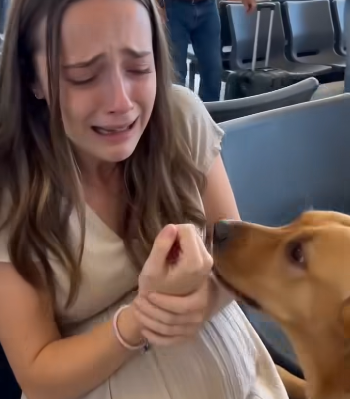
I was stranded at a Phoenix bus station with swollen ankles when our Labrador kept dragging me toward an abandoned Army backpack under the bench.
I thought somebody had forgotten it after a long day, and honestly I wanted no part of it.
But Charlie kept pulling until my wrist hurt.
The backpack had dirt on the straps and a luggage tag with my husband’s name written in Sharpie.
My stomach dropped so fast I had to sit down.
A transit cop told me not to touch it and called it suspicious.
Charlie barked at the side pocket instead of the main zipper.
Inside was a cheap bracelet from a hospital gift shop, the one Adam bought me after our first ultrasound.
There was also a note that said, “If my wife finds this, tell her I tried to get home.”
I started sobbing right there between a soda machine and a Greyhound sign.
Then Charlie nosed the bottom seam until it split open.
A tiny recorder fell out and started playing Adam’s voice.
He said the person who picked him up was wearing a police badge.
The entire bus station seemed to stop breathing.
Even the vending machine hum felt too loud.
The transit cop, whose name tag read HARRIS, froze with one hand halfway toward the recorder. His face changed so quickly that I noticed it through my tears. One second he was irritated, treating me like a pregnant woman making a scene over an abandoned bag. The next, he looked like he had heard a ghost speak from the floor.
Charlie stood over the recorder with his paws planted on either side of it.
He did not growl.
He did not bark.
He just stared at Officer Harris like he was daring him to reach for it.
Adam’s voice kept playing.
It was thin, scratchy, broken by static, but it was my husband.
My Adam.
The man I had not heard from in four days.
“The badge looked real,” he said through the tiny speaker. “Phoenix police, maybe. Could have been county. I don’t know. He said there was a problem with my transfer ticket. Said my wife had called. Said she was in trouble.”
I covered my mouth.
I had not called anyone.
Officer Harris said, very quietly:
“Turn that off.”
I looked up at him.
“What?”
“Ma’am, turn that off. This is now evidence.”
His voice was calm, but his hand shook.
Charlie lowered his head.
The recorder continued.
“I knew something was wrong when he didn’t take me to the main exit. He took me through the side lot by the old employee gate. White SUV. Dark tint. Smelled like cigarettes and mint gum.”
A woman waiting near the ticket counter whispered:
“Oh my God.”
Officer Harris stepped forward.
Charlie barked once.
The sound cracked through the station.
People turned. A man holding a duffel bag stepped back. A mother pulled her teenage son closer. Two college girls stopped filming themselves and lifted their phones toward us instead.
Officer Harris held up both hands.
“Control your dog.”
I pulled Charlie’s leash tight, but I did not tell him to stop.
Because he had found the backpack.
He had found the bracelet.
He had found Adam’s voice.
And suddenly I trusted my dog more than any uniform in that room.
The recorder clicked, then Adam’s voice returned, lower now, like he had been trying not to be heard.
“If this gets to Maya, baby, listen to me. Don’t let them tell you I ran. Don’t let them tell you I changed my mind. I was coming home. I swear to God, I was coming home.”
My body folded around the words.
A sob came out of me so hard it hurt my ribs.
Because those were the exact words I had been afraid to need.
Adam was coming home.
He had not left me.
He had not disappeared because fatherhood scared him.
He had not decided overseas was easier than a wife with swollen feet, a half-packed nursery, and a baby due in six weeks.
He had tried to get home.
Charlie pressed his body against my knee.
The recorder clicked again.
Then there was a different sound.
A car door.
A man’s voice, muffled.
Then Adam, closer to the recorder:
“He called me by my rank, but wrong. He said Sergeant Hale. I’m not Sergeant anymore. Nobody from my unit would make that mistake.”
Officer Harris’s face went pale.
I saw it.
So did Charlie.
So did the woman near the ticket counter.
“Officer,” I said, my voice shaking, “why did your face change?”
He looked at me sharply.
“Ma’am, you need to step away from the bag.”
“No.”
“This could be part of an active investigation.”
“Then call Phoenix police.”
“I am police.”
“You said transit.”
His jaw tightened.
People were listening now.
Not just watching. Listening.
A man in a Suns hoodie took one step closer and said:
“She asked you to call Phoenix police.”
Officer Harris turned on him.
“Sir, back up.”
The man lifted his hands.
“I’m backed up.”
The recorder clicked again.
Adam’s voice came back in a whisper.
“He took my phone. Said it was procedure. If you find the bag, check the seam. I put the recorder there when he stopped for gas. I don’t know if I can keep it hidden. He keeps asking about the locker key.”
Locker key.
My breath caught.
I looked at the backpack.
Officer Harris looked at the backpack too.
Too fast.
Too hungry.
Charlie saw it and moved one paw onto the bag.
Officer Harris said:
“Ma’am, I need you to hand me that backpack now.”
“No.”
His expression hardened.
“Do not make this harder.”
Something about that sentence hit me wrong.
Not because it was loud.
Because it sounded practiced.
Like he had said it to other scared people before.
I placed one hand on my belly and the other on Charlie’s collar.
“What locker key?”
Officer Harris did not answer.
A young woman behind me whispered:
“Keep recording.”
I turned slightly.
At least four people had their phones up now.
That was the only reason Officer Harris did not grab the bag.
I knew it.
He knew it.
Charlie knew it.
The recorder went silent.
For a moment, all I could hear was my own breath and the soft clicking of Charlie’s tags.
Then the station doors opened.
Two more officers came in.
Real Phoenix police.
I knew they were different before they spoke.
Maybe it was the uniforms. Maybe it was the way Officer Harris stiffened. Maybe it was the way Charlie did not bark when they approached.
The first was a woman with dark hair pulled into a tight bun. Her badge was visible, her body camera light blinking. The second was a tall man with a notebook already in his hand.
The woman spoke first.
“Who called in the suspicious bag?”
Officer Harris turned with visible relief.
“I did. I’ve got it handled.”
“No,” I said.
My voice was weak, but it carried.
The female officer looked at me.
“I’m sorry?”
“He doesn’t have it handled.”
Officer Harris snapped:
“Ma’am—”
I lifted the bracelet from my lap.
“This is my husband’s backpack. He has been missing for four days. There is a recorder inside that says a man with a police badge picked him up.”
The female officer’s eyes sharpened.
“What’s your husband’s name?”
“Adam Hale.”
Her partner stopped writing for half a second.
Just half a second.
But I saw it.
“You know his name,” I whispered.
The male officer looked at the woman.
Officer Harris said quickly:
“This is why I wanted the area cleared. We don’t know what we’re dealing with.”
The female officer ignored him.
“Ma’am, I’m Officer Ramirez. This is Officer Keller. Is the recorder still here?”
Charlie looked down.
So did I.
The tiny recorder sat on the tile near the split seam of the backpack.
Officer Ramirez crouched, but she did not touch it.
“Has anyone handled it?”
“My dog found it.”
She glanced at Charlie.
Charlie wagged his tail once.
“Anyone else?”
“No.”
Officer Ramirez looked at Harris.
“Did you touch it?”
“No.”
Charlie let out one low sound.
Not a bark.
Not a growl.
A warning.
Officer Ramirez noticed.
So did Officer Keller.
Harris laughed sharply.
“You’re taking the dog’s word now?”
Officer Ramirez stood.
“I’m taking everyone’s behavior into account.”
The air shifted.
Harris’s face shut down.
For the first time, I understood that he was not just nervous.
He was afraid.
Officer Ramirez radioed something in a low voice. Officer Keller asked people to move back, but he did it carefully, respectfully, not like Harris had. He asked for witnesses to remain nearby. He told the young woman recording to keep the footage and not post it yet.
Then he turned to me.
“Mrs. Hale, can you tell us when you last heard from your husband?”
I tried.
I really did.
But the words tangled.
My husband had landed in Los Angeles four days ago after finishing a private security contract overseas. He had planned to take a connecting bus through Phoenix because flights were a mess and he said he wanted to save money for the baby. I had told him not to be ridiculous. He had laughed and said, “It’s one bus ride, Maya. I’ve slept in worse places.”
Then he stopped answering.
His last text to me had been:
Battery low. Phoenix transfer delayed. Home tomorrow. Kiss Charlie for me.
Tomorrow never came.
At first I thought his phone died.
Then I called the bus company.
Then his old unit friends.
Then hospitals.
Then every number I could find.
A missing adult report had been taken, but the man on the phone had sounded tired, like missing husbands were common and pregnant wives were dramatic.
And then today, while trying to get to my mother’s house in Tucson because I could not sit alone in our empty rental anymore, Charlie had dragged me to the backpack.
Officer Keller listened without interrupting.
Officer Ramirez looked at Harris.
“You were first on scene?”
Harris nodded.
“Did you know about the missing person report?”
“No.”
Officer Ramirez’s eyes stayed on him.
“Are you sure?”
His mouth tightened.
“I said no.”
Charlie barked.
One sharp sound.
Officer Keller looked at Charlie, then back at Harris.
“Interesting timing,” he murmured.
Harris glared at him.
Officer Ramirez asked me for permission to secure the backpack as evidence. I nodded, but when she reached toward it, Charlie placed himself between her and the bag.
“Charlie,” I whispered. “It’s okay.”
He did not move.
Not until Officer Ramirez took one step back and crouched to his level.
“Hey, buddy,” she said softly. “You found him, didn’t you?”
Charlie’s ears shifted.
“I’m not taking it from her,” she said, nodding toward me. “I’m trying to help bring him home.”
I don’t know if dogs understand words like that.
But Charlie looked at me.
I put my hand on his head.
“It’s okay,” I said again, even though nothing was okay.
Charlie stepped back.
Officer Ramirez carefully bagged the recorder, the note, the bracelet, and the backpack. When she reached the side pocket, Charlie nudged my arm.
“What?” I whispered.
He stared at the pocket.
Officer Ramirez paused.
“There’s more?”
Charlie whined.
She opened the pocket slowly.
Inside was a folded bus schedule, a cracked phone case, and a small brass key taped under the fabric lining.
Locker key.
Officer Ramirez removed it with gloved hands.
A number was stamped on the tag.
B-17.
The station lockers were on the opposite side of the building, near the restrooms.
Officer Harris spoke quickly:
“That area has been closed all week. Half the lockers are broken.”
Officer Keller looked at him.
“How do you know which one it goes to?”
“I don’t. I said the area.”
Officer Ramirez held up the key.
“Let’s find out.”
Harris shifted.
“I should come with you. I know the station layout.”
“No,” Officer Ramirez said.
One word.
Flat.
Harris stared at her.
“Excuse me?”
“You can stay here with Officer Keller.”
Officer Keller smiled without warmth.
“Please.”
The way he said please made Harris stop moving.
Officer Ramirez looked at me.
“Mrs. Hale, you can wait here.”
“No.”
My voice surprised all of us.
She softened.
“You’re pregnant. This might be stressful.”
“My husband put that key there hoping I’d find it.”
Charlie stood beside me.
Officer Ramirez looked at him, then at me.
“All right. But you stay behind me, and if I tell you to stop, you stop.”
I nodded.
The walk to the lockers felt endless.
The bus station smelled like hot concrete, old coffee, floor cleaner, and too many lives passing through too quickly. A man slept curled around a trash bag near the far wall. A woman argued quietly with someone on the phone. A little boy in a Spider-Man backpack watched Charlie like he was the only safe thing in the building.
Locker B-17 was near the end of the row.
Its metal door was dented.
Someone had scratched initials into the paint.
Officer Ramirez inserted the key.
It turned.
The door opened with a tired metallic click.
Inside was Adam’s phone.
A black wallet.
A folded gray hoodie.
And another note.
Officer Ramirez photographed everything before touching it.
I stood back like she told me, but my whole body leaned forward.
Charlie did not bark.
He sat.
Completely still.
Officer Ramirez unfolded the note.
Her face changed as she read.
“Can you read it?” I asked.
She hesitated.
Then she said:
“It appears to be addressed to you.”
My hand shook as she placed it into an evidence sleeve and held it where I could see.
Adam’s handwriting.
Messier than usual.
But his.
Maya, if this is the only thing you find, I need you to know I did not leave you. A man with a badge said you were in medical distress. He knew your name, the baby’s due date, and Charlie’s name. That’s why I got in the SUV. I thought I was going to you.
My knees nearly gave out.
Officer Ramirez grabbed my elbow with one hand.
Charlie pressed against my leg from the other side.
The note continued.
He asked about the envelope from Tucson. I don’t know how he knew. I told him it was nothing. He said people get hurt when they carry things that don’t belong to them. If I disappear, find Sergeant Cole Vance. He warned me not to trust local pickup.
Sergeant Cole Vance.
I knew that name.
Adam had mentioned him once.
An old friend.
Not close, but trusted.
A man who had called Adam two weeks ago and made him step outside to talk.
When Adam came back in, he had looked shaken.
I asked what happened.
He kissed my forehead and said:
“Nothing you need to worry about.”
I hated that sentence now.
I hated every sentence men used to protect women from information that could save them.
Officer Ramirez read the note again.
“Do you know what the envelope from Tucson means?”
I hesitated.
Then I remembered.
A manila envelope Adam had mailed ahead to my mother’s house. He said it had documents he didn’t want lost in transit. I had not asked too many questions because he was exhausted and I was trying not to nag.
“My mother has it,” I whispered. “In Tucson.”
Officer Ramirez looked at me.
“What’s in it?”
“I don’t know.”
Her phone rang before she could answer.
She listened, her eyes narrowing.
Then she turned away slightly.
“Yes. Confirmed. Bus station locker. Personal property located. Possible connection to Adam Hale missing person case.”
She paused.
Then:
“Say that again.”
The hair on my arms lifted.
Officer Ramirez looked back toward the main hall.
Toward Officer Harris.
Toward the place where he stood with Officer Keller.
“Where is he now?” she asked into the phone.
Another pause.
Her jaw tightened.
“Do not let him leave.”
I knew before she said anything.
“What?”
Officer Ramirez ended the call.
“Mrs. Hale, Officer Harris was not scheduled here today.”
My mouth went dry.
“What does that mean?”
“He called himself in.”
The hallway seemed to tilt.
Charlie stood.
Officer Ramirez said into her radio:
“Keller, keep Harris there. Do not let him exit.”
Static answered.
Then Officer Keller’s voice:
“He’s moving.”
Officer Ramirez took off running.
Charlie surged forward.
I grabbed his leash, but he was stronger than me and I was too slow.
He pulled me back toward the main hall, not roughly enough to hurt me, but with absolute certainty.
“Charlie, wait!”
Officer Ramirez shouted:
“Stay behind me!”
But Charlie was already barking.
Not panicked.
Directed.
Furious.
We reached the main hall just as Officer Harris pushed through a side door marked STAFF ONLY.
Officer Keller was right behind him.
People started shouting.
Charlie pulled once more, hard, toward the side corridor.
I braced one hand on the wall and gasped as pain tightened across my lower back.
Officer Ramirez saw me and stopped.
For half a second, I saw the conflict on her face.
Chase Harris.
Or help me.
Charlie solved it.
He stopped pulling me.
He dropped the leash from tension, turned, and ran after Harris himself.
“Charlie!” I screamed.
But he was gone through the side door, a flash of yellow fur into the corridor.
Officer Ramirez swore under her breath and pressed her radio.
“Yellow Labrador loose, following suspect through staff corridor. Do not harm the dog.”
Do not harm the dog.
Those words nearly broke me.
Officer Keller’s voice came back:
“He’s got him pinned by the employee gate.”
Pinned.
Not bitten.
Not attacked.
Pinned.
I moved as fast as I could, one hand on the wall, Officer Ramirez returning to steady me.
“I told you to stay,” she said.
“My dog is there.”
“And so is my partner. Breathe.”
By the time we reached the employee gate, Harris was on the ground, not injured, but trapped between a chain-link fence and an old newspaper rack. Charlie stood three feet away, barking every time Harris tried to move.
Officer Keller had his weapon lowered but ready, his voice calm.
“Harris, hands where I can see them.”
Harris looked at me.
Not at the officers.
At me.
His face was twisted with anger.
“You have no idea what your husband was carrying.”
I stopped breathing.
Officer Ramirez stepped in front of me.
“Don’t talk to her.”
Harris laughed.
“She thinks he’s some hero trying to get home. He was carrying evidence that could ruin people.”
Officer Keller moved closer.
“Hands out.”
Harris’s smile faded.
“You don’t understand who is involved.”
Officer Ramirez said:
“Then start explaining.”
Harris looked toward the gate.
For one awful second, I thought someone else would appear there. Another badge. Another SUV. Another man who knew my name.
But no one came.
Only the desert heat pushed through the gaps in the metal door.
Harris lowered his hands.
Officer Keller cuffed him.
Charlie stopped barking.
Then he turned, walked straight to me, and pressed his head against my belly.
I collapsed onto the nearest bench.
Not fainted.
Just sat down because my body had reached the end of what it could do standing.
Officer Ramirez crouched in front of me.
“Mrs. Hale, I need to ask. Are you having pain?”
“Yes,” I whispered.
Her face tightened.
“Steady pain or coming and going?”
“I don’t know.”
That scared her.
And if it scared her, it terrified me.
An ambulance came.
Again, in a bus station.
Again, because my life had become a place where ordinary objects carried warnings.
A backpack.
A bracelet.
A locker key.
A dog’s bark.
Charlie tried to climb into the ambulance with me.
The paramedic hesitated.
Officer Ramirez said:
“That dog is evidence of why she’s alive and why we have a suspect. Let him ride if you can.”
The paramedic looked at my face, then at Charlie.
“Fine. But he stays down.”
Charlie stayed down.
He lay on the ambulance floor beside the stretcher, his head near my hand.
At the hospital, they monitored the baby.
The heartbeat came through strong.
Fast.
Beautiful.
I cried so hard when I heard it that the nurse had to wipe my face because I could not let go of Charlie’s collar.
My mother arrived from Tucson two hours later with the manila envelope in her purse and terror in her eyes.
She hugged me carefully, then hugged Charlie harder.
“What is happening?” she whispered.
“I don’t know,” I said. “But Adam didn’t leave.”
Her face changed.
Not relief.
Not exactly.
Something deeper.
Vindication.
Because my mother had never believed he left.
She had said it from the beginning.
“Adam Hale is stubborn, not cruel. There is a difference.”
Officer Ramirez came to the hospital that evening with a detective named Morales.
They did not bring Harris.
They did not tell me everything.
But they told me enough.
Officer Harris was not Phoenix PD. He was transit security with limited authority, but he had access to the station, cameras, staff corridors, and enough of a uniform to confuse tired travelers.
He had been seen speaking to Adam on security footage four days earlier.
A white SUV had entered the employee lot twenty minutes before Adam vanished.
The plates were obscured.
The driver wore a badge.
The footage was not enough to prove everything.
But the backpack, recorder, locker, note, and Harris running made it impossible to dismiss.
Then Detective Morales asked for the envelope.
My mother handed it over like she was giving away a bomb.
Inside were printed emails.
Photographs.
Copies of wire transfers.
A flash drive.
And a handwritten note from Sergeant Cole Vance.
Detective Morales read silently.
His face grew harder with every page.
“What is it?” I asked.
He looked at Officer Ramirez.
Then back at me.
“Your husband appears to have been carrying evidence connected to a private transport company operating out of Arizona and California. There may be people with law enforcement connections involved.”
My mother sat down.
I touched my belly.
“Where is Adam?”
Detective Morales’s expression softened.
“We don’t know yet.”
That almost destroyed me.
Yet.
Not no.
Yet.
I held onto that word like a rope.
“Is he alive?” I asked.
Morales did not lie.
“We have reason to believe he may have been alive after he disappeared.”
I closed my eyes.
The room moved around me.
Nurses.
Monitors.
My mother’s hand on my shoulder.
Charlie’s head on my knee.
Officer Ramirez said:
“Mrs. Hale, the recorder and notes changed this from a missing adult case to something much bigger. We are moving quickly.”
I looked at her.
“Please find him.”
She nodded.
“We will try.”
After they left, my mother opened the window blinds. Phoenix was turning orange outside, the sunset burning across the hospital glass.
Charlie stood at the window and stared out.
Like he was looking for Adam too.
The next twenty-four hours were the longest of my life.
My phone became a weapon and a punishment.
Every buzz made me jump.
Every unknown number stole my breath.
David no, Adam’s sister called from Ohio screaming and crying at the same time. His old unit friends started calling each other. Sergeant Cole Vance was located in New Mexico and agreed to speak with investigators. The bus station footage was pulled. The white SUV appeared twice. Harris asked for a lawyer.
And Brittany did not exist in this story.
There was no nosy neighbor, no misunderstanding, no petty drama.
This was worse.
This was the kind of fear that wore official-looking clothes and knew how to make people disappear into paperwork.
I hated that.
I hated that a badge could turn danger into obedience.
Adam had gotten into the SUV because he thought I needed him.
Because the man knew my name.
Because he knew I was pregnant.
Because he knew Charlie’s name.
That detail broke me more than anything.
Charlie’s name.
Someone had studied us.
Someone had known the exact word that would make Adam believe.
At 2:36 a.m., Charlie woke from a dead sleep and started whining at the hospital room door.
My mother sat up from the chair.
“What is it?”
Charlie scratched once.
“Charlie,” I whispered.
He looked at me, then at the door.
The nurse opened it.
Officer Ramirez stood in the hallway.
Her face told me before she spoke.
Not everything.
But something.
“We found the SUV.”
My heart stopped.
“Where?”
“Abandoned near a storage facility outside Buckeye.”
My mother covered her mouth.
“Was Adam inside?”
“No.”
The word hurt.
But Ramirez stepped closer.
“There was blood on the seat, but not a large amount. There were zip ties cut on the floor. And there were footprints leading away from the vehicle.”
I gripped the blanket.
“His?”
“We don’t know yet.”
“But he got out?”
“It looks like someone got out.”
I stared at her.
“Alive.”
She held my gaze.
“Possibly.”
Charlie whined again.
Officer Ramirez looked at him.
“There’s something else.”
I braced myself.
“We recovered part of a torn shirt sleeve caught in the rear door. There was a name written on the inside cuff.”
“Adam writes his name on gear,” I said immediately. “Habit.”
She nodded.
“It said HALE.”
I started crying again.
Not because he was safe.
Because he was fighting.
Adam was hurt, scared, trapped in something bigger than either of us, but he had left pieces of himself behind like breadcrumbs.
A backpack.
A recorder.
A locker.
A note.
A sleeve.
A name.
My husband was still trying to get home.
By morning, the story started leaking.
Not with my name at first.
“Missing veteran linked to Phoenix transit investigation.”
“Security officer detained after suspicious evidence found at bus station.”
“Private transport company under review.”
Reporters called.
I didn’t answer.
My mother handled my phone.
Charlie stayed pressed against my bed.
The hospital wanted to keep me one more night because stress had triggered contractions that needed monitoring. I hated that I could not search. I hated that I was lying in a bed while Adam might be somewhere alone.
Officer Ramirez came by again at noon.
This time, she brought Sergeant Cole Vance.
He was older than I expected, with a shaved head, tired eyes, and a limp he did not try to hide. He stood at the door like he was asking permission to enter a place grief had already claimed.
“Mrs. Hale,” he said.
I nodded.
He looked at Charlie.
“Adam talked about that dog.”
Charlie sniffed the air.
Then he stood.
His tail moved once.
That was enough for me.
Cole came in.
He did not waste words.
“Adam contacted me three weeks ago. He said he found irregularities in transport contracts tied to men coming home from overseas jobs. People being overcharged, documents disappearing, benefits redirected. He thought it was fraud. Then he found names. Some of the men had gone missing for days before resurfacing scared and silent.”
My skin went cold.
“Why didn’t he tell me?”
Cole’s face tightened.
“Because I told him not to until I could verify it.”
I stared at him.
“You told my husband to hide danger from his pregnant wife?”
He took the hit.
“Yes.”
My mother said:
“That was a mistake.”
Cole nodded.
“It was.”
I liked that he did not defend himself.
It did not fix anything.
But it made me listen.
“Adam was supposed to give me the envelope in Tucson,” Cole continued. “Then take a direct ride home. He changed plans last minute because he thought he was being watched.”
“He was being watched,” I said.
Cole lowered his eyes.
“Yes.”
Charlie moved closer to him.
Cole crouched carefully.
“Hey, Charlie.”
Charlie sniffed his hand.
Then he licked it.
Cole closed his eyes for one second.
“Adam told me if anything happened, his dog would find what people missed.”
I broke.
Just completely broke.
Because Adam had known.
Not everything.
But enough to trust Charlie with the part humans might fail.
That afternoon, the first real lead came from someone no one expected.
The young woman from the bus station.
The one who had whispered “keep recording.”
Her name was Lila. She brought her footage to the police. In the background of her video, reflected in the soda machine glass, was Officer Harris looking toward the side entrance before the recorder ever started playing.
And beside the side entrance was a woman in a gray blazer.
She held a phone to her ear.
She turned just enough for the camera to catch her face.
Sergeant Cole Vance recognized her.
“Marcy Vale,” he said. “She runs desert transfer logistics for the contractor.”
Detective Morales found that Marcy Vale owned a storage unit near the place where the SUV was abandoned.
By sunset, police had a warrant.
By nightfall, they found Adam.
He was alive.
I did not get the call from a detective first.
I got it from Adam.
A nurse was adjusting the monitor on my belly when my phone rang from an unknown number. My mother almost declined it because we had been avoiding reporters.
But Charlie woke from sleep and barked once.
Not a warning.
An answer.
I grabbed the phone.
“Hello?”
Static.
Breathing.
Then:
“Maya?”
Everything inside me stopped.
“Adam?”
My mother dropped into the chair.
The nurse froze.
Charlie stood with both ears forward.
“Maya,” he said again, and his voice broke.
I could not speak.
I could only sob.
“I’m okay,” he said quickly. “I’m okay. I’m with police. I’m coming to you.”
“Are you hurt?”
“Not bad.”
That meant yes.
I knew Adam.
“Don’t lie to me.”
A shaky laugh.
“I missed you too.”
I cried harder.
“The baby?”
“Okay,” I said. “He’s okay. Charlie found your bag. Charlie found everything.”
Adam was quiet for a moment.
Then he whispered:
“Good boy.”
Charlie whined at the phone.
Adam heard it.
“Oh, buddy,” he said, and then he was crying too.
They brought him to the hospital under police protection.
Not because the immediate danger was still in the hallway, they said, but because the case was not finished.
I did not care.
When Adam walked into my room, the world narrowed to the fact that he was standing.
He had a bruise along one cheek, a bandage on his forearm, and exhaustion so deep it seemed carved into him.
But he was alive.
Charlie reached him first.
For the first time in his life, my perfectly trained Labrador forgot every command he had ever known.
He launched himself forward with a sound between a bark and a sob.
Adam dropped to his knees.
Charlie hit his chest and knocked him backward against the wall. Adam wrapped both arms around him and buried his face in his fur.
“I tried to get home,” Adam kept saying. “I tried, buddy. I tried.”
Charlie made a soft broken sound I had never heard before.
The whole room cried.
The nurse.
My mother.
Officer Ramirez at the door.
Even Cole Vance, who turned his face away like that made him invisible.
Adam finally looked at me.
He tried to stand too fast and winced.
“Don’t,” I said, already crying.
He came slowly.
Carefully.
Like he was approaching a miracle he did not deserve to touch.
I reached for him.
He took my hand and pressed it to his mouth.
“I didn’t leave you,” he whispered.
“I know.”
“I need you to know I didn’t leave.”
“I know.”
“I thought you were hurt. He said you were hurt. He knew everything, Maya. He knew the hospital bracelet, the baby, Charlie. I thought—”
“I know.”
He broke then.
Not loud.
Not dramatic.
Just folded over our joined hands, shaking.
I touched his hair.
For days I had imagined being angry when I found him. Angry that he took risks. Angry that he hid things. Angry that he carried evidence through bus stations and left me in the dark.
I was still angry.
But first, I was grateful.
Grateful enough to hurt.
Later, he told me what happened.
Not all at once.
Not in front of everyone.
And not in awful detail.
He told me enough.
The man with the badge had convinced him I was in medical distress at a nearby clinic. Adam got into the SUV because the man knew things a stranger should not know. Once inside, he realized too late the doors were locked from the front.
He had hidden the recorder when the driver stopped.
He had left the backpack where he hoped someone would find it because he could not keep carrying it without drawing attention.
He had put the bracelet in the pocket because he knew Charlie would smell me on it.
“That’s why he barked at the side pocket,” I whispered.
Adam nodded, eyes wet.
“I rubbed it on his blanket before I packed it. I don’t even know why. I just… I thought if anything went wrong, Charlie would know.”
Charlie lay between us, his head on Adam’s boot.
“He did,” I said.
Adam reached for my belly.
Then stopped.
“Can I?”
That broke me again.
“Yes.”
He placed his hand gently on my stomach.
The baby kicked.
Adam’s face crumpled.
“Hey, little man,” he whispered. “I’m late. I’m sorry.”
The baby kicked again.
Adam laughed through tears.
My mother said:
“He has opinions.”
For one tiny second, the room felt like a family again.
Not safe yet.
But together.
The case unfolded for months.
Harris took a deal eventually. Marcy Vale was arrested. Other people were investigated. Some names appeared in headlines. Some stayed buried in sealed documents I was not allowed to see.
I learned to live with not knowing everything.
But I learned something else too.
Secrets are not protection when they leave the people you love unprepared.
Adam learned that harder than anyone.
He apologized many times.
For hiding the envelope.
For not telling me about Cole.
For thinking danger was something he could carry alone.
The first time he said, “I thought I was protecting you,” I answered:
“You were protecting the version of me who didn’t get a choice.”
He sat with that for a long time.
Then he said:
“I won’t do that again.”
He did not promise perfectly.
He promised differently.
And then he proved it.
He showed me documents.
He included me in calls.
He let me be angry without calling it stress.
He told the truth even when it made him look reckless, scared, or wrong.
Charlie watched all of this like a judge with fur.
Our son was born five weeks later.
We named him Gabriel Adam Hale.
Gabriel because my mother said he had been announced by warnings, protected by signs, and delivered into our arms after too many people tried to silence the truth.
Adam cried when he heard the name.
Charlie met Gabriel at the hospital entrance two days later, wearing a blue bandana my mother bought in the gift shop.
He sniffed the baby’s blanket.
Then he sat down and looked at Adam.
As if to say:
This one too.
Adam nodded.
“Yeah, buddy,” he whispered. “This one too.”
When we finally went home, I placed the hospital bracelet in Gabriel’s memory box.
Not the one from his birth.
The cheap bracelet from my first ultrasound.
The one Adam had hidden in the backpack.
The one Charlie found.
Beside it, I placed the tiny recorder.
Not because I wanted Gabriel to grow up afraid.
Because one day, when he was old enough, I wanted him to know that his father tried to come home, his mother refused to be dismissed, and his dog understood the assignment before anyone else did.
The bus station changed in my memory after that.
It was still ugly.
Still hot.
Still full of flickering lights, soda machines, and strangers sleeping between departures.
But it was also the place where the lie cracked open.
The place where a dog dragged a pregnant woman toward the truth.
The place where Adam’s voice came out of a broken seam and pulled him back into the world.
Sometimes people ask how Charlie knew.
I tell them the simple answer first.
He smelled Adam.
He smelled me on the bracelet.
He sensed the wrongness.
But the real answer is harder to explain.
Charlie knew because love pays attention.
Not the loud kind of love.
Not the kind that gives speeches or makes promises at airports.
The quiet kind.
The kind that notices a side pocket instead of the obvious zipper.
The kind that remembers a hospital bracelet.
The kind that refuses to move even when you are tired, embarrassed, scared, and telling it to stop.
Adam kept the backpack.
Not the same way it was.
The police held it for a long time. When it finally came back to us, the straps were dirt-stained, the seam was split, and the luggage tag still had his name in black Sharpie.
He hung it in the garage, not as a trophy, but as a reminder.
Under it, he placed Charlie’s leash from that day.
And beside both, a small framed note:
If my wife finds this, tell her I tried to get home.
I used to hate that note.
Now I understand it differently.
It was not goodbye.
It was proof.
Proof that Adam fought.
Proof that Charlie listened.
Proof that I was not crazy for sobbing between a soda machine and a Greyhound sign while a transit cop told me to step back.
The last time we passed through Phoenix, Gabriel was almost one.
We did not need to stop at the bus station.
But Adam asked if I wanted to.
I said no at first.
Then Charlie, older but still strong, lifted his head from the back seat and looked out the window as if he remembered the exact turn.
So we stopped.
Just for five minutes.
The station looked the same.
People dragging suitcases.
Drivers calling destinations.
A soda machine humming near the wall.
I stood in the doorway with Gabriel on my hip, Adam beside me, Charlie at our feet.
The bench where the backpack had been was empty.
Clean.
Ordinary.
I stared at it for a long time.
Adam touched my shoulder.
“You okay?”
I looked down at Charlie.
He was watching the bench too.
Then he looked up at me and wagged his tail once.
“Yes,” I said.
And for the first time, I meant it.
Because the place that almost swallowed my husband whole had failed.
The badge had failed.
The lie had failed.
The people who counted on fear and confusion had failed.
Adam came home.
Gabriel was safe in my arms.
And Charlie, the dog everyone would have called stubborn if they had seen only the beginning, stood between us and the past like he was still guarding the seam where the truth fell out.
