The moment Victoria Harrington shoved me in front of the small auditorium, I heard something inside the room disappear.
Not a sound.
A certainty.
Until that second, everyone had been so sure they knew the story. They knew Victoria was the polished one, the trustworthy one, the girl adults smiled at because her emails had perfect punctuation and her mother donated silent auction baskets wrapped in gold ribbon. They knew I was Lucia Herrera, the quiet Guatemalan American girl in the old cardigan who stayed after school to fix slides, organize files, and iron the same white blouse carefully enough that nobody could tell how many times it had been washed.
They knew Victoria had a version of the truth.
They just did not know the PowerPoint had a history.
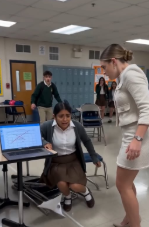
I was seventeen years old, standing beside the stage steps with my palms damp and my throat tight, when I saw Victoria walking toward me like the entire small auditorium belonged to her family. She wore a pearl-colored skirt suit, low heels, a silver watch, and diamond earrings small enough to look tasteful but bright enough to remind everyone she could afford them. Her hair was pinned back perfectly. Her smile was calm. Her eyes were not.
Behind her, three of her friends held their phones low, pretending they were not filming.
That was how I knew something bad was coming.
The small auditorium at Westbridge High was not impressive, but on district showcase days, teachers acted like it was Carnegie Hall. The curtains had been steamed. The front rows were reserved with printed signs. Sponsor banners stood near the exit. A folding table in the corner held coffee, cookies, and name tags for school board guests. Everything smelled like floor polish, paper programs, and the burnt coffee teachers drank when they were trying not to panic.
I had arrived early that morning because Ms. Patel trusted me with the presentation file.
That was the first mistake.
Not trusting me.
Trusting the room.
The presentation was for the American History Youth Showcase, a district event where juniors and seniors presented research projects connected to local community records. Our group’s project was supposed to be simple: a timeline showing how immigrant families, union workers, and student organizers shaped public education in our city. I had built most of the slideshow because I liked making messy information clear. I liked clean labels, careful dates, original sources, and backup files with boring names that no one else opened.
Victoria hated that.
She was the official student presenter because she could speak like she was already running for office. I was the research coordinator. That meant I found documents, checked citations, scanned old newspaper clippings, and made sure nobody turned family stories into decorative lies.
For two weeks, things had been tense but manageable.
Then Victoria wanted to remove one slide.
Slide 18.
The cafeteria workers’ strike.
“It slows down the narrative,” she told me the day before the showcase, standing in the library with her silver watch catching the sun. “We need the story to feel inspiring.”
“It is inspiring,” I said. “They organized for safer kitchen conditions and fair pay. Three student groups supported them.”
Victoria’s smile tightened. “Sponsors do not want to sit through labor conflict.”
“The prompt is community history.”
“And I’m telling you how to present it.”
I looked at the open laptop between us. Slide 18 showed a scanned photo from the school archive: cafeteria workers standing outside the old building in winter coats, holding hand-painted signs. One woman near the center had sharp cheekbones, tired eyes, and a determined mouth.
My abuela.
Victoria did not know that at first.
To her, the woman was just an inconvenient face in an inconvenient story.
“My grandmother is in that photo,” I said.
Victoria blinked once. “That’s sweet.”
Sweet.
As if the word could shrink a person’s history into something harmless.
“She worked here for twenty-three years,” I said. “The slide stays.”
Victoria leaned closer, lowering her voice. “Lucia, do not make this personal.”
“It is personal.”
“That’s the problem.”
The next morning, Slide 18 was gone.
Not only gone.
Replaced.
In its place was a glossy chart titled COMMUNITY UNITY INITIATIVE, claiming that student volunteers and school leadership had worked together smoothly with local workers to improve conditions without conflict. It was neat, cheerful, and false.
I stared at the slide in the backstage prep room while the auditorium filled outside.
My fingers went cold.
Ms. Patel stood beside me, adjusting her glasses. “Lucia? Is something wrong?”
“This slide was changed.”
She frowned. “Changed how?”
“It removed the strike.”
Ms. Patel looked at the screen, then at me. “Victoria said you finalized this version last night.”
I turned so fast my cardigan slipped off one shoulder. “No. I didn’t.”
The room seemed to tilt.
Ms. Patel’s face tightened with concern, but before she could answer, Victoria entered with her friends.
“There you are,” Victoria said brightly. “Everyone’s waiting.”
I pointed at the laptop. “You changed Slide 18.”
Her expression did not move. That was the frightening thing about Victoria. Most people lied with nerves. She lied like she had practiced in a mirror.
“I cleaned up the presentation,” she said. “You approved it.”
“No, I didn’t.”
Victoria sighed, soft and disappointed. “Lucia.”
I hated the way she said my name, like she was already forgiving me in front of invisible witnesses.
Ms. Patel looked between us. “Victoria, did Lucia approve the final changes?”
“She emailed me last night,” Victoria said. “She said the labor strike material was too sensitive and could distract from the district message.”
My heart punched against my ribs.
“I never sent that.”
Victoria’s friend Madison lifted her eyebrows. “Then why would Victoria have the email?”
Another friend, Claire, murmured, “This is so awkward.”
Victoria opened her phone and turned the screen toward Ms. Patel.
There it was.
An email from my school account.
Victoria, you were right. Remove the strike slide and use the unity chart instead. It will look better for sponsors. Lucia.
For a second, I could not speak.
The words were mine only in name.
My school account. My signature. My betrayal.
Ms. Patel’s face changed, not fully into doubt, but close enough that my stomach dropped.
“I didn’t write that,” I whispered.
Victoria tilted her head. “Then who did?”
That was when I understood this had not started that morning.
It had been built.
Carefully.
A missing slide. A fake email. A room full of adults. Phones ready before I even walked out.
Victoria had not improvised a lie.
She had staged one.
The showcase began at ten.
By then, the rumor had already escaped the prep room.
When I stepped into the small auditorium, students turned in their seats. Not openly at first. Just enough. A glance over a shoulder. A whisper behind a program. A phone tilted toward me, screen glowing.
I heard pieces.
“She changed her mind and is blaming Victoria.”
“Her grandma was on the slide or something.”
“She probably got emotional.”
“Victoria saved the presentation.”
Saved.
That word followed girls like Victoria everywhere. They never changed things, erased things, or took things. They saved them.
I stood near the side aisle, clutching my printed notes so tightly the pages bent. My blouse was ironed, but my cardigan had a loose thread at the cuff. My Mary Jane shoes were polished, but the left strap had been repaired with brown thread that did not perfectly match. Suddenly I could feel every old thing on my body.
Victoria took the stage.
She smiled at the audience.
“Good morning, everyone. Our presentation today honors the spirit of unity that has always defined Westbridge High.”
Unity.
The word made my jaw tighten.
Slide after slide appeared behind her. Early school founding. Student clubs. Community drives. Local families. Everything smooth. Everything safe. Everything scrubbed clean.
Then Slide 18 appeared.
COMMUNITY UNITY INITIATIVE.
Victoria gestured gracefully toward the fake chart.
“In 1998, our school community came together through peaceful collaboration to improve cafeteria conditions without division or conflict.”
My chest burned.
Without division.
Without conflict.
My abuela had stood outside in freezing weather because the kitchen ceiling leaked, because two workers had slipped on broken tile, because requests had been ignored for months. Students had joined them. Parents had brought hot coffee. The local paper had called it one of the most important youth-supported labor actions in the district.
Victoria had turned it into a smiling chart.
I looked at Ms. Patel.
She was watching the screen with a strained expression, like part of her knew something was wrong but another part was afraid of what fixing it would cost.
That was when Victoria’s eyes found mine.
She smiled.
Not for the audience.
For me.
Something inside me snapped quietly.
I stepped toward the stage.
“Ms. Patel,” I said.
It came out too soft.
No one heard except the students near me.
I tried again. “Ms. Patel, that slide is false.”
The room stirred.
Victoria stopped speaking.
Ms. Patel turned sharply. “Lucia, please wait until the presentation is finished.”
“No,” I said, louder. “The original record proves this chart was changed.”
Victoria’s smile faded just enough. “Lucia, we discussed this.”
“We didn’t.”
She laughed lightly, performing patience. “I understand you’re upset because your family connection was removed, but this is not the appropriate time.”
My face went hot.
There it was.
She had made the truth sound like a tantrum.
I took another step. “Open the PowerPoint history.”
Victoria’s eyes hardened.
“Don’t do this,” she said.
“Open it.”
The auditorium had gone still now. Teachers stood along the walls. A district administrator in the front row leaned forward. Cameras from the school media club shifted toward us.
Victoria stepped down from the stage.
Her heels clicked once.
Twice.
Three times.
Each click made the room smaller.
She stopped in front of me, close enough that I could see the pale pink gloss on her lips.
“You are embarrassing yourself,” she whispered.
“No,” I whispered back. “You are scared.”
Her nostrils flared.
Then she shoved me.
Her shoulder drove into mine first, then her hands hit my arms, pushing me backward away from the stage steps. My notes scattered across the floor. My old shoes slipped against the polished aisle. A sound rose from the audience, half gasp, half thrill, the ugly sound people make when conflict becomes entertainment.
For one second, nobody moved.
I could hear everything too clearly.
The buzz of the projector.
A phone vibrating.
A chair leg scraping.
My own breathing.
Victoria stepped back immediately, lifting both hands like she was the one who had been attacked.
“She grabbed at me,” she said.
I stared at her.
The lie came so fast it almost felt automatic.
“She tried to rush the stage,” Madison added, phone already up.
“I saw it,” Claire said.
But she had not seen it.
She had prepared it.
My eyes burned, but I would not cry.
I bent down, gathered one page from the floor, and stood with my hands shaking.
“Open the PowerPoint history,” I said again.
This time, the district administrator stood.
He was a tall man with gray hair and a badge that read DR. ELLIOT MARKHAM. Until then, he had looked politely bored. Now his face was sharp.
“Ms. Patel,” he said, “please open the version history.”
Victoria turned toward him. “Dr. Markham, this is a misunderstanding. Lucia has been under a lot of stress.”
My laugh came out before I could stop it.
A small, cracked sound.
Victoria looked furious.
Dr. Markham did not look at her. “Version history, please.”
Ms. Patel walked to the laptop.
Her hands trembled as she clicked File.
Version History.
See Version History.
The projector changed.
A sidebar opened on the screen.
Everyone saw it.
Yesterday, 8:17 p.m. — edited by Lucia Herrera.
Victoria exhaled loudly, like a wounded person relieved by justice.
“There,” she said. “I wish this had not become necessary.”
The room shifted again.
Doubt moved like cold air.
My name was on the screen.
I could feel it pressing against my chest.
But then I remembered the thing people never remembered about files.
The first screen was never the whole truth.
“Click details,” I said.
Ms. Patel glanced at me.
“Please,” I said. “Click details.”
Victoria’s head snapped toward me.
That tiny movement told me everything.
Ms. Patel clicked.
The expanded history showed device information.
Edited by Lucia Herrera.
Device: Auditorium Tech Booth Desktop.
Authentication: Session recovery.
Time: 8:17 p.m.
The room murmured.
I had never used the auditorium tech booth desktop.
That computer was locked behind the sound booth door, and only teachers, tech crew, and administrators had access.
“I was not in the auditorium at 8:17,” I said. “I was at the public library with my brother.”
Victoria crossed her arms. “Anyone can say that.”
“My library card scanned at 7:58 and 8:43. Security cameras too.”
That was not luck. That was life. My little brother Mateo needed internet for homework because our apartment Wi-Fi had been unreliable all month. We had gone to the library after dinner. I had receipts because I always kept receipts.
Victoria’s jaw tightened.
Dr. Markham looked at Ms. Patel. “Who accessed the tech booth?”
Ms. Patel clicked the sign-in log connected to the equipment checkout system.
The screen loaded slowly.
The first name appeared.
Victoria Harrington.
8:05 p.m.
Purpose: Presenter rehearsal.
A wave of whispers broke across the auditorium.
Victoria’s friends lowered their phones slightly.
Victoria gave a sharp laugh. “Yes, I rehearsed. That doesn’t mean I changed anything.”
“Scroll,” I said.
Ms. Patel scrolled.
Second entry.
Administrator override: Principal Elaine Harrington.
8:09 p.m.
The room went dead silent.
Victoria’s mother was the principal.
Principal Harrington had not been in the auditorium, at least not where people could see her. But her name on the screen felt like she had entered anyway.
Victoria’s face changed for the first time.
Not fear exactly.
Anger at the truth for showing up early.
Dr. Markham stood straighter. “Principal Harrington accessed the booth?”
Victoria said quickly, “My mother probably unlocked it for me.”
“That is not what the log says,” Ms. Patel whispered.
Everyone turned to her.
She looked at the screen, then at me, then at Dr. Markham.
“It says administrator override was used after student login recovery failed.”
I frowned. “What does that mean?”
Ms. Patel swallowed. “Someone tried to open your account from the tech booth. The password failed. Then an administrator overrode the login and restored the session.”
The words moved through me slowly.
Someone had not just changed the slide.
They had used my account to do it.
Just like the fake email.
I looked at Victoria.
“Who helped you?”
She rolled her eyes, but her mouth was pale. “This is ridiculous.”
Dr. Markham said, “Ms. Patel, open the earlier versions.”
The version timeline expanded.
And there it was.
Yesterday, 5:42 p.m. — edited by Lucia Herrera.
That was my real version.
Ms. Patel clicked it.
The original Slide 18 appeared.
The cafeteria workers stood outside in winter coats, my abuela at the center, her sign raised.
WE FEED THIS SCHOOL. RESPECT OUR WORK.
A sound came from the back of my throat before I could hide it.
Seeing her face on that big screen changed the room.
The fake chart had been neat.
The photo was alive.
The workers’ eyes were tired and proud. The students beside them held thermoses and handmade signs. Snow blurred the edges of the old picture. It was not decorative. It was real.
“My grandmother,” I said, voice shaking, “is Elena Herrera. She worked in this school cafeteria until her hands hurt too badly to hold trays. That strike was not a problem to hide. It was history.”
No one laughed.
No one whispered.
Even the phones seemed lower now.
Then Dr. Markham asked the question that made Victoria’s expression crack.
“Who else had helped you change the record?”
Victoria turned toward him slowly. “Excuse me?”
He pointed to the screen. “The official school chart claims district approval. That chart was not created by Lucia. It was inserted from an administrative template folder. Who gave it to you?”
Victoria said nothing.
Then the auditorium doors opened.
Principal Harrington walked in.
She wore a navy dress and a white blazer, and her face carried the kind of calm that made adults move aside before they knew why. She looked at the screen, then at her daughter, then at me.
“Dr. Markham,” she said smoothly, “I can explain.”
My stomach dropped.
Because the way she said it made me realize something worse.
This was not Victoria’s cover-up.
It was her mother’s.
Principal Harrington stepped down the aisle as if she were approaching a podium, not a disaster.
“There was a concern,” she said, “that certain historical materials could create controversy during a donor-attended event. I advised students to use a more balanced presentation.”
“You advised them to remove an original school record?” Dr. Markham asked.
“To contextualize it.”
“You used an administrator override to access a student account.”
Her smile tightened. “The system may have logged it imprecisely.”
Ms. Patel, who had been silent too long, suddenly spoke.
“No, it did not.”
Everyone looked at her.
Principal Harrington’s face cooled. “Ms. Patel.”
The warning in her voice was clear.
But Ms. Patel lifted her chin.
“The system did not log it imprecisely. The chart was uploaded from the principal office drive. The fake email was also sent through a recovered session from Lucia’s account.”
My knees nearly gave out.
The fake email.
She could prove that too.
Victoria looked at Ms. Patel with pure betrayal. “You said you deleted the draft logs.”
Ms. Patel flinched.
The whole room heard it.
Principal Harrington closed her eyes for half a second.
Victoria had just exposed the one thing her mother could not explain away.
Dr. Markham turned to Ms. Patel. “What draft logs?”
Ms. Patel’s face had gone pale. “I found them this morning.”
Principal Harrington said, “This is not the place.”
“It became the place when your daughter put her hands on Lucia,” Ms. Patel said.
Her voice shook, but she did not stop.
She opened another file.
Email recovery log.
A draft had been created from my account at 8:22 p.m.
The first version said:
Victoria, I do not agree to remove the strike slide. Lucia.
Then the sentence was deleted.
A new message was typed.
Victoria, you were right. Remove the strike slide and use the unity chart instead. It will look better for sponsors. Lucia.
The editor ID attached to the recovered session was not mine.
It was Principal Harrington’s administrator credential.
The auditorium exploded.
Parents stood. Students shouted. Teachers whispered in horrified clusters. Victoria’s friends backed away from her as if scandal were contagious.
My whole body went numb.
Principal Harrington had not only helped Victoria.
She had written my false confession.
She had turned my own name into a weapon.
For a moment, I felt too small to stand under the weight of it.
Then someone in the back spoke.
“Lucia.”
I turned.
My abuela stood in the doorway.
She leaned on her cane, wearing her brown coat and the knitted scarf I had given her last Christmas. My mother stood beside her, one hand on her arm, eyes wet and furious.
I had not invited them because I did not want them to miss work or worry.
But Mateo must have told them.
Abuela looked at the screen where her younger self stood in the snow.
Then she looked at Principal Harrington.
Her voice was quiet, accented, and clear.
“You erased us once in that kitchen,” she said. “You will not erase us again from the story.”
Principal Harrington’s face drained.
That was when I remembered something my abuela had told me years ago.
The strike ended after the district promised repairs.
But one administrator had tried to punish workers by cutting their shifts.
A young teacher had leaked the memo.
The administrator’s name had been Harrington.
Principal Harrington’s father.
Suddenly, the cover-up was not about avoiding controversy.
It was about family reputation.
Victoria had not removed Slide 18 only because sponsors were coming. Her mother had removed it because that slide connected the Harrington name to an old injustice they had spent decades polishing out of memory.
Dr. Markham looked from my abuela to Principal Harrington.
“Is there a historical record involving your family and this strike?” he asked.
Principal Harrington said nothing.
But silence can be a confession when the file is already open.
Ms. Patel clicked the citation link on the original slide.
A scanned district memo appeared.
Signed in 1998 by Deputy Administrator Charles Harrington.
Recommendation: Reduce hours for cafeteria staff participants to discourage future labor disruption.
The name filled the screen like a verdict.
Victoria sat down in the front row as if her legs had stopped working.
I looked at her, expecting defiance.
Instead, she looked like someone watching the walls of her house turn into paper.
Principal Harrington reached for control one last time.
“This is an old matter being misrepresented by a student with a personal attachment.”
My mother stepped forward.
“My daughter’s attachment is to the truth.”
Principal Harrington’s eyes cut toward her. “This is a school matter.”
“My child was shoved in a school auditorium after your office used her account to fake an email,” my mother said. “Now it is a family matter too.”
I had never loved her more.
Dr. Markham ordered the showcase paused. He asked the media club to stop recording, but by then half the auditorium had already streamed pieces of the confrontation. He escorted Principal Harrington to a side office. Victoria stayed seated, staring at nothing.
Ms. Patel came to me with tears in her eyes.
“I’m sorry,” she said. “I should have stopped it sooner.”
I wanted to be gracious.
I wanted to say it was okay.
But it was not.
“You saw the logs this morning,” I said.
She nodded, crying harder. “I was scared.”
“Of her?”
She looked toward the side office. “Of losing my job. Of making it worse. Of not being believed.”
I looked at the scattered notes still on the floor.
“That’s how they keep doing it,” I said.
Ms. Patel covered her mouth.
“I know,” she whispered.
The next two weeks felt unreal.
Principal Harrington was placed on administrative leave. Dr. Markham opened an investigation into unauthorized account access, student records misuse, and historical archive manipulation. Victoria disappeared from school for several days. Madison and Claire claimed they had only filmed because they thought I was “acting unstable.” Nobody believed them, but plenty of people pretended to because pretending was easier than admitting they had enjoyed my humiliation.
The PowerPoint became famous in the worst way.
People called it PowerPointgate.
I hated that name.
It made everything sound silly.
Nothing about it had felt silly when my name was on a fake email. Nothing about it was silly when my abuela cried quietly at our kitchen table because the photo of her strike had been shown to the whole school only after someone tried to erase it.
One night, she sat beside me while I reorganized the evidence folder on my old laptop.
“You keep many copies,” she said.
“Always.”
She smiled faintly. “Good. Paper remembers when people pretend.”
I looked at her hands, the knuckles swollen from years of work.
“Were you scared during the strike?” I asked.
“Every day.”
“But you still stood outside.”
She touched the edge of the printed photo. “Because fear is not always a stop sign. Sometimes it is proof you are standing near something powerful.”
I thought about Victoria’s face before she shoved me.
I had believed she was powerful because everyone treated her like she was.
But maybe power was not the same as courage.
Maybe power was only what people handed you until someone asked for the history.
The final hearing happened in the same small auditorium.
That was Dr. Markham’s decision. He said the community deserved to hear the corrected presentation in the place where the false one had been exposed. Part of me hated returning. Part of me needed to.
This time, the room felt different.
Not safer exactly.
More awake.
The sponsor banners were gone. The reserved signs were gone. No one served cookies. The front row held cafeteria workers, parents, teachers, and students whose families had been part of the 1998 strike. My abuela sat in the center wearing the same brown coat, her cane resting against her knee.
Victoria arrived with no pearl suit, no friends, no cameras. She wore a plain black dress and looked like she had not slept well in days.
Principal Harrington did not attend.
Her resignation had been announced that morning.
Dr. Markham opened the hearing with a statement about student integrity, archive transparency, and institutional accountability. Adults loved phrases like that. They sounded clean. But the room was not clean. It was full of old hurt, fresh anger, and people waiting to see if truth would be made small again.
Then he invited me to present the corrected slideshow.
My hands shook as I walked to the laptop.
The first slides were familiar. School founding. Community clubs. Student volunteers. Then Slide 18 appeared.
The real one.
The cafeteria workers in the snow.
This time, no one interrupted.
I told the story slowly.
I spoke about the broken kitchen tile, the leaking ceiling, the ignored complaints, the students who carried signs, the parents who brought food, the workers who risked their jobs. I spoke about Elena Herrera, my abuela, who had worked mornings before sunrise and still came home to help her children with homework. I spoke about Charles Harrington’s memo and the attempted retaliation.
My voice shook when I said the Harrington name.
But it did not break.
Then I clicked to the final slide.
I had added it myself.
It showed the PowerPoint version history.
Not as scandal.
As evidence.
“The truth survived,” I said, “because files keep records. But records only matter if people are brave enough to open them.”
The auditorium stood.
Not all at once.
First my mother.
Then my abuela.
Then Mateo.
Then students, teachers, parents, cafeteria workers, even Dr. Markham.
I looked out at them through tears I refused to wipe away.
And then, to my shock, Victoria stood too.
She did not clap loudly. She did not try to draw attention. She simply stood near the side aisle, crying silently.
After the hearing, she found me near the stage.
For once, she waited until I looked at her.
“I’m sorry,” she said.
I said nothing.
“I know that doesn’t fix it.”
“No,” I said. “It doesn’t.”
She nodded, tears slipping down her face. “My mother told me that if people saw the slide, they would use it against our family forever. She said you were making the project about yourself. I believed her because it was easier than asking why the truth scared her so much.”
I studied her face.
There was no performance now.
No perfect posture.
Just a girl who had inherited a lie and chosen to protect it until it burned her too.
“You shoved me,” I said.
“I know.”
“You lied about me.”
“I know.”
“You let people think I was unstable because my grandmother mattered to the story.”
Victoria’s mouth trembled. “I know.”
I waited for anger to rise again.
It did.
But something else rose with it.
A tired understanding that apology was not repair.
“Tell the board everything,” I said. “Not the soft version. Not the version that saves your mother. Everything.”
She wiped her face. “I already did.”
That surprised me.
She reached into her bag and handed me a printed statement.
It was signed, dated, and notarized.
In it, Victoria admitted her mother had instructed her to replace the strike slide, helped access my account, drafted the false email, and encouraged her to provoke me publicly so my objection would look emotional instead of factual.
At the bottom, there was one sentence that made my chest tighten.
Lucia Herrera did not damage the presentation. She protected a history my family tried to bury.
I looked up.
Victoria’s eyes were red.
“I should have said it before I was exposed,” she whispered. “I know that.”
“Yes,” I said. “You should have.”
She nodded.
I did not forgive her that day.
But I kept the statement.
Three months later, Westbridge High renamed the annual showcase the Community Memory Project. The first exhibit was about the cafeteria workers’ strike. My abuela cut the ribbon with three other retired workers, and the school cafeteria served free coffee in paper cups like the parents had brought to the picket line in 1998.
Ms. Patel created a new rule: every student presentation had to include a version history review before public display. Mateo called it “the Lucia Rule,” which made me threaten to hide his cereal.
Victoria transferred schools after her mother resigned.
Before she left, she mailed a box to the archive.
Inside were family papers from 1998.
Letters. Meeting notes. A photograph of her grandfather standing beside the old cafeteria entrance, looking stern and certain and wrong.
There was also a note.
Some histories are inherited. So are chances to stop hiding them.
I showed it to Abuela.
She read it twice, then folded it carefully.
“She is learning,” she said.
“Too late,” I muttered.
Abuela looked at me over her glasses. “Late is not the same as never.”
I did not answer, but I thought about it for a long time.
The next year, I applied for a district student archivist internship. In my essay, I wrote about old records, false charts, and the day a PowerPoint history proved that truth can live inside the smallest dropdown menu if someone knows where to click.
I got the position.
On my first day, Dr. Markham handed me a badge and showed me the archive room. Metal shelves held boxes of meeting minutes, photographs, old programs, and forgotten reports. The air smelled like dust and paper and time.
On the back wall, someone had framed a copy of Slide 18.
My abuela in the snow.
Her sign raised.
Her face unafraid.
I stood in front of it for a long moment.
Then I opened my laptop, created a new folder, and named it:
ORIGINALS_DO_NOT_ERASE.
I smiled.
Because I knew now that humiliation could be survived. A shove could be survived. A lie could be survived.
But a history, once opened in front of the right people, could do more than survive.
It could walk back into the room with every person someone tried to erase.
It could stand under the auditorium lights.
It could look power in the face.
And it could ask, calmly and clearly, who else helped change the record.
THE END
