Part 2: The Page Nobody Expected Him To Read
The event director adjusted the microphone with trembling hands.
Every guest in the Albany civic hall leaned forward.
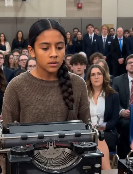
Nora Bainbridge stood frozen beside the display tables.
Her confident smile was gone.
The director unfolded the first page from the stenotype record.
“This document contains the complete work log for the restoration project.”
The room remained silent.
He cleared his throat.
“Student number forty-seven. Mireya Torres.”
My heart pounded.
The director continued reading.
“Three hundred twenty-six volunteer hours.”
A murmur swept through the audience.
Nora’s eyes widened.
“One hundred eighty-four cataloged machines.”
More whispers followed.
“Forty-seven repair reports.”
A reporter lowered his camera.
The sponsor section exchanged confused glances.
The director lifted another sheet.
“Twenty-three instructional guides written for future students.”
The room erupted.
People looked at me differently now.
Not with pity.
With surprise.
Because they were finally seeing the work that had happened when nobody was watching.
Nora shook her head.
“No.”
The word escaped her lips before she could stop it.
The director looked directly at her.
“Would you like me to continue?”
She didn’t answer.
So he did.
“Student number twelve. Nora Bainbridge.”
The room became completely still.
“Volunteer hours recorded: eleven.”
The silence afterward felt deafening.
Then somebody in the audience gasped.
Because the difference wasn’t small.
It was overwhelming.
And the next page would make things even worse.
Part 3: The Signature Hidden At The Bottom
Nora lunged toward the folder.
The director stepped backward.
“Do not touch these documents.”
Her face flushed bright red.
“Those records are incomplete.”
Several reporters immediately raised their cameras.
The director slowly turned to the final page.
“I thought you might say that.”
He pointed to the bottom corner.
There, beneath dozens of entries, sat a signature.
Nora’s signature.
The room froze.
She stared at it.
I stared at it.
Everyone stared at it.
The date beside the signature was from six weeks earlier.
A verification form.
Nora herself had signed the document confirming the work records were accurate.
One reporter laughed in disbelief.
Another rushed forward to photograph the page.
“You verified this?” a sponsor asked.
Nora swallowed.
“It wasn’t supposed to—”
She stopped herself.
Too late.
The audience heard every word.
The event director narrowed his eyes.
“Wasn’t supposed to what?”
Nora remained silent.
The director carefully removed another document.
A typed email.
His expression darkened.
“This changes everything.”
The audience held its breath.
Because the email wasn’t written by Nora.
It came from someone far more powerful.
Her father.
Part 4: The Email That Changed The Entire Ceremony
The screen behind the stage flickered to life.
The email appeared for everyone to see.
Several people immediately pulled out phones.
The sender was Gregory Bainbridge.
Owner of Bainbridge Historical Holdings.
Primary sponsor of the event.
The message was short.
Painfully short.
“Remove Torres from all public recognition materials before the ceremony.”
A shocked murmur rolled through the hall.
Then the second line appeared.
“Replace her with Nora.”
Nobody spoke.
Nobody moved.
The words hung over the room like a storm cloud.
Gregory Bainbridge stood near the sponsor section.
His face had gone pale.
“This is being taken out of context,” he said.
But his voice lacked conviction.
The event director wasn’t finished.
He displayed the next message.
A reply.
From a project coordinator.
“We cannot do that. The records clearly show Torres completed the work.”
Another email followed.
Gregory’s response.
“Find a way.”
The audience exploded into conversation.
Journalists rushed toward the sponsor area.
Cameras flashed continuously.
For the first time in years, Gregory Bainbridge looked completely powerless.
Then an elderly woman sitting near the back slowly stood.
Her voice cut through the chaos.
“I’ve seen this before.”
The room turned toward her.
Nobody realized yet that she was about to uncover a secret buried for nearly forty years.
Part 5: The Forgotten Transcript In The Archive Room
The woman introduced herself as Eleanor Whitaker.
Most students had never heard her name.
The historians in the room had.
She was a retired court stenographer.
For decades she had preserved thousands of transcripts throughout New York.
Eleanor approached the stage carrying a worn leather case.
Her hands trembled slightly.
“I came today because these machines matter.”
She glanced toward the Bainbridge family.
“And because certain names sounded familiar.”
The room grew quiet again.
Eleanor opened her case.
Inside rested a faded transcript.
Yellow with age.
Nearly forty years old.
The event director carefully examined it.
“What is this?”
Eleanor inhaled slowly.
“A hearing transcript.”
She pointed toward a family name printed near the top.
Bainbridge.
The audience gasped.
Gregory Bainbridge looked genuinely alarmed now.
Eleanor continued.
“Decades ago, another student restoration project disappeared from public records.”
A chill ran through me.
The room felt colder.
The similarities were impossible to ignore.
“The student responsible was never credited.”
Eleanor tapped the paper.
“But I kept my copy.”
The audience leaned closer.
Then Eleanor revealed something shocking.
The forgotten student had uncovered valuable historical documents connected to several properties.
Properties later acquired by companies associated with the Bainbridge family.
Gregory immediately stood.
“This is absurd.”
But nobody was listening anymore.
Because the transcript suggested that what happened to me wasn’t an isolated incident.
It might have been part of a pattern stretching back generations.
Part 6: The Investigation Nobody Could Stop
Within days, local newspapers carried the story everywhere.
What began as a school ceremony became a statewide controversy.
Investigators started reviewing old archives.
Historical societies reopened storage rooms.
University researchers volunteered to help.
The deeper they searched, the stranger things became.
Several restoration projects from previous decades showed similar irregularities.
Student contributions vanished.
Records disappeared.
Recognition shifted elsewhere.
Not always to the Bainbridge family.
But often enough to raise serious questions.
I tried avoiding the attention.
It was impossible.
Every interview request reminded me of that moment on the floor when Nora shoved me.
Then one afternoon the event director called.
His voice sounded urgent.
“Mireya, we found something.”
I arrived at the archive building within an hour.
Inside, investigators surrounded a large table.
Documents covered every surface.
One historian pointed toward a ledger.
“We discovered where the missing records went.”
The room fell silent.
Many of the documents hadn’t been destroyed.
They had been hidden.
Stored under incorrect classifications.
Misfiled for decades.
Accidentally invisible.
Or perhaps intentionally.
Then investigators uncovered something even bigger.
A complete transcript collection.
Hundreds of pages.
And among them sat a file labeled with Gregory Bainbridge’s grandfather’s name.
The truth was finally coming into focus.
But it would destroy far more than a single reputation.
Part 7: Nora Finally Tells The Truth
A public hearing was scheduled in Albany City Hall.
The room overflowed with reporters.
Students filled every seat.
Historical organizations watched online.
The Bainbridge family sat quietly near the front.
For once, they looked nervous.
Nora looked exhausted.
Weeks of public scrutiny had erased every trace of her former arrogance.
When her turn came to speak, she approached the microphone slowly.
Her hands shook.
For several seconds she couldn’t speak.
Then she finally looked at me.
“I’m sorry.”
The words stunned the room.
Nora swallowed hard.
“I knew Mireya did the work.”
The audience remained silent.
“I saw the records.”
Her voice cracked.
“I knew she earned the recognition.”
A tear rolled down her cheek.
“But my family always taught me that influence mattered more than effort.”
Nobody interrupted.
Nobody moved.
Because everyone sensed how difficult this confession was.
“I thought taking credit would be easy.”
She lowered her head.
“Instead, I became exactly the kind of person I promised myself I would never become.”
The silence felt endless.
Then Nora reached into her folder.
She handed investigators several documents.
Private communications.
Internal instructions.
Evidence.
The hearing lasted hours.
When it ended, investigators had enough information to close the case.
But one final discovery remained.
And it would change Mireya’s future forever.
Part 8: The Museum Wing Named After The Girl
Three months later, the restored stenotype collection reopened.
Crowds filled the historic building.
Students from across New York attended.
Historians traveled from other states.
I expected a simple ribbon-cutting ceremony.
Nothing more.
Then the director smiled.
“Before we begin, we have an announcement.”
A curtain slowly rose behind the stage.
The audience gasped.
A completely renovated exhibition wing stretched beyond it.
Glass displays.
Interactive archives.
Historical transcripts.
Restored stenotype machines.
At the entrance stood a bronze plaque.
I couldn’t breathe when I read it.
THE MIREYA TORRES STUDENT PRESERVATION CENTER
The crowd erupted into applause.
Tears blurred my vision.
The director wasn’t finished.
“The investigation recovered thousands of forgotten student contributions.”
He pointed toward the exhibits.
“Every name will now receive proper credit.”
A standing ovation swept through the hall.
Then Eleanor Whitaker approached carrying the old transcript.
She carefully placed it into my hands.
“For forty years,” she said softly, “someone waited for the truth to be heard.”
I looked around the room.
The students.
The historians.
The volunteers.
The people who finally cared about the work hidden behind the spotlight.
Years from now, visitors would walk through those halls and see every forgotten contribution restored to its rightful owner.
And among all those recovered names, the girl once pushed to the floor would forever stand as the reason none of them were lost again.
