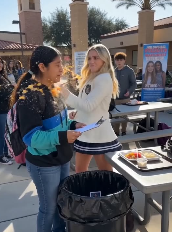
The strawberry punch struck my face before I understood that Brielle Whitmore had lifted the bowl.
One second, I was standing beside the senior picnic display with a folder pressed against my chest. The next, red liquid poured through my hair, soaked the shoulders of my blue-green hoodie, and dripped from my eyelashes while pieces of fruit slid down my cheeks.
The senior picnic area went silent.
Not quieter.
Silent.
Hundreds of students had been talking beneath the white canopy tents only moments earlier. Music had played from two speakers near the basketball court. Teachers had shouted instructions over the scraping of picnic tables. Phones had been raised to photograph the senior memory display.
Then Brielle threw the punch, and everything stopped.
She stood three feet away from me in her white blazer, pleated tennis skirt, and polished boots, breathing as though I had attacked her instead.
“Maybe now you’ll stop making everything about yourself,” she said.
The first sound after that was the soft electronic chime of someone beginning to record.
Then another.
Then six more.
I could feel every camera turning toward me.
My name is Luna Castillo. I was seventeen years old, a Guatemalan American senior at Hillcrest Preparatory Academy in San Antonio, Texas, and I had spent most of high school learning how to become invisible without looking afraid.
At Hillcrest, invisibility was useful.
It kept teachers from noticing that my mother sometimes picked me up wearing her hotel housekeeping uniform. It kept wealthy students from asking why I brought the same canvas backpack every year. It kept people like Brielle from remembering that my scholarship allowed me into the school but did not make me one of them.
That morning, however, I had made the mistake of noticing something.
A cardboard archive box filled with transfer-student photographs had been shoved into a black trash bag behind the senior picnic stage.
Those photographs were supposed to be part of the school’s “Four Years Together” display.
The display covered an entire wall beneath the main pavilion. It included freshman orientation photographs, sports teams, debate trophies, theater productions, volunteer events, and college acceptance announcements. The yearbook committee had arranged everything in a perfect timeline.
Except the transfer students were missing.
Students who had arrived during sophomore, junior, or senior year had been removed from the story as if they had never belonged there.
My friend Mateo Ruiz was one of them.
Mateo had transferred during junior year after his father died. He had spent months eating lunch alone before joining the engineering club. That spring, his robotics design had won Hillcrest its first state award in almost a decade.
His photograph should have been centered beneath the award certificate.
Instead, the photograph was inside a trash bag.
So were thirty-seven others.
I had pulled the box out and carried it to the records table, assuming it was a mistake.
Brielle had seen me.
Now punch ran down my face while everyone watched her turn that mistake into my humiliation.
“Brielle,” Principal Harlan said from behind her, his voice stunned. “What have you done?”
She did not look at him.
Her eyes were fixed on the folder in my hands.
That was when I understood.
The punch had never been about embarrassing me.
It had been about the folder.
I tightened my grip.
Inside were twelve photographs, two printed inventory sheets, and a small yellow envelope that had fallen from the bottom of the discarded archive box.
Brielle took one step forward.
“Give me that.”
My heart pounded so hard that the pavilion seemed to pulse around me.
“No.”
Her expression changed.
For years, Brielle Whitmore had mastered a certain smile—the kind that made teachers believe she was responsible, donors believe she was gracious, and nervous students believe refusing her would be socially fatal.
The smile vanished.
“You stole school property,” she said loudly.
Murmurs spread through the crowd.
“I found it in a trash bag.”
“She was digging through restricted materials,” Brielle continued, turning toward Principal Harlan. “I told her to stop, but she became aggressive.”
I stared at her.
The lie came so easily that it sounded rehearsed.
“I asked why the transfer students had been removed from the display.”
“There were no transfer-student photographs scheduled for the display.”
I opened the folder and pulled out the first inventory sheet.
“Yes, there were.”
Brielle lunged for it.
A hand caught her wrist before she reached me.
Ms. Elena Alvarez, the school librarian, stepped between us.
She was small, gray-haired, and usually so gentle that students lowered their voices instinctively around her. But the look she gave Brielle made even Principal Harlan step back.
“That is enough,” Ms. Alvarez said.
Brielle’s mother appeared seconds later.
Vanessa Whitmore moved through the crowd with the confidence of someone accustomed to doors opening before she reached them. As president of the Parent-Teacher Association and chair of the school’s annual donor gala, she had raised more than two million dollars for Hillcrest.
The new arts building bore her family’s name.
Her pale linen dress showed no sign that the Texas heat affected her. Her expression, however, was cold enough to freeze the air beneath the pavilion.
“What happened?” she demanded.
“Luna stole materials and caused a scene,” Brielle said.
“She threw punch at Luna,” Mateo called from the crowd.
Vanessa glanced at my stained hoodie as though it were an inconvenient decoration.
“I am sure Brielle reacted under considerable pressure.”
A bitter laugh escaped me before I could stop it.
Vanessa’s eyes moved to mine.
“Do you find this amusing?”
“No,” I said. “I find it familiar.”
The students nearest us went quiet again.
Vanessa’s smile sharpened.
“I suggest you choose your next words carefully.”
My hands were shaking, but Ms. Alvarez stayed beside me.
So did Mateo.
For the first time, I realized that being frightened and being alone were not the same thing.
“I found a box of transfer-student photographs in a trash bag,” I said. “The inventory sheet says they were approved for today’s display. Somebody removed them.”
Principal Harlan held out his hand.
“Let me see the sheet.”
I gave it to him.
Brielle’s face went pale.
He read the page once, then again.
At the bottom was the signature of student display coordinator Brielle Whitmore.
The list included every photograph in the discarded box.
Principal Harlan looked up slowly.
“You signed this.”
“That isn’t my signature.”
“It matches the signature on the rest of the display forms,” Ms. Alvarez said.
Vanessa took the sheet from him without asking.
“Documents can be altered.”
“The sheet came from the archive box,” I said.
“According to you.”
Her words landed with the precision of small knives.
That was how people like Vanessa protected themselves. They did not need to prove that you were lying. They only needed to make the truth appear debatable long enough for everyone to become tired of defending it.
She turned toward Principal Harlan.
“This picnic has already been disrupted. Brielle should go home, and Luna should be escorted to the office until the school can determine whether she tampered with the records.”
Mateo stepped forward.
“You can’t punish her for finding proof.”
Vanessa barely looked at him.
“This does not involve you.”
“It involves every transfer student whose picture was thrown away.”
More voices rose behind him.
Students I recognized from the discarded photographs began moving closer.
A girl from the tennis team.
Two members of the marching band.
A quiet student who had transferred from El Paso only four months earlier.
For the first time, the crowd was not forming around Brielle.
It was forming around us.
Brielle noticed too.
Her panic returned.
“Check the cameras,” I said.
Principal Harlan hesitated.
The pavilion had security cameras at each entrance and one above the records table. Hillcrest had installed them after expensive audio equipment disappeared the previous year.
“Check them now,” Ms. Alvarez said.
Vanessa’s voice hardened.
“There is no need to turn a student misunderstanding into a criminal investigation.”
“No one said anything about a crime,” I replied.
Her eyes flashed toward me.
That single reaction told me more than any confession could have.
Principal Harlan asked the school security officer, Mr. Collins, to retrieve the recordings. We were moved into the administrative conference room while teachers dismissed the picnic early.
I was allowed five minutes in the nurse’s office to wash the punch from my face.
The liquid came out of my hair, but the stain on my hoodie remained.
As I scrubbed my cheek with a damp paper towel, I stared at myself in the mirror.
My eyes looked enormous.
My face looked younger than seventeen.
For a moment, I wanted my mother so badly that breathing hurt.
She was working a double shift at the River Walk hotel because one of her coworkers was sick. Calling her would mean losing wages she could not afford to lose.
I put my phone away.
When I returned to the conference room, Brielle sat beside her mother. Principal Harlan was at the head of the table. Ms. Alvarez and Mateo sat across from them.
The folder rested in front of me.
The yellow envelope remained unopened.
Mr. Collins connected his laptop to the wall screen.
“We have footage from the picnic pavilion beginning at six this morning,” he said.
Brielle folded her arms.
“Good.”
Her confidence had returned too quickly.
That worried me.
Mr. Collins played the footage.
At 6:18 a.m., two custodians carried display boxes into the pavilion.
At 6:43, Brielle arrived with three members of her friend group: Madison Lee, Harper Doyle, and Sophie Kent.
They began arranging photographs.
At 7:12, Brielle pointed toward the box marked TRANSFER STUDENTS—YEARS TWO THROUGH FOUR.
Madison carried it out of the camera’s view.
Five minutes later, she returned without it.
The room became very still.
“There,” Mateo said. “That proves it.”
Brielle shook her head.
“It proves Madison moved a box.”
“Why?” Principal Harlan asked.
“She said some photographs had water damage.”
All eyes turned toward Madison, who had been called into the room with the others.
Madison’s lips parted.
“I never said that.”
Brielle stared at her.
Madison looked terrified, but she continued.
“You told me those students weren’t part of the original class and the display would look crowded. You told me to put the box by the dumpsters.”
Vanessa leaned forward.
“Madison, consider whether you are remembering accurately.”
Madison’s face crumpled.
“My mother works for Mrs. Whitmore,” she whispered.
The meaning of that sentence settled over the table.
Vanessa’s expression did not move.
Madison looked down.
“She manages events for the Whitmore Foundation. Brielle said if I didn’t help, my mother might not have a job after summer.”
Brielle shot to her feet.
“You’re lying!”
The outburst echoed through the conference room.
Principal Harlan ordered her to sit.
Mr. Collins continued the recording.
At 7:24, Brielle stood alone beside the records table. She looked around, removed several papers from the master binder, folded them, and slipped them inside her blazer.
The camera angle did not show which papers she had taken.
At 8:03, I appeared on-screen behind the pavilion. I stopped beside the trash bags, noticed the cardboard box, and pulled it free.
At 8:06, Brielle confronted me.
The recording had no sound, but her body language was unmistakable. She blocked my path twice. When I tried to pass, she grabbed the box. I pulled it back.
Then she saw the yellow envelope.
Her entire posture changed.
She reached for it.
I stepped away.
Seconds later, the recording showed me placing the envelope into my folder.
Brielle walked toward the punch table.
The footage captured everything.
She lifted the bowl with both hands.
She carried it across the pavilion.
She threw its contents directly into my face.
No one spoke when the video ended.
Principal Harlan removed his glasses.
“Brielle, you will be suspended pending a disciplinary hearing.”
Vanessa stood.
“My attorney will contact the school before the end of the day.”
“There is still the matter of the removed photographs,” he said.
“My daughter made an aesthetic decision for a student display. Poor judgment is not grounds for destroying her future.”
“It wasn’t an aesthetic decision,” I said.
Vanessa turned toward me.
I placed the yellow envelope on the table.
“This is what she wanted.”
Brielle’s chair scraped backward.
“Don’t open that.”
It was the first honest thing she had said all day.
Vanessa looked at her daughter.
“What is inside?”
Brielle’s lower lip trembled.
“I don’t know.”
“Yes, you do,” I said. “You saw it in the box before I did.”
Principal Harlan opened the envelope.
Inside was an old photograph, a handwritten letter, and a hospital identification bracelet.
The photograph showed two women standing outside Hillcrest Preparatory Academy almost eighteen years earlier.
One was much younger, but unmistakable.
Vanessa Whitmore.
The other woman had dark curls, tired eyes, and a smile I knew better than my own.
My mother.
Marisol Castillo.
I stopped breathing.
Mateo whispered my name, but his voice sounded distant.
In the photograph, Vanessa and my mother were both visibly pregnant.
They stood with their arms around each other.
On the back, someone had written:
FOR OUR DAUGHTERS, SO THEY WILL NEVER INHERIT OUR FEAR.
My fingers went numb.
Principal Harlan unfolded the letter.
The handwriting belonged to Ms. Alvarez.
I knew because I had spent four years reading her notes inside library books.
She reached across the table.
“Please,” she said quietly. “Let me explain.”
Every face turned toward her.
Ms. Alvarez looked at me first, then Brielle.
“Your mothers attended Hillcrest together,” she said. “They were not friends in the way this photograph suggests. Not at first.”
Vanessa remained standing, one hand pressed against the table.
“Stop.”
Ms. Alvarez did not.
“Marisol was a scholarship student. Vanessa came from one of the school’s wealthiest families. During their senior year, both became pregnant.”
The room seemed to tilt.
I stared at Vanessa.
She looked older than she had ten minutes earlier.
“Vanessa’s parents feared scandal,” Ms. Alvarez continued. “They arranged for her to leave school quietly and give birth under another name. Marisol’s family had very little money, but she refused to hide.”
My voice emerged as a whisper.
“What does that have to do with us?”
Ms. Alvarez looked at the hospital bracelet.
“Everything.”
Brielle began crying.
Not the controlled tears she used when teachers questioned her.
These were frightened, choking sobs.
“I didn’t know at first,” she said. “I swear I didn’t know.”
Vanessa grabbed her arm.
“Be quiet.”
Brielle pulled away.
“You told me she was trying to take my place!”
I stared at her.
“What place?”
Vanessa closed her eyes.
Ms. Alvarez slid the bracelet toward me.
The name printed on the faded plastic was BABY GIRL CASTILLO.
The date was my birthday.
But the medical identification number had been crossed out in blue ink and replaced with another.
A number matching the copy of Brielle’s birth record attached to the letter.
My stomach turned.
“No,” I said.
Ms. Alvarez’s eyes filled with tears.
“The hospital experienced a power failure during a severe storm. Records were handled manually for several hours. Your mothers delivered within twenty minutes of each other.”
Mateo leaned forward.
“Are you saying they were switched?”
“No,” Vanessa said sharply. “She is saying nothing because she knows nothing.”
Ms. Alvarez faced her.
“I know you paid the hospital records clerk to alter the discharge papers.”
Principal Harlan stood.
“This has moved beyond a school disciplinary matter.”
Vanessa’s composure cracked.
“You have no idea what happened.”
“Then tell us,” I said.
She looked at me.
For the first time in my life, Vanessa Whitmore looked at me as though she already knew every feature of my face.
Her gaze moved over my eyes, my cheekbones, and the dark curls that had begun drying around my shoulders.
Then she sat down.
“When Brielle was born, she stopped breathing,” Vanessa said.
Brielle covered her mouth.
Vanessa stared at the table.
“The nurses took her away. Hours passed. No one told me anything. My parents arrived and spoke to administrators. When they brought a baby back, my mother told me never to ask questions.”
My heart hammered.
“And you didn’t?”
“I was seventeen.”
“So was my mother.”
Vanessa flinched.
“I knew something was wrong. The bracelet did not match. But my parents said the hospital had corrected a clerical error.”
Ms. Alvarez shook her head.
“You discovered the truth months later.”
“Yes.”
The word was barely audible.
“What truth?” Brielle asked.
Vanessa finally looked at her daughter.
“You were Marisol’s biological child.”
The world fractured without making a sound.
Brielle stared at Vanessa.
I stared at Brielle.
We were not switched accidentally.
Someone had chosen.
Vanessa’s parents had believed their granddaughter was dying. In the confusion, they had taken my mother’s healthy newborn and given the critically ill Whitmore baby to Marisol.
But the baby they believed would die had survived.
I had survived.
Marisol had taken me home, loved me, worked endless hours for me, and never once allowed me to feel unwanted.
Vanessa had taken Brielle home and raised her inside a mansion built on a theft.
“Mom knew,” I whispered.
Ms. Alvarez nodded sadly.
“Marisol learned the truth when you were six months old. By then, she loved you completely. She confronted Vanessa.”
Vanessa wiped her face with trembling fingers.
“I offered to reverse everything.”
“You offered her money,” Ms. Alvarez corrected.
“I offered security.”
“You offered to keep Brielle and take Luna too.”
Brielle recoiled.
Vanessa’s voice rose.
“I could have cared for both of them!”
“By taking another child from Marisol?”
“I was trying to fix what my parents had done!”
“No,” Ms. Alvarez said. “You were trying to control the outcome.”
The accusation struck with the same force as the punch bowl.
I remembered Vanessa’s expression when I found the archive box.
Not anger.
Recognition.
“You knew who I was the entire time,” I said.
She did not answer.
“You watched me attend this school.”
“I arranged your scholarship.”
The confession stunned me.
“My mother earned that scholarship for me.”
“Yes, she did. But the committee initially rejected the application.”
My chair moved backward as I stood.
“You made us think it was charity?”
“I wanted you close.”
“Then why pretend I didn’t exist?”
Vanessa looked toward Brielle.
“Because when Brielle was fifteen, she found part of the original letter.”
Brielle’s tears fell silently now.
“She believed Luna would expose everything,” Vanessa continued. “She believed I would choose my biological daughter over her.”
I turned to Brielle.
“So you removed my photograph?”
“Not just yours,” she whispered.
The answer surprised me.
She wiped her face.
“If I removed only yours, people would ask why. I removed all the transfer students so it would look like a display decision.”
Mateo’s jaw tightened.
“You erased thirty-eight students to hide one picture?”
Brielle looked ashamed.
“The photograph in the box showed our mothers. I found it last week when we were sorting old archive materials. I saw Luna’s mother. Then I found the bracelet.”
“And instead of asking the truth, you threatened Madison, threw away the photographs, accused me of stealing, and dumped punch on me.”
“I panicked.”
“So did I,” I said. “But I didn’t destroy anyone.”
She lowered her head.
Principal Harlan contacted the district’s legal counsel and child welfare authorities, although Brielle and I were both nearly adults. The room filled with administrators and questions.
But I heard almost none of them.
One thought consumed me.
My mother had known.
When she arrived forty minutes later, still wearing her hotel uniform, she ran into the conference room and wrapped both arms around me.
The scent of laundry soap and lemon cleaning solution surrounded me.
It was the smell of childhood.
The smell of safety.
I stood stiffly inside her embrace.
She felt it immediately.
Her arms loosened.
“You opened the envelope,” she said.
It was not a question.
“You knew.”
Her eyes closed.
“Luna—”
“You knew Vanessa was my biological mother.”
“Yes.”
“And Brielle is your biological daughter.”
“Yes.”
The word broke between us.
Everyone else left the room except Ms. Alvarez. Even Vanessa and Brielle were escorted into another office.
My mother sat across from me.
She looked smaller than usual.
“You should have told me.”
“I wanted to.”
“When?”
“Every year. Every birthday. Every time you asked why you didn’t look like your cousins.”
“But you didn’t.”
“No.”
“Why?”
She pressed both hands together.
“Because biology explains where a body begins. It does not explain where a life belongs.”
I looked away.
“That sounds beautiful, but it isn’t an answer.”
“You are right.”
Her voice shook.
“The truth is that I was afraid. Not that you would stop loving me. I trusted your heart more than that. I was afraid the Whitmores would use their money to take you.”
“I’m seventeen.”
“You were six months old when I learned the truth.”
Tears slid down her cheeks.
“I had no lawyer. No savings. No influence. Vanessa’s father came to our apartment with two attorneys and told me that if I spoke publicly, they would prove I had stolen you from the hospital. They would call me an unstable teenage mother. They would take you first and investigate later.”
My anger faltered.
“He threatened you?”
“For years.”
Ms. Alvarez placed a hand over her mouth.
Marisol continued.
“I kept every document I could find. I gave copies to Elena because I needed someone to know. When Vanessa’s father died, I thought the danger was over. But Vanessa asked me to stay silent for Brielle’s sake.”
“And you agreed?”
“I looked at you and knew that telling the truth would tear two girls apart before either of you could understand it.”
“You decided for us.”
“Yes.”
She did not defend herself.
That made it harder to remain angry.
My mother had always told me that an apology without responsibility was only another way of escaping. Now she sat before me and accepted every consequence of her choice.
“I am sorry,” she said. “I thought silence would protect you. I did not understand that silence was also protecting the people who hurt us.”
I began to cry.
She did not reach for me until I reached first.
Then I fell into her arms.
Nothing about the truth changed the hands that had braided my hair before school. It did not erase the nights she had sat beside me during asthma attacks, the birthday cakes she had decorated after midnight, or the shoes she had worn until the soles split so I could attend Hillcrest.
Vanessa had given birth to me.
Marisol had built my life.
Both facts could exist.
Only one woman was my mother.
The disciplinary hearing occurred two weeks later.
Brielle was removed as senior display coordinator and suspended for threatening Madison, falsifying records, destroying school materials, and assaulting me.
Vanessa resigned as PTA president.
The Whitmore Foundation’s influence over Hillcrest came under investigation after evidence surfaced that scholarship decisions had been altered for years. Principal Harlan also ordered an independent review of the administration’s donor policies.
The transfer-student photographs were restored.
Not at the edge of the display.
At the center.
Mateo’s robotics photograph hung directly beneath a new title chosen by the students:
WE BELONG TO EVERY CHAPTER WE HELPED WRITE.
I thought that would be the end.
It was not.
Three days before graduation, Brielle asked to meet me in the library.
I almost refused.
Then Ms. Alvarez told me Brielle had found something else.
She sat at a table near the back windows, wearing jeans and an ordinary gray sweatshirt. Without the white blazer, the perfect makeup, and the friends surrounding her, she looked younger.
She looked like someone who had fallen out of a role and did not know who remained underneath.
“I’m not asking you to forgive me,” she said.
“Good.”
She nodded.
“I deserved that.”
Between us lay a small digital recorder.
“What is this?”
“My grandfather’s confession.”
I stared at her.
“I found it in my mother’s safe.”
She pressed play.
An elderly man’s voice filled the quiet library.
He described the hospital storm, the altered bracelets, and the payment to the records clerk.
Then he revealed the detail none of us knew.
The babies had not been switched because Vanessa’s child was expected to die.
They had been switched because he had ordered genetic testing before birth.
Vanessa’s baby was not biologically related to the Whitmore family.
Brielle’s biological father had been Daniel Castillo—my mother’s older brother.
My uncle.
Vanessa and Daniel had been secretly involved during high school. Vanessa’s father considered Daniel unsuitable because he was the son of Guatemalan immigrants and worked in his family’s repair shop.
When Vanessa became pregnant, her father planned to hide the child permanently.
But Marisol gave birth the same night.
The opportunity to exchange the infants had allowed him to replace the baby he considered unacceptable with one he believed carried Whitmore blood.
Except he had made one final mistake.
A test later revealed that Vanessa’s own father could not have children.
Vanessa herself had been born from an affair her mother concealed.
There was no Whitmore bloodline to protect.
The entire crime—the threats, the stolen childhoods, the money, the silence—had been committed to preserve a legacy that had never existed.
I stopped the recording.
“That’s the twist?” I whispered. “All of this happened because he worshipped a family name that wasn’t even biologically his?”
Brielle gave a broken laugh.
“Yes.”
I should have felt satisfied.
Instead, I felt tired.
“So Daniel Castillo was your father.”
She nodded.
“He died before I was born. A construction accident.”
I had grown up seeing Daniel’s photograph on my grandmother’s wall.
My mother’s brilliant, reckless older brother.
The one she said could repair any engine and make anyone laugh.
Brielle had his eyes.
I had never noticed until that moment.
“You’re my cousin,” I said.
“And legally, because of what happened at the hospital…” She swallowed. “I suppose we were raised in each other’s places.”
I leaned back.
“What do you want from me?”
“To give you this.”
She pushed the recorder toward me.
“My mother wanted to destroy it. I made a copy first.”
“Why?”
“Because you protected the truth even when it could hurt you. I spent years attacking anything that frightened me.”
She looked toward the restored display visible through the library windows.
“I thought being important meant controlling who was allowed to stand beside me. Now I think it means making sure no one is erased.”
Her words did not undo what she had done.
But remorse was not supposed to undo the past. It was supposed to change what happened next.
I took the recorder.
“Madison’s mother lost her job because of this.”
“I know. I asked the trustees to release the employment records proving my mother pressured her. Madison’s mother has already been offered a position with the school foundation.”
“And the transfer students?”
“I wrote apologies to all of them.”
“That doesn’t mean they’ll forgive you.”
“I know.”
She kept saying that.
Not defensively.
Honestly.
I stood to leave.
“Luna?”
I looked back.
“Why didn’t you open the envelope immediately at the picnic?”
The question surprised me.
“Because it wasn’t mine.”
She frowned.
“You found it.”
“Finding something doesn’t give you the right to control the life inside it.”
Her face tightened with emotion.
“That’s the difference between us.”
“No,” I said. “It’s the difference between who you were that day and who you decide to become.”
Graduation morning arrived beneath a brilliant Texas sky.
My mother sat in the front row wearing a yellow dress she had saved for months to buy. Mateo’s family filled nearly an entire section. Ms. Alvarez cried before the ceremony even began.
The school had asked me to speak as the student representative chosen by the senior class.
Months earlier, Brielle had expected that honor.
Now she sat among the graduates and listened.
I walked to the podium.
Behind me, the restored photographs had been enlarged across the stage.
I looked at the faces of students who had arrived late, started over, survived loss, crossed borders, changed schools, or entered rooms where no one had prepared a place for them.
“For a long time,” I began, “I believed belonging was something other people decided for us.”
The field became quiet.
“I thought it belonged to families with names on buildings, students whose photographs were placed in the center, and people who never had to explain why they deserved to be present.”
I found my mother in the crowd.
She pressed a hand to her heart.
“But records are strange things. They can preserve the truth, and they can also preserve a lie. A name on a bracelet can be changed. A photograph can be thrown away. A signature can be denied. Yet none of those things can erase the life a person has actually lived.”
Brielle lowered her eyes.
I continued.
“We are not made worthy by bloodlines, money, or the stories powerful people tell about us. We are made by the choices we repeat when no one is applauding.”
A breeze moved across the stage.
My graduation gown fluttered around my legs.
“The truth did not give me a different mother. It showed me more clearly who my mother had always been.”
Marisol covered her face as she cried.
“And the truth did not turn an enemy into a sister or erase the harm she caused. But it gave both of us the chance to stop inheriting other people’s fear.”
Brielle looked up.
For the first time since the picnic, we met each other’s eyes without anger.
After the ceremony, she approached my mother.
Her steps were hesitant.
Marisol froze.
Brielle held a small photograph in both hands.
It was a restored copy of the image found in the envelope—the two pregnant girls standing outside Hillcrest eighteen years earlier.
“I thought you should have this,” Brielle said.
My mother took it.
Her fingers trembled over the image of Vanessa.
Then she looked at Brielle’s face.
At her brother’s eyes.
At the daughter she had given birth to but never raised.
Marisol lifted one hand slowly and touched Brielle’s cheek.
Brielle began to cry.
“I am sorry,” she whispered.
My mother did not say that everything was fine.
It was not.
She did not pretend that love could be summoned instantly from blood.
It could not.
She simply said, “You should have been told the truth without being taught to fear it.”
Then she opened her arms.
Brielle stepped into them.
I watched from a few feet away, surprised that the sight did not make me feel replaced.
Love was not a chair someone else could steal.
My mother had taught me that without ever saying the words.
Later, Vanessa approached me alone.
She no longer looked like the woman who had controlled every room at Hillcrest. She looked tired, uncertain, and painfully human.
“I don’t expect you to call me anything,” she said.
“I already have a mother.”
“I know.”
She looked toward Marisol and Brielle.
“I spent eighteen years believing that if the truth came out, I would lose everything.”
“You did lose a lot.”
“Yes.”
“But not because the truth came out.”
She looked at me.
“You lost it because you kept choosing the lie.”
Vanessa nodded.
“I understand that now.”
I was not ready to forgive her.
Perhaps one day I would be.
Perhaps forgiveness would not look like closeness. Perhaps it would simply mean refusing to carry her choices inside me.
She handed me a sealed document.
“What is this?”
“The Whitmore Foundation scholarship fund has been transferred to an independent board. Marisol will serve as one of its directors, if she accepts.”
I glanced at my mother.
“She doesn’t have experience managing a foundation.”
“She has eighteen years of experience understanding what students like you need.”
That, at least, was true.
The following autumn, Mateo and I began college in San Antonio. He studied mechanical engineering. I studied investigative journalism.
Brielle enrolled in community college and volunteered twice a week with the independent scholarship board. Some students never forgave her. Others eventually did. She learned to accept both outcomes without demanding control over either.
The restored senior display remained at Hillcrest.
Every year, new photographs were added.
No student was placed at the edge because they had arrived late.
No family name determined whose story mattered.
And the stained blue-green hoodie I had worn at the picnic?
I never washed the final red mark from the sleeve.
I framed it beside a copy of the discarded inventory sheet and hung both above my desk.
People sometimes asked why I kept evidence of the worst public humiliation of my life.
The answer was simple.
The stain reminded me that Brielle had thrown food to make me disappear.
Instead, she had marked the exact moment I became impossible to erase.
THE END
