The spoonful of raspberry mousse struck my face just as the orchestra reached the brightest note of the evening.
For one strange second, the room remained beautiful.
Crystal chandeliers glowed above the ballroom. Candlelight trembled in silver holders. A string quartet played beneath an arch of white roses. Hundreds of donors sat at tables covered in champagne-colored linen, smiling beneath a ceiling painted with clouds and gold-leaf stars.
Then the mousse began sliding down my cheek.
A red streak crossed the front of my pale blue dress.
The spoon hit the marble floor with a sharp metallic sound.
Someone gasped.
Someone else whispered my name.
And before I fully understood that Audrey Winthrop had thrown food at me in front of the most powerful families in the city, I heard the soft electronic chorus of phones being lifted to record.
Audrey stood two feet away from me, perfectly composed.
Her white designer gown did not have a single wrinkle. Diamonds glittered at her throat. Her blond hair had been twisted into a polished knot that probably took longer to create than I had spent getting ready for the entire event.
She looked like royalty.
I looked like an accident.
“Do not pretend you belong in my place,” she said.
Her voice was quiet, but the microphone near the stage carried it across the ballroom.
The quartet stopped playing.
Every conversation died.
My face burned.
Not only from the raspberry sauce.
From the attention.
My name is Priya Dawson. I was seventeen years old, Nepalese American, and a scholarship student at Ashbourne Preparatory School, one of those private schools where the buildings looked like museums and some students arrived in cars driven by people wearing white gloves.
My mother worked as a respiratory therapist at a public hospital.
My father had died when I was nine.
He had been born in Kathmandu, moved to the United States for graduate school, and believed so deeply in education that he used to read old science journals at the dinner table as if they were adventure novels.
After he died, my mother worked night shifts to keep us stable.
When I earned a scholarship to Ashbourne, she cried in the grocery store parking lot.
I had promised her I would not waste the opportunity.
At Ashbourne, however, an opportunity was never just an opportunity.
It was a reminder.
Every school trip came with a fee I had to quietly request help paying. Every formal dinner required a dress I could not afford. Every casual conversation about summer homes, ski trips, and private tutors reminded me that everyone else seemed to have entered life through a different door.
I learned to stay prepared.
I arrived early.
I took notes.
I volunteered for work nobody wanted.
I smiled when people called me “inspiring” in the same tone they used for charity posters.
And I tried never to let anyone see how tired my mother looked when she came home after a twelve-hour shift.
That was how I ended up at the exclusive Winthrop Foundation Charity Gala.
Officially, I had been chosen to perform the central ceremonial role because of my academic achievement and community service.
The gala raised money for student arts programs, hospital equipment, and scholarships.
At the most important moment of the evening, I was supposed to carry the foundation’s silver lantern onto the stage and light the ceremonial flame while the names of scholarship recipients appeared on a large screen.
It was symbolic.
The light of opportunity.
The future of the community.
The usual beautiful language rich people preferred when speaking about children whose lives they did not understand.
Audrey believed the role belonged to her.
Her family had hosted the gala for twelve years.
Her grandfather founded the Winthrop Foundation. Her father, Charles Winthrop, chaired its board. Her mother chose the menu, the flowers, and the guest list.
Audrey had carried the lantern the previous year.
She expected to do it again.
Then the committee selected me.
Three days before the gala, she cornered me outside the school library.
“You should decline,” she said.
I thought I had misheard her.
“Decline what?”
“The lantern ceremony.”
“Why?”
She looked around to make sure no teacher was close enough to hear.
“Because it is embarrassing.”
“For whom?”
“For everyone.”
I stared at her.
Audrey smiled thinly.
“The role is supposed to represent the foundation.”
“I received a written invitation from the foundation.”
“My father signs hundreds of things without reading them.”
“The committee voted.”
“My family is the committee.”
That was not completely true.
But it was close enough to be dangerous.
I closed my locker.
“I’m not declining.”
Her expression changed.
It was not anger yet.
It was disbelief.
People rarely told Audrey no.
“You do realize,” she said, “that they chose you for the story.”
“What story?”
“The scholarship girl. The hardworking immigrant daughter. The tragic father. It photographs well.”
Every word struck exactly where she intended.
I gripped the strap of my backpack.
“You know nothing about my father.”
“I know the biography they sent to donors.”
My breath caught.
The foundation had asked me for a short paragraph about my family.
I had written it for the program.
Audrey leaned closer.
“They do not admire you, Priya. They admire themselves for inviting you.”
I hated that part of me believed her.
She stepped back.
“Give me the ceremony, and I will make sure you still receive public recognition.”
“I don’t need you to give me recognition.”
Her smile disappeared.
“You need more from my family than you seem to understand.”
Then she walked away.
I told no one about the conversation.
I did not want my mother to worry.
I did not want the school to think I was creating conflict.
Most of all, I did not want Audrey to know she had made me question whether I deserved the role.
On the afternoon of the gala, my mother helped me dress in the employee restroom at St. Matthew’s Hospital because she could not leave work early enough to come home.
The dress had belonged to my cousin.
We had altered the waist ourselves at the kitchen table.
My mother pinned my hair while wearing blue medical scrubs.
“You look beautiful,” she said.
“I look nervous.”
“That too.”
I smiled.
She touched the small silver pendant at my throat.
It had belonged to my father.
“Your father would have worn a suit three sizes too large and taken eight hundred photographs.”
I laughed, then nearly cried.
My mother saw it.
She placed both hands on my shoulders.
“You are not walking into that room to prove you deserve to be there.”
“Aren’t I?”
“No. You are walking in because you were invited. Those are different things.”
I wanted to believe her.
At seven o’clock, I entered the Grand Beaumont Hotel beside a marble check-in table covered in cream place cards.
The ballroom doors were still closed.
Staff hurried through the lobby carrying floral arrangements, cables, trays, and boxes of printed programs.
I had arrived ninety minutes early, as instructed.
The gala coordinator, Mrs. Elaine Prescott, met me near the registration table.
She was a small woman with silver hair and the concentration of an air-traffic controller.
“Priya, thank heaven,” she said. “We have a problem.”
That was the beginning of everything.
The digital donor display had failed.
The screen behind the stage was supposed to show photographs and scholarship stories during the ceremony. Instead, it flashed an error message.
Two sound technicians were arguing near the control booth.
A delivery truck carrying the replacement lantern candles had gone to the wrong hotel.
Thirty place cards had been printed with incorrect table numbers.
A volunteer had spilled coffee over the final ceremony script.
And one of the junior scholarship recipients, a ten-year-old violinist named Lucy, was crying backstage because someone had told her she was no longer performing.
“Who told her that?” I asked.
Mrs. Prescott pressed two fingers to her temple.
“We do not know.”
I found Lucy behind a velvet curtain, clutching a violin case against her chest.
“My name was crossed out,” she whispered.
She showed me the printed performance order.
A thick black line covered her name.
Beneath it, someone had handwritten:
AUDREY WINTHROP — SPECIAL ADDRESS.
I recognized the handwriting from school announcements.
Audrey’s.
I looked toward the ballroom doors.
She had not arrived yet.
At least, I had not seen her.
“Did anyone speak to you?” I asked Lucy.
“A lady with a headset said Miss Winthrop had changed the program.”
“Which Miss Winthrop?”
“She just said Miss Winthrop.”
Audrey’s mother was Mrs. Winthrop.
Audrey often insisted staff call her Miss Winthrop.
I took Lucy to Mrs. Prescott.
The coordinator stared at the altered program.
“No change was approved.”
“Can Lucy still play?”
“She has four minutes before the pledge ceremony.”
Lucy looked terrified.
I crouched beside her.
“Do you know your piece?”
She nodded.
“Then you are playing.”
Mrs. Prescott looked uncertain.
“The timing—”
“I’ll shorten my introduction.”
“It is supposed to be ninety seconds.”
“I can do it in thirty.”
That was how my central ceremonial role slowly became backstage work.
While other guests arrived in formal clothes, I sat on the floor beside the audio console and helped a technician rebuild the donor slideshow from a backup folder.
I used the theater software from school to reformat photographs.
I matched the corrupted files to names in the printed program.
I carried place cards between the lobby and ballroom.
I found the replacement candles in a delivery van parked at the service entrance of another hotel across the street.
I rewrote my stained ceremony script from memory.
And when Mrs. Prescott discovered that the engraved donor plaques had been arranged in the wrong order, I stayed beside her for forty minutes sorting names while wearing my pale blue dress and borrowed heels.
No one photographed that part.
No one applauded.
That was fine.
The event was beginning to work again.
At eight fifteen, the ballroom doors opened.
Donors entered under the white-rose arch.
Audrey arrived with her parents.
She stopped when she saw me beside the stage stairs holding a clipboard.
Her gaze moved from my dress to the repaired screen.
“You came early,” she said.
“I was told to.”
“My mother said ceremonial guests should arrive at eight.”
“Mrs. Prescott asked me to come at seven.”
Audrey glanced at the coordinator.
Something passed across her face.
Not surprise.
Annoyance.
“You have been touching the program?”
“I helped fix a few problems.”
“You were not asked to manage the event.”
“Actually, I was.”
Her eyes hardened.
Behind her, Charles Winthrop greeted a state senator.
Audrey lowered her voice.
“You should be careful.”
“About what?”
“Confusing usefulness with importance.”
She walked away.
Ten minutes later, I discovered that the silver lantern was missing.
It had been sitting inside a velvet case in the backstage office.
The case remained.
The lantern did not.
Mrs. Prescott nearly collapsed.
“That lantern has been part of the ceremony since the foundation began.”
“We can use another one,” I said.
“No. Mr. Winthrop will stop the entire program.”
I searched the storage room, prop cabinets, coatrooms, and service corridor.
Nothing.
Then I noticed a thin line of silver polish on the handle of a catering cart.
The cart had been pushed toward the hotel kitchen.
I followed it.
The lantern was inside a laundry bag beneath a pile of used tablecloths.
A waiter named Mateo found me kneeling beside it.
“How did that get there?” he asked.
“I don’t know.”
But I did know.
Someone was trying to make the ceremony fail.
And every failure was designed to look like my responsibility.
The corrupted slideshow folder had been saved under my volunteer login.
The incorrect table cards had been found in the envelope assigned to me.
The damaged ceremony script had coffee stains matching the cup someone had left beside my bag.
Now the missing lantern had been moved through the same backstage corridor I had used all evening.
I looked at the ceiling.
A small security camera faced the service door.
“Does that camera record?” I asked.
Mateo followed my gaze.
“It should.”
“Who can access the footage?”
“Hotel security.”
I brought the lantern back to Mrs. Prescott.
She was so relieved she hugged me.
I told her about the camera.
Her expression changed.
“Priya, is there something I should know?”
Before I could answer, Audrey appeared.
“There you are,” she said.
Her voice was loud enough for the volunteers around us to hear.
“Everyone has been searching for the lantern.”
“I found it.”
“In the laundry?”
“Yes.”
She smiled.
“How convenient.”
Mrs. Prescott stepped between us.
“Audrey, we are beginning in twelve minutes.”
“My father wants to speak with Priya.”
“About what?”
“The backstage disruptions.”
I looked at Audrey.
“Did you tell him I caused them?”
“I did not have to. The files are under your name.”
Mrs. Prescott frowned.
“What files?”
“The corrupted display folder. The revised seating chart. The performance order.”
Audrey held up her phone.
“I have screenshots.”
That was when I realized how carefully the trap had been built.
She had not merely caused problems.
She had created a record.
A false record with my name attached.
I felt cold despite the heat backstage.
“You used my login,” I said.
Audrey laughed.
“Do you hear yourself?”
“You were here before eight.”
“My family owns part of the hotel.”
“That is not an answer.”
Her face tightened.
“You should leave before you humiliate yourself.”
“I’m carrying the lantern.”
“Not anymore.”
She reached for it.
I pulled it away.
Mrs. Prescott raised her voice.
“Enough. Priya is performing the ceremony. That decision has not changed.”
Audrey stared at her.
“You work for my father.”
“I work for the foundation.”
“My father is the foundation.”
Mrs. Prescott’s expression became very still.
“No,” she said. “He is not.”
For the first time, Audrey looked uncertain.
Then someone called us to the ballroom.
The ceremony began.
I waited behind the curtain holding the silver lantern.
Through a narrow opening, I could see more than three hundred guests.
My mother had arrived during the first course.
She sat at a distant table in a plain black dress, still wearing hospital shoes because she had not had time to change them.
When she saw me backstage, she smiled.
That smile steadied me.
Mrs. Prescott approached.
“Whatever happens,” she whispered, “walk slowly and keep your eyes on the center aisle.”
“Whatever happens?”
Before she could explain, Audrey appeared in her white gown.
She carried a plate of raspberry mousse.
“What are you doing?” Mrs. Prescott asked.
Audrey ignored her.
The master of ceremonies stepped to the microphone.
“And now, to carry the Winthrop Lantern and represent the young people whose dedication gives this foundation its purpose, please welcome Priya Dawson.”
Applause rose.
I took one step toward the curtain.
Audrey moved in front of me.
“No,” she said.
The backstage microphone was live.
Her voice traveled across the ballroom.
I stopped.
She turned toward the audience.
“My family has allowed this farce to continue long enough.”
A confused murmur spread through the room.
Charles Winthrop stood from his table.
“Audrey, step away from the stage.”
She did not.
She looked directly at me.
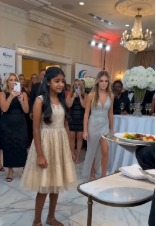
“I cannot handle watching a scholarship girl pretend she is the guest of honor at an event my family built.”
The words echoed.
My mother rose slowly from her chair.
I saw the pain on her face.
Not embarrassment for herself.
Pain for me.
“Audrey,” I said, “move.”
Her eyes flashed.
“You should have taken the recognition we offered you.”
“I earned this role.”
“You were given it because people feel sorry for you.”
Then she threw the mousse.
It struck my cheek and the front of my dress.
The plate shattered near my feet.
The ballroom erupted.
Guests stood.
Phones lifted.
Someone shouted for security.
I heard my mother call my name.
My vision blurred, but I refused to cry.
Audrey wanted tears.
She wanted a video of me breaking down.
She wanted to prove that I could not survive in her world.
So I wiped the sauce from my eye.
I lifted the silver lantern.
And I said, “I am still ready.”
The microphone carried those words too.
The room went silent.
Audrey’s face changed.
For the first time all evening, she looked frightened.
Then a hotel security manager walked onto the stage.
Behind him came Mateo, the waiter from the service corridor, and a woman carrying a laptop.
Mrs. Prescott followed them.
“Before the lantern ceremony continues,” she announced, “the committee needs to address the backstage interference that nearly destroyed tonight’s event.”
Charles Winthrop stepped forward.
“This is neither the time nor the place.”
Mrs. Prescott faced him.
“According to the foundation bylaws, suspected interference with a charitable event must be disclosed immediately when donor funds or scholarship records may have been compromised.”
Audrey looked at her father.
“Do something.”
He did not move.
The woman with the laptop connected it to the ballroom screen.
Security footage appeared.
The first clip showed me arriving at seven o’clock.
It showed me helping repair the donor display.
Sorting place cards.
Comforting Lucy.
Recovering the lantern.
Rewriting the ceremony script.
Carrying equipment.
Helping staff.
For nearly an hour, camera after camera had quietly recorded the work no guest had seen.
Mrs. Prescott spoke into the microphone.
“When the event’s digital system failed, Priya Dawson reconstructed the scholarship presentation. When the seating plan was altered, she corrected it. When a young performer was removed without authorization, Priya restored her place. When the ceremonial lantern disappeared, Priya found it.”
Applause began somewhere near the back.
Then spread.
Audrey turned white.
The footage changed.
A timestamp appeared.
6:42 P.M.
Audrey entered the hotel through a private side door.
She wore ordinary clothes beneath a long coat.
She used a staff badge to access the backstage office.
She sat at the control computer.
The screen recording showed her entering my student volunteer number.
She corrupted the slideshow folder.
She changed the table assignments.
She crossed Lucy’s name from the performance list.
She poured coffee over the script.
Then she placed the silver lantern onto the catering cart.
The evidence was undeniable.
Audrey stared at the screen as if it were showing someone else’s life.
Her father climbed onto the stage.
“Turn that off.”
Mrs. Prescott did not.
Charles grabbed the laptop cable.
Mateo stepped between him and the computer.
“You do not touch hotel evidence, sir.”
Charles’s voice dropped.
“You know who I am?”
“Yes,” Mateo said. “That is why we saved three copies.”
The ballroom reacted with nervous laughter.
Audrey looked toward the exit.
Two security officers appeared there.
She turned back to her father.
“You said the cameras were disabled.”
The sentence slipped out before she could stop it.
Every microphone caught it.
The ballroom became still.
Charles’s face lost all color.
Audrey covered her mouth.
Mrs. Prescott stared at him.
“You knew?”
He reached for his daughter’s arm.
“Do not say another word.”
She pulled away.
“You told me the backstage cameras were turned off.”
“Audrey.”
“You said if the ceremony failed, the committee would remove her.”
“Audrey, stop.”
“You promised me.”
The room was no longer looking only at Audrey.
It was looking at Charles Winthrop.
Mrs. Prescott closed the laptop.
“Mr. Winthrop, please step away from the stage.”
He laughed bitterly.
“This foundation carries my name.”
A new voice came from the center table.
“Not for much longer.”
An elderly woman stood slowly.
She had white hair, a straight back, and a dark green dress fastened with a small gold pin.
I recognized her from the photographs in the foundation office.
Eleanor Winthrop.
Audrey’s grandmother.
The widow of the foundation’s founder.
She rarely appeared in public and had not been listed in the program.
Audrey stared at her.
“Grandmother?”
Eleanor walked toward the stage.
No one tried to stop her.
“The Winthrop Foundation was established by my husband and me,” she said. “Your father became chairman because I believed he understood that service is not ownership.”
Charles clenched his jaw.
“Mother, this is a family matter.”
“No. You made it a public matter when you used charitable funds to train your daughter to humiliate a child.”
“I am not a child,” I said before I could stop myself.
Eleanor looked at me.
A faint smile touched her face.
“No,” she agreed. “You are not.”
She faced Charles again.
“For six months, the board has been investigating missing scholarship funds.”
A shock moved through the ballroom.
Charles looked toward the exits.
The security officers did not move aside.
Eleanor continued.
“We suspected that donor money had been redirected into private event accounts. Tonight’s sabotage gave us access to the digital files Audrey altered.”
The woman with the laptop reopened it.
A series of financial records appeared on the screen.
Payments from the scholarship fund had been transferred into a consulting company.
That company belonged to Charles.
Audrey stared at the records.
“You said the foundation was losing money because of the scholarship program.”
Charles said nothing.
“You told me students like Priya were taking places meant for families who built the school.”
Still he remained silent.
Eleanor’s voice softened.
“He used your jealousy because it distracted you from his theft.”
Audrey shook her head.
“No.”
“You were not defending your inheritance,” Eleanor said. “You were helping him hide the fact that he had already stolen it.”
Charles stepped toward his mother.
“This is absurd.”
Then the ballroom doors opened.
Two federal investigators entered with a hotel attorney and a representative from the state charity commission.
The silence became absolute.
Charles Winthrop looked around the room he had believed he owned.
Donors.
Parents.
Board members.
Politicians.
Cameras.
His own daughter.
No one came to his defense.
One investigator approached him.
“Mr. Winthrop, we need you to come with us.”
Audrey began to cry.
Not elegantly.
Not quietly.
Her whole body shook.
She looked at me as the officers escorted her father away.
“I did not know,” she whispered.
The words should have made me feel victorious.
They did not.
She had known enough.
She knew she was hurting me.
She knew Lucy had been removed.
She knew people’s futures were being treated as decorations for her family’s reputation.
She simply had not known she was disposable too.
Mrs. Prescott signaled the security team.
Audrey looked toward them.
“Are you throwing me out?”
The coordinator held her gaze.
“Yes.”
Audrey’s eyes widened.
“This is my family’s gala.”
Eleanor stepped beside her granddaughter.
“No,” she said. “It belongs to the people it was created to serve.”
Audrey looked around the ballroom one final time.
Then security escorted her through the same doors she had entered believing no one could close against her.
The next name called was not mine.
It was hers.
Not as guest of honor.
Not as ceremonial representative.
As the person ordered to leave.
I stood onstage covered in raspberry mousse, still holding the lantern.
Mrs. Prescott handed me a clean cloth.
“We can delay the ceremony.”
I looked toward my mother.
She was crying.
But she was smiling too.
“No,” I said. “Lucy still has to perform.”
Lucy stepped onto the stage with her violin.
Her hands trembled.
I crouched beside her.
“Do you remember what I told you?”
“That I know my piece.”
“You do.”
She nodded.
The orchestra gave her the opening note.
Lucy began to play.
The melody was delicate at first, almost uncertain.
Then it grew.
It filled the ballroom that had witnessed cruelty, exposure, and collapse.
While she played, staff helped me clean the lantern.
Mrs. Prescott found a cream shawl to cover the stain on my dress.
When Lucy finished, the entire room stood for her.
Then it was my turn.
I carried the lantern down the center aisle.
I walked slowly, just as Mrs. Prescott had instructed.
I passed donors who would never again see scholarships as a decorative word in a program.
I passed board members who could no longer pretend not to know how Charles had used the foundation.
I passed my mother.
She reached out and touched my hand.
At the stage, I lit the ceremonial flame.
The scholarship recipients’ names appeared on the repaired screen.
For the first time that evening, everything worked.
Three months later, Charles Winthrop was formally charged with fraud, embezzlement, falsifying charity records, and obstruction.
The missing funds were recovered through frozen accounts and the sale of his private consulting company.
Eleanor Winthrop dissolved the old board and rebuilt the foundation under independent oversight.
The most surprising decision came at the first public meeting.
She announced that the organization would no longer carry the Winthrop name.
It became the Lantern Foundation.
Its new student advisory board would include scholarship recipients, community volunteers, hospital workers, teachers, and young artists.
I was asked to become its first student chair.
My mother framed the invitation.
Audrey was expelled from Ashbourne for the remainder of the semester but was allowed to complete school through supervised independent study.
For weeks, I heard nothing from her.
Then a letter arrived.
It was handwritten.
Priya,
I have written twelve versions of this letter, and all of them sounded like I was trying to make myself the victim.
I am not.
I knew what I was doing when I tried to humiliate you. I believed your success reduced mine. I believed my family’s money gave me the right to decide who deserved to be seen.
The footage showed what you did backstage.
It also showed what I did when I thought no one important was watching.
I understand now that character is what remains when you do not believe there will be an audience.
I am sorry.
I do not expect forgiveness.
Audrey.
I read the letter twice.
Then I placed it in a drawer.
I did not answer.
Not immediately.
Some apologies are sincere.
That does not mean they are keys that instantly unlock forgiveness.
Six months after the gala, the Lantern Foundation held its first community event inside St. Matthew’s Hospital.
The program funded new respiratory equipment for the pediatric wing and music lessons for children receiving long-term treatment.
Lucy performed her violin piece again.
This time, her name was printed in letters large enough for everyone to see.
My mother stood beside me while the hospital director thanked the foundation.
After the ceremony, I found Audrey stacking chairs in the community room.
Her blond hair was tied in a simple ponytail.
She wore jeans, sneakers, and a volunteer badge with no family name printed beneath it.
She saw me and froze.
“I can leave,” she said.
“Did someone ask you to?”
“No.”
“Then finish the chairs.”
She nodded.
We worked in silence.
When the final chair was stacked, she picked up a cloth and began wiping tables.
“You do not have to do that,” I said.
“I know.”
That answer mattered.
I watched her for a moment.
“Why are you here?”
“My grandmother said apologies that require the injured person to comfort you are just another form of selfishness.”
“That sounds like her.”
“She also said I should spend one year doing work nobody photographs.”
I almost smiled.
“A year is a start.”
Audrey folded the cloth.
“I am sorry about your dress.”
“The dress survived.”
“And the mousse?”
“Raspberry stains are stubborn.”
She nodded seriously.
“So are scholarship girls.”
I looked at her.
She seemed horrified by what she had said.
“I did not mean—”
I laughed.
It surprised both of us.
Audrey laughed too, cautiously.
We did not become best friends.
That would have been too easy.
Trust did not appear because the villain had cried and written a letter.
But over time, she became someone different from the girl who had stood beneath the chandeliers and treated cruelty like a birthright.
She listened more than she spoke.
She worked.
She stopped using her grandmother’s name to enter rooms.
And when students from wealthy families complained that the Lantern Foundation gave too much authority to scholarship recipients, Audrey was often the first person to tell them why that authority mattered.
One year after the gala, we returned to the Grand Beaumont Hotel.
The marble check-in table was covered in place cards again.
The orchestra played beneath another arch of white flowers.
But the event had changed.
Hospital workers sat beside donors.
Students sat beside board members.
Volunteers were introduced by name.
Backstage staff received applause before anyone from the foundation did.
I wore the same pale blue dress.
The stain had never completely disappeared.
My mother and I had covered it with a small embroidered lantern.
Before the ceremony, Audrey approached me carrying two plates of raspberry mousse.
I raised an eyebrow.
“Dangerous choice.”
“I was told it was symbolic.”
“By whom?”
“Lucy.”
The young violinist stood nearby, laughing.
Audrey handed me one plate.
Then she stepped aside as Mrs. Prescott approached the microphone.
“And now,” the coordinator announced, “to light the ceremonial flame, please welcome the young woman whose courage changed this foundation forever.”
The ballroom stood.
I looked toward my mother.
She pressed her fingers to my father’s silver pendant, which she now wore around her own neck.
I carried the lantern down the center aisle.
This time, I did not feel like the room was waiting for me to make a mistake.
I knew something the old Priya had not known.
Belonging was not permission granted by people like Audrey.
It was not a place card, a family name, or a role assigned by a committee.
It was the quiet certainty that my work mattered even backstage, my voice mattered even when it shook, and my dignity did not disappear simply because someone powerful tried to stain it.
At the stage, I lit the flame.
The repaired screen glowed behind me.
It showed no family crest.
No portrait of a wealthy founder.
Only one sentence:
THE LIGHT BELONGS TO EVERYONE.
The applause rose.
And this time, when the phones lifted, I did not lower my face.
THE END
