Part 2: The Screen That Turned Every Camera
Victoria Harrington’s face lost all color.
The giant screen displayed hundreds of entries.
Each recovery log carried the same name.
Grace Foster.
My name.
The veterinarian adjusted his glasses and faced the crowd.
“These are not opinion pieces.”
He tapped the screen.
“They are timestamped medical records stored directly in each rabbit’s microchip database.”
The audience watched silently.
A reporter stepped closer.
The veterinarian opened another file.
The screen filled with dates.
Emergency treatments.
Feeding schedules.
Weight recovery charts.
Night observations.
Every record showed who had entered the information.
Grace Foster.
Grace Foster.
Grace Foster.
Again and again.
A small boy near the front tugged on his mother’s sleeve.
“That’s her.”
His finger pointed at me.
The crowd slowly turned.
For months I had worked before sunrise and long after sunset.
Nobody noticed then.
Now everybody was looking.
Victoria forced a laugh.
“Anyone could type a name into a database.”
The veterinarian nodded.
“Normally, yes.”
Then he revealed another screen.
Biometric verification logs.
Fingerprint authentication.
Staff access records.
Digital signatures.
The room fell silent.
Every entry matched perfectly.
The records couldn’t be altered without triggering alerts.
Victoria’s confidence crumbled.
Several sponsors exchanged uneasy glances.
Then the veterinarian said something that made the situation even worse.
“The rabbits themselves recorded the truth.”
Nobody understood what he meant.
Until he opened the movement-tracking archive.
Part 3: The Hidden Pattern Inside The Tracking Data
Colored dots appeared across the giant screen.
Each dot represented a rabbit wearing a monitoring chip.
Lines traced their movements over the previous year.
At first the display looked confusing.
Then the veterinarian activated a filter.
The sanctuary map appeared.
Recovery areas.
Medical enclosures.
Feeding stations.
Observation zones.
The colored trails revealed something remarkable.
The rabbits consistently gathered around one location.
A small rehabilitation building.
My building.
The veterinarian zoomed closer.
“The colony spent more time near Grace than any other caretaker.”
Whispers swept through the crowd.
He opened another chart.
Stress levels.
Heart-rate readings.
Recovery speeds.
All improved dramatically during periods when I supervised the animals.
One wildlife expert stood.
“This recovery rate is extraordinary.”
Another expert nodded.
“I’ve never seen numbers like these.”
Victoria clenched her fists.
“This proves nothing.”
But nobody was listening anymore.
The data spoke for itself.
Then a sanctuary administrator hurried onto the stage carrying a thick folder.
His face looked grim.
“We found additional records.”
The veterinarian frowned.
“What records?”
The administrator swallowed.
“Someone tried to delete part of the rabbit archive six months ago.”
The crowd gasped.
And suddenly this wasn’t just about stolen credit anymore.
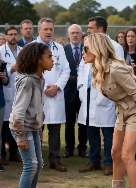
Part 4: The Deletion Request Nobody Expected
The administrator opened the folder.
Several printed documents slid onto the table.
Every camera zoomed in.
The deletion request had been rejected automatically by the sanctuary system.
But the attempt remained permanently logged.
The administrator pointed toward the applicant’s name.
Victoria Harrington.
The crowd erupted.
Victoria stepped backward.
“I was only reviewing files.”
The administrator shook his head.
“No.”
He held up another document.
“This request specifically targeted Grace Foster’s rehabilitation records.”
A wave of disbelief rolled through the audience.
The sanctuary director approached the microphone.
“Why would you try to erase those files?”
Victoria said nothing.
Her silence became its own answer.
The director looked toward the sponsor section.
Several executives from Harrington Development suddenly looked uncomfortable.
Then another investigator arrived carrying a tablet.
His expression was serious.
“There’s more.”
The room instantly quieted.
The investigator displayed a satellite image of land surrounding the sanctuary.
A large section glowed red.
“What is that?” someone asked.
The investigator zoomed in.
“The rare rabbit habitat.”
Several conservation experts immediately recognized it.
Then he revealed the next image.
A proposed luxury development project.
The construction site overlapped the rabbit territory.
My stomach dropped.
Because the company listed on the proposal belonged to the Harrington family.
And suddenly Victoria’s actions made perfect sense.
Part 5: The Habitat Everyone Thought Was Empty
The investigation exploded across Arizona.
News helicopters circled the sanctuary.
Conservation groups demanded answers.
The rabbit colony became national news.
Meanwhile, scientists reviewed years of microchip data.
What they discovered shocked everyone.
The rabbits weren’t simply surviving.
They were mapping something.
The movement patterns consistently followed the same routes.
Ancient migration corridors.
Wildlife pathways nobody had documented before.
Researchers became fascinated.
Teams arrived from universities across the country.
One afternoon, a senior ecologist called an emergency meeting.
The room filled with reporters.
Scientists crowded around projection screens.
The ecologist pointed at the rabbit tracking data.
“These animals led us directly to a previously undocumented ecosystem network.”
The room fell silent.
The migration routes connected multiple protected habitats.
Birds.
Foxes.
Pollinators.
Dozens of species depended on them.
If the proposed development moved forward, the entire network could collapse.
Reporters immediately began asking questions.
The ecologist raised one hand.
“The person who first noticed the pattern was Grace Foster.”
Every head turned toward me.
I felt heat rise into my face.
Months earlier, I had noticed unusual movements and documented them.
At the time, I thought nobody cared.
Now scientists were using those observations to protect thousands of acres.
But the biggest revelation was still hidden inside the oldest tracking files.
Part 6: The Discovery Buried In The First Records
Investigators dug deeper into archived sanctuary data.
Years deeper.
Then decades.
One discovery changed everything.
The rabbit habitat had been surveyed twenty years earlier.
The ecological corridor had already been identified.
And then it disappeared from official reports.
The room fell silent when the evidence emerged.
Entire sections had been removed.
Maps vanished.
Studies were incomplete.
Recommendations disappeared.
The pattern felt disturbingly familiar.
The lead investigator examined old corporate records.
His face darkened.
The original land purchases surrounding the corridor had been connected to companies later absorbed by Harrington Development.
Victoria’s father wasn’t responsible for the original cover-up.
But his company benefited from it.
For years developers assumed the corridor would eventually be forgotten.
Instead, the rabbits preserved the evidence.
Their movements revealed what paperwork had hidden.
The public reaction was immediate.
Government agencies launched formal inquiries.
Conservation protections accelerated.
The development project stalled.
Then something nobody expected happened.
Billionaire Marcus Harrington scheduled a press conference.
Thousands watched live.
His voice sounded strained.
“My company benefited from information that should have been disclosed.”
The statement shocked investors.
But he wasn’t finished.
He announced full cooperation with investigators.
And a massive land donation.
Yet the biggest surprise came from someone else entirely.
Victoria.
Part 7: Victoria’s Confession Before The Final Vote
Three months later, conservation officials gathered for a decisive hearing.
The future of the corridor would be decided that day.
Scientists filled the chamber.
Reporters lined the walls.
I sat quietly near the back.
Then Victoria entered.
The room immediately tensed.
She looked completely different.
No designer outfit.
No confident smile.
No entourage.
She approached the microphone alone.
For several seconds she simply stood there.
Then she spoke.
“I was jealous.”
The honesty stunned everyone.
Victoria looked directly at me.
“I thought recognition belonged to people like me.”
Her voice trembled.
“When everyone praised Grace, I couldn’t accept it.”
The chamber remained silent.
“I tried to remove her records.”
A few people shook their heads.
Others stared.
Tears appeared in Victoria’s eyes.
“But I never expected the truth to become this big.”
She opened a folder.
Inside were documents investigators had never seen.
Old company communications.
Land reports.
Environmental studies.
Evidence.
Powerful evidence.
The hearing continued for hours.
When it finally ended, officials had enough information to make their decision.
The vote appeared on a massive screen.
UNANIMOUS APPROVAL.
The ecological corridor received permanent protection.
The audience erupted in applause.
Then the sanctuary director stood for one final announcement.
Part 8: The Sanctuary That Carried Her Name
The celebration took place six months later.
Families packed the sanctuary pathways.
Children watched rabbits race through protected grasslands.
Scientists unveiled new research facilities.
Conservation leaders attended from around the country.
I expected to help guide visitors.
Nothing more.
Then the sanctuary director invited me onto the stage.
A curtain slowly lifted behind him.
The audience gasped.
A new conservation center stood beyond the gate.
Glass observation rooms.
Wildlife laboratories.
Education halls.
Research stations.
At the entrance hung a bronze plaque.
My breath caught.
THE GRACE FOSTER RABBIT CONSERVATION CENTER
The crowd erupted into applause.
I couldn’t speak.
The director smiled.
“The rabbits survived because someone cared when nobody was watching.”
Tears blurred my vision.
Then the lead ecologist stepped forward.
He handed me the original tracking map.
The first one I had created by hand.
Folded.
Worn.
Covered in notes.
“You saw value before anyone else did.”
I looked across the sanctuary.
The rabbits moved freely through protected meadows stretching toward the horizon.
The corridor was safe.
The habitat was permanent.
And the animals whose tiny microchips had uncovered decades of hidden truth continued hopping through the grass, completely unaware that they had changed the future for an entire landscape.
