Part 2: The Page That Made Lydia Tremble
The director’s hand shook slightly as he held the page beneath the microphone.
Not because he was afraid of me.
Because everyone in that hall had just realized the same thing at once.
Lydia Rockwell had attacked me before anyone had checked the truth.
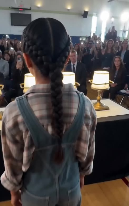
The silver decorations above the stage flickered against the polished floor. Rows of old reading lamps waited on the display tables, each one restored, cleaned, fitted with fresh batteries, and tagged with tiny labels in my handwriting.
Lydia stood beside me with her fingers still curled, as if my hair were somehow still trapped in her fist.
The director, Mr. Albrecht, adjusted his glasses.
His voice carried across the hall.
“Entry one. Monday, 4 March. Diana Flores remained after workshop hours to test thirty-two donated reading lights. Fourteen had corroded battery terminals. She cleaned them by hand.”
A murmur moved through the audience.
My cheeks burned.
I remembered that day. The metal smell on my fingers. The cold room. The way the janitor in Barcelona’s old civic library had turned off half the lights because everyone else had already left.
Mr. Albrecht continued.
“Entry two. Wednesday, 6 March. Diana Flores replaced batteries in twenty-seven lamps rejected by the first repair team.”
A reporter lifted her camera.
Lydia’s smile twitched.
Her mother, seated in the sponsor row in a pearl-colored jacket, leaned forward slowly.
Mr. Albrecht turned the page.
“Entry three. Friday, 8 March. Diana Flores stayed until 8:40 p.m. to finish the reading-light installation before the inspection.”
My throat tightened.
I had never written those entries to be praised. I had written them because Mr. Albrecht insisted that every completed lamp needed a time, a date, and a name. A boring record. A dull folder. The kind of thing Lydia had laughed at.
Now that folder was louder than any speech.
Lydia snapped, “Those could have been copied.”
Mr. Albrecht looked at her.
“No.”
The word landed hard.
He reached into the folder and removed another sheet.
“These records were signed daily by maintenance staff, the student coordinator, and the municipal project supervisor.”
Lydia’s eyes darted toward the sponsor row.
Mr. Albrecht’s voice lowered.
“And there is something else.”
The room seemed to pull inward.
He held up a page with a red mark across the top.
“This log also records who removed Diana’s name from the public program.”
My stomach dropped.
Lydia went completely still.
Her mother stood.
“Careful, Emil,” Mrs. Rockwell said softly. “This is a public event.”
Mr. Albrecht did not look away from the page.
“Yes,” he said. “That is exactly why I am reading it.”
Then he lifted the paper closer to the microphone.
“The request to replace Diana Flores’s name with Lydia Rockwell’s came from the sponsor office yesterday afternoon.”
Gasps broke across the hall.
Lydia whispered, “No.”
But her face said yes.
Part 3: The Sponsor Row Went Silent
Mrs. Rockwell moved faster than anyone expected.
She stepped into the aisle with a smile so polished it looked almost painted on. Her heels clicked against the marble floor of the Barcelona Cultural Forum, each sound sharp enough to cut through the whispers.
“Mr. Albrecht,” she said, “this is clearly a misunderstanding.”
Nobody answered her.
Not the reporters.
Not the students.
Not the city officials seated beneath the banners.
Only the old reading lights hummed faintly on the tables, waiting to be switched on.
Mrs. Rockwell turned toward the audience.
“My daughter has supported this project from the beginning.”
Lydia straightened at once, clinging to those words like a railing.
“Yes,” she said quickly. “Exactly. My family funded the materials.”
I stared at the rows of lamps.
Funded.
That word tasted strange.
Her family had paid for boxes of batteries and publicity banners. They had not sat in the storage room sorting leaking cells from working ones. They had not carried cracked lamps through the rain. They had not gone home with black dust under their nails.
Mr. Albrecht closed the folder slowly.
“Funding is not labor.”
The room shifted.
Lydia’s mouth opened, but nothing came out.
A student near the front whispered, “Finally.”
Mrs. Rockwell heard it. Her gaze snapped toward the girl, and the girl immediately lowered her eyes.
That was how power worked around them.
Quiet pressure. Smiling threats. Doors closing before anyone saw a hand touch them.
Then a man in a dark municipal suit stood near the stage.
“I would like to see the document,” he said.
Mrs. Rockwell turned pale.
I recognized him from the introduction earlier. Councillor Mateo Klein. He oversaw youth service grants across the city.
Mr. Albrecht handed him the folder.
The councillor read quickly. His face did not change, but his fingers tightened around the pages.
“Mrs. Rockwell,” he said, “your office requested a program change after the final verification?”
She gave a soft laugh.
“My assistant may have corrected an oversight.”
The councillor looked at me.
“Was Diana informed?”
I shook my head.
My voice came out smaller than I wanted.
“No, sir.”
Lydia scoffed. “She is acting innocent.”
Something inside me hardened.
I turned toward her.
“You pulled my hair in front of everyone because you thought I had no proof.”
The room froze.
Lydia’s lips parted.
I stepped closer, my hands still shaking, but my voice steadier now.
“You weren’t angry because I lied. You were angry because the truth got announced before you could erase it.”
A reporter repeated the sentence under her breath while typing.
Mrs. Rockwell’s polished smile finally cracked.
“Diana,” she said, too sweetly, “you should be very careful.”
Mr. Albrecht moved between us.
“No,” he said. “She has been careful long enough.”
Then Councillor Klein turned another page in the log and frowned.
“There are missing entries.”
My breath caught.
Mr. Albrecht looked confused. “Missing?”
The councillor held up the folder.
“Three pages were removed.”
Lydia’s face lost every trace of color.
Part 4: Three Missing Pages And One Locked Cabinet
The ceremony did not continue.
Not officially.
The guests remained seated, but nobody looked at the stage anymore. Their eyes followed the folder, the councillor, Lydia’s trembling hands, Mrs. Rockwell’s stiff smile.
Mr. Albrecht led us behind the stage into the project office, a narrow room that smelled of dust, cardboard, and warm electrical wiring. Stacks of old reading lights leaned against the wall. Battery packets were sorted into trays. A kettle sat unplugged beside a chipped mug.
Councillor Klein placed the folder on the desk.
“Who had access to this?”
Mr. Albrecht swallowed.
“Myself. The student coordinator. The municipal supervisor. And the sponsor liaison for delivery scheduling.”
“The sponsor liaison,” the councillor repeated.
Mrs. Rockwell folded her arms.
“Our office handled logistics. That does not mean we tampered with records.”
Lydia stood behind her mother, silent now.
That silence frightened me more than her shouting.
Mr. Albrecht opened a locked filing cabinet and searched inside. His shoulders tensed.
“The duplicate log should be here.”
He pulled out folders one by one.
Receipts.
Attendance sheets.
Inspection forms.
No duplicate log.
My stomach twisted.
Lydia noticed. For the first time since the stage, she almost smiled again.
Then someone knocked on the office door.
A cleaning woman stood there holding a brown envelope.
Her gray hair was pinned under a scarf, and her work gloves were tucked into her apron pocket.
“Excuse me,” she said. “I was told not to interrupt unless the folder was opened.”
Mr. Albrecht turned.
“Greta?”
She stepped inside and looked at me, not at Lydia.
“You were always the last one here,” she said quietly. “You said good night to me every evening.”
I remembered her then. Greta Vogel. She emptied the bins, wiped the tables, and once gave me a biscuit when I forgot dinner.
Greta placed the envelope on the desk.
“I made copies.”
Mrs. Rockwell’s head snapped up.
Greta did not flinch.
“I saw someone near the cabinet two nights ago. I thought maybe I was imagining things. Then I saw pages in the paper bin, torn in half.”
Lydia whispered, “That’s impossible.”
Greta looked at her.
“Not impossible. Just careless.”
The councillor opened the envelope.
Inside were three photocopied pages, creased but readable.
Mr. Albrecht leaned over them.
His face changed first.
Then Councillor Klein’s.
Then Greta’s.
I could not breathe.
“What do they say?” I asked.
Mr. Albrecht did not answer right away.
He looked wounded, as if the pages had struck him.
Finally, he turned one toward me.
The missing entries were not only about me.
They listed failed safety checks.
They listed lamps marked “installed” before they had ever been touched.
And beside several of those entries was one name.
Not mine.
Lydia Rockwell.
Part 5: The Lights That Were Never Fixed
Lydia lunged for the copies.
Councillor Klein lifted them out of reach before her fingers touched the paper.
“Enough,” he said.
The word cracked through the office like a dropped plate.
Mrs. Rockwell’s voice sharpened. “My daughter has been embarrassed publicly. I will not allow this harassment to continue.”
Greta laughed once, bitter and tired.
“Harassment? That girl came here after school until her shoes were soaked through. Your daughter came once with a photographer.”
Lydia turned on her.
“You clean floors.”
Greta’s face did not change.
“Yes,” she said. “That is why people forget I can hear.”
Silence swallowed the room.
My chest ached.
Those missing pages showed dates I remembered too well. Dates when half the lamps had arrived damaged from storage. Dates when Lydia had posed beside unopened boxes while her mother’s assistant arranged the cameras. Dates when adults had thanked her for “leadership” while I sat in the corner testing switches.
Mr. Albrecht read aloud from the first missing page.
“Lydia Rockwell demonstration table: twelve lamps displayed as completed. Batteries not installed. Terminals unchecked. Labels attached before inspection.”
He looked up.
“Why was this removed?”
No one spoke.
Then Lydia whispered, “It was only for photos.”
Councillor Klein stared at her.
“You displayed non-working reading lights at a literacy charity inspection?”
“They were going to be fixed later,” Lydia said.
“By whom?” I asked.
Her eyes flicked toward me.
There it was.
The answer neither she nor her mother wanted to say.
By me.
I stepped closer to the desk.
“You wanted the cameras, but you expected me to do the work after everyone left.”
Lydia’s eyes filled with angry tears.
“You don’t understand what it’s like,” she said. “Everyone expects my family to be perfect.”
I almost laughed, but it hurt too much.
“I know what it is like to be expected to disappear.”
That silenced her.
Outside the office, the audience began murmuring louder. News had spread. People were waiting. The ceremony was no longer about who would turn on the first reading light.
It was about who had lied.
Councillor Klein gathered the pages.
“We will return to the stage.”
Mrs. Rockwell stepped in front of the door.
“No.”
Her voice was no longer sweet.
“You will not drag my daughter through a spectacle.”
The councillor met her stare.
“Your daughter dragged another student by the hair in front of witnesses.”
Mrs. Rockwell’s mouth tightened.
Then she said the sentence that changed everything.
“Without our sponsorship, this program dies tonight.”
Mr. Albrecht went still.
The threat filled the office like smoke.
Lydia looked at me, and this time her smile came back.
Small.
Cruel.
Certain.
Part 6: When The Sponsor Threatened The Children
Nobody moved.
For one terrible second, I saw the whole project collapse.
The old reading lights. The repair sessions. The boxes packed for rural libraries, hospital rooms, shelters, and school corners where children read under weak bulbs because nobody had bought anything new in years.
All of it could vanish because Lydia Rockwell could not survive being ordinary.
Mrs. Rockwell opened the office door and walked back toward the hall, already wearing her public face again.
Councillor Klein followed.
Mr. Albrecht touched my shoulder gently.
“You do not have to speak.”
I looked down at my hands.
There were tiny scratches across my fingers from battery springs and cracked plastic clips. I had hidden them for weeks because I was embarrassed by how rough they looked.
Now they felt like proof.
“Yes,” I said. “I do.”
When we returned to the stage, the audience quieted instantly.
Mrs. Rockwell reached the microphone first.
“My family is deeply saddened by the confusion tonight,” she said. “We believe this ceremony has become hostile and unfair. Under these circumstances, we must reconsider our sponsorship.”
A ripple of alarm moved through the crowd.
Lydia stood beside her mother, eyes lowered, playing wounded.
For a moment, it worked.
People began whispering about funding.
Budgets.
Materials.
The future of the program.
Then Mr. Albrecht placed the light-installation log on the podium.
I stepped forward before fear could stop me.
My voice shook at first.
“This project was never supposed to belong to one family.”
The hall quieted again.
I swallowed.
“It belongs to every student who stayed late. Every worker who unlocked the doors. Every librarian who saved broken lamps instead of throwing them away. Every child who will read under one of these lights.”
Lydia looked up sharply.
I turned toward the display tables.
“You can take your name off the banner,” I said to Mrs. Rockwell. “You can take your cameras. You can take your money.”
Gasps scattered through the hall.
My heart pounded so hard I felt it in my teeth.
“But you cannot take credit for work you did not do.”
For a second, there was nothing.
Then Greta began clapping.
One clap.
Then another.
A student joined.
Then a teacher.
Then the entire left side of the hall.
Mrs. Rockwell’s face hardened.
Councillor Klein stepped to the microphone.
“The city will open an emergency review of the sponsorship.”
The applause grew.
He lifted the missing pages.
“And until the review is complete, all sponsor branding connected to false labor claims will be suspended.”
Lydia whispered, “Mother, do something.”
But Mrs. Rockwell was staring past us.
At the back of the hall, an elderly man had risen from his seat.
The applause faded as people recognized him.
Sir Anton Weiss.
The founder of Europe’s largest independent library trust.
And he was holding one of the old reading lights in his hand.
Part 7: The Man Who Tested The Last Lamp
Sir Anton Weiss walked slowly, but the hall parted for him as if he carried a royal seal.
He wore a plain dark coat, not a sponsor ribbon. His silver hair was combed back, and his eyes were fixed on the lamp in his hand.
No one spoke as he reached the front.
Mrs. Rockwell’s expression changed completely.
“Sir Anton,” she said warmly, “I did not realize you were attending.”
“I prefer to see projects before people know I am watching,” he replied.
Lydia’s face tightened.
Sir Anton turned the reading light over in his hands.
“This lamp was on the third table.”
Mr. Albrecht nodded. “Yes, sir.”
“It works,” Sir Anton said.
His thumb pressed the switch, and a clean circle of warm light appeared against his palm.
Something in me loosened.
Then he looked at Lydia.
“The label says it was installed by you.”
Lydia’s lips parted.
Mrs. Rockwell moved quickly. “There were several student teams. Labels may have been mixed during transport.”
Sir Anton reached into his coat pocket and removed a tiny folded slip.
“No,” he said. “I checked the installation mark inside the battery cover.”
My breath stopped.
Installation mark?
He opened the lamp and showed the inside panel to the audience camera.
There, written in tiny black ink, were my initials and the date.
D.F.
I remembered doing it because Greta had joked that future historians might want to know who saved the lamps.
Sir Anton looked directly at me.
“You marked them all?”
“Only after testing,” I said.
“How many?”
I glanced at the tables.
“One hundred and eighty-six.”
The hall erupted.
Sir Anton nodded once, as if that answer confirmed something he had already suspected.
Then he faced the audience.
“My trust came tonight prepared to offer a matching grant to the sponsor family if the student program proved genuine.”
Mrs. Rockwell’s eyes flashed with relief.
But Sir Anton was not finished.
“Instead, I will offer the grant directly to the municipal library network, under one condition.”
Councillor Klein stepped forward.
“What condition?”
Sir Anton pointed at the log.
“That the student who did the verified work helps design the new training system, so no sponsor can ever steal a child’s labor again.”
The room exploded into applause.
I could not move.
Mr. Albrecht covered his mouth.
Greta wiped her eyes with the back of her wrist.
Lydia stared at me like I had taken the floor from under her.
Then she did something I did not expect.
She stepped toward the microphone.
Her mother hissed, “Lydia, stop.”
But Lydia kept walking.
For the first time all night, her voice sounded young.
“I didn’t remove the pages,” she said.
The applause died.
She looked at her mother.
“You did.”
Part 8: The First Light Was Never Mine Alone
Mrs. Rockwell did not shout.
That made it worse.
She simply looked at her daughter with a coldness that made the whole hall feel smaller.
“Step away from the microphone,” she said.
Lydia’s hands trembled.
“No.”
The word was barely audible, but it carried.
She turned to the audience, face wet now, silver dress shining under lights that suddenly made her look trapped instead of powerful.
“I lied about the work,” she said. “I let people believe I led it. I wanted the attention.”
Her voice cracked.
“But I didn’t tear the pages out. My mother told our office to remove anything that made the sponsor table look fake.”
Mrs. Rockwell’s smile vanished.
Councillor Klein signaled to a staff member near the cameras. “Keep recording.”
Lydia looked at me.
The hatred was gone.
What remained was uglier in a different way: shame.
“She said nobody would believe Diana over us.”
The sentence struck harder than the hair pull.
Because it was true.
For most of my life, people like Mrs. Rockwell had not needed to prove anything. Their voices arrived already polished. Mine had to fight its way into rooms.
Sir Anton closed the lamp gently.
“Then tonight we believe the record.”
Mrs. Rockwell tried to leave, but two municipal officers blocked the aisle. Not dramatically. Not violently. Just firmly enough for everyone to understand that her control had ended.
Mr. Albrecht returned to the microphone.
“This ceremony began with one question,” he said. “Who should turn on the first light?”
He looked at me.
My stomach flipped.
But I looked at the lamps, at Greta, at the students who had clapped before it was safe, at the old workers who had signed the logs, at Mr. Albrecht, who had finally chosen truth over comfort.
I stepped to the first reading light.
Then I stopped.
“No,” I said.
A hush fell.
I turned and held out my hand to Greta.
Her eyes widened. “Me?”
“You made the copies.”
Then I looked at the other students near the front.
“And they stayed late too.”
One by one, they came forward.
Greta. Mr. Albrecht. The quiet students from the repair tables. Even the janitor who had unlocked the storage room each evening.
We stood together around the display.
Lydia remained alone beside the sponsor row.
Then, slowly, she removed the false name badge from her dress and placed it on the floor.
“I’m sorry,” she whispered.
I did not forgive her right away.
Some apologies need time to become anything more than words.
But I nodded once, because the night had already taken enough from me.
Together, we pressed the switches.
One lamp turned on.
Then another.
Then another.
Warm light spread across the hall until every table glowed.
No banner looked important beneath it.
No diamond earring. No sponsor logo. No silver dress.
Sir Anton announced the grant before the cameras, but he added one more surprise.
The new training program would be named not after me, not after him, and not after any donor.
It would be called The Verified Hands Project.
Every student’s work would be recorded. Every worker’s signature would matter. Every hidden hour would count.
Months later, children across Barcelona, Lyon, Prague, and Lisbon read beneath restored lamps carrying tiny marks inside their battery covers.
Not famous names.
Not rich names.
Real names.
And whenever I saw those lights glowing in photographs, I remembered the night Lydia Rockwell thought the log would be too small to save me.
She was wrong.
Because sometimes the smallest record becomes the brightest proof, and sometimes the first light only shines because everyone forgotten finally steps forward to turn it on.
