The first bullet shattered the school window exactly where Milo’s head had been.
For one frozen second, he did not understand why he was on the pavement, why his cheek burned against wet gravel, or why the muddy Labrador had his teeth locked in Milo’s torn hoodie.
Then the screams began.
“Gun!”
Students dropped behind cars. Teachers dragged children through the entrance. Glass rained like ice across the steps.
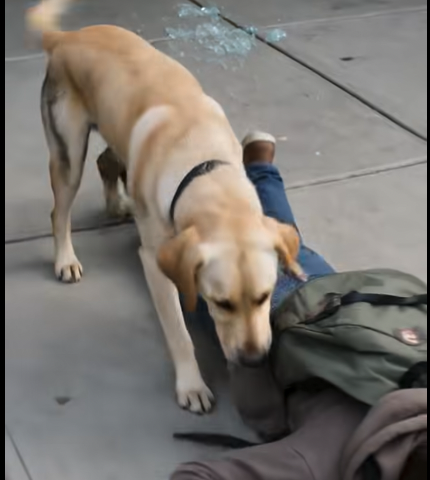
And Bruno—the stray everyone called trash—stood over Milo with his ribs showing, his fur caked in mud, and his teeth bared at the man across the street.
The shooter fired again.
Bruno lunged.
“Bruno, no!” Milo screamed.
But the dog did not stop.
He crossed the street like a storm made of bone and loyalty. The man raised his gun, but Bruno hit him low, slamming into his legs. The weapon skidded across the asphalt. The shooter cursed, grabbed Bruno by the collar, and drove a knee into his side.
Milo ran before he could think.
He had spent his whole life running from laughter, from fists, from hunger, from people who looked through him like he was already gone.
But now he ran toward danger.
“Leave him alone!”
The shooter turned.
For the first time, Milo saw his face clearly.
And the world tilted.
The man had the same gray eyes as the photograph Milo kept hidden under his mattress.
His father’s eyes.
The police arrived in a scream of sirens. Teachers pulled Milo back. Officers tackled the man. Bruno collapsed beside the curb, whining softly.
Milo crawled to him, sobbing.
“You saved me,” he whispered. “You saved me, boy.”
Bruno lifted his muddy head and pressed his nose into Milo’s palm.
At the hospital, nobody laughed.
The same students who had filmed Milo feeding Bruno now stood in silent clusters, pale and shaking. His teacher, Mrs. Keller, sat beside him with red eyes.
“Milo,” she said gently, “the man who attacked the school… he wasn’t aiming at everyone.”
Milo already knew.
“He was aiming at me.”
Mrs. Keller looked away.
That night, Detective Harris came with a folder. Inside were old newspaper clippings, adoption records, and one faded photograph of a young woman holding a baby.
“Milo,” the detective said, “your mother didn’t abandon you.”
Milo’s throat closed.
“She testified against a criminal organization twelve years ago. Your father was part of it. Before she died, she hid you under a new name.”
“My mother died?”
“She was murdered,” Harris said softly. “But not before she left something behind.”
He placed a small silver locket in Milo’s hand.
Inside was a picture of a baby Milo, wrapped in a blue blanket.
And beside him—
A yellow Labrador puppy.
Milo stopped breathing.
“That’s Bruno.”
Detective Harris nodded. “Your mother’s dog. He disappeared the night she was killed. We thought he was dead.”
Milo looked through the hospital window where Bruno slept bandaged on a blanket, alive but weak.
“He’s been looking for me,” Milo whispered.
“For twelve years,” said Mrs. Keller.
The twist broke something open inside Milo.
All those rainy afternoons behind the school fence. All those times Bruno waited, hungry and shivering. All those moments Milo thought the dog loved him because nobody else did.
Bruno had known him first.
Before the poverty. Before the bullying. Before the loneliness.
He had loved Milo when Milo still had a mother.
The next week, the school held an assembly.
The principal stood onstage, voice trembling, while Bruno lay beside Milo wearing a clean blue collar donated by the police department.
The students watched in shame.
One boy stepped forward—the same one who had called Bruno trash.
“I’m sorry,” he said, crying. “To both of you.”
Milo looked at him for a long moment.
Then he looked down at Bruno.
The dog wagged his tail once, as if forgiveness was simpler than humans made it.
Milo nodded.
After the trial, Detective Harris adopted Milo, officially and publicly. Mrs. Keller helped him catch up in school. The videos that once mocked him disappeared, replaced by news stories calling Bruno a hero.
But Milo never liked that word.
At night, when the house was quiet, he would sit on the porch with Bruno’s head in his lap and open the silver locket.
“You weren’t trash,” Milo whispered.
Bruno sighed happily.
“You were family.”
Years later, Milo would become a veterinarian. Above the door of his first rescue shelter hung a wooden sign:
For every animal someone threw away, and every child who felt the same.
And underneath it, in smaller letters:
Founded in honor of Bruno, the muddy dog who remembered love when the whole world forgot.
