Part 2: The Tablet Everyone Pretended Not To See
The donor’s voice sliced through the ballroom so cleanly that even the violinist lowered her bow.
“Why,” he asked, still pointing at the staff tablet, “does this log say Elena Varga restored the heirloom case by herself?”
My throat tightened around my own name.
Across the luxury buffet, fruit juice ran cold down my cheek and into the neckline of my turquoise dress. A cube of pear clung to my sleeve. Somewhere behind me, a woman whispered, “That’s the girl Madison just humiliated.”
Madison Ashford’s smile twitched once.
Only once.
Then she laughed softly, like the whole room had misunderstood an amusing little joke.
“That’s impossible,” she said, turning her diamond bracelet so it caught the chandelier light. “Elena was just helping the staff carry boxes.”
The young event coordinator holding the tablet swallowed hard. His name tag said Lukas. His thumb hovered over the screen as if he wanted to hide it again, but the donor stepped closer.
“Open the file,” the donor said.
Madison’s mother, dressed in silver silk, moved so fast her champagne nearly spilled. “This is not appropriate during the ceremony.”
“Neither was throwing food at a guest,” someone said.
A few people gasped, but nobody laughed.
My hands shook at my sides. I wanted to wipe my face, but I could not make myself move. If I lifted one hand, everyone would see how badly I was trembling.
Lukas tapped the tablet.
A photograph appeared on the big screen behind the podium.
The antique doll cabinet stood in the museum workshop three weeks earlier, its glass cracked, one hinge broken, its carved walnut frame sagging like an old person’s shoulder. Beside it was me, hair tied back, sleeves rolled up, holding a tiny brass screwdriver.
Then came another photo.
Me again, varnish on my wrist, carefully realigning the door.
Another.
Me bent over the base panel at midnight, alone beneath fluorescent lights.
Then the repair log appeared.
Every entry had my name.
Elena Varga.
My hours.
My sketches.
My handwritten notes scanned into the official archive.
The room changed in a way I could feel against my skin. The whispers stopped sounding cruel. They turned uncertain. Embarrassed. Afraid.
Madison looked at the screen, then at me, and for the first time that night, her face lost its practiced softness.
“That proves nothing,” she snapped. “Anyone can write a name.”
Lukas flinched. “Miss Ashford, the log was locked in the museum system.”
Her father stepped forward from the donor table. Edmund Ashford had been smiling in every poster outside the venue, his family name printed beneath the words Legacy Preservation Fund. Now his mouth was flat.
“Turn it off,” he said.
The room heard him.
Everyone heard him.
The donor who had first spoken looked slowly from Edmund to the screen. “Why would you want it turned off?”
Madison’s mother reached for her daughter’s hand. Madison yanked away.
I finally wiped my cheek with the back of my wrist. Fruit syrup smeared across my skin. My dress was ruined. My face burned. But the longer I stood there, the less I felt like disappearing.
The cabinet waited beneath a velvet cloth near the stage.
The heirloom Madison had been ready to open.
The heirloom her family claimed to have saved.
The heirloom I had spent six nights repairing after school and every weekend, because the museum director had said they had no money left for specialists.
I had done it quietly because I loved broken things before anyone called them valuable.
Then Lukas whispered, “There’s more.”
Madison turned her head sharply. “No.”
One tiny word.
Too sharp.
Too scared.
Lukas looked at me. His eyes were pale with panic, but he did not lower the tablet.
“There’s a second folder,” he said. “It was scheduled to open after the ceremony.”
Edmund Ashford’s face drained.
I heard my own heartbeat again.
The donor stepped closer to the tablet.
“Open it now.”
Madison whispered, “If you do that, my father will destroy you.”
Lukas looked at her.
Then he tapped the screen.
And the first document that appeared was not a repair note.
It was a transfer agreement.
With Edmund Ashford’s signature at the bottom.
And under the owner’s name of the family heirloom cabinet, it did not say Ashford.
It said Varga.
Part 3: The Name Hidden Beneath The Velvet
The ballroom seemed to lean toward the screen.
For a moment, nobody breathed. Not the donors. Not the waiters. Not the photographers with their cameras half-raised. Even Madison stood frozen, one hand pressed against the pearls at her throat as if they had suddenly become too tight.
My surname glowed above the stage.
Varga.
The name my grandmother used to say with both pride and sorrow, as if it was a candle she kept cupped inside her palms.
I stared until the letters blurred.
“That is a forgery,” Edmund Ashford said.
His voice was calm, but the vein near his temple pulsed.
The donor turned to him. “A forgery stored in your own foundation archive?”
“My assistant uploaded the wrong file.”
Lukas shook his head before he could stop himself. “No, sir. It came from the municipal registry in Prague.”
Prague.
The word cracked something open inside me.
My grandmother had been born there. She had kept a black-and-white photograph above her stove: a narrow street, a toy shop, a smiling woman in a dark coat standing beside a doll cabinet with glass doors.
I used to ask about it when I was little.
She always touched the frame and said, “Some things are not lost. They are only waiting for brave hands.”
I thought she meant memories.
I never knew she meant this.
Madison recovered first.
“Oh, please,” she said, loud enough for the back tables. “This is ridiculous. She hears a family name and suddenly decides she’s an heiress?”
The word heiress landed strangely.
People turned toward me, measuring my stained dress, my cheap flats, the fruit drying on my skin.
I wanted to tell them I was not claiming anything. I wanted to tell them I had come only to open the cabinet because the restoration committee asked me. I wanted to say I did not even know how to stand under so many eyes.
But then Edmund Ashford stepped toward the podium.
“Ladies and gentlemen,” he said, raising both hands, “I apologize for this disruption. A confused young woman has been misled by an administrative error.”
The shame tried to come back.
It reached for me with familiar fingers.
A confused young woman.
A scholarship guest.
A helper.
A nobody in a dress she had altered by hand.
Then an elderly woman at the second table slowly stood.
She wore a dark green coat though the ballroom was warm, and her silver hair was pinned with a black comb. She had not spoken all evening. I had noticed her only because she watched the velvet-covered cabinet with a grief so quiet it felt private.
“I knew Marta Varga,” she said.
The room turned.
Edmund stiffened.
Madison’s mother whispered, “Oh no.”
The elderly woman walked toward the stage with a cane tapping softly against the polished floor.
“My name is Klara Weiss,” she said. “My father owned the toy shop next door in Prague. Marta Varga’s family owned that cabinet before the war. It was taken, moved, sold, hidden, and renamed by people who profited from silence.”
Every word landed like a stone dropped into glass.
Edmund spoke too quickly. “Mrs. Weiss, this is not the time.”
“It is exactly the time.”
Klara stopped beside me.
Up close, her eyes were wet but fierce. She looked at the fruit on my dress, then at Madison.
“She restored what your family tried to claim,” Klara said. “And your daughter punished her for standing too close to the truth.”
Madison’s cheeks flushed scarlet. “You don’t know anything about me.”
“I know enough.”
The photographers began taking pictures.
Edmund snapped, “No photographs.”
That made them take more.
Lukas touched the tablet again. “There’s an audio file attached to the transfer folder.”
Madison’s head jerked toward him.
Her father’s calm finally shattered. “Do not play that.”
But the donor who had first stood up crossed his arms.
“After what I have seen tonight,” he said, “I think everyone should hear it.”
Lukas hesitated.
I looked at the screen where my name still glowed. I thought of my grandmother’s hands folding dough in our tiny kitchen, her knuckles swollen, her voice soft when she spoke of Prague.
Then I heard myself say, “Play it.”
My voice sounded small.
But it carried.
Lukas pressed the button.
Static filled the speakers.
Then Edmund Ashford’s voice poured into the ballroom, recorded and unmistakable.
“The girl repaired it well. Use her name in the internal notes if you must, but the public story remains Ashford restoration. After the unveiling, remove her access and close the Varga inquiry permanently.”
A woman gasped.
Madison whispered, “Daddy…”
But the recording was not finished.
Another voice appeared.
Madison’s.
Cold. Bored. Laughing.
“Let her come in that sad little dress. I’ll make sure nobody looks at the screen long enough to care.”
My breath stopped.
Madison covered her mouth.
And every camera in the ballroom turned toward her.
Part 4: The Girl They Tried To Erase
The sound that followed was worse than shouting.
It was silence with judgment inside it.
Madison took one step back, then another, as if the cameras had heat. Her mother reached for her again, but Madison slapped the hand away and stared at me with naked hatred.
“You don’t understand,” she said.
I almost laughed.
The words were so absurd that my chest hurt.
My face was sticky. My dress was stained. My grandmother’s history had just been dragged into a ballroom full of strangers. And Madison Ashford, surrounded by diamonds and lawyers and donors, wanted me to understand her.
“What don’t I understand?” I asked.
Her lips parted.
No answer came.
Klara Weiss rested one hand on my arm. Her fingers were light, but the touch steadied me.
Edmund recovered enough to signal to a security guard near the doors. “Remove the tablet. This event is being sabotaged.”
The guard looked uncertain.
Then the donor stepped in front of Lukas.
“No,” he said.
Another donor stood.
Then another.
Within seconds, five people formed a quiet wall around the young coordinator and the tablet.
Edmund’s face hardened. “Do you know how much money my family gives this institution?”
Klara lifted her chin. “Less than they took.”
The words struck him so visibly that even Madison looked at him.
For the first time, I wondered how much she knew. Not about tonight. She knew plenty about that. But about the cabinet. About Prague. About the name hidden under her family’s polished speeches.
The museum director, who had been pale and sweating near the stage curtain, finally stepped forward.
His name was Henri. He had given me the workshop keys. He had brought me tea when I stayed late. He had also asked me to keep my role quiet until the ceremony, saying the donors preferred a simple story.
Now he could barely look at me.
“Elena,” he said, “I was told the ownership matter had been settled.”
“By whom?” the donor asked.
Henri looked at Edmund.
That was answer enough.
My stomach tightened.
I had trusted Henri.
Maybe not completely, but enough to believe he saw my work as more than cheap labor. Enough to believe that when he said my grandmother would be proud, he meant it.
“You knew there was an inquiry?” I asked.
Henri’s face folded with shame. “I knew there was a question.”
“A question?” Klara said sharply. “A family’s stolen property is not a question.”
Madison suddenly laughed.
It was a brittle, ugly sound.
“All this over a doll cabinet?” she said. “Do you hear yourselves? It’s wood and glass. My family built an entire foundation around preserving history.”
I turned to her.
“No,” I said. “You built a stage on top of it.”
The room went still again.
Madison’s eyes shone, but not with tears. With fury.
“You think this makes you special?” she whispered. “You think because your grandmother had some sad story, you get to walk in here and take everything?”
“I didn’t come to take anything.”
“Liar.”
The word hit hard, but I did not step back.
“I came because I fixed something broken.”
Madison stared at me, breathing fast.
Then she reached for the velvet cloth covering the cabinet.
For a split second, nobody moved. Maybe nobody believed she would do it. Maybe everyone thought even Madison Ashford had a limit.
She did not.
She grabbed the cloth and yanked.
The antique cabinet appeared beneath the chandelier light, repaired and gleaming, its curved glass doors shining like water. The tiny porcelain dolls inside stood in perfect rows, their painted faces solemn, their lace dresses yellowed by time.
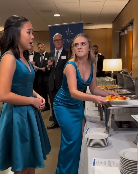
A murmur passed through the room.
Even now, even after everything, it was beautiful.
Madison looked at it with disgust.
“If everyone wants a spectacle,” she said, “let’s give them one.”
She seized the brass handle.
I lunged forward.
“Don’t!”
She pulled the door open too hard.
A crack split the air.
One of the restored hinges tore loose.
The cabinet tilted.
The front glass shuddered.
For one horrible second, I saw all my work collapsing. I saw my grandmother’s photograph. I saw Klara’s grief. I saw every hour I had spent coaxing the broken frame back into shape.
Then I threw myself against the cabinet and caught the side panel with both hands.
Pain shot through my wrist.
The cabinet slammed into my shoulder instead of the floor.
Several people screamed.
Lukas and Henri rushed forward, helping me steady it. Klara cried out my name.
A porcelain doll tumbled from the top shelf.
Madison watched it fall.
I twisted, caught it against my chest, and dropped to one knee.
The ballroom erupted.
Not in applause.
In outrage.
Madison backed away, her face white now.
The doll lay safe in my hands.
But the impact had opened something inside its hollow porcelain body.
A folded strip of old paper slid from beneath its dress and landed on my ruined turquoise skirt.
Klara saw it first.
Her cane slipped from her hand.
“Elena,” she whispered. “Do not let Edmund touch that.”
Part 5: The Doll With The Paper Heart
I held the doll so carefully my fingers cramped.
The folded paper resting on my stained skirt was no bigger than a ribbon. Its edges were browned with age, and the crease lines looked ready to dissolve if anyone breathed too hard.
Edmund Ashford moved toward me.
Klara stepped between us.
She was old, small, and shaking.
But Edmund stopped.
“Mrs. Weiss,” he said quietly, “you are making a mistake.”
“No,” she answered. “I made my mistake seventy years ago when I stayed silent because men like you frightened everyone around me.”
His expression changed.
There it was.
Recognition.
Not of her face, maybe. But of what she represented. A witness. A door he thought had been sealed. A living memory with a voice still sharp enough to cut him.
Henri crouched beside me, hands raised but not touching the paper. “We need gloves.”
“No one leaves,” the donor said.
Madison let out a sharp sound. “You can’t keep us here.”
“No,” he said, looking at her. “But every person in this room can remember who runs.”
That trapped her more effectively than locked doors.
A staff member brought white cotton gloves from the display table. Henri put them on with shaking fingers and lifted the paper from my skirt.
The big screen still showed the repair file. Lukas connected the tablet camera so everyone could see the tiny note magnified.
The handwriting appeared slowly, dark ink faded to brown.
It was in German.
Klara covered her mouth.
Henri translated aloud, voice breaking in places.
“To whoever finds this, my daughter’s name is Anika Varga. If I do not return, the cabinet and all dolls belong to her and to the children who come after her. The Ashford agent offered papers. I refused. If he claims sale, he lies.”
The room seemed to fall away beneath me.
My grandmother’s mother.
My great-grandmother.
A woman I had known only from one cracked photograph and one lullaby.
She had hidden her truth inside a doll.
Inside the very cabinet they stole.
Madison whispered, “That doesn’t prove—”
“Be quiet,” her mother snapped.
Everyone turned.
Vivienne Ashford looked as if her own words had surprised her. Her silver silk dress trembled at the waist where her hands gripped the fabric.
Edmund stared at his wife. “Vivienne.”
She did not look at him.
She looked at me.
“I knew there were documents,” she said, barely above a whisper. “I didn’t know there was a note.”
Madison’s face twisted. “Mother, stop.”
Vivienne’s eyes filled. “I told myself it was old business. Before us. Before our daughter. I told myself museums were full of complicated histories.”
Klara’s voice was cold. “That is what comfortable people call theft.”
Vivienne flinched.
Then she reached into her clutch.
Edmund grabbed her wrist.
The movement was quick. Violent in its quietness.
“Do not,” he said.
The donor stepped forward. “Take your hand off her.”
Edmund released her, but the damage was done. Everyone had seen it.
Vivienne opened the clutch and pulled out a small brass key on a black ribbon.
Madison stared at it. “What is that?”
“The lower compartment,” Vivienne whispered. “Your father told me it was empty.”
My mouth went dry.
The cabinet had a lower drawer disguised by carved leaves. I had noticed it during restoration, but it was locked from inside with a mechanism I could not open without damaging the wood. Henri had told me to leave it.
Now I understood why.
Vivienne held the key out to me.
Edmund said, “You will regret this.”
She looked at him then.
For the first time all night, she did not look elegant.
She looked awake.
“I already do.”
The room parted as I stood.
My wrist throbbed. My shoulder ached from catching the cabinet. My dress clung coldly to my skin. But when I took the key from Vivienne Ashford, my hand was steady.
I knelt before the cabinet.
The carved leaves hid the keyhole so well I found it only by touch. The brass key slid in with a soft click.
I turned it.
For a second, nothing happened.
Then the bottom panel released.
Inside lay a flat velvet bundle, a stack of letters tied with blue thread, and a silver locket tarnished almost black.
Klara made a sound like a sob.
“The locket,” she whispered. “Marta wore it in the photograph.”
I lifted it.
The hinge resisted, then opened.
Inside was a tiny portrait of a young woman with my grandmother’s eyes.
And behind the portrait, folded impossibly small, was a second paper.
This one had a seal.
Henri leaned closer.
His face changed.
“Elena,” he said slowly, “this is not only ownership.”
“What is it?” I asked.
He looked toward Edmund Ashford.
Then he looked back at me.
“It is a bank trust.”
Part 6: The Fortune Beneath The Floorboards
Edmund Ashford stopped pretending.
“Enough,” he said.
One word, and the polished philanthropist vanished.
He strode toward the cabinet with such force that two waiters stepped back at once. Lukas clutched the tablet to his chest. Henri stood, placing himself between Edmund and me, but he looked terrified.
I did not blame him.
Edmund had the kind of anger that expected doors to open and people to kneel.
But this time, the room did not move for him.
The donor blocked his path again. “You are done giving orders here.”
Edmund laughed once. “You think a few dramatic papers change anything? My foundation owns the venue, funds the museum, pays half the salaries of the people standing around enjoying this circus.”
Klara’s cane struck the floor. “And now every journalist in this room knows why.”
The photographers surged closer.
Madison stood near the buffet, abandoned by the friends who had filmed my humiliation minutes earlier. Their phones were still raised, but now they were pointed at her.
She looked smaller without their laughter behind her.
Not innocent.
Just smaller.
Vivienne’s hands shook as she touched Madison’s arm. “Come with me.”
Madison pulled away. “You ruined us.”
Vivienne’s face crumpled. “No, darling. We did that before tonight.”
For one heartbeat, I saw something human pass across Madison’s face. Fear, maybe. Or the terrible shock of realizing her mother was no longer standing between her and consequence.
Then Henri unfolded the trust paper under the tablet camera.
The seal belonged to a Swiss bank in Geneva.
The document was old, but official.
A trust established for Anika Varga and her descendants, funded by the sale of carved toys, porcelain miniatures, and a property near Prague that had once belonged to my family. If no descendant came forward, the assets were to remain frozen.
Henri’s voice lowered as he read the final line.
“The trustee of record after 1998 is Edmund Ashford.”
A collective murmur rolled through the ballroom.
I stared at Edmund.
“You knew,” I said.
He gave me a look so cold it almost steadied me.
“Your grandmother came asking questions twenty-two years ago,” he said. “She had no proof.”
The room vanished.
My grandmother.
In her worn brown coat, taking a train, clutching her little folder of photographs and letters.
I remembered her coming home one winter evening with red eyes. I had been seven. She had told me she slipped on ice.
“She came to you?” I asked.
“She came to my father first,” Edmund said. “Then to me. Sad woman. Very emotional.”
Klara whispered a curse under her breath.
My fingers curled around the locket.
“What did you do?”
Edmund adjusted his cuff. “I protected my family from a false claim.”
The donor’s voice turned hard. “By hiding a trust?”
“By preventing chaos.”
“By stealing from her,” I said.
He finally looked fully at me.
“Do not dress poverty up as righteousness. Your grandmother wanted what she could not earn.”
The words struck me in the chest.
I saw my grandmother counting coins for bread. Sewing my school uniform twice because we could not replace it. Smiling when she gave me the turquoise fabric I later turned into this dress, saying, “Make something beautiful. Beauty is also resistance.”
My eyes burned, but I did not cry.
Not for him.
Never for him.
“She earned more than you could understand,” I said. “She survived.”
Klara reached into her coat pocket and pulled out a worn envelope.
“I have something else,” she said.
Edmund’s confidence flickered.
Klara held the envelope to her chest. “Marta Varga gave my mother a copy of a witness statement before she disappeared from Prague. My mother hid it. I was afraid to bring it forward for years. Then I saw Elena’s name in the program.”
She looked at me.
“I came tonight to see if you had Marta’s hands.”
My breath caught.
“And you do,” she said.
Inside the envelope was a photograph.
Not the one from my grandmother’s kitchen.
This one showed the cabinet in the toy shop. Beside it stood Marta Varga. Next to her was a little girl holding the same silver locket.
And behind them, visible in the shop window, was a carved sign:
VARGA MINIATURES.
Klara turned the photograph over.
On the back were signatures.
Witnesses.
Dates.
A stamp from Prague.
Edmund’s face went gray.
Then Madison suddenly grabbed a champagne bottle from the buffet.
“No one cares about your dead relatives!” she screamed.
She hurled it toward the cabinet.
I moved without thinking.
But someone else reached it first.
Vivienne stepped in front of the cabinet, arms wide.
The bottle smashed against the floor beside her, spraying glass across her silver dress.
Madison stared at her mother in horror.
Vivienne did not move.
She only said, “You will not break another woman’s inheritance to protect our lie.”
Part 7: The Heiress Who Lost Her Reflection
Madison began to cry then, but it was not the kind of crying that asks forgiveness.
It was angry, humiliated crying. The kind that comes when a person loses a mirror that always showed her what she wanted to see.
“You chose her,” Madison said to Vivienne.
Vivienne’s lips trembled. “I chose the truth too late.”
Security finally moved, but not toward me.
They came for Madison after the bottle shattered. She struggled once when they touched her elbow, then seemed to notice every camera watching and went rigid.
“Don’t film me,” she snapped.
No one lowered a phone.
I knew I should have felt victorious.
Instead, I felt exhausted down to the bone.
My wrist was swelling. My shoulder burned. My dress smelled of citrus and sugar. The locket lay warm in my palm, as if my body had already decided it belonged there.
Edmund leaned close to his daughter as security guided her away.
“Say nothing,” he whispered.
Madison looked at him, waiting for rescue.
He gave her strategy instead.
Something in her face cracked.
For the first time all night, I wondered if Madison had ever been loved without instruction.
Then she looked at me, and the softness vanished.
“This isn’t over,” she said.
I believed her.
The police arrived within fifteen minutes, called quietly by one of the donors after the audio played. They did not drag anyone out dramatically. Real consequences, I learned, often enter rooms in dark coats and ask calm questions.
Edmund tried to leave through a side entrance.
Klara saw him.
“Coward,” she said.
He turned, and for a second I thought he would answer. Instead, he walked faster.
The officers stopped him near the cloakroom.
That image stayed with me: Edmund Ashford beneath a wall of velvet coats, his foundation smile gone, while a young policewoman asked him to remain available for questioning.
Henri approached me after giving his statement.
He looked older than he had an hour earlier.
“Elena,” he said, “I failed you.”
I did not rush to comfort him.
The old me would have. The old me would have made his guilt easier to carry because I was afraid of seeming unkind.
Tonight had burned that habit out of me.
“Yes,” I said. “You did.”
He closed his eyes.
“I told myself keeping you quiet would protect the restoration until the unveiling. I thought if the cabinet was seen whole, then your work would be undeniable.”
“It was deniable when nobody planned to say my name.”
He nodded, tears standing in his eyes. “I am sorry.”
“I know.”
That was all I gave him.
Not forgiveness.
Not yet.
Maybe someday.
But not because he looked sad in a ruined ballroom.
Klara sat beside me near the stage while a medic wrapped my wrist. The velvet bundle from the cabinet rested on the table before us. Inside were more letters, tiny sketches, receipts, and three miniature wooden animals carved so delicately their eyes seemed alive.
Klara touched one with a gloved finger.
“Your great-grandmother made these,” she said. “Children used to press their faces to the shop window to see them.”
I looked at the little wooden fox.
It was no bigger than my thumb.
All that beauty hidden because powerful people preferred silence.
Vivienne approached slowly.
Her silver dress was torn near the hem where glass had caught it. Without the sharp posture, without her husband at her side, she looked strangely fragile.
“Elena,” she said. “I cannot ask you to accept an apology tonight.”
“No,” I said. “You can’t.”
She nodded, tears slipping down her face. “The key was given to me by Edmund’s father before he died. He told me never to open the compartment. I should have questioned it. I should have questioned everything.”
“Yes,” Klara said. “You should have.”
Vivienne accepted that like a sentence.
Then she placed something on the table.
A folder.
“My personal copies,” she said. “Bank correspondence. Foundation board notes. Letters from your grandmother. Edmund kept some. I kept others because I was afraid he would destroy them.”
I stared at the folder.
My grandmother’s letters.
My hands went numb.
Vivienne’s voice broke. “There is one more thing you need to know.”
Klara stiffened.
Vivienne looked not at the folder, but at me.
“Your grandmother did not stop fighting because she had no proof,” she said. “She stopped because Edmund threatened to have you taken from her.”
The room tilted.
I heard Klara inhale sharply.
Vivienne whispered, “He told her poverty made her an unfit guardian.”
Something inside me went quiet.
Not calm.
Quieter than calm.
A deep place where grief turns into steel.
I opened the folder.
On top lay a letter in my grandmother’s handwriting.
My name was on the first line.
For Elena, when she is old enough to know why I bowed my head.
Part 8: The Cabinet Opened For The Right Girl
I did not read the letter in the ballroom.
Some truths deserve more than chandelier light and strangers holding cameras.
I took it home unopened, pressed against my chest beneath my coat while rain washed the fruit sugar from my hair. Klara came with me. She said no one should read a grandmother’s last courage alone.
Our flat in Vienna was small, with a kitchen table that rocked unless you folded paper under one leg. The radiator knocked in the wall. The window looked out over wet rooftops and a bakery sign that flickered when the wind was strong.
It was the most honest room I had ever known.
I made tea because my hands needed a task.
Klara sat across from me.
The locket lay between us.
At midnight, I opened the letter.
My grandmother’s handwriting trembled more than I remembered.
My Elena,
If you are reading this, then the cabinet found its way back to you, or you found your way to it. Both are miracles, and our family has always survived by recognizing miracles when they arrive wearing ordinary shoes.
I laughed once, and the sound broke into a sob.
Klara reached across the table but did not touch me. She let me choose whether to take her hand.
I did.
The letter told me everything.
How my grandmother had tracked the cabinet through old auction records. How Edmund Ashford’s father had admitted privately that the sale was false but refused public restitution. How Edmund later promised help, then threatened court action, debt claims, and social services if she continued.
Then came the part that changed my life more than the trust, more than the cabinet, more than the money.
My grandmother had not been born Anika Varga.
She had been adopted by Anika after the war.
Anika, the little girl in the photograph, had survived long enough to rescue another child from a station platform in Salzburg. That child became my grandmother.
Not by blood.
By choice.
The Varga line had not continued through inheritance.
It had continued through love.
I looked up at Klara, unable to speak.
She was crying openly now.
“Then I’m not—” I began.
“You are,” she said fiercely. “Do not let dead men teach you that blood is the only truth.”
I read the final page.
Anika left everything to the child she raised and to the children who came after her, not because of blood, but because family is the hand that reaches back.
My grandmother had underlined the last sentence.
The next morning, the story was everywhere.
Not as Madison wanted.
Not as Edmund planned.
The headlines did not call me a pity guest.
They called me the restorer who uncovered a stolen legacy.
But the public noise mattered less than what happened quietly over the next months.
The museum suspended Henri, then reinstated him only after he publicly testified against Edmund and created a restoration scholarship in my grandmother’s name using his own savings. I did not forgive him quickly. He did not ask me to. That helped.
Vivienne gave investigators everything. Her testimony opened not just my case, but five others tied to the Ashford foundation. Families from Prague, Kraków, Budapest, and Trieste came forward with photographs, letters, and missing heirlooms hidden beneath polite donor plaques.
Madison disappeared from society pages.
Then, six months later, a letter arrived.
No perfume.
No expensive paper.
Just a plain envelope and a single page.
Elena,
I used to think being embarrassed was the worst thing that could happen to me. It is not. The worst thing is realizing everyone taught you to win by making other people small.
I am not asking you to forgive me.
I am entering a restitution program as part of my sentence. My mother says repair without applause is still repair. I hate that she is right.
Madison
There was no signature flourish.
No excuse.
I folded the letter and placed it in a drawer.
Not near my grandmother’s.
Some things do not belong together yet.
A year after the charity night, the cabinet was unveiled again.
Not in Cincinnati.
Not under the Ashford name.
In Prague, inside a restored toy museum on a narrow street where Varga Miniatures once stood.
The donors came, yes. So did journalists. So did families whose own histories had been mislabeled, misfiled, and nearly erased.
But the front row was reserved for children.
Klara sat beside me in a dark green coat, her cane across her knees. Vivienne sat two rows behind us, quieter now, dressed simply, her face changed by the kind of grief that had finally become useful.
Henri stood near the wall, not onstage.
He had asked where he should sit.
I told him, “Somewhere you can see the work.”
He understood.
When they called my name, I walked forward in the same turquoise dress.
Not stained now.
Repaired.
I had cut away the ruined panel and embroidered tiny silver leaves over the place where fruit had soaked into the fabric. From far away, it looked like decoration. Up close, it looked like survival.
The room went silent as I reached the cabinet.
The repaired hinge gleamed.
The doll with the hidden paper heart stood on the second shelf.
I placed my grandmother’s locket inside the lower compartment, not to hide it, but to keep it where the story had waited so long.
Then I opened the glass doors.
No one stopped me.
No one spoke over me.
No one called me confused.
Klara began to cry when the music started: an old lullaby from Prague, played softly on violin.
I looked at the children in the front row, their faces bright with wonder, and understood why my great-grandmother had carved tiny foxes, why Anika had saved a child who was not hers, why my grandmother had bowed her head only long enough to protect me.
The trust money did not make me rich the way Madison had feared.
It made something better possible.
We used it to create the Varga House of Returned Things, a place where stolen objects, broken heirlooms, and buried names could be researched, restored, and returned without families needing to beg powerful people for permission.
On opening day, the first item accepted was not a jeweled crown or famous painting.
It was a cracked wooden horse brought by a little boy from Bratislava, wrapped in a towel, because his grandmother said it was the only thing her father carried across a border.
I took it from him with both hands.
“I think it can be repaired,” I said.
The boy looked at me as if I had performed a miracle.
But I knew the truth by then.
Repair was not magic.
It was patience.
It was witness.
It was refusing to let damage have the final word.
That evening, after everyone left, I stood alone before the cabinet. My reflection shimmered faintly in the curved glass: turquoise dress, silver leaves, tired eyes, steady hands.
Behind my reflection stood all the women who had reached back through time without knowing whether anyone would reach forward.
Marta.
Anika.
My grandmother.
Klara.
Even Vivienne, late but not useless.
I touched the glass gently.
For the first time, I did not feel like the girl Madison had humiliated in front of everyone.
I felt like the door that opened after generations of locked rooms.
And inside that quiet museum in Prague, surrounded by rescued toys and returned names, I finally understood that inheritance was never what they stole from us—it was what survived anyway.
