Part 2: The Lawyer Said My Name Twice
The microphone cracked before anyone breathed again.
“Clara Dawson restored the missing ink on the scroll,” the lawyer said, his voice carrying across the ballroom in London like a bell struck too hard.
For one wild second, I thought he had said the wrong name.
Then he said it again.
“Clara Dawson.”
My palms pressed against the polished marble floor. The hem of my dress was twisted beneath one knee where Isabelle Waverly’s heel had caught it, and my clutch had skidded under a velvet rope. A waiter bent to pick it up but stopped, frozen like everyone else.
Isabelle’s face changed so quickly I almost missed it. The cruel smile she had worn all night collapsed into something tight and pale.
“That file is private,” she snapped.
The lawyer did not lower his arm. He held the folder against his chest as if she were a child reaching for a flame.
“No,” he said. “It is evidence.”
The word rippled through the room.
Evidence.
Cameras turned. Phones lifted higher. The livestream operator, a young man in a black suit with a headset slipping down his cheek, looked from Isabelle to me, then quietly adjusted the lens.
I pushed myself upright before anyone could help me.
My legs shook so badly I had to grip the edge of the registration table. I could feel a hundred eyes dragging over my plain dress, my scraped ankle, the tiny tear near the hem. Isabelle had wanted me remembered as the girl who fell at the entrance.
Now everyone was watching her.
Her father, Lord Alaric Waverly, stepped forward from beside the donor wall. He was tall and silver-haired, with the kind of calm that made other people apologize before he spoke.
“This is an unfortunate misunderstanding,” he said smoothly.
The lawyer turned toward him.
“Then you will not object to me reading the restoration record aloud.”
Lord Waverly’s smile thinned.
Isabelle laughed once, sharp and ugly. “She cleaned dust from a display case. That is all.”
My throat burned. I had spent six months in a cold archive room in Edinburgh, bent under magnifying lamps until my eyes watered, testing pigment flakes no larger than crumbs. I had worked with gloves too big for my hands because the museum’s budget was already gone. I had written report after report that no donor ever read.
I had told myself the work mattered even if nobody knew.
But now the lawyer opened the file.
“The original inspection listed the scroll as incomplete,” he read. “Central inscription faded. Lower seal damaged. Ownership line illegible.”
Isabelle’s hand tightened around her crystal bracelet.
The lawyer lifted one page. “Three months later, a restoration note was submitted under Clara Dawson’s signature. It identified the erased family name beneath the final layer of ink.”
My breath caught.
I had not known that detail would be read aloud.
Lord Waverly moved one step closer. “Mr. Caron, enough.”
The lawyer looked straight at him. “No, my lord. Enough began twenty-six years ago.”
The ballroom went so silent that the fountain outside seemed thunderous.
Isabelle’s mother made a small choking sound.
A woman near the front whispered, “Twenty-six years?”
My stomach twisted. The number meant nothing to me, yet the way Lord Waverly’s face emptied made it feel like a door opening beneath my feet.
The lawyer closed the folder halfway.
Then he looked at me, not the donors, not the cameras.
“Miss Dawson,” he said softly, “before you open the scroll, there is something you deserve to know.”
Isabelle lunged for the file.
The lawyer stepped back.
And the page that slipped loose from the folder landed at my feet with my surname written beside the Waverly crest.
Part 3: The Crest Beneath The Faded Ink
Nobody moved to pick up the page.
Maybe they were afraid of what it would say. Maybe they were waiting for me to do it because the whole room had suddenly decided this disaster belonged to me.
I bent down slowly.
My fingers trembled as I lifted the paper. It was a reproduction from the archive scan, clean and enlarged, with careful notes marked in blue. At the bottom of the scroll image, beneath layers of faded gold and brown, a name had been circled.
Dawson.
Not handwritten beside the image.
Not added later.
Part of the scroll itself.
My mouth went dry.
“That can’t be right,” Isabelle whispered.
The lawyer, Mr. Caron, spoke without looking at her. “It is right.”
Lord Waverly’s voice turned cold. “This event is over.”
He made a quick gesture to the security staff near the doors, but they hesitated. Everyone had seen too much. Everyone wanted the next sentence.
Mr. Caron raised the microphone again.
“The honorary scroll was commissioned in Vienna in 1898 to recognize two founding families of the Waverly Arts Trust. One family name remained visible. The other was deliberately obscured.”
He turned a page.
“The visible name was Waverly. The hidden name was Dawson.”
My chest tightened so hard I almost dropped the paper.
“My grandfather was a school caretaker,” I said. The words came out barely louder than air. “My mother worked at a bakery in Leeds. We are not—”
“Old families lose everything,” Mr. Caron said gently. “Sometimes because of war. Sometimes because of money. Sometimes because someone with power decides the truth is inconvenient.”
Isabelle’s laugh returned, thinner now. “This is insane. You are pretending she belongs here because she fixed some ink?”
I looked at her then.
Really looked.
Her diamonds were still perfect. Her hair still gleamed. But her eyes were wild, flicking from her father to the cameras to the paper in my hand.
She was not angry because I had been praised.
She was afraid because I had been recognized.
A curator from the Royal Manuscript House stepped forward. Her name tag read Elise Moreau. She was small, middle-aged, and had the calm face of a woman who had spent her life handling fragile things.
“Miss Dawson did not simply restore ink,” she said. “She found chemical traces of nineteenth-century concealment varnish. Someone had painted over the Dawson name and aged the alteration to match the scroll.”
A wave of whispers broke across the ballroom.
Lord Waverly said, “Elise.”
The curator looked at him sadly. “You asked me to authenticate the scroll for tonight. I did.”
Isabelle spun toward her father. “Say something.”
He did not.
For the first time since I entered that room, Isabelle Waverly looked smaller than me.
Mr. Caron reached into the file again and removed a sealed envelope. The wax on it had cracked with age. Across the front, in slanted writing, were two words:
For Clara.
My heart slammed against my ribs.
“That was found inside the scroll casing,” he said. “Hidden behind the lower rod.”
I shook my head. “That’s impossible. The scroll is over a hundred years old.”
“Yes,” Mr. Caron said. “But the casing was opened once in 1999.”
Lord Waverly’s face turned gray.
My voice failed, so Elise Moreau answered the question I could not ask.
“Your father opened it,” she said.
The room tilted.
My father had died when I was eight. I remembered his wool coat, his rough hands, the way he hummed while making tea. I remembered him telling me never to let anyone make me feel small in a room built by thieves.
I had thought it was just something fathers said to daughters.
Mr. Caron held out the envelope.
I reached for it.
Lord Waverly suddenly shouted, “Do not give her that.”
And that was when I knew.
Whatever was inside had been waiting for me longer than Isabelle’s hatred had.
Part 4: The Letter My Father Hid For Me
The envelope felt too light to carry so much fear.
My thumb brushed the cracked wax seal. A tiny piece broke away and fell onto the tablecloth, dark red against white linen. The sound was nothing, but Isabelle flinched as if something had shattered.
“Clara,” Mr. Caron said quietly, “you do not have to read it aloud.”
Lord Waverly exhaled with relief.
That decided me.
I opened it.
The paper inside was folded twice, yellowed at the edges, but my father’s handwriting was unmistakable. I had not seen it in years. My mother had kept his grocery lists and birthday cards in a biscuit tin, and sometimes, when grief made the house too quiet, I took them out just to see the shape of him again.
My eyes blurred before I reached the first line.
My Clara,
If this letter has found you, then the scroll has finally told the truth.
I pressed one hand over my mouth.
Isabelle whispered, “This is staged.”
But nobody listened.
I kept reading, my voice shaking.
The Dawson name was not lost by accident. It was removed after my grandmother refused to sign away her claim to the Waverly Arts Trust. The trust was built from two family collections, not one. The Waverlys kept the title. We kept the silence because silence was safer.
Lord Waverly’s jaw clenched.
I looked up. “You knew my father.”
He said nothing.
My fingers tightened around the letter.
I found the scroll casing during conservation work in Prague. I placed this letter inside because I could not prove enough then. Alaric had lawyers. I had a dying wife and a little girl who still believed museums were places where truth lived.
My breath broke on the word dying.
My mother had never told me he had been investigating anything. She had said he took restoration jobs because the pay was steady and the work was quiet.
Maybe she had wanted me safe too.
The letter trembled in my hand.
If you are reading this, Clara, do not let them turn you bitter. Bitterness is another way powerful people keep what they stole. Ask for the record. Ask for the ledger. Ask why the Dawson share was transferred three days after my accident.
A sound moved through the crowd like wind through dry leaves.
My accident.
I looked at Mr. Caron.
His face had gone still.
“What accident?” I asked.
Lord Waverly stepped forward. “This has gone far beyond—”
“What accident?” I repeated, louder.
Mr. Caron closed his eyes for half a second. “Your father died after a fall at a restoration site in Prague.”
“I know how he died.”
“No,” Elise Moreau said. Her voice was barely there. “You know what they told your mother.”
The ballroom lights seemed suddenly too bright. My skin felt cold beneath them.
Isabelle grabbed her father’s sleeve. “Papa.”
He shook her off.
That small gesture made her eyes fill with panic.
Mr. Caron pulled another document from the file. “The site report stated a railing failed. But your father’s final letter asks why the Dawson share was transferred three days after the accident. That transfer bears Lord Waverly’s authorization.”
Lord Waverly’s mask cracked.
Only for a second.
But the cameras caught it.
The livestream caught it.
I caught it.
My father’s letter ended with one final line.
Do not open the scroll for them, Clara. Open it for us.
I lowered the paper.
Across the ballroom, the ceremonial table waited beneath a glass dome. The honorary scroll rested inside, tied with a pale ribbon, as if it had not just dragged a buried crime into the light.
Mr. Caron looked at me.
“The choice is yours.”
Isabelle’s voice shook. “She cannot touch it.”
I stepped toward the table.
And every Waverly in the room stepped back.
Part 5: The Scroll Opened The Wrong Door
The glass dome lifted with a soft hiss.
I had imagined this moment for weeks. I thought I would feel honored, maybe nervous, maybe proud in a quiet way. Instead, I felt my father standing somewhere behind my ribs, asking me to keep going when my knees wanted to fold.
The scroll ribbon was smooth beneath my fingertips.
Elise Moreau stood beside me with white gloves ready, but she did not rush me. Her eyes were damp.
“Slowly,” she whispered. “Let it breathe.”
I almost laughed, because the scroll was not the thing struggling for air.
I untied the ribbon.
The parchment opened inch by inch, golden under the chandelier light. The visible ink was graceful, old, and formal. The Waverly name curled proudly across the center.
Then came the restored section.
Dawson.
The word emerged from the past like a hand through fog.
Several people gasped.
A reporter near the livestream said, “Zoom in.”
Isabelle made a broken sound. “No.”
But beneath the Dawson name, where I had thought the restoration ended, the warm light revealed something else. A line of tiny writing, nearly invisible unless the scroll was angled exactly right.
Elise leaned closer.
Her face went white.
“What is it?” I asked.
She did not answer.
Mr. Caron stepped to her side and read over her shoulder. His hand gripped the table.
Lord Waverly turned toward the exit.
Security moved, but not for me this time. Two uniformed officers entered from the side corridor, escorted by a plain-clothed woman with severe dark hair and a badge at her waist.
The woman looked at Mr. Caron. “Is it visible?”
He nodded.
She turned to Lord Waverly. “Alaric Waverly, I need you to remain here.”
Isabelle screamed, “You cannot do this at our gala!”
The officer ignored her.
I stared at the hidden line on the scroll. “What does it say?”
Elise swallowed.
“It is not part of the original commission,” she said. “It was added later. By your father.”
My pulse hammered in my ears.
Mr. Caron carefully angled the parchment toward the microphone camera so the room could see the faint lettering.
A code.
Not a sentence.
Numbers. Initials. A location marker.
PRG-17. VLTAVA STOREHOUSE. A.W. TRANSFER LEDGER.
The plain-clothed woman spoke sharply into her radio. “Confirm secondary warrant.”
Lord Waverly’s calm broke at last. “That is enough.”
He grabbed the edge of the table.
The scroll shifted.
I moved without thinking, placing both hands over the parchment to stop it from sliding. The entire ballroom seemed to inhale.
Lord Waverly looked down at my hands, then at my face.
For the first time, he did not see a poor girl in a borrowed dress.
He saw the daughter of the man who had outplanned him.
“Your father should have stayed quiet,” he said.
The words were soft.
The microphone caught them anyway.
Isabelle stared at him as if she had never seen him before.
“Papa,” she whispered. “What did you do?”
He turned on her with cold fury. “I protected what was ours.”
“No,” I said.
My voice surprised me. It was steady.
“You protected what you stole.”
The plain-clothed woman stepped between us. “Lord Waverly, come with me.”
He smiled then, but it was not calm anymore. It was desperate.
“You think this ends with a hidden note? You think a girl like you can inherit a storm and survive it?”
I looked at the Dawson name glowing under the lights.
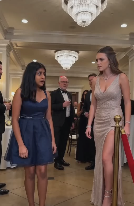
Then I looked at Isabelle, who had gone silent, her lips parted, her whole life cracking in front of strangers.
“No,” I said. “I think the storm was already mine.”
That was when Isabelle reached into her clutch and pulled out a small brass key.
Part 6: Isabelle’s Key Changed Everything Again
The officers turned too late.
Isabelle clutched the brass key so tightly that its teeth cut a red line across her palm. Her eyes darted from her father to me to the scroll, and for one terrifying second I thought she meant to destroy something.
But she did not move toward the table.
She moved toward me.
“Take it,” she whispered.
I stared at her.
The room erupted.
Lord Waverly shouted her name with such force that several people stepped backward.
Isabelle flinched, but she kept her arm extended.
“Take it before he makes me afraid again.”
The words landed harder than any insult she had thrown at me.
I took the key.
It was warm from her hand.
Lord Waverly lunged, but the officer caught his arm. His face twisted, not with fear now, but betrayal.
“You stupid girl,” he hissed.
Isabelle’s chin trembled. “You said it was just paperwork.”
He said nothing.
She turned to me, and all the cruelty had drained out of her, leaving someone younger, frightened, and lost.
“There’s a box,” she said. “In our house in Geneva. Behind the music room wall. I heard him talking to Mr. Voss after the Vienna auction. They said if the scroll was ever opened, the box had to disappear.”
Mr. Caron stepped forward. “What kind of box?”
“A black archive box. Metal. My grandmother’s name is on it.” Isabelle swallowed. “And Dawson.”
Lord Waverly struggled against the officer’s grip. “She is lying for attention.”
Isabelle laughed, but it came out like a sob. “That was always your favorite line.”
For the first time, I saw her clearly.
Not as the richest girl in the room.
Not as the girl who had made me stumble on camera.
But as someone raised inside a golden cage, taught that love was earned by protecting the family lie.
It did not erase what she had done.
But it changed the shape of it.
The officer took the key from me in an evidence pouch. Mr. Caron spoke rapidly to her in a low voice. Elise covered the scroll again with trembling hands.
The gala had collapsed into chaos now. Donors whispered into phones. Journalists pushed toward the rope barriers. A Waverly cousin was crying near the champagne tower. Someone from the trust board kept saying, “We need a statement,” like words could put the ceiling back up.
Isabelle stood alone.
I should have hated her cleanly.
I wanted to.
Instead, I walked toward her.
She looked ready for me to slap her. Maybe she thought she deserved it. Maybe part of me thought so too.
I stopped an arm’s length away.
“You kicked my dress,” I said.
Her face crumpled. “I know.”
“You wanted me humiliated.”
“I know.”
“You smiled when I fell.”
Tears slid down her cheeks. “I know.”
I looked at the cameras, then back at her.
“Then stand there and tell them why.”
Her eyes widened.
“No,” she whispered.
“Yes.”
The room seemed to quiet around us again, sensing another fall, another opening, another truth forcing its way out.
Isabelle turned toward the microphone with shaking shoulders.
“My father told me Clara Dawson was trying to steal our family’s place,” she said. “He told me she was dangerous. He told me if she opened the scroll, everything my family built would be ruined.”
She looked at me.
“And I believed him because believing him meant I did not have to ask who paid for my life.”
Lord Waverly stopped struggling.
The sentence did what the officers had not.
It defeated him.
Then Mr. Caron’s phone rang.
He listened for ten seconds, and the color left his face.
When he lowered it, he looked at me as if the night had found one more blade.
“The Geneva box was opened this morning,” he said. “By your mother.”
Part 7: My Mother Knew The Ending First
My mother was supposed to be in Leeds.
That was my first thought.
Not the scroll. Not Geneva. Not the box.
My mother, who saved jam jars and mended sleeves and called any room with chandeliers “a room that needs dusting.” My mother, who had kissed my forehead that morning and told me my father would have polished my shoes himself if he were alive.
“She is where?” I asked.
Mr. Caron held the phone away from his chest. “Geneva.”
The ballroom blurred.
I gripped the back of a chair.
“She knew?”
Elise Moreau touched my arm. “Clara—”
“Did she know?”
Nobody answered fast enough.
That answer hurt more than yes.
Mr. Caron spoke carefully. “Your mother contacted me two weeks ago after you found the hidden Dawson name. She said if tonight went wrong, she would go to Geneva herself.”
I stared at him.
“Tonight went wrong the second I walked in.”
“No,” Isabelle said quietly. “Tonight went wrong before you were born.”
I turned on her, but the anger had nowhere clean to go.
The plain-clothed officer received another call. She moved away, listening, her expression sharpening. Across the ballroom, Lord Waverly watched her with a stillness that made my skin crawl.
Mr. Caron put his phone on speaker.
My mother’s voice crackled through.
“Clara?”
I almost broke.
“Mum?”
“Oh, my brave girl.” Her voice shook, but there was a smile inside it. “I watched the livestream until the signal cut. Did you open it?”
I swallowed hard. “You knew about the letter.”
“Yes.”
“You knew Dad hid something.”
“Yes.”
The word was gentle.
That made it worse.
“Why didn’t you tell me?”
For a moment, there was only static.
“Because I promised him I would let you grow up before I gave you a war.”
My eyes filled.
“I’m already in it.”
“I know,” she whispered. “And I am sorry.”
Behind her voice came another sound. Metal scraping. Papers shifting.
“What are you doing?” Mr. Caron asked.
My mother inhaled.
“I opened the box.”
Lord Waverly’s head snapped up.
The officer stepped closer to the phone.
My mother continued, “There are ledgers. Photographs. Letters from Alaric to his solicitor. And one tape.”
“A tape?” I said.
“A small recorder tape. Your father labeled it: For Clara, when she stops being afraid.”
My hand closed around the back of the chair until my fingers ached.
“Play it,” I whispered.
Mr. Caron shook his head urgently. “Not here. We need chain of custody.”
My mother’s voice softened. “No, monsieur. He wanted her to hear it before the lawyers buried it under procedure.”
A click sounded through the speaker.
Then a hiss.
Then my father’s voice entered the ballroom.
Older than I remembered. Tired. Alive.
“Clara, if you are hearing this, then your mother has decided you are strong enough to know that my death was not the important part.”
I stopped breathing.
“The important part is what I found before it.”
Lord Waverly shouted, “Turn that off!”
The officers held him back.
My father’s voice continued.
“The Waverly trust does not belong to the Waverlys. It never did. The Dawson share was not merely stolen. It was hidden in plain sight, waiting for a direct descendant to restore the scroll and claim stewardship. Clara, that descendant is you.”
The ballroom disappeared.
Only his voice remained.
“And if Alaric is listening, then he should know one thing.”
The tape crackled.
“I kept the original ledger where no thief would ever look.”
A pause.
“Inside the Waverly family chapel, beneath his wife’s memorial stone.”
Isabelle gasped.
Her mother fainted.
And Lord Waverly began to laugh.
Part 8: The Girl Who Refused The Throne
The Waverly chapel stood on a hill outside Geneva, gray and narrow against the morning sky.
I saw it first through the rain-streaked window of a police car, my mother’s hand wrapped around mine so tightly our knuckles pressed together. Isabelle sat in the front seat beside the officer, silent since dawn. She had not slept. None of us had.
Lord Waverly had laughed because he thought the chapel made the truth untouchable.
It was private property. Sacred ground. Family stone. Old grief polished into marble.
But he had forgotten something my father had understood.
Rich families built locked rooms everywhere because they were terrified of what open doors could do.
By noon, the warrant came through.
By one, the memorial stone was lifted.
By one fifteen, the original ledger lay on a steel table beneath white evidence lights, dry and perfect inside a sealed copper case.
My mother cried without making a sound.
I did not cry until I saw my father’s final note tucked inside the cover.
Not a legal instruction.
Not a warning.
Just one sentence.
Tell Clara she was never outside the room.
That sentence did what the gala had not.
It brought me to my knees.
The investigation moved faster than grief. Alaric Waverly was formally charged with fraud, evidence tampering, and conspiracy tied to the trust transfer after my father’s death. Others followed: solicitors, board members, a retired archive director who had signed false reports for years.
The news called me the lost heir.
I hated that.
Heir sounded like a crown.
My father had not died for a crown.
Weeks later, the emergency trust hearing took place in Vienna. I wore the same repaired dress, hem mended with thread my mother matched by hand. Isabelle came too, in a plain black coat, no jewelry except a small band from her grandmother’s box.
When she saw me in the corridor, she stopped.
“I gave my statement,” she said.
“I heard.”
“I also resigned from the trust board.”
“You were on the board?”
She gave a small, embarrassed nod. “Ceremonial seat. I never read anything.”
I looked at her until she lowered her eyes.
“Now I read everything,” she whispered.
I believed her.
Not fully.
But enough to let the silence soften.
Inside the hearing room, Mr. Caron presented the ledger, the scroll, the tape transcript, and my father’s chain of evidence. The judge, a stern woman with silver glasses, asked me only one question.
“Miss Dawson, do you wish to assume the Dawson family’s restored controlling share of the Waverly Arts Trust?”
Every camera behind me waited for the fairy-tale answer.
Yes.
The poor girl becomes powerful.
The humiliated girl takes the throne.
The richest girl watches her lose everything.
I looked at the old men in expensive suits. I looked at the reporters. I looked at Isabelle, sitting alone, hands clasped so tightly her fingers had gone white.
Then I thought of my father’s letter.
Do not let them turn you bitter.
“No,” I said.
The room stirred.
Mr. Caron turned sharply. “Clara?”
I stood.
“I will not become the face of another family empire. The Dawson share was stolen, and it should be restored, but not to me as a private inheritance.”
The judge leaned forward.
“What do you propose?”
My voice shook once, then steadied.
“The trust becomes public. Independent. Protected from family control forever. The Dawson share funds restoration training for students who cannot afford unpaid work. Every archive record connected to this case is opened. Every object with disputed ownership is reviewed.”
Lord Waverly’s former solicitor muttered, “Absurd.”
I looked at him.
“So was stealing a century and calling it tradition.”
The judge’s mouth twitched like she was fighting a smile.
It took months of hearings, arguments, appeals, and newspaper headlines. But in the end, the trust was rebuilt into something no Waverly could own and no Dawson could hoard.
My mother became its first public access director.
Elise Moreau led the archive review.
Mr. Caron claimed he was retiring, then immediately accepted a role teaching ethics to young lawyers.
And Isabelle?
She asked for the hardest job.
Not chairwoman.
Not ambassador.
Not donor liaison.
She became a volunteer catalog assistant in the basement archive in Prague, where the heating failed twice a week and nobody cared what surname was stitched inside her coat.
The first time I visited, she was labeling damaged boxes with ink on her fingers.
She looked up and smiled awkwardly.
“I am still very bad at being useful.”
I placed a stack of folders beside her.
“Then start with these.”
For a second, I saw the old Isabelle bristle.
Then she laughed at herself.
“Fair.”
Years after the gala, the restored scroll was displayed in Vienna under simple glass, not as a trophy, but as a warning. Beneath it was a plaque with both family names and one line from my father’s final note.
On opening day, a little girl with muddy shoes pressed her nose to the glass and asked me why the old writing mattered.
I looked at the Dawson name glowing softly under the museum lights.
Then I looked at the open doors, the free entry desk, the students in borrowed coats learning to restore what others had forgotten.
“Because,” I told her, “sometimes the truth waits for the person nobody invited.”
