Part 2: The Donor Asked The Question Too Loudly
The donor’s voice cut through the ballroom so sharply that even the string quartet stopped playing.
“Why,” he asked, pointing at the glowing tablet, “would Madison Ashford try to bury proof that Elise Moreau saved this ceremony?”
My name sounded strange in his mouth.
Not invisible. Not accidental. Not whispered like an apology.
Spoken.
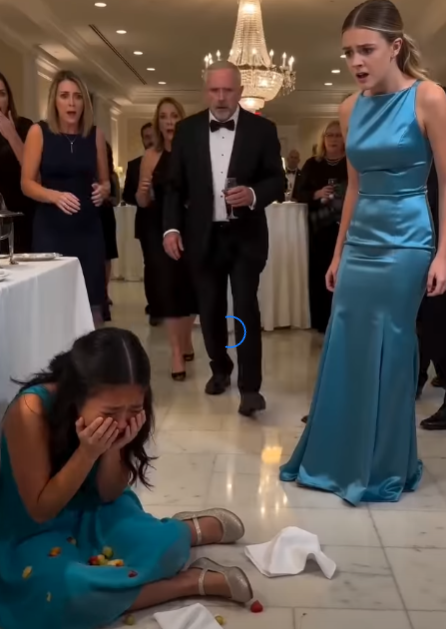
I stood near the luxury buffet in a restored palace hotel in Monaco, fruit juice dripping from my cheek onto the turquoise dress I had stitched by hand under my desk lamp. A slice of peach clung to my collarbone. Someone had tossed a napkin at my feet but not one person had stepped close enough to help.
Until now.
Madison Ashford’s smile was still on her face, but it no longer belonged there.
“I didn’t bury anything,” she said, her voice sweet enough to rot. “This is clearly some staff mistake.”
The donor, Lord Henrik Voss, lifted the tablet from the table. “A staff mistake with Elise’s name, timestamps, repair notes, irrigation photographs, and weather warnings?”
Madison’s mother, Vivienne Ashford, rose slowly from the front table.
Her diamonds flashed under the chandelier light. Her mouth did not move, but her eyes gave Madison an order.
Fix this.
Madison turned toward me. “Elise probably exaggerated. Girls like her always do when they want attention.”
Something in my chest folded, then hardened.
The event director, Stefan Bauer, took the tablet from Lord Voss and connected it to the ballroom screen. Suddenly, my garden log filled the wall behind the podium.
Rows of notes. Photos of split branches. Soil readings. Emergency watering charts. The golden orange tree in the courtyard, weak and browning before I found the root rot.
The same tree I had been chosen to harvest from tonight.
The symbol of the foundation.
The reason donors had flown in from Paris, Milan, and Vienna.
Stefan’s voice shook. “The ceremony would have been canceled if this tree had died.”
Madison laughed once. “It’s a tree.”
Lord Voss turned to her. “No. It is a heritage specimen insured for nine million euros.”
The room inhaled.
Madison’s face changed.
For the first time, she looked less angry than afraid.
Then Stefan tapped the screen again.
A new file opened.
At the top were three words that made Vivienne Ashford grip the table.
Unauthorized Removal Request.
Part 3: The Tree Was Never Meant To Survive
The ballroom became so silent that I could hear fruit syrup dripping from my sleeve onto the marble floor.
Stefan Bauer stared at the screen as if he wished the words would rearrange themselves into something less dangerous.
Lord Voss stepped closer. “Read it.”
Vivienne Ashford said, “That is unnecessary.”
“Read it,” he repeated.
Stefan swallowed. “Request submitted to remove the golden orange tree after gala completion due to projected decline.”
Projected decline.
I looked toward the courtyard doors.
Beyond the glass, the tree stood under soft lights, its leaves glossy and alive because I had spent six weeks fighting for it. I had wrapped its cracked roots in damp cloth. I had argued with vendors twice my age. I had stayed after midnight when sprinklers failed and the palace staff forgot the greenhouse heaters.
Projected decline.
They had already written its death certificate.
Madison crossed her arms. “Old trees die. It’s sad, but it happens.”
I turned to her.
“You knew?”
Her eyes flicked away too fast.
Vivienne stepped forward. “No one here understands horticultural procedure. My family has funded this foundation for years.”
A woman near the back murmured, “That doesn’t answer anything.”
Stefan scrolled.
Another document opened.
Replacement Contract — Ashford Botanical Acquisitions.
The name hit the room like a dropped plate.
Madison’s family company.
Lord Voss read over Stefan’s shoulder. “If the tree failed, the foundation would purchase a replacement orchard from the Ashfords.”
A bitter taste filled my mouth.
Not fruit. Not shame.
Rage.
“You wanted it to die,” I whispered.
Vivienne’s eyes snapped toward me. “Be careful.”
I took one step forward in my stained dress.
“I was careful. That was the problem for you.”
Madison’s lips trembled, then twisted. “You think you’re so noble because you watered some roots?”
“No,” I said. “I think someone gave orders to starve them.”
The screen refreshed.
A third file appeared automatically, as though the tablet had been waiting for the room to be ready.
A photograph filled the wall.
It showed Madison in the moonlit courtyard two nights earlier, standing beside the irrigation control box.
In her hand was a silver key.
And behind her, half-hidden in the dark, stood a man in an Ashford security uniform holding pruning shears.
Madison whispered, “Turn it off.”
No one did.
Part 4: The Gardener Came Back With Mud On His Shoes
The courtyard doors opened before anyone could speak.
Cold night air swept into the ballroom, carrying the scent of wet leaves, polished stone, and rain. A man stepped inside with mud on his shoes and a brown envelope under one arm.
I recognized him instantly.
Nicolas Weber.
The head gardener who had vanished three days earlier.
Everyone had been told he quit after an argument with suppliers. I had not believed it. Nicolas loved that courtyard with a patience most people reserved for children. He spoke to the trees in a low voice when he thought nobody was listening.
Now he looked exhausted.
His coat was damp. His cheek was bruised.
Madison backed away from him. “What are you doing here?”
Nicolas looked at her, then at Vivienne.
“Finishing what you tried to stop.”
A sound moved through the room.
Vivienne lifted her chin. “This man was dismissed for misconduct.”
Nicolas gave a tired laugh. “I was locked out after refusing to sign a false report.”
Lord Voss moved beside him. “What report?”
Nicolas opened the envelope and removed several pages sealed in plastic.
“A report stating Elise Moreau overwatered the golden orange tree and caused fungal spread.”
My breath caught.
Again.
My name.
Always ready. Always waiting to be used.
Madison looked at the floor.
Vivienne did not.
“You cannot prove that came from us,” she said.
Nicolas reached into his pocket and pulled out his old staff badge.
“The maintenance office records badge access,” he said. “So does the irrigation box. So does the greenhouse corridor.”
Stefan Bauer’s eyes widened. “You kept the backups?”
Nicolas nodded toward me.
“Elise reminded me to. She wrote in her log that the irrigation numbers kept changing after midnight.”
My throat tightened.
I remembered that entry. I had written it half-asleep with dirt under my nails, unsure whether I was being paranoid or just tired.
Nicolas placed a small memory card on the podium.
“This shows who entered the courtyard.”
Madison lunged.
Not toward Nicolas.
Toward the memory card.
I moved without thinking and slapped my palm over it.
Her fingers scraped my hand.
The room gasped.
She hissed, “Give it to me.”
I looked straight at her.
“No.”
For one second we stood like that, her diamonds flashing, my dress ruined, both of us breathing hard over the proof.
Then Nicolas said quietly, “Play the courtyard footage.”
Part 5: The Footage Showed More Than Sabotage
The screen went black.
Then the courtyard appeared in grainy silver light.
The golden orange tree stood in the center, its branches tied gently with support ribbons. The timestamp read 01:13.
I watched myself enter the frame first.
A smaller version of me, wrapped in a cardigan, carrying a bucket and a coil of hose. I adjusted the soil blanket around the roots, checked the moisture probe, and wrote something in my notebook.
I remembered that night.
My feet had hurt so badly I cried in the service hallway afterward.
On the screen, I left.
Seven minutes later, Madison entered.
The ballroom shifted.
She was not alone.
The security guard followed her to the irrigation control box. He unlocked it. Madison read from her phone while he twisted the valve.
The water line shut off.
My stomach turned.
For days, I had wondered why the soil dried so fast.
For days, I had blamed myself for not catching it sooner.
Madison on-screen pointed toward one branch. The guard lifted pruning shears.
Nicolas cursed under his breath.
The guard cut a living branch.
A fresh, healthy branch.
The tree shook slightly, as if it felt the betrayal.
Someone in the ballroom whispered, “Monster.”
Madison shouted, “It was already dying!”
But the footage kept going.
Another figure entered the courtyard.
A man in a tuxedo.
Not a guard. Not a gardener.
Gaspard Ashford.
Madison’s father.
The room recognized him before I did. People turned toward the front table, where his empty chair sat beside Vivienne.
He had not appeared at the gala yet.
On-screen, Gaspard examined the cut branch, nodded, then handed Madison a folded paper.
The camera caught his face clearly as he said something.
There was no sound, but Nicolas had prepared for that.
He opened a transcript from the security company’s lip-reading consultant.
Stefan read it aloud, voice trembling.
“She must find it dead. The girl’s log makes her useful.”
My body went cold.
Useful.
Not talented. Not careful. Not chosen.
Useful.
Madison stared at the screen like she was seeing her father for the first time.
Then the ballroom doors opened again.
Gaspard Ashford walked in, late, smiling, and completely unaware that his face was already twenty feet tall behind him.
Part 6: Her Father Smiled Before He Saw The Screen
Gaspard Ashford carried the calm of a man who expected rooms to forgive him before he entered them.
He removed his gloves, kissed Vivienne’s cheek, and said, “Why does everyone look like a funeral started without me?”
No one laughed.
Madison made a small sound.
He turned then.
Saw the screen.
Saw himself beneath the courtyard lights, standing beside the tree he had ordered wounded.
For the first time that night, someone richer than Madison looked trapped.
Lord Voss folded his arms. “Gaspard. We were just discussing your replacement contract.”
Gaspard’s smile returned, thinner this time. “Administrative planning. Nothing more.”
Nicolas stepped forward. “You tried to kill a protected heritage tree.”
“Careful,” Gaspard said. “Accusations have consequences.”
I wiped the last of the fruit syrup from my jaw and felt my hand stop shaking.
“So do logs,” I said.
He looked at me then. Really looked, maybe for the first time. His eyes traveled over my ruined dress, my plain shoes, my stained hands.
A calculation passed across his face.
“Miss Moreau,” he said gently, “you are young. You were overwhelmed. You made notes you did not fully understand.”
I almost laughed.
That was the voice.
The voice powerful people used when they wanted to tuck a knife inside a blanket.
“I understood the moisture drop,” I said. “I understood the cut branch. I understood that someone kept canceling supply deliveries after I confirmed them.”
His eyes sharpened.
Vivienne whispered, “Gaspard, stop.”
He ignored her.
“Perhaps,” he said, “you resented Madison. Perhaps you wanted her place tonight.”
Madison looked at him.
The cruelty in his strategy was so familiar that even she recognized it.
He would blame me.
He would blame Nicolas.
If needed, he would blame his own daughter.
Madison stepped back from him.
“You said nobody would be hurt,” she whispered.
Gaspard’s mouth tightened. “Do not embarrass yourself further.”
Something broke in her face.
Not innocence. That had been gone long before she threw fruit at me.
Obedience.
Madison turned to Stefan Bauer and said, “There are emails.”
Gaspard went still.
Vivienne shut her eyes.
Madison swallowed hard.
“My father told me to delete them,” she said. “I didn’t.”
Part 7: Madison Opened The Email That Ruined Him
Madison’s phone looked tiny in her jeweled hand.
For a moment, I thought she would change her mind. Her thumb hovered above the screen. Gaspard watched her with the kind of silence that could make weaker people fold.
But Madison had already humiliated me in front of everyone.
Maybe she understood, finally, what it felt like to stand in a room and be hunted.
She handed the phone to Markus, the foundation’s legal counsel.
“Search ‘orange asset failure,’” she said.
Gaspard moved.
Two security guards blocked him.
“Madison,” he said, warning wrapped in velvet.
She flinched, but did not stop.
Markus connected her phone to the screen.
An inbox appeared.
The subject line sat there like a loaded gun.
Orange Asset Failure — Donor Timing.
Markus opened it.
Gaspard’s instructions were careful. Not emotional. Not angry. Worse than that.
Practical.
Reduce irrigation by controlled intervals. Introduce visual decline. Prepare blame trail through junior volunteer log. Ensure public discovery before harvest ceremony. Replacement purchase to follow under emergency preservation clause.
The ballroom erupted.
This time, the outrage had shape.
Committee members stood. Donors demanded copies. Someone called the police. Nicolas covered his face with both hands, and I wondered how many years he had spent protecting living things from people who only saw profit.
Madison stared at the email like it belonged to a stranger.
Then Markus scrolled lower.
There was an attachment.
A scanned document.
At the top was an old foundation incident report from fifteen years earlier.
My mother’s name appeared halfway down.
Clara Moreau — seasonal garden assistant.
I stopped breathing.
My mother had died when I was little. People told me she had been talented, quiet, unlucky. They said an accident at a botanical estate had ended her career before illness ended her life.
Markus read silently, then looked at me with sudden caution.
“Elise,” he said softly. “You may not want this read aloud.”
Every part of me wanted to say no.
But the room had survived on buried records for too long.
“Read it,” I said.
His voice lowered.
“Clara Moreau reported deliberate soil contamination before the Ashford acquisition of the Saint-Rémy orchard. Her report was dismissed. She was removed from employment and listed as unstable.”
Vivienne covered her mouth.
Gaspard said, “This is irrelevant.”
But Madison whispered, “Papa, what did you do?”
Markus opened the final page.
A photograph appeared.
My mother stood beside the same golden orange tree when it was young, one hand resting against its trunk.
And written below the photograph, in her handwriting, were the words:
If they try again, believe the girl with the garden log.
Part 8: The Orange Was Never The Prize
I walked toward the screen as if the photograph might disappear if I moved too quickly.
My mother’s face glowed in the projected light. Young. Serious. Dirt on her sleeve. One hand on the tree I had fought to save without knowing she had once fought for it too.
The ballroom faded until there was only her handwriting.
Believe the girl with the garden log.
I pressed my fingers to my mouth.
For years, I had thought my carefulness came from loneliness. From fear. From needing to earn my place in rooms that never opened easily.
But it had come from her.
Gaspard Ashford’s voice cracked through the silence. “This sentimental theatre proves nothing.”
Lord Voss turned slowly. “It proves motive. Pattern. Suppression. Fraud.”
Markus added, “And with tonight’s footage and emails, it proves conspiracy.”
The police arrived through the side entrance ten minutes later.
Gaspard did not run. Men like him rarely did. He argued. He threatened. He named judges and ministers and old friends over golf lunches.
Still, the officers took him.
Vivienne Ashford removed her wedding ring before he reached the doors.
Madison saw it and began to cry.
I expected satisfaction to feel brighter.
It felt quiet instead.
Madison came to me after the police took her father away. Her face was blotched, her hands empty of all that sharp confidence.
“I was jealous,” she said. “Then I was cruel. Then I was a coward.”
I said nothing.
She looked at my dress. “I can pay for—”
“No,” I said.
She stopped.
“You can tell the truth,” I said. “All of it. Not the version that saves you.”
Madison nodded.
Then she walked to the microphone.
“My name is Madison Ashford,” she said, trembling. “I ruined Elise Moreau’s dress because I thought humiliating her would protect my family’s lie. It didn’t. She protected the tree. I helped hide the attempt to destroy it.”
The cameras captured every word.
The ceremony changed after that.
There was no polished harvest speech. No Ashford family photo. No champagne toast beneath their crest.
Instead, Nicolas placed a small ladder beneath the golden orange tree. Lord Voss held the basket. Stefan Bauer stood beside me with the garden log open to my mother’s photograph.
I climbed the ladder in my stained turquoise dress.
The orange was smaller than I expected.
Warm. Heavy. Perfect.
When I twisted it free, the room applauded—not loudly at first, but deeply, like the sound came from somewhere older than manners.
Six months later, the foundation renamed the courtyard after Clara Moreau. Nicolas became director of horticulture. The Ashford replacement contract was voided, and every old acquisition tied to Gaspard was reopened.
Madison testified.
Not beautifully. Not heroically. But honestly.
And one spring morning in Saint-Rémy, I received a package from Vivienne Ashford. Inside was my ruined turquoise dress, cleaned but not altered, folded beside a small brass plaque.
It had been removed from the Monaco courtyard before the new one was installed.
The plaque read:
CLARA AND ELISE MOREAU — THEY SAVED WHAT OTHERS TRIED TO PROFIT FROM LOSING.
I carried it to the golden orange tree myself.
When the gardeners fixed it beneath the branches, sunlight moved through the leaves and landed on my hands.
For the first time, I understood the fruit had never been the honor.
The honor was knowing the truth had roots, and my mother and I had kept them alive.
