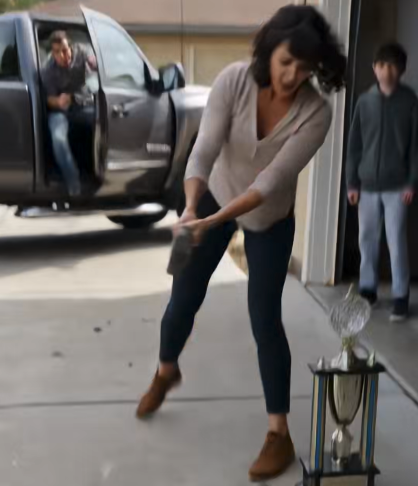
The first baseball trophy shattered louder than I expected.
The crack of metal splitting against concrete echoed across the driveway like a gunshot.
For one second, I just stood there gripping the hammer, staring at the broken gold figure rolling across the pavement with one arm missing.
Then I swung again.
Another trophy exploded.
And another.
Tiny brass nameplates scattered like shrapnel beneath my shoes.
“Mom…”
Ethan’s voice trembled behind me.
I looked toward the front door.
My fourteen-year-old son stood frozen beneath the porch light wearing an oversized hoodie despite the summer heat. His face looked pale, terrified—not of me, but of what this meant.
Because for the first time in years, someone was finally choosing him over his father.
I lifted another trophy.
“1989 State MVP.”
The engraved letters glinted in the afternoon sun.
Connor loved this one most.
He kept it above the fireplace.
Polished every Sunday.
Told the same stories about it at every family gathering like his glory days were scripture.
I brought the hammer down hard enough to snap the wooden base in half.
Ethan flinched at the sound.
But he didn’t look away.
And neither did I.
Because every shattered trophy felt like another lie dying.
Every crack in the metal sounded like all the excuses I’d made for my husband over the years finally breaking apart.
Connor had always been intense.
That’s what everyone called it.
“Competitive.”
“Passionate.”
“Hard on his kid because he wants him to succeed.”
Even I believed it.
God help me—I believed every word.
I remembered Ethan at seven years old gripping a baseball bat almost bigger than he was while Connor crouched behind him barking instructions.
“Again.”
Swing.
“Wrong.”
Swing.
“Too slow.”
Swing.
Ethan used to glance toward me after practices with those huge exhausted eyes like he wanted permission to stop.
But Connor always answered first.
“Champions don’t quit.”
And I let it continue.
Because Connor had been a baseball legend in our town once.
The kind of man strangers still recognized at gas stations.
People loved him.
Coaches adored him.
Parents envied him.
When Ethan made the middle school team, Connor acted like destiny itself had finally arrived.
At first it looked normal.
Extra batting practice.
Private coaching sessions.
Strict routines.
Then slowly, little things started changing.
Ethan stopped smiling.
Stopped eating dinner with us.
Started sleeping in hoodies even during heat waves.
Every time his team lost, Connor’s mood darkened for days.
And somehow, I kept missing what was right in front of me.
Until six nights ago.
The memory hit me so hard my grip tightened around the hammer.
I’d walked into Ethan’s room carrying laundry when he accidentally dropped his towel changing after practice.
Purple bruises covered his ribs.
Not one.
Not two.
Dozens.
Deep yellowing marks layered beneath newer ones.
Like someone had been beating him for years.
I remember the sound that came out of my mouth.
Not words.
Just horror.
Ethan immediately covered himself.
“It’s nothing.”
His voice cracked.
I grabbed his wrists gently. “Who did this?”
His eyes flooded instantly.
“No one.”
“Ethan.”
Silence.
Then his lips started trembling.
And finally—
“Dad says real athletes don’t cry.”
I felt my entire world stop spinning.
At first I thought I misunderstood him.
Then the rest came pouring out between sobs so violent he could barely breathe.
Punches after bad games.
Slaps after strikeouts.
Hours locked in the garage without food.
Connor forcing him to hold baseballs in outstretched hands until his arms collapsed from exhaustion.
“Pain builds discipline.”
That’s what Connor told him.
“Winners earn love.”
That one hurt worst.
Because Ethan believed it.
My son genuinely believed his father only loved him when he performed well.
I barely slept that night.
I sat beside Ethan’s bed until sunrise while he finally cried like a child again after years of swallowing everything.
And somewhere around four in the morning, something inside me changed forever.
By noon the next day, I’d already called the police.
By evening, I’d contacted a lawyer.
By midnight, I knew I was leaving Connor.
But the trophies…
The trophies felt personal.
Because those stupid pieces of metal had become symbols of everything Connor worshipped more than his own child.
Winning.
Image.
Legacy.
Strength.
The driveway was nearly covered in shattered plaques now when headlights suddenly turned into the street.
My stomach dropped.
Connor’s truck.
Hours early.
Beside me, Ethan stiffened.
Fear instantly flooded his face so fast it physically hurt to see.
That fear told me everything.
Children don’t react like that unless terror has become instinct.
Connor stepped out slowly.
For a moment, he simply stared.
Broken trophies littered the driveway like bodies after a war.
His expression shifted from confusion…
to disbelief…
to pure rage.
“What the hell did you do?”
His voice thundered across the yard.
I tightened my grip on the hammer.
“You don’t deserve them.”
Connor started toward me fast.
Then another vehicle rolled quietly behind his truck.
A police cruiser.
Connor stopped cold.
The color drained from his face.
Officer Ramirez stepped out slowly, hand resting near his belt.
“Connor Hale?”
Connor looked between us.
“What is this?”
I stepped forward before fear could stop me.
“You touched our son again.”
Connor’s eyes snapped toward Ethan standing in the doorway.
Instantly his voice changed.
Softened.
Manipulative.
“Buddy…”
Ethan shrank backward immediately.
That tiny movement made Officer Ramirez notice everything.
Connor saw it too.
Panic flickered across his face.
“You told her lies?” Connor asked Ethan sharply.
“No!” I shouted. “Don’t you dare—”
“I pushed him because he needs discipline!” Connor barked. “You think baseball is gentle?”
Officer Ramirez moved closer.
“Sir, I need you to calm down.”
Connor ignored him completely.
“He wants to play professionally someday!”
Ethan whispered something so quietly I almost missed it.
“I never wanted baseball.”
Silence.
Connor blinked.
“What?”
“I hate baseball.”
The words seemed to physically wound him.
For years, Connor had treated Ethan like an extension of himself.
Not a child.
A second chance.
A replacement for the dreams he lost decades ago.
And hearing Ethan reject baseball felt like hearing his entire identity rejected too.
Connor’s jaw tightened.
“You don’t mean that.”
“I do.”
“You’re just upset.”
“I hate it,” Ethan repeated, louder this time. “I hate all of it.”
Connor suddenly lunged forward.
Officer Ramirez intercepted him instantly.
“Sir!”
Connor shoved against him violently.
Everything exploded at once.
Another officer appeared from the cruiser.
Connor yelling.
Ethan crying.
Neighbors stepping outside.
Then handcuffs clicked around my husband’s wrists.
And the man who once looked invincible finally looked small.
But the worst part?
He looked at Ethan with betrayal instead of guilt.
Like he was the victim.
“You ruined this family,” Connor spat.
Ethan flinched.
I moved between them instantly.
“No,” I said quietly. “You did.”
Connor was arrested that night for felony child abuse.
And somehow, that was only the beginning.
The town turned against us almost immediately.
Because Connor Hale wasn’t just another father.
He was a local hero.
The Connor Hale.
State champion.
Former minor league prospect.
Little League coach.
Church donor.
The guy who shook hands with mayors and signed baseballs for kids.
People didn’t want to believe men like that could hurt their children.
So instead—
they blamed Ethan.
At the grocery store, women whispered when we passed.
Online comments exploded beneath local news articles.
“Kids today are soft.”
“Parents can’t discipline anymore.”
“Sounds exaggerated.”
I stopped reading after someone called Ethan “weak.”
Weak.
A fourteen-year-old boy who survived years of abuse while carrying the crushing weight of disappointing his father every single day.
Connor made bail after four days.
The restraining order kept him away physically.
But emotionally?
He still haunted our lives.
Ethan stopped sleeping.
Every creak in the house made him panic.
Every truck that passed outside sent him running to the windows.
One night I found him sitting in the bathroom at 3 a.m. hugging his knees.
“I think maybe it’s my fault,” he whispered.
That sentence nearly destroyed me.
I knelt in front of him.
“Listen to me very carefully. None of this is your fault.”
“But if I was better at baseball—”
“No.”
I grabbed his face gently.
“You never had to earn love.”
He burst into tears again.
Children believe what they survive.
Connor had taught him pain was affection.
Performance was worth.
Failure deserved punishment.
Undoing that damage felt impossible some days.
But slowly…
tiny things began changing.
Ethan started drawing again.
I hadn’t realized how much he loved art because Connor mocked it constantly.
“Drawing won’t make you a man.”
Now sketchbooks started appearing everywhere.
Kitchen table.
Bedroom floor.
Porch swing.
Mostly charcoal drawings.
Dark ones at first.
Broken bats.
Storm clouds.
Faceless men.
But over time, lighter things appeared too.
Birds.
Mountains.
Hands reaching toward sunlight.
Healing looked strange sometimes.
Three months after Connor’s arrest, the court case began.
I thought I was prepared.
I wasn’t.
Because Connor came into that courtroom wearing the exact same charming smile that once made everyone adore him.
And people still did.
Even the jury seemed captivated initially.
Connor testified calmly.
Carefully.
He admitted to being “strict.”
Demanding.
Intense.
But never abusive.
“He bruised during training drills,” Connor explained smoothly. “Baseball is physical.”
Then he looked directly at Ethan.
“I pushed him because I believed in him.”
God, he sounded convincing.
I watched jurors nod slightly.
My stomach twisted with panic.
Then the defense attorney called their final witness.
Coach Daniels.
Connor’s longtime best friend.
My heart sank.
Daniels had coached with Connor for years.
If he defended him, this case could collapse.
Daniels walked to the stand slowly.
Avoided Connor’s eyes completely.
That was the first sign something was wrong.
The prosecutor asked quietly, “Did you ever witness concerning behavior between Connor Hale and his son?”
Long silence.
Then Daniels inhaled shakily.
“Yes.”
Connor’s entire body stiffened.
Daniels swallowed hard.
“I saw Connor hit Ethan after games.”
The courtroom went silent.
“Multiple times.”
Connor exploded instantly.
“You lying son of a bitch!”
The judge slammed the gavel.
But Daniels kept talking.
Voice shaking.
“I should’ve reported it years ago.”
He looked toward Ethan with tears in his eyes.
“I’m sorry.”
Then came the real bombshell.
Daniels revealed Connor had abused other players too.
Not physically like Ethan.
But psychologically.
Humiliation.
Screaming.
Threats.
Control.
Several former players testified afterward.
One admitted he quit baseball entirely after developing panic attacks from Connor’s coaching.
Another confessed he’d considered suicide at sixteen because Connor convinced him failure made him worthless.
The image of Connor Hale began cracking publicly for the first time.
But the final twist came from somewhere none of us expected.
Connor himself.
Because during cross examination, the prosecutor asked one simple question.
“Mr. Hale, why was winning so important to you?”
Connor laughed bitterly.
“You wouldn’t understand.”
“Help us understand.”
And suddenly…
Connor stopped performing.
The charm vanished.
The mask slipped.
For the first time in decades, I saw the terrified boy hiding underneath the monster he became.
“My father used to beat me with baseball bats,” Connor whispered.
The courtroom froze.
Connor stared at his hands.
“He said losing meant weakness.”
His voice sounded distant now.
“He locked me outside during winters after bad games.”
Ethan stared at him in shock.
Connor continued numbly.
“When I got drafted at nineteen… he finally hugged me.”
Tears filled his eyes instantly.
“And then I blew out my shoulder.”
Everything clicked together horribly.
Connor hadn’t loved baseball.
He’d survived it.
And somewhere deep inside, he’d convinced himself brutality created strength because admitting otherwise meant admitting his entire childhood was abuse too.
The courtroom felt impossibly quiet.
Then Connor looked directly at Ethan.
And for the first time ever—
he truly saw him.
Not a replacement.
Not a failed athlete.
Just his son.
Broken by the exact same cycle.
Connor started crying.
Not dramatic tears.
Real ones.
Ugly ones.
“I did to him what was done to me.”
Ethan’s breathing became shaky beside me.
Connor covered his face.
“I swore I never would.”
Even the prosecutor looked rattled.
Because monsters are easier to hate when they aren’t human.
But trauma passes through generations like poison unless someone stops it.
And somehow…
my terrified fourteen-year-old son had become the one person brave enough to end it.
Connor accepted a plea deal two weeks later.
Mandatory prison time.
Court-ordered psychiatric treatment.
Permanent removal from youth coaching.
Most people expected Ethan to celebrate.
He didn’t.
One evening after sentencing, I found him sitting quietly on the porch sketching.
“You okay?”
He nodded slowly.
Then asked something that stunned me.
“Do you think Dad was ever happy?”
I sat beside him.
“I don’t know.”
Ethan stared toward the sunset.
“I think maybe he was scared all the time.”
That was Ethan.
Even after everything, his heart still searched for understanding.
Not excuses.
Understanding.
There’s a difference.
The next year changed our lives completely.
Therapy helped.
Slowly.
Painfully.
Ethan stopped apologizing for existing.
Stopped flinching when adults raised their voices.
Started laughing again.
Real laughter.
The kind that filled entire rooms.
And his art…
God.
His art became extraordinary.
At fifteen, he won a statewide student competition for a charcoal piece titled Inheritance.
It showed two hands passing down a cracked baseball bat wrapped in barbed wire.
But beneath it, another pair of hands was breaking the wire apart.
People stood silently in front of it for minutes.
One gallery owner cried.
Another offered to sponsor private art classes.
For the first time in his life, Ethan looked proud of himself for something his father hadn’t chosen.
That mattered more than anything.
Then, almost two years after Connor’s arrest, something happened none of us expected.
A letter arrived.
Prison stationery.
Connor’s handwriting.
Ethan stared at it for nearly ten minutes before opening it.
I told him he didn’t have to read it.
But he did.
Silently.
Slowly.
Then he handed it to me.
The letter wasn’t asking for forgiveness.
That surprised me most.
Instead, Connor wrote page after page admitting things he’d never admitted aloud.
About his father.
About the abuse.
About how terrified he’d always been of becoming irrelevant after baseball ended.
“I thought if Ethan became great,” he wrote, “then maybe my suffering meant something.”
My chest tightened reading that.
But the final paragraph broke me completely.
“You destroyed my trophies,” Connor wrote to me. “At first I hated you for it. Then I realized those trophies were the chains I kept worshipping. You didn’t destroy my life that day. You destroyed the lie.”
Ethan read that sentence three times.
Then quietly folded the letter away.
He didn’t respond.
Not then.
Maybe not ever.
Healing doesn’t always mean reconciliation.
Sometimes healing just means the bleeding stops.
Another year passed.
Then another.
Ethan turned seventeen.
Tall.
Confident.
Still quiet, but no longer afraid of taking up space.
One October evening, I stood inside a downtown art gallery surrounded by people admiring Ethan’s first official exhibition.
Reporters wandered between paintings.
Collectors whispered prices.
One massive canvas dominated the center wall.
A shattered baseball trophy melting into a field of wildflowers.
The title nearly made me cry.
What Grows After.
Ethan stood nearby speaking nervously with visitors when someone entered the gallery behind us.
Connor.
My pulse jumped instantly.
He looked older.
Softer somehow.
Years of therapy and prison had stripped away the arrogance he once wore like armor.
He froze when he saw Ethan’s artwork.
Especially the trophy painting.
For a long moment, nobody moved.
Then Ethan walked toward him.
I held my breath.
Connor looked terrified.
“I can leave,” he said immediately.
Ethan shook his head.
Silence stretched between them painfully.
Then Connor noticed a small framed sketch near the entrance.
A little boy holding a baseball bat while standing beside his mother.
Above them, sunlight breaking through storm clouds.
Connor stared at the signature date.
It was drawn years earlier.
Before everything collapsed.
“He still loved you then,” I said quietly beside him.
Connor closed his eyes.
Pain washed across his face so intensely it looked physical.
“I know.”
When he opened them again, tears were already falling.
“I don’t deserve this second chance.”
“No,” Ethan said honestly. “You don’t.”
Connor nodded slowly like he expected that answer.
Then Ethan continued.
“But I’m tired of carrying hate.”
Connor looked shattered by those words.
Ethan inhaled carefully.
“I forgive you.”
Not because Connor earned it.
Not because prison erased anything.
But because Ethan deserved freedom more than revenge.
And sometimes forgiveness isn’t mercy for the person who hurt you.
Sometimes it’s finally setting yourself down after carrying something unbearable for too long.
Connor broke down completely.
Not dramatic.
Not cinematic.
Just a broken man crying quietly in front of the son he almost destroyed.
Later that night, after the gallery emptied, Ethan and I stood alone beneath the giant trophy painting.
“You know what’s weird?” he said softly.
“What?”
He smiled faintly.
“I don’t hate baseball anymore.”
I laughed through tears.
“You don’t?”
He shook his head.
“I think I just hated what it became.”
Then he glanced toward the painting.
“But broken things can become something else.”
Outside, rain began falling gently across the city.
And for the first time in years—
it sounded peaceful.
