Part 2: The Signature That Made The Donor Freeze
Audrey’s father did not blink.
That was what scared me most.
The entire ballroom inside the Lake Como villa had gone breathless, but Lord Henry Kensington stood beneath the chandelier with his champagne glass still raised, staring at the bottom of the design file like the ink had reached up and grabbed his throat.
The coordinator, Elise Varga, held the folder open beneath the stage lights.
“Sir,” she said carefully, “this is the original submission form.”
Cold soup dripped from my sleeve onto the red carpet.
I could smell onion cream, white wine, and humiliation.
Audrey stood three steps away, her diamond necklace glittering against her throat. “That proves nothing,” she snapped. “Anyone can scribble a name.”
Elise did not look at her.
She looked at me.
“Amara Morgan submitted the centerpiece concept six weeks ago,” she said into the microphone. “The glass-and-candle design being unveiled tonight was built from her sketches.”
A wave of whispers moved through the donors.
My hands curled at my sides.
I wanted to say something, but my voice was trapped behind the shame in my chest. Everyone was staring at the stain spreading across my borrowed dress. Everyone had seen Audrey throw the soup. Everyone had seen me cry.
Then Elise turned the page.
A second signature appeared beneath mine.
Lord Henry’s.
The room shifted.
Not loudly. Not dramatically. But I felt it. A tiny collapse in the air, like people had just realized the scandal was not between two girls.
It had teeth.
Elise’s voice sharpened. “Lord Kensington personally approved the original design after Miss Morgan’s presentation.”
Audrey’s face drained of color.
Her father lowered the glass.
“You told me,” he said slowly, looking at Audrey, “that the girl withdrew her design.”
Audrey’s lips parted.
For the first time that night, she looked seventeen instead of untouchable.
“I fixed it,” she whispered.
The microphone caught every word.
Lord Henry’s eyes narrowed. “Fixed what?”
Audrey looked around, suddenly aware that every camera, every donor, every old-money smile in the room had turned into evidence.
Then someone from the back of the stage said, “She means the archive packet.”
A young man in a black waiter’s jacket stepped forward holding a silver tray.
On it sat a sealed envelope.
And across the front, in red ink, someone had written:
DO NOT OPEN UNLESS KENSINGTON DENIES THE SIGNATURE.
Part 3: The Waiter With The Locked Envelope
Audrey stared at the envelope like it was alive.
The waiter carried it with both hands, careful and steady, though his face was pale. He could not have been much older than twenty. His name tag read Matteo Ricci, and I remembered him from earlier.
He was the only person who had asked whether I needed water before the ceremony.
Elise took the envelope.
Lord Henry stepped forward. “Where did you get that?”
Matteo swallowed. “From Mrs. Moreau.”
A ripple passed through the older guests.
Audrey’s mother, Lady Celeste Kensington, rose so fast her chair scraped the marble.
“My aunt is unwell,” she said sharply. “She has no business interfering in foundation matters.”
From a side doorway, a thin elderly woman appeared in a black velvet shawl.
The room parted for her before anyone told it to.
She walked with a silver cane, but her eyes were bright and furious. Every pearl around her neck looked less like jewelry and more like armor.
“I am eighty-three,” she said. “Not dead.”
A few nervous laughs flickered and vanished.
Lady Celeste stiffened. “Aunt Margot.”
Madame Margot Moreau ignored her and looked straight at Lord Henry.
“You signed that girl’s form because you recognized brilliance,” she said. “Then you let your daughter cover it because recognition was less convenient than inheritance.”
Lord Henry’s jaw tightened. “You do not know what happened.”
“No?” Margot lifted her cane and pointed at the envelope. “Open it.”
Audrey shook her head. “Papa, don’t.”
That word—Papa—was soft, scared, and childish.
For one second, I almost felt sorry for her.
Then I felt soup drying cold against my skin.
Elise broke the wax seal.
Inside were photocopies, emails, and one printed message chain. She handed the first page to Lord Henry, but Margot snapped, “No. Read it aloud. She was humiliated aloud.”
Elise’s mouth trembled.
Then she read.
“Move Amara Morgan’s file into rejected concepts. Re-label the final drawings under Audrey Kensington’s presentation folder.”
The room went dead.
Audrey whispered, “Stop.”
Elise continued.
“If anyone asks, say the original volunteer lacked polish and failed committee review.”
My knees weakened.
Lacked polish.
That was what they had called my secondhand dress, my quiet voice, my careful sketches, my entire body standing in a room that had already decided I was not expensive enough to matter.
Margot turned toward me.
“I am sorry, child.”
I could not answer.
Because Elise had reached the final page.
And her face changed.
“This one,” she said, “was not sent by Audrey.”
Lord Henry looked up.
Elise read the name.
“It was sent by Lady Celeste Kensington.”
Part 4: The Mother Behind The Stolen Design
Lady Celeste did not deny it.
That was how everyone knew.
She stood near the sponsor table with her hands folded over her emerald clutch, chin lifted, expression perfectly composed. Her daughter was unraveling beside her, but Lady Celeste looked as if she were watching rain threaten a garden party.
Audrey stared at her mother.
“Mama?”
Lady Celeste’s face barely moved. “Darling, do not make yourself look more foolish.”
The words struck harder than a slap.
Audrey flinched.
So did I.
Because suddenly I understood something awful. Audrey had been cruel, yes. She had thrown soup across my dress, blocked the cameras, and tried to shove me out of my own moment.
But someone had taught her that cruelty was a family language.
Lord Henry’s voice dropped. “Celeste.”
She finally looked at him. “You would have ruined us for sentiment.”
“Sentiment?” Margot’s cane struck the floor. “The girl created the centerpiece.”
“She is a volunteer,” Lady Celeste said. “Audrey is a Kensington.”
A low gasp moved through the room.
Lady Celeste turned, cold and glittering. “Do not pretend you are shocked. Every person here understands how patronage works. Names carry events. Names bring press. Names bring money.”
My chest burned.
I took one step forward before I knew I was moving.
“My name was good enough when you wanted my work,” I said.
The microphone was still on.
My voice, small but steady, filled the ballroom.
Lady Celeste looked at me as though furniture had spoken.
Audrey’s eyes filled with tears, but she did not defend me. She wiped her face angrily, like crying embarrassed her more than stealing did.
Then Matteo stepped forward again.
“There is something else.”
Lady Celeste snapped, “You are staff.”
Matteo’s face went red, but he did not retreat. “Yes. And staff see what people hide.”
He pulled a phone from his jacket pocket.
Elise shook her head. “Matteo, be careful.”
“I already sent it to the foundation board,” he said.
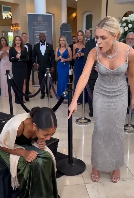
Lady Celeste went very still.
Matteo tapped the screen. His hand shook once, then steadied.
The ballroom speakers crackled.
A recording began.
Lady Celeste’s voice came through, soft and unmistakable.
“If the Morgan girl refuses to disappear, make the night unbearable enough that she leaves on her own.”
My breath stopped.
Then Audrey’s voice followed.
“What if she cries?”
Lady Celeste answered without hesitation.
“Then the cameras will know she was never suited for the room.”
Part 5: The Centerpiece They Could Not Light
No one spoke after the recording ended.
Even the orchestra had stopped pretending to tune.
The centerpiece stood beneath its silk cover at the center of the stage, tall and elegant, waiting for the ceremonial lighting that was supposed to make the Kensington family look generous in every morning newspaper across Europe.
Now the silk looked like a shroud.
Elise turned to me. “Amara, do you still want the ceremony to continue?”
Everyone stared.
The question terrified me.
If I said yes, I would have to walk up those steps in a stained dress, with soup in my hair and tears still drying on my face. If I said no, people would say I had destroyed the evening. They would lower their voices and call me dramatic. Difficult. Ungrateful.
Audrey looked at me with desperation and anger tangled together.
For once, she needed something from me.
I looked at the centerpiece.
My centerpiece.
I had drawn it late at night in the tiny apartment above my aunt’s flower shop in Marseille, using the back of old invoices because proper paper felt too precious. I had wanted it to look like candlelight caught inside rain. Something fragile, but not weak.
I lifted my chin.
“Yes,” I said. “But not under their name.”
A sound moved through the crowd—surprise, approval, fear.
Lord Henry closed his eyes.
Lady Celeste whispered, “This is blackmail.”
“No,” Margot said. “This is authorship.”
Elise nodded once. “Then the program will be corrected before the lighting.”
A stage assistant hurried to the printer table.
But just as she moved, a sharp crack rang out.
Everyone turned.
The silk cover trembled.
Another crack.
This one deeper.
Matteo rushed toward the stage, but I saw the problem before he reached it.
The support frame under the centerpiece had been altered. The central pole leaned a few degrees too far left, pulling the glass petals against one another. It was subtle enough for rich people to miss from champagne distance.
But I had built the original model with my own hands.
“That’s wrong,” I said.
Elise froze. “What is wrong?”
“The frame.”
Audrey’s face changed.
I saw it.
A flicker of guilt.
Lord Henry saw it too.
“What did you do?” he asked his daughter.
Audrey backed away. “I didn’t know it would break.”
The words punched the air from the room.
Lady Celeste shut her eyes.
I stepped toward the stage slowly.
Audrey whispered, “I only wanted it to look less like yours.”
Then the silk cover slipped.
And the first glass petal shattered against the marble.
Part 6: The Girl Who Chose To Save It
People scattered from the stage as the sound of breaking glass multiplied.
Not an explosion. Not chaos. Something worse.
A delicate, expensive failure.
Petal after petal slid from the upper frame, striking the floor in bright, ringing bursts. Guests pulled back their chairs. Someone cried out. A photographer dropped to one knee, still filming.
Elise shouted for everyone to move away.
But I ran forward.
Matteo caught my wrist. “Amara, don’t.”
“It’s going to collapse inward,” I said. “The candles are already wired.”
“The power is off.”
“No, only the stage lights. The ignition line is separate.”
His eyes widened.
I knew because I had asked about it during installation. The technician had laughed at me then, told me not to worry my pretty head, then left the diagram open on a worktable while I memorized everything.
Another glass piece fell.
Audrey stood near the bottom step, frozen.
“Move!” I shouted at her.
She did not.
Maybe guilt had pinned her there. Maybe fear. Maybe she had never imagined consequences could physically fall toward her.
I pushed past Matteo and grabbed the velvet rope from the aisle barrier. My hands burned as I looped it around the leaning support and pulled sideways, dragging the pressure away from the cracked glass crown.
“Elise!” I yelled. “The lower bracket!”
She understood instantly and ran to the opposite side.
Matteo joined me, wrapping both hands around the rope.
The structure groaned.
Audrey finally stumbled backward, but a falling shard clipped the floor near her shoe. She screamed and dropped to her knees, covering her head.
I should have hated her in that moment.
Part of me did.
But another part saw a girl whose mother had turned her into a weapon and then looked disappointed when the weapon shook.
“Under the table!” I shouted.
Audrey crawled behind the stage table.
Elise found the lower bracket and kicked the release latch with her heel. It stuck.
“Again!” I cried.
She kicked it harder.
The latch snapped open.
The whole centerpiece dropped six inches into its safety cradle.
Silence crashed down.
The glass stopped falling.
The room erupted into stunned applause, but I barely heard it. My palms were scraped. My dress was ruined. My body shook from head to toe.
Audrey crawled out from under the table, mascara streaking down her cheeks.
She looked at the saved centerpiece.
Then at me.
Her lips trembled.
“Why did you help me?”
Part 7: The Apology No One Expected
I wanted to give Audrey a noble answer.
I wanted to say something that would make the cameras love me, something clean and bright and impossible to twist.
But I was too tired to perform.
“Because I know what it feels like,” I said. “To stand in front of a room and have everyone decide what you are.”
Audrey’s face crumpled.
Not prettily. Not like a girl in a painting.
Like someone whose whole life had cracked open in public.
Lady Celeste moved toward her. “Stand up, Audrey. Immediately.”
Audrey looked at her mother.
For the first time all night, she did not obey.
“No.”
The word was small.
Then it grew.
“No,” Audrey said again, louder. “I am not standing beside you.”
Lady Celeste’s expression hardened. “Do not embarrass this family further.”
Audrey laughed through tears, a broken sound. “You taught me embarrassment was worse than cruelty.”
Lord Henry turned away as if the sentence had cut him.
Audrey faced the cameras. Her shoulders shook, but she did not hide.
“I stole Amara Morgan’s design,” she said.
Lady Celeste inhaled sharply.
Audrey continued.
“I let people believe it was mine. I let my mother remove her name. And I threw soup at her because I was afraid everyone would see that she had talent and I only had access.”
The room was utterly silent.
Audrey looked at me.
“I’m sorry,” she said. “Not because I got caught. Because you were right there, and I still treated you like you weren’t a person.”
I did not forgive her.
Not then.
Some apologies are doors. You do not have to walk through them the moment they open.
But I nodded once.
That was all I could give.
Margot Moreau stepped beside me and placed a warm hand on my shoulder.
“The foundation charter allows emergency replacement of the presenting sponsor in cases of public misconduct,” she announced.
Lady Celeste went pale.
Lord Henry whispered, “Margot.”
“No, Henry,” she said. “You built your reputation on generosity while letting your house feed on other people’s names.”
She looked toward the board table.
“All in favor of suspending Kensington family presentation rights pending formal review?”
One by one, hands rose.
Lady Celeste stared in disbelief as the room she had controlled quietly removed her power.
Then Margot turned to me.
“And all in favor of naming Miss Amara Morgan as the official artist of tonight’s centerpiece?”
Every hand in the room rose.
Except one.
Lady Celeste’s.
Then, slowly, Lord Henry raised his too.
Part 8: The Light That Carried Her Real Name
The corrected program card was still warm from the printer when Elise placed it in my hands.
My name sat at the center in gold letters.
Not hidden. Not taped over. Not spoken as an afterthought.
Centerpiece Artist: Amara Morgan.
For a moment, I could not move.
I thought of my aunt in Marseille, closing the flower shop late, telling me that rich rooms were not magic, only rooms where people had learned to sound certain. I thought of myself sketching candlelight on old invoices, afraid to make the lines too bold.
Now my name was bold enough for everyone to read.
The damaged centerpiece could not be lit in its original form, so Matteo and Elise helped me do what I had done all my life.
We made beauty from what was left.
We gathered the unbroken glass petals and arranged them across the long stage table. We placed candles between them in uneven rows, letting the cracks catch the flame. It was no longer a tower. It was a river of light.
More honest than the original.
More alive.
When the ballroom lights dimmed, no one looked at the Kensingtons.
They looked at the glass.
Elise handed me the taper.
My hands still hurt, but they were steady now.
I lit the first candle.
Then the second.
Then the third.
The flames traveled across the table, reflecting in every rescued shard until the stage looked as if someone had poured stars over the marble.
The applause began softly.
Then rose.
Not polite applause. Not donor applause.
Real applause.
Matteo smiled at me from the side of the stage. Margot wiped her eyes. Even Lord Henry bowed his head, not grandly, not for cameras, but like a man finally facing the cost of what he had allowed.
Audrey stood alone near the back.
She did not clap at first.
Then she did.
Slowly.
With both hands trembling.
Lady Celeste left before the ceremony ended.
No dramatic speech. No final insult. Just the quiet defeat of a woman who had mistaken control for dignity.
Weeks later, the foundation announced a new rule: no design, concept, or volunteer contribution could be presented without signed credit verification. Margot named it the Morgan Clause.
But the shock came after that.
Lord Henry resigned from the board and donated the Kensington villa—not money, not a plaque, not another empty apology.
The villa itself.
It became a free arts residence for young designers who could not afford rooms like that.
And the first studio, the one overlooking the lake, had my centerpiece rebuilt inside it.
Not the stolen version.
Mine.
Glass petals rising like rain caught in candlelight.
On opening day, Audrey came without cameras, without diamonds, and without her mother. She brought one thing: the original folder she had hidden.
“I found your first sketch,” she said.
I took it from her.
In the corner, beneath my careful pencil lines, was a note I had forgotten writing.
Make something fragile look impossible to break.
I looked through the studio window at the lake, at the light moving across the water, at the room full of young artists waiting for permission they no longer had to beg for.
Then I placed the sketch beneath the glass display with my name beside it.
And for the first time in my life, I did not feel lucky to be in the room.
The room was lucky to hold what I had survived.
