Part 2: The Signature That Turned The Room Cold
The coordinator’s finger stopped on the last line of the Efficiency Form.
For one breath, no one inside the glass-roofed engineering hall in Hamburg moved. The turbine model sat on the display table with one blade still trembling from the air vents overhead, and almond cake slid slowly down the front of my old cotton dress.
Olivia Sterling had gone pale.
Not embarrassed pale.
Afraid pale.
The coordinator, Frau Neumann, lifted the form closer to the stage lights. “This removal request was entered at 8:14 this morning.”
A teacher whispered, “Before registration opened.”
My heart was still thudding so loudly I could barely hear anything else. My skin felt sticky from the cake, my throat hurt from holding back tears, and the whole room smelled like sugar, metal polish, and expensive perfume.
Olivia recovered first.
“That is not what it looks like,” she said.
Frau Neumann looked at her. “Then explain it.”
Olivia’s father, Alaric Sterling, stood from the sponsor table with a smoothness that made several adults straighten automatically. He wore a charcoal suit, a silver tie, and the expression of a man used to doors opening before he touched them.
“I am sure this is an administrative misunderstanding,” he said. “No need to turn a student celebration into a courtroom.”
A few sponsors nodded too quickly.
I noticed that.
So did Frau Neumann.
She turned the form outward. “The request says Emilia Kraus’s name should be removed from the turbine repair discovery and replaced with Sterling Sustainable Systems.”
My knees almost gave.
Sterling Sustainable Systems.
Olivia’s family company.
The logo was everywhere: on banners, brochures, badges, the wall behind the stage. I had spent weeks repairing the turbine model under those banners, eating vending machine crackers for dinner while their slogan stared down at me: Innovation With Integrity.
Olivia’s mouth opened, but her father spoke over her.
“Our engineers provided the original framework.”
“No,” I said.
My voice was small, but it came out.
Everyone looked at me.
The cake on my dress suddenly felt heavier.
I wiped one hand against my denim jacket and stepped closer to the table. “Your engineers dropped off a broken model.”
A few students murmured.
I pointed at the turbine. “The torque shaft was misaligned. The old bearing was cracked. The efficiency readings were wrong because the blade pitch had been reversed.”
Olivia hissed, “Stop pretending you understand any of that.”
I looked at her, my cheek hot, my hands shaking.
“I understand it because I fixed it.”
The words landed harder than I expected.
Frau Neumann nodded once, then read the next line.
“The removal request was approved by—”
Alaric Sterling moved fast. “That document is private.”
Sirens did not sound. Nobody screamed. Nothing dramatic happened.
But two staff members stepped in front of him, and the whole room understood the same thing at once.
He had tried to stop the name.
Frau Neumann finished reading.
“Approved by Alaric Sterling, temporary sponsor liaison.”
Olivia stared at her father.
“Papa?” she whispered.
He did not look at her.
That was when I realized Olivia might have thrown the cake, but she was not the only one trying to erase me.
Part 3: Olivia’s Father Smiled Like A Warning
Alaric Sterling smiled.
That was worse than anger.
Anger would have meant he had lost control. His smile meant he was choosing his next lie carefully.
“Students misunderstand paperwork all the time,” he said. “Emilia is talented, certainly, but enthusiasm is not ownership.”
The word ownership made something sharp rise in my chest.
I had stayed after school until the janitors shut off the corridor lights. I had burned my fingers on the soldering pen. I had skipped two weekends because the turbine kept stalling at low speed. I had written every reading by hand because the tablet battery kept dying.
Enthusiasm?
Frau Neumann slid the Efficiency Form into a clear folder. “The discovery log includes Emilia’s measurements, repair notes, and three teacher confirmations.”
Alaric gave her a colder smile. “Teachers influenced by a touching scholarship story, perhaps.”
The room shifted.
There it was.
The thing Olivia had said with cake and cruelty, now dressed in a sponsor’s voice.
Poor girl. Pity case. Background labor.
My teacher, Herr Vogel, stepped forward from the second row. His face was red with anger.
“I signed because I watched her do the work.”
Alaric barely glanced at him. “And did you verify she did not copy Sterling materials?”
The accusation moved through the hall like a stain.
My breath caught.
Olivia looked at me, and for a second, I saw panic flicker behind her superior expression. Maybe she had not expected her father to go that far.
Then she hardened again.
“She was always alone with the model,” Olivia said. “Who knows what she took?”
The old shame rose automatically.
The kind that makes you want to prove you are harmless, neat, grateful, quiet.
I almost apologized.
For standing there.
For being accused.
For existing near something expensive.
Then I saw the turbine blade turn once under the overhead vent.
A small motion.
But mine.
I lifted my chin. “Open my notebook.”
Frau Neumann blinked. “Emilia?”
“My repair notebook. It is under the display table.”
Olivia’s eyes widened.
Alaric’s smile faded just a little.
Herr Vogel crouched and pulled out my battered black notebook. The cover was bent, stained with machine oil, and held together with blue tape. It looked ugly beside the polished sponsor brochures.
He handed it to Frau Neumann.
She opened the first page.
My handwriting filled the paper. Dates. sketches. failed readings. crossed-out guesses. new calculations. little notes to myself when I got stuck.
Frau Neumann turned page after page.
The hall watched in silence.
Then she stopped.
“What is this?” she asked softly.
I stepped closer.
It was a photograph I had taped inside the notebook weeks ago. A faded picture of a much older turbine prototype, smaller and rusted, sitting on a workshop bench in Graz.
“My grandfather’s,” I said. “He used to repair farm turbines in Austria.”
Alaric’s face changed.
Only for a second.
But I saw it.
So did Frau Neumann.
She looked from the photo to him. “You recognize this?”
Alaric adjusted his cuff. “Old machinery all looks the same.”
But Olivia whispered, “Papa, that is in our company archive.”
My stomach dropped.
Frau Neumann slowly turned the notebook toward the audience.
On the back of the photograph, in faded blue ink, was written:
Kraus blade-pitch concept, 1998. Do not release to Sterling.
Part 4: The Old Photograph Cut Deeper Than Cake
My grandfather’s name had never belonged in rooms like this.
At least, that was what I had always thought.
Oskar Kraus was a man in work boots and wool sweaters, a man who fixed machines in villages where people paid him with cash, pears, and sometimes nothing at all. He taught me how to listen to metal. He said every machine complained before it broke, if you respected it enough to hear.
He died when I was twelve.
I remembered his hands better than his face.
Scarred knuckles. Grease under his nails. One crooked finger from a workshop accident he joked about but never explained.
Now his old photograph lay open under stage lights, and Alaric Sterling looked like someone had pulled a thread from his perfectly tailored life.
Frau Neumann turned the page carefully. “Emilia, where did you get this photo?”
“My grandmother kept it in a biscuit tin,” I said. “She told me he was proud of that design, but nothing came of it.”
Alaric gave a short laugh. “Family legends are charming.”
Olivia looked at him sharply.
He continued, louder now. “This has nothing to do with today’s model. My company has decades of independent research.”
Frau Neumann did not answer him. She looked at the committee’s technical judge, a white-haired engineer named Herr Bader.
He took the notebook, adjusted his glasses, and leaned over the turbine model. For several agonizing minutes, he compared my sketches to the blade assembly.
The hall waited.
Olivia shifted from one heel to the other.
Cake dried against my dress.
My mother, sitting near the back after rushing from her shift at the hotel laundry, pressed both hands over her mouth. She had told me not to bring Grandfather’s photo because rich people hated being reminded that ordinary families had history too.
Herr Bader finally straightened.
“The blade-pitch correction Emilia made,” he said, “matches the geometry shown in the old Kraus photograph.”
A murmur broke out.
Alaric snapped, “That is speculative.”
Herr Bader lifted one hand. “No. It is measurable.”
Frau Neumann turned to the audience. “The restored efficiency increase was not a sponsor contribution. It was Emilia’s application of an older Kraus family concept.”
My eyes burned.
Grandfather.
You were here.
Olivia’s face folded with confusion. She looked at her father. “But our company presentation says Sterling developed that pitch correction.”
Alaric’s voice dropped. “Not now.”
She did not stop. “It is in the investor video. You said Great-Grandfather invented it.”
The room froze.
Alaric’s expression sharpened into a warning. “Olivia.”
But she was staring at him now, no longer at me.
“You said our family built everything from nothing.”
My mother stood.
She had been quiet all evening, almost invisible in her gray coat, but now her voice carried.
“Oskar Kraus worked for Sterling as a contract mechanic for six months.”
Alaric turned slowly.
My mother’s hands shook, but her voice did not.
“He came home with bruises on his wrist after refusing to sign away a workshop sketch.”
Alaric said, “Careful.”
My mother took one step forward.
“No,” she said. “You were careful. That was how you stole it.”
Part 5: The Contract They Hid In Berlin
Frau Neumann ordered the sponsor screens turned off.
One by one, the Sterling logos vanished from the walls.
It should have felt satisfying.
Instead, the blank screens looked like dark windows.
Alaric Sterling remained standing beside the sponsor table, but something had changed. He was no longer trying to charm the whole room. He was calculating which people still mattered.
“Accusations based on a dead mechanic’s photograph are beneath this event,” he said.
My mother flinched at dead mechanic.
I stepped in front of her before I realized I had moved.
“He had a name.”
Alaric looked down at me. “And so do many people who imagine they were wronged.”
Herr Bader closed my notebook carefully. “There may be a way to verify this.”
Alaric’s eyes moved to him.
Herr Bader continued. “The student archives in Berlin hold industrial education contracts from that period. If Oskar Kraus worked under Sterling supervision, there should be a record.”
Frau Neumann nodded to a staff member. “Access the digital archive.”
Alaric laughed. “During a ceremony?”
“During an attempted public theft of credit,” she replied.
The staff member opened a laptop at the judge’s table. The projector flickered, replacing the blank wall with an archive search page.
My hands went cold.
This was no longer just about me.
It was about my mother’s father. My grandmother’s biscuit tin. The way our family had learned to say nothing when powerful people got too close.
Olivia slowly walked away from her father and stood near the stage steps. Not beside me. Not with me.
But not beside him either.
The archive search loaded.
Oskar Kraus.
Sterling Industrial Trial Division.
Three results appeared.
Alaric’s jaw tightened.
The first was an employment record.
The second was a safety complaint.
The third was labeled: Disputed Efficiency Concept Transfer — Restricted Review Copy.
A committee member whispered, “Restricted?”
Herr Bader clicked it.
A password box appeared.
Alaric exhaled softly, almost relieved.
Then Herr Bader said, “I have senior engineering archive access.”
Alaric’s relief vanished.
The document opened.
At the top was a scanned contract with my grandfather’s signature. Below it was a typed clause transferring all experimental improvements to Sterling Industrial Trial Division.
But beside the clause, in handwritten German, was a note from Oskar.
I do not consent to transfer the blade-pitch design. It predates this contract.
My mother began to cry.
Herr Bader scrolled down.
There was another signature beneath a witness statement.
Not Oskar’s.
Not Alaric’s.
The witness was a young assistant engineer.
Matthias Sterling.
Olivia whispered, “My grandfather.”
The room turned toward her.
Alaric stepped forward. “Enough.”
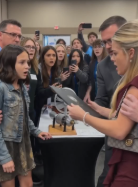
But Herr Bader kept reading.
“Witness confirms concept was demonstrated by Oskar Kraus before company assignment.”
The words blurred in my eyes.
Before company assignment.
Before Sterling.
Before their logo.
Before Olivia’s pearls and wine-red dress and the cake on my clothes.
Before all of it, my grandfather had been telling the truth.
Then the staff member gasped.
“There is an attached memo.”
Frau Neumann said, “Open it.”
Alaric shouted, “Do not.”
The memo appeared on the screen anyway.
It was short.
Cold.
Signed by Matthias Sterling.
Delay payment. Remove Kraus from demonstration materials. Rebrand concept after patent filing.
Olivia covered her mouth.
I looked at her father.
For the first time all evening, he had no smile left.
Part 6: Olivia Saw Her Crown Turn To Dust
Olivia backed away from the screen as if the words could reach down and mark her.
“No,” she said. “No, that cannot be real.”
Alaric turned to her, his voice low. “Stand with your family.”
She looked at him with wet, furious eyes. “Did you know?”
He did not answer.
That was enough.
The hall, once eager for drama, had become painfully still. Students who had laughed when cake hit me now stared at their shoes. Sponsors whispered into phones. Teachers clustered near the aisles, guarding the exits without looking like they were.
Frau Neumann faced Alaric. “Sterling Sustainable Systems will be removed from judging authority pending review.”
“You cannot remove the primary sponsor,” he said.
Herr Bader looked at the screen. “We can when the sponsor is implicated in falsifying student credit and historic design theft.”
Alaric’s gaze swept the room. “Do you understand the financial consequences?”
There it was again.
Money as a locked door.
Frau Neumann hesitated.
Not because she believed him.
Because everyone knew he was right. The event depended on sponsor funds. Student travel grants, lab equipment, next year’s energy challenge—all tied to Sterling money.
Alaric saw the hesitation and stepped into it.
“Cancel my family’s support,” he said, “and half these students lose their project funding by morning.”
The words hit the room harder than the evidence.
My anger faltered.
Because it was one thing to expose a thief.
It was another to watch other students pay for it.
Then Olivia spoke.
“Use my trust.”
Alaric turned slowly. “What did you say?”
Her hands trembled around her designer handbag. “Grandmother left me the education trust. It activates for engineering outreach if Sterling sponsorship is compromised.”
His face darkened. “That trust is not yours to throw away because you feel guilty.”
“I am not throwing it away.”
She looked at me, then at the cake still staining my dress.
“I am putting it where our family should have put it before.”
Alaric moved toward her. “Olivia.”
She stepped back, but she did not lower her head.
For the first time, the superior expression was gone. She looked frightened, ashamed, and painfully young.
“I did what you taught me,” she said. “I treated Emilia like a problem because she stood near credit we wanted.”
His voice turned icy. “You humiliated this family.”
“No.” Her voice cracked. “I copied it.”
The sentence opened something raw in the room.
Olivia turned to me.
“I threw the cake because I wanted cameras to record you as messy before anyone recorded you as brilliant.”
The honesty hurt.
Not because I needed it.
Because everyone else did.
“I wanted you erased,” she said. “And now I know that was not my idea. It was my inheritance.”
Alaric reached for her arm.
My mother shouted, “Do not touch her.”
Olivia pulled away herself.
Then she walked to the committee table and placed her designer handbag beside the Efficiency Form.
“My trust documents are in there,” she said. “Fund the students. Investigate my family. And put Emilia’s name on the turbine.”
Part 7: The Turbine Spun Under My Name
The lawyers did not arrive with flashing lights.
They arrived quietly, with tablets and gray coats, as if scandal had a schedule.
While they reviewed Olivia’s trust documents, Frau Neumann took me to a side room and gave me a clean black cardigan from the staff closet. I sat on a folding chair while my mother dabbed almond cream from my jacket with wet paper towels.
Her hands kept shaking.
“I should have stopped you from entering this competition,” she whispered.
I looked at her. “Then they would still have Grandfather’s idea.”
Her face crumpled.
“He died thinking no one believed him.”
I reached for her hand. “We believe him now.”
She pressed my fingers to her lips.
When we returned to the hall, everything had rearranged itself.
The sponsor banners were gone. The Sterling table stood empty except for abandoned champagne glasses. Alaric was speaking with two lawyers near the exit, his face controlled but gray.
Olivia sat alone in the front row.
No friends. No pearls of laughter. No royal circle.
Just a girl staring at the floor with red eyes.
Frau Neumann stepped onto the stage.
“The committee has verified emergency funding continuity for Energy Engineering Day,” she announced. “The student awards will proceed under independent oversight.”
A sound of relief moved through the students.
Then she turned toward the turbine model.
“The efficiency discovery will be recorded under the name Emilia Kraus, with historical reference to Oskar Kraus’s documented blade-pitch concept.”
My mother sobbed once.
The sound broke me more than applause ever could.
Herr Bader gestured for me to come forward.
My legs felt unsteady, but I walked.
This time, no one blocked me.
No one laughed.
No one looked at my shoes first.
I stood beside the turbine, black cardigan over my ruined dress, and placed my fingers on the small crank.
Herr Bader said gently, “Whenever you are ready.”
I thought of my grandfather telling me machines complained before they broke.
I thought of my mother carrying silence like a second coat.
I thought of Olivia throwing cake because she believed the spotlight was property.
Then I turned the crank.
The turbine blades began to spin.
Slowly at first.
Then faster.
The indicator light blinked, flickered, and glowed steady green.
The hall erupted.
Students cheered. Teachers clapped. Someone shouted my name from the back.
Not pity.
Not shock.
My name.
Olivia stood too.
She clapped once, then stopped, as if unsure she had the right.
I looked at her.
She lowered her hands.
I did not smile.
But I nodded.
That was all I could give.
And maybe all she deserved.
Then the projector behind me changed.
A staff member had uploaded the corrected file.
The title appeared huge across the screen:
Kraus Efficiency Recovery Model — Student Lead: Emilia Kraus
Under it was another line:
Original Blade-Pitch Concept: Oskar Kraus
My mother covered her mouth.
But Herr Bader frowned at the screen.
“There is one more archive attachment,” he said.
Frau Neumann looked startled. “Another?”
He opened it.
A scanned letter appeared, written in my grandfather’s hand.
The first line made my mother stop breathing.
For my granddaughter, if the machine ever finds her.
Part 8: The Letter Made The Victory Ours
No one spoke while Herr Bader printed the letter.
The turbine still spun softly beside me, its little green light glowing like a held breath. My mother gripped my arm so tightly I could feel every finger.
Herr Bader brought the page to us with both hands.
“I think,” he said, voice rough, “this belongs to your family.”
My mother took it, but she could not read. Her tears kept falling onto the paper, and she laughed once, embarrassed and broken.
So I read it aloud.
Not to the room at first.
To her.
My grandfather’s words were careful and plain. He wrote that machines were easier to fix than people, because machines did not pretend the broken part was pride. He wrote that if his blade idea ever surfaced again, he hoped it would help someone young build without fear. Then he wrote that he had placed a copy in the archive because truth needed more than memory.
My voice cracked near the end.
If my granddaughter ever touches this work, do not tell her she is lucky. Tell her she listened well.
My mother bent over the letter and cried into both hands.
The applause that followed was softer than before.
Deeper.
Even the students seemed to understand this was not just an award anymore. It was a message arriving late, but not too late.
Frau Neumann returned to the microphone.
“Effective immediately, the top student engineering grant will be renamed the Oskar Kraus Listening Well Award.”
My mother looked up, stunned.
Herr Bader nodded. “Sponsored by the independent education trust, not Sterling Sustainable Systems.”
Olivia stood from the front row. Her face was blotchy from crying, her elegant hair coming loose at one side.
“I will sign whatever is needed,” she said. “And I will give testimony about what my father told me to do.”
Alaric, still near the exit, turned sharply. “Olivia, you are finished if you do this.”
She looked at him.
This time, she did not flinch.
“No,” she said. “I was finished when I thought being your daughter mattered more than being honest.”
He left without another word.
Months later, investigators confirmed what the archive had already shown. Sterling’s company had built years of branding around a concept taken from Oskar Kraus, then tried to steal my student repair the same way. Their sponsorship contracts were suspended across Europe. Alaric Sterling resigned before the hearings ended.
Olivia testified.
She lost friends, invitations, and the kind of easy approval she had once worn like jewelry. She sent me an apology letter with no perfume, no dramatic excuses, and no request for friendship.
I kept it in a drawer.
Not because forgiveness had arrived.
Because truth had.
One year later, Energy Engineering Day moved to Graz, into a restored railway workshop with brick walls, high windows, and old machines displayed like witnesses. My grandmother came in a wheelchair, wrapped in a green scarf, holding the biscuit tin on her lap.
Inside it were more photographs.
More sketches.
More proof that Oskar Kraus had been more than a footnote in someone else’s company story.
When they called my name for the first Oskar Kraus Listening Well Award, I did not walk to the stage alone. I pushed my grandmother’s chair, and my mother walked beside us.
The turbine model waited under a glass case, polished now but still mine in all the ways that mattered.
Beside it was the Efficiency Form, open to the page where my name had almost been removed.
People took pictures of that page.
Not because it was beautiful.
Because it was evidence.
After the ceremony, my grandmother touched the glass and whispered something in German I had heard my grandfather say a hundred times.
My mother translated through tears.
“She says the machine found you.”
I looked at the little turbine, at the blade angle my grandfather had protected, at the green light glowing steady beneath my name.
Then I thought of the girl I had been that night, covered in almond cake, shaking under sponsor logos, believing one clean moment had been stolen forever.
I wished I could tell her what came next.
That humiliation was not the end of the story.
That records could outlive lies.
That quiet work could become thunder when the right page opened.
I placed my hand against the glass beside my grandmother’s.
And for the first time, I did not feel like I had borrowed a place in the room.
I felt like my family had been waiting there all along.
