Part 2: The Screen That Made Scarlett Step Back
The principal did not press play right away.
That was the worst part.
He simply stood there with one hand on the laptop, his face stiff, while the projector threw a pale rectangle across the history fair backdrop. The whole room smelled like cider, damp cardboard, old costume fabric, and the sticky drink still sliding from my cheek onto the collar of my hoodie.
Scarlett Monroe’s smile stayed in place for three seconds too long.
Then it began to crack.
“Mr. Adler,” she said, and her voice had gone bright and careful, like glass held too tightly. “I really think this is being blown out of proportion.”
Nobody answered her.
I bent down to pick up the folder I had dropped, but my fingers slipped on the wet cover. Before I could try again, a boy from my history group, Lukas Meyer, crouched beside me and lifted it gently.
“You had this the whole time?” he whispered.
I nodded once.
Scarlett saw that tiny movement. Her eyes darted from me to Lukas to the screen.
“Don’t touch her things,” Scarlett snapped. “She’s been hiding evidence all day.”
My stomach pulled tight, but I forced myself to stand. My sleeves were soaked. My face still burned. Everyone was waiting for me to either cry or explode.
I did neither.
Mr. Adler clicked once.
The first image appeared: the shared planning document for the reenactment fair.
At the top was the title everyone had seen for weeks: “Living History Fair: Student Roles, Safety Notes, And Artifact Handling.”
At the side was the edit history.
My name appeared again and again beside safety corrections, privacy notes, and reminders that younger students’ personal information should not be printed on display cards. Then, lower down, in red highlights, Scarlett’s account appeared.
A deleted sentence came up.
“Remove note about Emilia’s medical accommodation; do not display private information.”
Under it, another edit.
Scarlett Monroe had deleted my warning.
The silence changed shape.
Someone near the costumes whispered, “That’s messed up.”
Scarlett lifted her chin. “That could have been anyone using my laptop.”
Mr. Adler clicked again.
The next entry showed a comment I had left the night before: “This violates privacy rules. Emilia never agreed to this being displayed.”
Then Scarlett’s reply appeared below it, restored from the history.
“Stop acting like you own the fair, Sienna.”
My throat tightened.
Across the room, Emilia Laurent stood frozen beside the medieval medicine display. She was thirteen, one of the younger students who had helped paint signs after school. Her eyes were huge, and both hands were clasped around the ribbon of her costume apron.
Scarlett had not just tried to make me look dramatic.
She had tried to expose Emilia’s private information because it made her display look more “authentic.”
Mr. Adler turned toward Scarlett. “Explain this.”
Scarlett’s red jacket seemed suddenly too bright. “I didn’t mean it like that.”
“You threw a drink in Sienna’s face,” Lukas said, his voice shaking. “Because she stopped you from embarrassing Emilia?”
Scarlett glared at him. “Stay out of it.”
Then Emilia spoke.
Her voice was tiny, but the room was so quiet it carried.
“She asked me yesterday if people would feel sorry for me if they knew.”
Scarlett went white.
I looked at Emilia, and something inside me broke open. Not in weakness. In rage.
“You promised me you removed it,” I said to Scarlett.
Scarlett’s mouth twisted. “You always make yourself the hero.”
“No,” I said, wiping my cheek with my sleeve. “I was trying to keep you from making a child into a decoration.”
A few students gasped.
Scarlett turned toward the doors as if she could leave and take the truth with her.
But the vice principal, Mrs. Moreau, had already stepped in front of them with her phone in her hand.
And on her screen was a message thread Scarlett had forgotten existed.
Part 3: The Message Scarlett Forgot To Delete
Mrs. Moreau did not raise her voice. That made it worse.
“Scarlett,” she said, “your mother just sent me something very interesting.”
Scarlett’s expression flickered so fast I almost missed it. Fear. Then calculation. Then anger.
“My mother?” she said. “Why would she message you?”
Mrs. Moreau looked down at her phone. “Because she saw a parent livestream.”
A horrible ripple moved through the room.
The phones that had been lifted halfway earlier were not frozen anymore. Some students lowered them quickly, like they had suddenly realized this was not entertainment. Others stared at their screens, faces pale, watching the comments climb beneath the fair livestream.
Scarlett’s hand twitched toward her pocket.
“Don’t,” Mr. Adler said.
She stopped.
Mrs. Moreau turned the phone slightly, not showing the whole room, only the principal. His jaw tightened as he read.
I felt dizzy.
Lukas moved closer, not touching me, just standing at my shoulder like a wall I had not known I needed.
“What is it?” I asked.
Mrs. Moreau’s eyes softened when they met mine. “It appears Scarlett sent her mother a screenshot last night.”
Scarlett laughed once. It sounded wrong. “So?”
“A screenshot of the display card before Sienna corrected it,” Mrs. Moreau said.
Emilia made a small sound and covered her mouth.
Scarlett stepped forward. “My mother helps with school events. That’s not illegal.”
“No,” Mr. Adler said. “But the caption beneath it is a problem.”
Mrs. Moreau read it aloud.
“If Baptiste keeps blocking me, I’ll make sure everyone thinks she ruined the fair herself.”
The words landed like a slammed door.
My knees nearly gave out.
I had known Scarlett wanted me blamed. I had felt it in every smirk, every whispered comment, every time she looked at my clothes like they proved I was disposable. But seeing the plan in her own words made the room tilt.
Scarlett’s face sharpened. “That was private.”
“So was Emilia’s information,” I said.
She spun toward me. “You think you’re better than everyone because you act poor and noble?”
Something in the room snapped.
Lukas said, “What is wrong with you?”
Another student, Clara Weiss, stepped forward from the costume table. “Sienna stayed late three nights fixing our labels.”
“She brought extra glue when the budget ran out,” Matteo Fischer added.
“She rewrote my speech so I wouldn’t get laughed at,” Emilia whispered.
Each sentence was small, but together they became something Scarlett could not swat away.
Scarlett’s eyes shone now, but not with regret. With fury.
“You’re all enjoying this,” she said. “You hated me before.”
“No,” I said. “We were scared of you.”
Her lips parted.
That truth frightened her more than the edit history.
Mrs. Moreau tucked the phone away. “The fair is paused. Scarlett, you will come with us.”
Scarlett stepped backward. “I’m not leaving while she gets to stand there like some victim.”
I looked down at my hoodie, stained and sticky. At my shaking hands. At the folder Lukas still held.
Then I looked back at her.
“I am not standing here like a victim. I am standing here because you missed.”
The room went dead still.
Scarlett’s face changed. For one second, she looked younger than eighteen. Trapped. Cornered. Almost human.
Then her eyes cut toward the prop table.
Before anyone could stop her, she grabbed the old leather-bound reenactment ledger, the one full of signed student role sheets and parent permissions.
“No!” Mr. Adler shouted.
Scarlett ran.
And this time, the entire room moved after her.
Part 4: The Ledger She Tried To Destroy
Scarlett’s polished shoes slipped on the hallway tiles, but she kept running.
The ledger was clutched against her red jacket like a stolen crown.
I followed without thinking. My sneakers squeaked. My soaked hoodie slapped cold against my skin. Behind me, I heard teachers calling for students to stay inside, heard Lukas shout my name, heard the fair dissolve into chairs scraping and nervous whispers.
Scarlett pushed through the side door into the courtyard.
Cold air hit my wet face so sharply I gasped.
The school campus opened around us: stone paths, old brick walls, gray morning sky pressing low over the rooftops. The reenactment tents flapped in the wind. Paper banners twisted from their strings. Somewhere beyond the courtyard, traffic hummed like the rest of the city had no idea my whole life was being dragged across wet pavement.
Scarlett reached the fountain.
She lifted the ledger.
“Scarlett!” I shouted. “Don’t.”
She turned, breathing hard. Her hair had come loose around her face. “This is what you wanted, isn’t it? Everyone chasing me. Everyone staring.”
“You took the permissions,” I said. “Those are not yours.”
Her fingers tightened around the book. “None of this was supposed to happen.”
“For who?” I asked. “You?”
Her face crumpled for half a second, then hardened. “You don’t understand what it’s like.”
I almost laughed because my face still stung from what she had thrown at me.
“You’re right,” I said. “I don’t understand having power and using it to hurt younger students.”
She looked toward the fountain water.
Lukas burst through the door behind me, followed by Mr. Adler and Mrs. Moreau.
“Put it down,” Mr. Adler said.
Scarlett’s hand trembled.
Then she opened the ledger.
Pages fluttered wildly. Student names, signatures, scene assignments, emergency contacts. Proof of who had agreed to what. Proof of who had responsibility.
Scarlett tore out one page.
The sound was small and awful.
Emilia’s permission form floated to the wet ground.
Mrs. Moreau inhaled sharply. “Scarlett, stop now.”
Scarlett looked at the page in her hand like she had expected it to save her and found only paper.
“My mother said the fair had to look perfect,” she whispered.
No one moved.
“She said donors were coming. She said the school needed families like ours. She said if my scene looked weak, people would laugh.” Scarlett’s eyes flashed toward me. “Then Sienna kept correcting everything.”
My voice came out hoarse. “Because it was wrong.”
Scarlett shook her head. “Because you could afford to be right.”
That sentence struck harder than I expected.
Behind me, Lukas muttered, “What does that even mean?”
Scarlett laughed bitterly. “It means when she breaks a rule, everyone calls it survival. When I make one mistake, I become a monster.”
I stared at her.
“One mistake?” I said. “You tried to expose Emilia. You planned to blame me. You threw a drink at me in front of everyone. You stole the ledger.”
Her jaw worked, but nothing came out.
Then Mrs. Moreau’s phone rang.
She glanced at the screen and went still.
“Mr. Adler,” she said quietly. “It’s the archive office.”
The principal took the call on speaker.
A woman’s voice crackled through the courtyard.
“We checked the cloud backup. There’s more. Scarlett Monroe did not create the controversial display card.”
Scarlett froze.
The woman continued.
“The first version came from an adult account.”
Mrs. Moreau looked slowly at Scarlett.
Scarlett whispered, “No.”
The woman on the phone said the name anyway.
“It was uploaded by Elise Monroe.”
Part 5: The Mother Behind The Perfect Display
Scarlett dropped the torn page.
For the first time all day, she looked truly afraid.
Not afraid of punishment. Not afraid of gossip. Afraid because something bigger than her had stepped into the light, and everyone could see its shape.
“My mother didn’t mean—” she started.
Mr. Adler ended the call and lowered the phone. “Scarlett, did your mother create the card with Emilia’s private information?”
Scarlett’s mouth opened, but she seemed unable to choose a lie fast enough.
Mrs. Moreau bent down and picked up the torn page from the wet stones. Her hands were careful, almost tender. “This can be repaired,” she said, though I could tell she was not only talking about the paper.
I looked at Scarlett.
Her eyes were shining now. She was still angry, but the anger had nowhere to stand.
“She said it would make the scene meaningful,” Scarlett whispered.
Emilia’s face crumpled.
I took one step forward. “Meaningful for who?”
Scarlett flinched.
The courtyard door opened again. This time, it was not a student or teacher.
A woman in a cream coat strode out, holding her phone as if it were a weapon. She had Scarlett’s same sharp cheekbones, the same controlled posture, the same expression that made apology look beneath her.
Elise Monroe.
“Scarlett,” she said, “come here.”
Scarlett did not move.
Elise’s eyes swept over the courtyard: the torn page, the principal, the teachers, me in my stained hoodie.
Then she smiled.
It was worse than shouting.
“I’m sure this has become very dramatic,” she said. “But these children are emotional. The fair is important for the school’s public image.”
Mrs. Moreau’s voice chilled. “A child’s private information was nearly displayed.”
Elise waved one hand. “It was educational context.”
Emilia stepped behind Clara.
Something hot climbed up my throat.
“No,” I said.
Elise looked at me like she had just noticed a stain on a curtain. “Excuse me?”
I wiped the last sticky streak from my jaw. My hands were still shaking, but my voice did not.
“Emilia is not educational context.”
Elise’s smile thinned. “You must be Sienna.”
I said nothing.
She stepped closer. “I’ve heard a great deal about you. Always correcting. Always inserting yourself. Some students mistake attention for leadership.”
Scarlett stared at her mother, and I saw the moment she understood. Elise was not defending her. Elise was using her.
Mr. Adler spoke firmly. “Mrs. Monroe, the edit history shows your account created the display text. It also shows Scarlett deleted Sienna’s correction and planned to blame her.”
Elise’s eyes flickered. Only once.
Then she said, “Teenagers exaggerate.”
Scarlett’s voice cracked. “Mum.”
The word came out small, not like the queen of the rich crowd, but like a girl begging someone to stop before there was nothing left to save.
Elise did not even look at her.
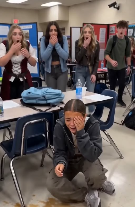
She looked at the principal. “I think you should consider the school’s relationship with my family before making this formal.”
There it was.
The threat.
The courtyard seemed to shrink around us.
Then Lukas stepped forward, holding up his phone.
“You may want to consider the livestream first,” he said.
Elise turned.
Through the glass doors behind us, students were pressed together, watching.
Lukas swallowed hard but did not lower the phone.
“Everyone heard that.”
Part 6: The Apology That Broke The Wrong Person
Elise Monroe’s face did not change immediately.
That was how I knew she was dangerous.
Some people panic when exposed. Elise became quieter. Sharper. She looked past Lukas, through the glass, at the students inside. Then at the security camera above the courtyard door. Then at Scarlett.
Only then did she understand there was no private room left to control.
“Turn that off,” she said.
Lukas held the phone tighter. “No.”
Mr. Adler stepped between them. “Lukas, lower it. We have enough.”
Lukas hesitated, then lowered the phone but did not stop recording. I noticed. So did Elise.
Scarlett stood beside the fountain, breathing unevenly. The red jacket that had made her look untouchable now made her look like a warning flag.
Elise turned to her daughter. “Apologize.”
Scarlett blinked. “What?”
“Apologize to the girl.” Elise’s voice was smooth. “Say this was a misunderstanding caused by stress.”
My skin went cold.
Even now, she was writing the script.
Scarlett looked at me. For a second, our eyes met, and I expected the usual hatred. But what I saw was worse. Shame. Not clean shame. The kind that had been taught to hide under polish and cruelty until it had nowhere to go.
“I…” Scarlett began.
Elise’s eyes narrowed. “Properly.”
Scarlett’s mouth trembled.
“I’m sorry,” she said.
The words sounded empty, but not because she did not feel anything. Because they were not hers.
Elise gave a satisfied nod. “There. Now we can all calm down.”
“No,” Scarlett whispered.
Her mother turned slowly.
Scarlett looked at her, and something fierce and terrified moved across her face.
“I said no.”
The courtyard held its breath.
Elise’s expression hardened. “Scarlett.”
“No,” Scarlett said again, louder. “I’m not saying it was stress.”
My fingers curled into my sleeves.
Scarlett faced me, and this time her voice broke in the middle.
“I threw the drink because I wanted them to laugh at you before they believed you. I deleted your warning because I hated that you were right. I took the ledger because I thought if the papers disappeared, maybe I could still say you lied.”
No one moved.
Then Scarlett looked at Emilia.
“And I let my mother use your private information because I wanted my display to win.”
Emilia’s eyes filled with tears, but she stood still.
Scarlett swallowed. “I am sorry because I did it. Not because I got caught.”
The words hit harder than the first apology ever could have.
Elise’s face went pale with fury.
“You ungrateful little fool,” she whispered.
Scarlett flinched as if slapped, though Elise had not touched her.
That was when I understood something I hated understanding.
Scarlett had learned humiliation at home before she ever used it at school.
Mrs. Moreau stepped forward. “Mrs. Monroe, that is enough.”
Elise ignored her. “You have no idea what you just cost this family.”
Scarlett’s voice was barely audible. “Maybe that’s the problem.”
Elise lifted her hand—not to strike, but to point, to command, to reclaim.
Before she could speak, Emilia stepped out from behind Clara.
She held a small memory card in her palm.
“Sienna told me to keep this safe yesterday,” Emilia said.
Scarlett stared at it.
Elise’s face emptied.
And I realized the edit history had never been the final proof.
Part 7: The Card Hidden Inside The Apron
Emilia’s hand was shaking so badly that Clara put an arm around her shoulders.
The memory card looked impossibly small against her palm. Tiny. Black. Ordinary. Yet Elise Monroe stared at it like it was a lit match beside gasoline.
“What is that?” Mr. Adler asked.
I answered before Emilia had to.
“The backup footage from the costume room camera.”
Lukas looked at me. “You had footage?”
“I didn’t know what was on it,” I said. “Not fully.”
That was the truth. Yesterday afternoon, when I found the private information printed on Emilia’s display draft, I had gone to the costume room to look for Mrs. Moreau. Instead, I had seen Elise Monroe standing by the printer with Scarlett beside her. I heard Emilia’s name. I heard the words “sympathy” and “donors.” I panicked and took the loose memory card from the camera dock because I was afraid the footage would disappear before an adult checked it.
Then I gave it to Emilia.
Because it was her story being stolen.
Elise’s voice sharpened. “That is school property.”
Mrs. Moreau held out her hand gently. “Emilia.”
Emilia looked at me first.
I nodded.
She placed the card in Mrs. Moreau’s palm.
Scarlett suddenly sat down on the edge of the fountain like her legs had stopped working.
Her mother looked at her with disgust. “Stand up.”
Scarlett did not.
The room inside had begun to empty into the courtyard despite teachers trying to hold students back. No one wanted to miss the end of the thing they had helped ignore.
Mrs. Moreau inserted the card into the laptop Mr. Adler had carried out.
The screen flickered.
The footage appeared grainy and colorless, angled from high in the costume room. There was Elise in her cream coat. Scarlett beside her. The printer glowing in the corner.
Elise’s recorded voice came through thin but clear.
“Use the girl’s condition. People donate when they feel something.”
A small cry escaped Emilia.
My chest hurt.
Scarlett on the video shifted uncomfortably. “Mum, she’s younger than us.”
Elise replied, “Then she is useful.”
In the courtyard, Scarlett covered her face.
The footage continued.
My own figure entered the doorway on the recording. I remembered standing there, frozen.
On screen, I said, “You can’t display that.”
Elise turned. “And who exactly gave you authority?”
Then Scarlett stepped between us.
For one strange second, it looked like she might defend me.
Instead, she said, “I’ll handle her.”
The video cut there.
No one spoke.
Elise Monroe’s power did not shatter loudly. It drained out of her in silence.
Mr. Adler closed the laptop. “Mrs. Monroe, you are no longer permitted to participate in school events. The board will receive this footage today.”
Elise’s eyes flashed. “You will regret humiliating me.”
“No,” Scarlett said from the fountain.
Everyone turned.
Scarlett lowered her hands. Her mascara had smudged, and her perfect expression was gone.
“She won’t,” Scarlett said. “Because I’m going to tell them everything else.”
Elise went still.
I felt my breath catch.
Scarlett looked at me, then at Emilia, then at the school behind us.
“My mother didn’t only write the card,” she said. “She paid someone to make Sienna’s scholarship file disappear.”
Part 8: The Name Scarlett Could Not Erase
For a moment, the courtyard made no sound at all.
Not the banners. Not the students. Not even the fountain.
I stared at Scarlett because the words had reached me, but they had not opened yet.
“My what?” I asked.
Scarlett looked sick.
Elise moved fast. “That is a lie.”
But she moved too fast.
Everyone saw it.
Mrs. Moreau’s face changed. “Scarlett, continue.”
Scarlett’s hands twisted together. “Last month, Sienna’s name was supposed to be sent to the regional student heritage program in Vienna. The one with the summer archive placement.”
I knew that program.
I had applied in secret.
I had written the essay after midnight for five nights, sitting at the kitchen table with the cheap lamp buzzing above me. I had never told most people because wanting something too openly made it easier for them to laugh when you did not get it.
“I didn’t get shortlisted,” I said slowly.
Scarlett’s eyes filled. “You did.”
The courtyard blurred.
Lukas whispered, “Sienna…”
Scarlett looked down. “My mother found out because she helped sponsor the fair. She said it would look better if a Monroe student represented the school. She asked an office assistant to delay your file until after the deadline.”
Mr. Adler turned to Elise. “Is this true?”
Elise’s silence answered first.
Then she lifted her chin. “Applications are misplaced all the time.”
Mrs. Moreau was already typing on her phone. “Not anymore.”
Elise laughed coldly. “You think anyone in Vienna will care about a schoolgirl’s complaint?”
A voice from behind the glass doors said, “They already do.”
A man stepped into the courtyard.
He was older, with silver hair and a dark wool coat, and he carried a visitor badge clipped neatly to his lapel. I recognized him from the fair brochure. Dr. Henrik Bauer, the regional archive coordinator, invited to judge the historical displays.
He had seen everything.
Elise’s face went blank.
Dr. Bauer looked at me, not her. “Miss Baptiste, your essay was the strongest submission we received from this school.”
My eyes stung so hard I had to blink.
He continued, “When your file failed to arrive officially, one of your teachers sent a copy separately because she suspected interference.”
Mrs. Moreau gave me a tiny, tearful smile.
I turned to her. “You?”
She nodded. “You earned the chance to be seen.”
Dr. Bauer stepped closer. “The committee reviewed it this morning. We came today intending to ask why your school had withdrawn you.”
My breath shook.
“I didn’t withdraw,” I said.
“I know,” he replied. “And now so does everyone else.”
Elise Monroe looked smaller than she had when she arrived.
Scarlett stood. “I’ll give a statement.”
Her mother snapped, “You will do no such thing.”
Scarlett’s voice trembled, but she did not step back. “I already did.”
She held up her phone.
A message had been sent.
To the school board. To Dr. Bauer. To Mrs. Moreau.
Attached were screenshots, emails, and the name of the assistant Elise had pressured.
Elise stared at her daughter as if seeing a stranger.
Scarlett looked at me. “It doesn’t fix what I did.”
“No,” I said.
She nodded, accepting it.
“But it changes what you do next,” I added.
Her face crumpled.
Two weeks later, the history fair reopened in a smaller hall in Lyon, where the regional program had invited our school to present the corrected exhibits. Emilia’s display was about medieval remedies, not her private life. Her name card said only what she wanted it to say.
Scarlett was not onstage. She was at the back, sorting labels quietly under Mrs. Moreau’s supervision, no red jacket, no polished throne of friends around her.
When my name was called for the Vienna archive placement, I looked first at Emilia, then Lukas, then Mrs. Moreau.
Scarlett did not clap loudly.
She simply stood, eyes wet, and placed one repaired page from the ledger on the table in front of me.
Across the top, in careful handwriting, she had written:
“Sienna Baptiste protected the truth before anyone rewarded her for it.”
I carried that page with me to Vienna, not because Scarlett deserved forgiveness, but because I deserved proof that the truth had survived every hand that tried to tear it apart.
