Part 2: The Screen That Made Audrey Stop Breathing
The principal’s hand hovered over the laptop, and Audrey Sinclair’s smile disappeared so fast it felt like someone had switched off the lights inside her.
The fire station classroom smelled like rubber hoses, metal lockers, dust, and the faint smoke clinging to old gear. Everyone had been laughing ten minutes ago. Everyone had been pretending this was just another field trip where rich kids got front-row spots and quiet kids carried the paperwork.
Now nobody laughed.
Mr. Granger, our teacher, stood between Audrey and me with one arm slightly raised, like he was afraid she might slap me again if he blinked. My cheek still stung. I could feel the heat spreading under my skin, but I refused to touch it. I would not give Audrey the satisfaction of seeing my hand shake against my own face.
On the floor between us lay the inspection card I had tried to protect.
Audrey pointed at it and said, “She stole that. She was trying to make our group look bad.”
Her voice came out polished, practiced, almost bored.
But her fingers were clenched around the strap of her white leather bag so tightly her knuckles looked pale.
The principal, Mrs. Hartley, did not answer right away. She clicked the trackpad once. The projector blinked.
A frozen frame appeared on the screen.
It showed the equipment table near the engine bay. It showed the emergency demonstration tags arranged in rows. It showed Audrey’s friends crowded around the red safety kit, laughing while the firefighter guide answered questions outside the frame.
And there I was in the corner of the image, holding a clipboard, looking small, serious, and completely unaware that anyone was recording.
Audrey whispered, “That clip doesn’t prove anything.”
Mrs. Hartley turned her head slowly. “Then you will not mind if we watch it.”
The clip started.
On the screen, Audrey’s friend Clara picked up a red tag marked RESTRICTED DEMO EQUIPMENT — DO NOT REMOVE. She held it like a joke. Another girl slipped a small pressure valve into her blazer pocket while the others blocked the view with their bodies.
My stomach twisted.
I remembered that moment now. I had only seen the empty slot afterward. I had only known that if the firefighters started the demonstration without checking the safety board, one of the younger students would be standing near equipment that had not been cleared.
On the screen, I stepped forward.
My recorded voice sounded thinner than I expected. “Please put that back. It’s part of the safety kit.”
Clara rolled her eyes. “Relax, Farah.”
Audrey stepped into the frame then.
Not angry yet.
Smiling.
She looked at the stolen valve, looked at the clipboard in my hands, and said softly, “Nobody has to know unless you make it ugly.”
The room shifted around me. Someone sucked in a breath.
Audrey snapped, “That’s edited.”
The firefighter captain, Captain Lewis, who had been silent until then, folded his arms. “It came from our station security system.”
The clip continued.
Audrey reached for my clipboard.
I pulled it back.
She smiled wider.
Then she said the sentence that made every adult in the room go still.
“If you write our names down, I’ll make everyone think you tampered with the kit.”
I felt my throat close.
Because there it was.
The thing I had tried to explain while my cheek burned and everyone stared at me like I was the problem.
There it was, bigger than me, brighter than Audrey’s money, louder than her slap.
The truth.
Part 3: The Lie Audrey Had Prepared Before Morning
Audrey moved before anyone expected it.
She lunged toward the laptop.
Captain Lewis caught her wrist before her fingers touched the keyboard. He did not grab hard. He did not need to. Audrey froze like she had hit a wall.
“Do not touch station property,” he said.
Her eyes flashed. “My father funds this school’s career program.”
Mrs. Hartley’s face changed at that. Not fear. Not surprise. Something colder.
“Then your father will receive a full report,” she said.
Audrey’s friends began stepping backward, one by one, creating space around her as if the shame were contagious. Clara looked at the floor. Elise covered her mouth. Someone near the back whispered, “She planned it.”
I looked down at the inspection card on the floor.
The edge was bent where it had hit the tile. My name was written in the corner because I had volunteered to check the student groups before the demonstration. Not because I wanted attention. Not because I wanted power. Because the firefighter guiding us had asked for someone responsible, and nobody else wanted the boring job.
Audrey had known that.
She had seen the clipboard in my hands and realized I was the one piece she could not control.
Mrs. Hartley replayed the last ten seconds.
This time the whole room heard more clearly.
“If you write our names down, I’ll make everyone think you tampered with the kit.”
Audrey’s face hardened. “Farah has always wanted people to feel sorry for her. She brings her own supplies like it’s some performance.”
The words hit differently than the slap.
A few students looked at me, then away, ashamed because they had heard versions of that before and never stopped it.
Mr. Granger finally spoke. His voice was rough. “Audrey, enough.”
“No,” Audrey said sharply. “She shouldn’t even have been in charge of the checklist.”
Captain Lewis walked to the equipment table and opened a small plastic evidence pouch. Inside was the pressure valve.
Clara gasped.
He placed it beside the laptop.
“This was found in the restroom trash after Miss Sinclair asked to leave the room,” he said.
Audrey went white.
I stared at the pouch.
The room tilted for a second, not from fear, but from the sudden understanding that Audrey had not only slapped me because she panicked.
She had already built the lie before she touched me.
Mrs. Hartley clicked another file open.
A second image appeared.
It was a photo of a printed anonymous complaint.
My name was typed in bold.
The accusation said I had removed safety equipment to embarrass Audrey’s group.
The timestamp on the complaint was 8:12 a.m.
We had not even arrived at the fire station until 10:03.
Part 4: The Complaint Sent Before The Crime
For several seconds, nobody spoke.
The projector hummed. Somewhere behind the classroom wall, a fire engine radio crackled. Outside the glass doors, younger students from another school walked past in matching jackets, unaware that my entire life at school was changing inside that room.
Mrs. Hartley looked at the anonymous complaint on the screen, then at Audrey.
“This was sent before the field trip began,” she said.
Audrey’s mouth opened, but no words came out.
I remembered 8:12 a.m.
I had been on the school bus, sitting alone near the front because Audrey’s group had filled the back seats with their bags so nobody else could join them. I remembered checking my scarf in the dark window reflection. I remembered telling myself to get through the day quietly.
While I was doing that, Audrey had already been preparing my punishment.
Mr. Granger rubbed both hands over his face. “Audrey… why?”
She looked at him like he had betrayed her by asking.
“Because people like her always get praised for doing the bare minimum,” she said.
The sentence landed with a sick softness.
I almost laughed, but it came out as one broken breath.
“The bare minimum?” I said.
Everyone turned toward me.
My voice shook, but I kept going. “I packed the consent forms when your group left them in homeroom. I reminded Clara about her inhaler because she forgot it last week during drills. I checked the equipment because Captain Lewis asked for help. I did the boring things you were too important to notice.”
Audrey’s eyes narrowed. “Don’t make this a speech.”
“No,” I said, surprising myself. “You don’t get to slap me and then decide how quietly I bleed.”
The room went silent again.
Mrs. Hartley stepped closer to me, not touching, but near enough that I no longer felt alone.
Captain Lewis lifted another folder. “There is one more matter.”
Audrey’s head snapped toward him.
He opened the folder and removed a student emergency roster.
“This station requires accurate medical notes for visiting groups,” he said. “One of Audrey’s group members had a severe allergy listed. The safety tag attached to that student’s helmet was removed.”
Clara began crying.
Audrey turned on her. “Don’t.”
Clara whispered, “I told you it wasn’t funny.”
Captain Lewis’s jaw tightened.
My hands went cold.
The missing tag had not just been about a demonstration kit. It had not just been about Audrey’s pride.
Someone could have been hurt because Audrey wanted the photos to look cleaner.
Mrs. Hartley closed the laptop halfway.
“Audrey,” she said, “who told you to remove that tag?”
Audrey stared at the floor.
Then Clara whispered something that made Audrey’s whole body stiffen.
“Her mother.”
Part 5: The Mother Behind The Perfect Smile
Audrey slapped Clara before anyone could stop her.
Not hard enough to knock her down, but enough that the sound cracked through the room like a dropped plate.
Captain Lewis moved instantly, stepping between them. Mrs. Hartley ordered Audrey to sit. Mr. Granger told Clara to come to the other side of the room.
Audrey screamed, “She’s lying!”
But the scream did not sound powerful anymore.
It sounded frightened.
Clara pressed one hand to her cheek and sobbed, “Your mum said the allergy tag ruined the photos. She said donors don’t like weakness in promotional material.”
The words were so ugly that for a moment I did not understand them.
Then I remembered Audrey posing near the fire engine before the tour began. White leather blazer. Perfect hair. Her clique angled around her like background decorations. Clara had been told to take off the bright medical tag clipped to her helmet because it looked “messy.”
I had found it under the bench later.
I had clipped it back on.
That was when Audrey first saw me with the checklist.
That was when everything started.
Mrs. Hartley’s lips pressed into a thin line. “Call Mrs. Sinclair.”
Audrey’s face sharpened. “You can’t.”
“I can,” Mrs. Hartley said. “And I will.”
Twenty minutes later, Audrey’s mother arrived at the station in a camel-colored coat, walking like the building belonged to her. Mrs. Vivienne Sinclair was beautiful in a way that looked expensive and exhausting. Her perfume reached us before she did.
She did not look at Audrey first.
She looked at the projector. Then the evidence pouch. Then me.
Her eyes flicked over my clothes, my scarf, my practical shoes, the red mark still fading on my cheek.
“I assume this has been blown out of proportion,” she said.
Captain Lewis did not move. “A student removed medical safety identification and attempted to hide restricted equipment.”
Mrs. Sinclair smiled politely. “Teenagers make foolish choices.”
Mrs. Hartley opened the laptop again. “A complaint was filed before the alleged incident occurred.”
The smile faded.
Mrs. Sinclair looked at Audrey.
Audrey looked away.
That tiny movement told me everything.
Mrs. Sinclair had not just influenced Audrey.
She had taught her.
Mrs. Hartley said, “Did you advise students to remove visible safety tags for photographs?”
Mrs. Sinclair’s expression turned smooth again. “I advised presentation standards. This school benefits greatly from my family’s donations.”
Captain Lewis placed one hand on the table.
“Madam,” he said, “this is a fire station, not a ballroom.”
For the first time all day, Audrey looked smaller than me.
Part 6: The Girl Audrey Chose To Sacrifice
Mrs. Sinclair asked to speak privately.
Mrs. Hartley refused.
That refusal changed the room.
Audrey’s mother blinked once, slowly, as if she had not heard the word no in years. “Principal Hartley, I am trying to protect the school.”
“No,” Mrs. Hartley said. “You are trying to protect your daughter from consequences.”
Audrey stood so suddenly her chair scraped backward. “I didn’t know Clara’s allergy was serious.”
Clara lifted her head. Her eyes were red. “You watched me use my emergency pen last year.”
Audrey looked trapped.
“I forgot.”
“No,” Clara said, and her voice broke. “You remembered when you joked that I should stand at the back because the tag made me look defective.”
That word made my stomach twist.
Defective.
The same kind of word Audrey used without touching anyone, but still leaving marks.
Mrs. Sinclair stepped toward Clara. “Young lady, be careful.”
Captain Lewis moved between them. “Do not intimidate a minor in my station.”
Mrs. Sinclair’s cheeks flushed.
Audrey suddenly turned toward me.
“This is your fault,” she said. “None of this would have happened if you had just stayed out of it.”
I looked at her. Really looked.
The polished boots. The expensive blazer. The perfect white outfit that had seemed untouchable an hour before. Now there was a tiny smear of black dust near her cuff from when Captain Lewis stopped her from reaching the laptop.
She was not untouchable.
She was just protected.
Until now.
“My fault?” I asked softly. “Because I put the tag back?”
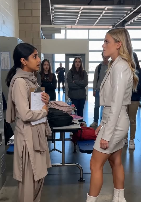
Audrey’s eyes filled with angry tears. “Because you always act like being good makes you better than us.”
I shook my head. “No. I act like rules matter when people can get hurt.”
Captain Lewis nodded once, almost to himself.
Mrs. Hartley turned to him. “Is there any official consequence from the station?”
He looked at Audrey, then at Mrs. Sinclair. “The school can handle discipline. But the station will file an incident report. We cannot host future visits unless student safety is guaranteed.”
Mrs. Sinclair inhaled sharply.
That was the first thing that truly scared her.
Not the slap. Not the lie. Not Clara’s tears.
The public record.
Then the door opened.
A firefighter entered holding a tablet.
“Captain,” he said, “we found another clip. From the engine bay.”
Audrey whispered, “No.”
Captain Lewis took the tablet.
He watched for five seconds.
Then his eyes lifted to Mrs. Sinclair.
“This one has audio of you.”
Part 7: The Recording Audrey’s Mother Could Not Buy
Mrs. Sinclair reached for her phone.
Mrs. Hartley said, “Do not call anyone until we finish.”
“This is harassment,” Mrs. Sinclair snapped.
Captain Lewis connected the tablet to the projector.
Audrey sat down like her knees had given out.
The new clip showed the engine bay before the tour. Students clustered near the fire engine while Mrs. Sinclair stood beside Audrey, adjusting the collar of her white blazer.
Her voice came through clearly.
“Move Clara behind you. The medical tag is distracting.”
Audrey’s recorded voice said, “Farah keeps checking everything.”
Mrs. Sinclair laughed lightly. “Then give her something to check. Girls like that love feeling useful.”
The room became so still I could hear Clara crying under her breath.
On-screen, Audrey glanced toward me.
Mrs. Sinclair continued, “If she causes trouble, make it look like she wanted attention. People believe that story easily.”
My chest tightened.
I had spent years trying not to be too loud, too needy, too visible, too invisible. Years carrying my own supplies so nobody could say I asked for too much. Years helping behind the scenes because it felt safer than wanting the spotlight.
And this woman had turned all of that into a weapon before I even knew I was in danger.
Audrey whispered, “Mum, stop it.”
But the recording did not stop.
Mrs. Sinclair’s voice came again.
“The complaint is already scheduled. By the time anyone asks questions, she’ll be defending herself.”
Mrs. Hartley’s face went pale with anger.
Mr. Granger stared at Audrey like he was seeing a stranger wearing a student’s face.
Captain Lewis paused the video.
Mrs. Sinclair said nothing.
Audrey began to cry, but it was not the kind of crying that asks forgiveness. It was the kind that arrives when a locked door finally opens and all the hidden mess spills out.
Mrs. Hartley turned to me. “Farah, I am sorry.”
Those four words almost broke me.
Not because they fixed anything.
Because no adult at school had ever said them to me that directly.
Audrey stood. Her voice shook. “I didn’t send the complaint.”
Everyone looked at her.
Mrs. Sinclair said sharply, “Audrey.”
But Audrey kept talking.
“I didn’t send it,” she said again. “I knew about it, but I didn’t send it.”
Mrs. Hartley asked, “Who did?”
Audrey looked at her mother.
Then at me.
Then at the screen.
“My mother used my school login,” she whispered.
Mrs. Sinclair’s perfect face finally cracked.
Part 8: The Apology That Was Not For Forgiveness
The school board meeting happened three days later in a municipal hall in Lisbon, because our school’s European exchange program office was based there and the incident had become bigger than one campus, one field trip, or one slap.
I sat in the second row with Clara on one side and Mr. Granger on the other. Captain Lewis had flown in to testify by video. Mrs. Hartley brought printed records, timestamps, station reports, and the complaint that had been scheduled before the trip began.
Audrey sat across the aisle from me.
No white leather. No polished smile.
Just a plain navy sweater, red eyes, and hands folded so tightly they trembled.
Mrs. Sinclair arrived with a lawyer.
She expected money to turn the room soft.
It did not.
The board chair read the findings in a steady voice. Safety interference. False complaint. Misuse of student login. Attempted intimidation. Physical assault by Audrey. Physical assault against Clara. Donor misconduct.
Then came the consequence.
Audrey would be suspended, removed from leadership privileges, required to complete restorative safety service, and barred from representing the school publicly for the year.
Mrs. Sinclair would be removed from all school committees.
Her family donation would be returned.
That last part made the room gasp.
Mrs. Sinclair stood. “You cannot afford that.”
The board chair looked at her calmly.
“We cannot afford you.”
For the first time, I saw Audrey flinch at her mother instead of at the consequences.
After the meeting, I walked outside into the cold evening air. The city lights blurred against the river. My cheek had stopped hurting, but something deeper still ached.
Audrey found me near the stone steps.
Clara stiffened beside me.
Audrey did not come too close.
“I’m not asking you to forgive me,” she said.
Good, I thought.
Because I was not ready.
Audrey swallowed. “I wanted you to disappear because you saw things clearly. My mother always told me people respect power. But you protected Clara when nobody was clapping for you.”
She reached into her bag and pulled out the original safety checklist.
The one I thought had been lost.
Its corner was bent. My handwriting covered the page. At the bottom, beneath my notes, Audrey had written something new.
Farah Aziz prevented a safety violation during the field trip. I lied because I was afraid of being exposed.
She handed it to Mrs. Hartley, not me.
That surprised me.
She was not trying to buy forgiveness from the person she hurt.
She was correcting the record where the damage began.
Months later, when the fire station reopened visits, Captain Lewis asked me to return—not as the girl with the clipboard, but as the student speaker for the safety program Clara helped design.
Audrey came too, assigned to stack chairs in the back.
She did not smile at me.
I did not smile at her.
But when a younger student dropped her medical tag and began to panic, Audrey picked it up, clipped it carefully back onto the girl’s jacket, and stepped away without waiting for praise.
That was when I understood the real ending was not Audrey being destroyed.
It was the record becoming stronger than the lie, and me finally becoming louder than the shame.
