Part 2: The Deleted Name Lit Up The Screen
The cursor blinked over the deleted entry like it was waiting for Sloane Sterling to confess.
Nobody moved.
The slap still burned across my cheek, but the room had shifted so violently that I almost forgot the pain. A minute earlier, people had been looking at me like I was a problem dragged in from the wrong street. Now every camera in the exhibition hall had turned toward the giant screen, where my name sat inside the archive log beside a red deletion mark.
NADIA STEWART — REMOVED BY ADMIN ACCESS.
The project lead, Étienne Morel, held the microphone with one hand and gripped the laptop stand with the other. His face had gone hard in a way I had never seen during the long weeks of testing, sewing, labeling, and saving damaged fragrance sachets from disaster.
“Open the access trail,” he said.
The technician hesitated. “In front of everyone?”
Étienne did not blink. “Especially in front of everyone.”
Sloane’s father, Conrad Sterling, stepped into the aisle. His silver hair was perfect, his suit expensive, his expression torn between fury and fear. “Étienne, this can be reviewed privately.”
“No,” Étienne said. “Your daughter made it public when she struck a student in front of press.”
A murmur ran through the audience. The church ladies in the front row whispered behind gloved hands. The news crews adjusted their cameras. Somewhere near the sweet tea table, a glass clinked against a saucer.
Sloane folded her arms, but her fingers trembled against the satin sleeves of her blazer.
The screen changed.
A list of log-ins appeared.
One account had opened the archive at 6:12 that morning, changed the presentation order, removed my name from the ceremonial lead role, and replaced it with Sloane Sterling.
The admin username was not hidden.
STERLING_S_PRIVATE.
Sloane’s face went white.
“That is not mine,” she said quickly.
Étienne looked at her. “Then whose is it?”
She swallowed. “Anyone could have used it.”
The technician clicked again.
A security still appeared beside the log. Sloane stood alone at the archive desk before sunrise, one hand on the keyboard, the other holding a coffee cup with her initials printed in gold.
The whole room inhaled.
Conrad’s chair scraped again as he stepped forward.
“Sloane,” he said, voice low, “tell me that is not what it looks like.”
She stared at the screen, trapped between the proof and the audience that had once obeyed her smile.
Then she turned on me.
“You don’t understand what you did,” she hissed. “You were never supposed to touch the master files.”
My knees weakened.
Étienne’s head snapped toward her.
“What master files?”
Sloane pressed her lips together, but it was too late.
The technician, pale now, pointed at a hidden folder blooming open at the bottom of the archive.
STERLING FOUNDATION — ORIGINAL FORMULA RIGHTS.
And underneath it was a document with my mother’s name.
Part 3: The Formula Had My Mother’s Signature
My mother’s name looked impossible on that screen.
Elena Stewart.
Not typed in some modern database. Not copied from a student registration form. It was written in scanned ink, dark and slanted, at the bottom of an old laboratory sheet dated seventeen years earlier in Grasse, France.
I heard myself breathe, but it sounded far away.
“My mother was a cleaner,” I whispered.
Étienne turned slowly. “Nadia, did she ever work in fragrance development?”
I shook my head because that was what I had always been told. My mother had scrubbed guest rooms, folded laundry, carried other people’s perfume on her sleeves when she came home tired from hotel shifts. She had known scents the way poor people know luxuries—by cleaning up after them.
Conrad Sterling stared at the document like it had risen from a grave.
Sloane saw his face and panicked.
“Dad,” she said, “don’t.”
That single word cracked the room open.
Conrad did not look at her. “Where did this file come from?”
The technician’s voice shook. “It was attached to the seam restoration log. Nadia’s overnight upload reopened the damaged archive chain. I think the system linked it automatically.”
I gripped the edge of the stage table.
The damaged seams. That was all I had fixed. A display panel had ripped during transport, and the scent pouches stitched into its fabric had leaked oil onto the inner lining. Everyone else had gone home. I had stayed until after midnight resewing the cloth, photographing each repair, and uploading proof because I was afraid somebody would blame me if anything failed.
I had thought I was protecting myself from another accusation.
I had accidentally opened a buried past.
Étienne clicked the document larger.
At the top was a project title: VEIL OF ORANGE BLOSSOM — ORIGINAL BLEND TRIAL.
Below it were three names.
Elena Stewart.
Conrad Sterling.
Margot Delacroix.
The last name made an elderly woman in the second row drop her handbag.
I turned.
She was small, elegant, with a navy hat pinned over silver hair. Her hands shook as she bent for the bag, but she never took her eyes off the screen.
Étienne noticed her too. “Madame Delacroix?”
The woman stood carefully.
Sloane whispered, “No.”
Madame Delacroix walked toward the aisle with the slow dignity of someone who had waited too many years to speak. “I wondered when that file would find daylight.”
Conrad closed his eyes.
The cameras swung toward her.
She faced me, and her expression softened so suddenly that something inside me ached.
“Your mother was not a cleaner when I met her,” she said. “She was the most gifted scent technician in our workshop.”
My hands went cold.
“No,” I said. “She would have told me.”
Madame Delacroix’s mouth trembled. “Not if telling you put you in danger.”
Sloane laughed sharply. “This is ridiculous. A sentimental old woman and a corrupt archive do not prove anything.”
Madame Delacroix looked at her with quiet contempt.
“Child,” she said, “I kept the original notebook.”
Conrad opened his eyes.
Madame Delacroix reached into her handbag and removed a small leather book wrapped in blue silk.
Sloane took one step back as if the notebook were a loaded weapon.
Part 4: The Notebook They Could Not Burn
The notebook was worn soft at the corners, the leather cracked from age and use. Madame Delacroix placed it on the presentation table with both hands, as if setting down a sleeping child.
“This belonged to Elena,” she said.
I could not touch it at first.
My mother had left me almost nothing. A chipped mug. A wool coat with one missing button. A tin of sewing needles. She had died with debts, secrets, and a smile that always looked like it was protecting me from bad weather.
Now this little book sat beneath the exhibition lights, carrying a version of her I had never been allowed to know.
Étienne opened it carefully.
The pages were filled with formulas, sketches of stitched fragrance panels, fabric notes, oil absorption measurements, and tiny comments in my mother’s handwriting.
Orange blossom fades when forced.
Lavender holds grief longer than joy.
Rose oil stains silk unless the seam is doubled.
My throat tightened.
She had written like a poet disguised as a technician.
Madame Delacroix pointed to a page near the back. “This was the breakthrough. The fabric seam method that allowed the fragrance panels to hold scent without leaking. Elena created it. Conrad funded the trial. I supervised the documentation.”
Conrad’s voice was hoarse. “Margot, please.”
She looked at him, and for the first time, anger sharpened her delicate face.
“No, Conrad. I kept quiet when Elena disappeared from the credits. I kept quiet when you said lawyers had settled it. I kept quiet when your family built a brand on her work. But I will not keep quiet while your daughter calls Elena’s child pathetic in front of cameras.”
The room erupted.
Sloane shouted over the noise. “She signed the rights away!”
Madame Delacroix turned a page.
“Did she?”
A scanned copy appeared on the screen beside the notebook page. It was a contract, supposedly signed by Elena Stewart, granting Sterling Fragrance permanent ownership of the seam infusion process.
At first glance, the signatures looked similar.
Then Étienne zoomed in.
The notebook signature had a small upward curve at the final letter. The contract signature did not. The ink pressure was wrong. The spacing was wrong. Even I could see it.
Étienne spoke into the microphone.
“We will need a forensic review.”
Madame Delacroix said, “I already had one done.”
Conrad staggered slightly.
Sloane looked at her father.
The anger on her face flickered into fear.
Madame Delacroix removed a folded report from the notebook.
“The signature on the transfer contract is a forgery.”
A camera operator cursed under his breath.
I felt the floor vanish beneath me.
Not literally. Worse.
The whole shape of my life changed while I was still standing inside it.
My mother had not failed. She had not hidden from ambition. She had not left the fragrance world because she lacked polish.
Someone had stolen the door before she could walk through it.
Conrad sat down slowly.
Sloane grabbed his shoulder. “Say something.”
He looked up at me.
For one terrible second, I thought he might apologize.
Instead, he whispered, “Your mother was supposed to take the money and leave.”
Part 5: The Sponsor Finally Broke In Public
Nobody spoke after Conrad said it.
Not because they misunderstood.
Because they understood too well.
Madame Delacroix’s face hardened. Étienne lowered the notebook as though it had become too heavy to hold. The church ladies in the front row had stopped whispering entirely. Even the reporters looked stunned, caught between scandal and something much older than scandal.
My voice came out thin. “What money?”
Conrad looked at his daughter, then at me.
Sloane shook her head violently. “Don’t do this here.”
He laughed once, empty and ruined. “You already did.”
He stood, but he no longer looked like the man whose name had opened doors. He looked like a man hearing every locked door slam shut behind him.
“Elena discovered the seam infusion method,” he said. “My father wanted it. The brand was failing. Investors were pulling out. We needed something no one else had.”
Madame Delacroix’s eyes shone with disgust. “You needed her.”
Conrad nodded slowly. “Yes.”
The admission rippled through the hall.
“Elena refused to sell full rights. She wanted licensing, credit, and a training program for young women from poor families.” His mouth twisted. “My father called her naïve.”
I closed my eyes.
Of course she had.
My mother had always saved coins for other people’s bus fare even when we needed bread.
Conrad continued. “A contract was prepared. She refused it. Then another appeared with her signature. By the time she tried to fight, our legal team buried her. She had a child. No money. No protection.”
My hands curled into fists.
“You knew,” I said.
He did not deny it.
Sloane grabbed his sleeve. “Grandfather handled that. You told me Grandfather handled it.”
Étienne snapped his gaze toward her. “So you did know.”
Sloane’s mouth opened, then closed.
Conrad looked older with every breath.
“My father told me Elena accepted a settlement and left Europe willingly,” he said. “I wanted to believe him.”
“Wanted,” I repeated.
That word tasted bitter.
The screen flickered again.
The technician leaned closer. “There’s another linked file.”
Sloane lunged. “Stop opening things.”
Security moved before she reached the laptop. One guard caught her by the arm, not roughly, but firmly enough that she froze in humiliation.
Étienne nodded to the technician.
The file opened.
It was a video.
Old, grainy, filmed from a security camera in a workshop hallway. The timestamp was from seventeen years earlier.
My mother stood by a door, younger than I remembered her, hair tied back, holding a folder against her chest. Conrad stood in front of her. Behind him was an older man I recognized from Sterling memorial portraits: Victor Sterling, the founder.
There was no audio.
But there did not need to be.
Victor snatched the folder from my mother’s hands.
She tried to take it back.
He shoved her against the wall.
I heard myself make a sound.
Madame Delacroix whispered, “Elena.”
Then the video showed something else.
Conrad stepped forward—not to help her.
To block the camera with his body.
Part 6: The Old Video Changed Everything
The room watched the video twice.
No one asked to replay it. Étienne did it because he understood the first viewing had turned everyone into statues. The second time, the truth became impossible to soften.
Victor Sterling took the folder.
My mother fought for it.
Victor shoved her.
Conrad stepped between the camera and the crime.
When the footage ended, the exhibition hall sounded different. Air-conditioning hummed. A microphone buzzed. Someone cried softly near the aisle.
I stared at Conrad.
“You saw him hurt her.”
He rubbed both hands over his face. “I was twenty-six. My father controlled everything.”
“So you chose him.”
He looked at me with wet eyes. “Yes.”
The simplicity of it struck harder than any excuse could have.
He had chosen.
My mother had paid.
Sloane began crying then, but her tears were angry. “Why didn’t you tell me?”
Conrad turned on her. “What would you have done? You slapped her for standing near a microphone.”
She flinched.
For the first time, no comeback came.
Madame Delacroix closed the notebook and placed her palm over it. “There is more.”
Conrad whispered, “Margot.”
She ignored him.
“Elena came to me after the workshop incident. She was frightened, but she had copied the formulas. She planned to file a claim in Paris. She also planned to name Nadia as future beneficiary of any recovered rights.”
I looked at her. “Me?”
“You were a baby,” Madame Delacroix said gently. “She wanted your life to be free.”
My chest cracked around the word.
Free.
I had spent years feeling guilty for needing secondhand shoes, free lunches, borrowed fabric, and late payment extensions. My mother had wanted freedom for me, and all I had inherited was struggle.
Étienne asked, “Why did the claim never happen?”
Madame Delacroix’s eyes moved to Conrad.
He swallowed.
“My father reported the formula copies stolen,” he said. “Elena became the accused instead of the inventor.”
The room groaned.
Sloane covered her mouth.
I stepped back from the table because I suddenly could not bear the lights, the cameras, the perfume, the sweet tea, the polished floor beneath my old shoes.
“I need air,” I said.
Étienne reached toward me. “Nadia—”
I was already moving.
The side corridor smelled of dust and expensive flowers. I pressed both hands against the wall and tried not to fall apart where anyone could film it.
A door opened behind me.
I turned, expecting Étienne or Madame Delacroix.
But it was Sloane.
Her mascara had streaked under one eye. Her designer shoes clicked once, then stopped.
“I didn’t know about the video,” she said.
I laughed without humor. “That is your apology?”
Her face twisted. “I knew there was an old dispute. I knew my grandfather said your mother tried to steal from us. I knew Dad hated talking about it. And when your name appeared in the archive…” She swallowed. “I thought you were coming to take what was mine.”
“What was yours?” I asked.
She looked at me then.
Really looked.
And for one second, the wealthy sponsor’s daughter disappeared, leaving only a terrified girl raised on poisoned stories.
Then the main hall doors burst open behind us.
A legal officer strode in with two investigators.
And one of them was carrying my mother’s missing folder.
Part 7: The Folder Held One Final Witness
The folder was gray, water-stained at one corner, and tied with faded red string.
I knew it before anyone said a word.
Not because I had seen it before, but because my body reacted as if my mother had walked into the corridor and touched my shoulder.
The legal officer introduced herself as Inspector Amélie Roche from a financial crimes unit in Paris. She spoke calmly, but every person who followed her looked serious enough to make the reporters lower their voices.
Étienne met her at the aisle. “Inspector, this is an active public event.”
“I am aware,” she said. “That is why we came before the evidence disappeared again.”
Sloane went rigid beside me.
Conrad stood near the stage like a man waiting for sentencing.
Inspector Roche lifted the folder. “This was recovered from a private Sterling archive in London during an unrelated audit last week. It was logged under obsolete textile patents.”
Madame Delacroix pressed a hand to her mouth.
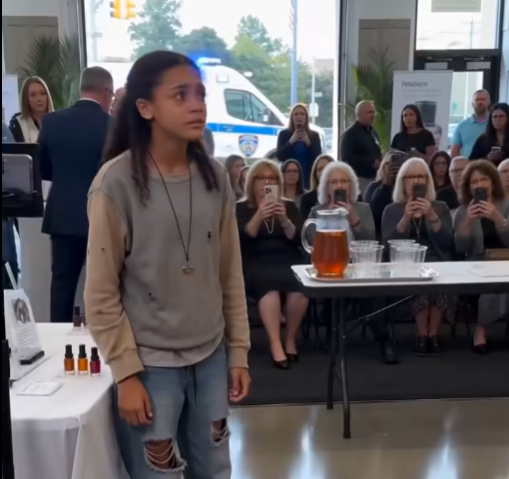
The inspector looked across the room. “It contains Elena Stewart’s original claim draft, witness notes, formula sketches, and correspondence addressed to Conrad Sterling.”
Conrad closed his eyes.
The inspector opened the folder and removed a letter sealed in a clear evidence sleeve.
“This letter was never sent,” she said.
My legs weakened.
Étienne brought me a chair, but I did not sit. I was afraid that if I did, I would never stand again.
Inspector Roche looked at me. “Miss Stewart, you have the right not to hear this publicly.”
Every camera waited.
Every donor waited.
Sloane waited too, pale and silent beside the corridor doors.
I thought of my mother’s life being discussed in locked rooms, hidden drawers, private offices, lawyer whispers. I thought of her being erased politely.
“No,” I said. “Read it.”
Inspector Roche nodded.
The letter began with Conrad’s name.
“Elena wrote,” the inspector said, “‘I do not want revenge. I want my daughter to grow up knowing that her mother created something beautiful and did not sell her name for silence.’”
The room blurred.
“She continued, ‘If you have any courage left, tell the truth before your father turns all of us into thieves.’”
Conrad covered his face.
Inspector Roche lowered the letter slightly. “There is a final page.”
Madame Delacroix whispered, “What final page?”
The inspector removed a smaller sheet.
“This one is addressed to Nadia.”
I could not breathe.
The hall seemed to fold inward, bringing every face closer.
Inspector Roche’s voice softened.
“‘My darling Nadia, if you are reading this, it means the truth took longer than I hoped. Do not let bitterness become the only inheritance they leave you. What they stole was work, not wonder. Wonder is still yours.’”
My lips parted, but no sound came.
Sloane began crying silently now.
Not the sharp, offended tears from before. Quiet ones. Human ones.
The inspector continued.
“‘If the formula rights are ever restored, I ask that they fund the program I could not build: training for girls who are told talent is not enough without money. And if you cannot forgive anyone, forgive yourself first. None of this began with you.’”
That broke me.
Not loudly.
I folded over the letter like the child I had once been, the child who never understood why her mother looked sad whenever perfume ads came on television.
Madame Delacroix held me.
Étienne stood in front of the cameras, shielding me from the worst of them.
Then Sloane stepped forward.
Her voice shook.
“I deleted Nadia’s name.”
Everyone turned.
Sloane looked at her father, then at me.
“And I lied about it because I was afraid the archive would prove her mother mattered more to our brand than we ever did.”
Part 8: The Credit Went To The Wrong Daughter
Sloane’s confession did not save her.
Maybe that was why I believed it.
No dramatic forgiveness swept through the hall. No one applauded. The legal officers took her statement. Conrad Sterling was escorted into a private room for questioning. Sterling Fragrance’s public launch collapsed before the first ceremonial ribbon could be cut.
The cameras caught everything.
But the part that mattered most happened after the reporters were moved outside.
The exhibition hall emptied slowly, leaving behind overturned chairs, cold tea, crushed flowers, and the giant screen still glowing with my mother’s handwriting.
Madame Delacroix sat beside me at the front table, the notebook between us.
“I should have found you sooner,” she said.
I looked at the page where my mother had written about lavender holding grief longer than joy.
“Why didn’t you?”
Her eyes filled. “Fear. Shame. Lawyers. Then illness. Then the terrible habit of thinking tomorrow will make courage easier.”
I understood that more than I wanted to.
Étienne returned with Inspector Roche. “Nadia,” he said carefully, “the project cannot continue under the Sterling name. But the exhibition board wants to preserve the student work. Yours especially.”
I looked toward the damaged panel I had resewn overnight.
The stitches were visible if someone looked closely. Not perfect. Strong.
“What does that mean?” I asked.
Inspector Roche placed a document in front of me. “The formula rights will be frozen during investigation. But Elena’s authorship can be publicly acknowledged today if you consent to the archive release.”
My mother’s name, restored today.
Not after years of court.
Not after another private meeting.
Today.
I picked up the pen.
Then stopped.
Across the hall, Sloane stood alone near the stage steps. Her wrists were not cuffed, but two officers waited near her. She looked at the torn exhibition banner, and for the first time, I saw the full ugliness of what her family had done to her too.
They had handed her stolen light and called it birthright.
I signed the release.
Then I took the microphone.
There were only a few people left inside, but the press outside still had their cameras pointed through the glass doors.
“My mother, Elena Stewart, created the seam infusion method behind this project,” I said. “Her work was stolen. Her name was buried. Today, that ends.”
My voice trembled, but it did not break.
“The student exhibition will continue under a new name: The Elena Stewart Workshop. Any money recovered from licensing will fund training for students who cannot buy their way into beautiful rooms.”
Madame Delacroix began to cry.
Étienne bowed his head.
Then I looked at Sloane.
“I will not pretend what happened to me was small,” I said. “It wasn’t. But I also will not let this story end with another daughter being taught that worth comes from owning what someone else made.”
Sloane stared at me.
I turned to Inspector Roche. “If the court allows community restitution, I want her assigned to the workshop archive. No cameras. No speeches. Just names, dates, and proof.”
Sloane whispered, “Why would you do that?”
“Because records saved me,” I said. “Maybe they can teach you what truth costs.”
A month later, the first workshop opened in Lyon, not in a marble hall but in an old textile school with cracked windows and sunlight spilling across worktables. Girls arrived with notebooks, borrowed coats, nervous hands, and ideas they apologized for before saying out loud.
I kept my mother’s notebook in a glass case near the entrance.
Not as a relic.
As evidence.
Sloane came every Thursday under supervision, cataloguing documents in silence. She never asked me to forgive her. That helped. Conrad’s testimony reopened three civil claims. Madame Delacroix taught scent history with a fierceness that made students sit straighter. Étienne rebuilt the project from scratch.
On opening day, a young girl with a patched sleeve raised her hand and asked whether someone poor could really invent something the world wanted.
I looked at my mother’s handwriting glowing beneath the glass.
Then I looked at my own uneven stitches holding the first exhibition panel together.
“Yes,” I said. “And this time, we will write down your name first.”
