Part 2: The Screen Nobody Wanted Charlotte To See
Charlotte’s face changed before anyone else understood why.
The teacher, Mr. Adler, stood between her and the path leading back toward the changing tents, one hand lifted, not touching her, but firm enough that every runner nearby stopped breathing for half a second.
“Charlotte,” he said, “stay here.”
Her ponytail was slipping loose from its ribbon. Mud striped the side of her expensive white jacket where she had brushed past the barrier. She looked less like the untouchable girl from St. Aurelia’s Academy and more like someone who had suddenly realized the ground under her feet was not solid.
“I have nothing to do with this,” she snapped.
But her voice came too fast.
The student referee, Lukas Meyer, held the GPS watch in both hands as if it had become evidence in a courtroom. Behind him, the course map flickered on the tablet screen beneath a grey sky over the park outside Munich. A red line traced the correct loop through the woods. Another line, taken from the lead runner’s watch, veered sharply toward the wrong footbridge.
The final marker had not just been turned backward.
It had been turned exactly enough to redirect anyone following it.
“That marker was checked at 8:12,” Lukas said, scrolling with his thumb. “Then checked again at 8:47.”
Mr. Adler leaned closer. “Who signed the second check?”
Lukas swallowed.
Charlotte laughed once, brittle and ugly. “This is ridiculous. Anyone could have touched it.”
I wiped mud from my palm onto my shorts. My shoulder still burned where she had shoved me, but I kept my hands steady because I knew she was watching for weakness.
“Read the name,” I said.
Lukas looked at me, then at Charlotte.
His mouth opened.
Before he spoke, Charlotte lunged for the tablet.
Mr. Adler caught her wrist—not hard, just enough to stop her.
The crowd gasped.
And on the screen, beside the 8:47 marker check, appeared the name she had spent the whole morning pretending did not matter.
Charlotte Fairchild.
Part 3: The Runner Who Never Reached The Finish
For a second, nobody moved except the wind.
It pushed through the pine trees and lifted the corner of the printed course map taped to the registration table. Somewhere behind us, a whistle blew for the younger runners warming up, but even that sound seemed embarrassed to enter the silence.
Charlotte yanked her wrist free. “That is my login, not my hand.”
Mr. Adler’s jaw tightened. “Your login was used.”
“Then someone stole it.”
I almost laughed, but the look on Lukas’s face stopped me.
He was pale.
Not scared of Charlotte anymore.
Scared of what the screen was beginning to prove.
“Open the backup,” I said.
Charlotte’s eyes snapped to mine. “Shut up.”
There it was. Not panic dressed as confidence. Not rich-girl annoyance. Real fear.
Mr. Adler turned to Lukas. “What backup?”
Lukas hesitated. “The race volunteers took checkpoint photos. Just for safety verification. Every marker, every water station, every split board.”
Charlotte stepped backward.
Her friend Elodie grabbed her sleeve. “Char, what is going on?”
Charlotte did not answer.
The first checkpoint photo appeared. Marker one. Clear. Marker two. Clear. Marker three. Clear. Then marker seven, the final turn before the footbridge.
At 8:12, the arrow pointed right.
At 8:49, it pointed left.
A black-gloved hand was visible at the edge of the second photo.
Charlotte folded her arms. “That proves nothing.”
Lukas zoomed in.
A gold bracelet flashed at the wrist.
Elodie made a tiny sound.
Charlotte’s bracelet was impossible not to recognize. Thin gold chain. Blue enamel charm. Her grandmother’s crest, she always said. She showed it off whenever she wanted everyone to remember her family donated the academy sports pavilion.
Mr. Adler looked at the bracelet on Charlotte’s wrist.
Then at the photo.
Then at me.
I thought victory would feel warm.
It did not.
It felt cold, because at the edge of the crowd, Matteo Klein, the runner who had lost first place after going off route, stood with his muddy knees trembling and his lips pressed together like he was trying not to cry.
He had not just lost a race.
Someone had taken it from him on purpose.
Part 4: Charlotte’s Father Arrived Before The Principal
The first car came too fast.
A black Mercedes rolled up onto the gravel beside the park entrance, tires crunching like breaking teeth. Everyone turned before the driver’s door opened, before the tall man in the camel coat stepped out, before Charlotte’s whole posture changed.
She did not look relieved.
She looked smaller.
“Dad,” she said.
Richard Fairchild did not go to her first. He went straight to Mr. Adler.
“What is the meaning of this?” he asked, with the calm voice of someone used to making rooms rearrange themselves.
Mr. Adler held the tablet at his side. “There has been an irregularity with the course markers.”
“My daughter is being publicly humiliated over a school race?”
I felt every adult near us stiffen. The assistant coach suddenly became very interested in stacking cones. The volunteer parents looked away. Even Lukas lowered the tablet a little.
That was how Charlotte survived, I realized.
Not because everyone loved her.
Because everyone knew what happened when the Fairchild name entered the conversation.
Mr. Adler, to his credit, did not step back.
“No one is being humiliated,” he said. “We are reviewing records.”
Richard Fairchild’s eyes moved to me. Not angry. Worse. Measuring.
“And who is this?”
My throat tightened.
Before I could answer, Matteo stepped forward.
“She is the one who told them,” he said.
His voice cracked, but he stayed beside me.
Charlotte stared at him like he had betrayed her.
Richard Fairchild smiled without warmth. “Ah. So one disappointed runner and one dramatic girl are making accusations.”
Matteo’s mother pushed through the crowd then, her scarf half falling from her shoulders. “My son followed the marker and ended up on the wrong path.”
“Then perhaps,” Richard said, “your son should learn to read a course.”
Matteo flinched.
Something in me snapped quiet and clean.
I stepped forward with my muddy hands, aching shoulder, and shaking knees.
“Open the volunteer camera folder,” I said. “The whole folder. Not one photo. All of it.”
Charlotte whispered, “Don’t.”
Her father heard her.
And for the first time since arriving, Richard Fairchild looked afraid.
Part 5: The Video Hidden Between The Checkpoint Photos
Lukas opened the folder with fingers that slipped twice on the screen.
It was not just photos.
There were short verification clips too, taken by volunteers walking the course before the race. Most were boring: shoes on gravel, arrows tied to stakes, wind in the trees, the low hum of morning traffic beyond the park.
Then Lukas tapped the clip recorded at 8:48.
The screen shook. A volunteer’s voice mumbled in German about the final marker. The camera swung past a row of birches.
Then Charlotte appeared.
Not clearly at first. Just a blur of white jacket and gold hair near marker seven.
She looked over her shoulder.
Reached down.
Turned the arrow.
The volunteer behind the camera called, “Charlotte? Is that supposed to be moved?”
On the video, Charlotte froze.
Then another voice answered from off-screen.
Richard Fairchild’s voice.
“Leave it. I authorized the adjustment.”
The air changed around us.
Even the parents who had been trying not to stare turned fully now.
Charlotte’s mouth opened, but no words came out.
Mr. Adler slowly lifted his eyes from the tablet. “Mr. Fairchild?”
Richard’s face had gone hard.
“That recording is out of context.”
Matteo’s mother whispered, “You authorized it?”
“It was a safety correction,” Richard said.
“No,” I said.
Everyone looked at me again, but this time I did not feel alone.
I pointed at the map. “That turn sends runners toward the old bridge path. The one blocked after last week’s rain. That is not safer.”
Lukas nodded quickly. “She is right. The city notice closed it.”
Charlotte’s hands were balled into fists. “You don’t understand.”
Elodie stepped away from her.
That hurt Charlotte more than the record did. I saw it land in her face.
Mr. Adler spoke carefully. “Why would you redirect the course?”
Richard Fairchild’s eyes moved to Matteo.
And then I understood.
Matteo had been leading.
Matteo, whose parents ran a bakery in Augsburg.
Matteo, who trained before sunrise because he worked after school.
Matteo, who was about to beat Charlotte’s brother for the regional scholarship spot.
This was never about one race.
Part 6: The Scholarship List Changed Everything
The principal arrived in a navy coat and flat shoes, walking fast across the grass with two officials from the regional athletics board behind her.
Charlotte’s father tried to meet her halfway.
“Dr. Vogel, this has become unnecessarily theatrical.”
Dr. Vogel did not shake his hand.
“I received three calls in seven minutes,” she said. “One from a parent, one from Mr. Adler, and one from the regional board.”
Richard Fairchild’s smile twitched. “Then let us discuss this privately.”
“No,” Matteo’s mother said.
It was not loud.
It did not need to be.
She stood beside her son with flour still caught under one fingernail, her coat too thin for the weather, her face pale with fury.
“No more private discussions.”
Dr. Vogel looked at Lukas. “Show me everything.”
He did.
The GPS route. The marker logs. The checkpoint photo. The video. The closure notice for the old bridge path. The regional scholarship ranking, where Matteo had been ahead by only three points.
Then Dr. Vogel asked the question that made Charlotte close her eyes.
“Who benefits if Matteo Klein’s race is invalidated?”
No one answered.
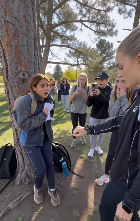
They did not have to.
Charlotte’s younger brother, Oliver Fairchild, stood near the team tent with his medal bag hanging loose from one hand. He looked fourteen, maybe fifteen, and utterly lost.
“I didn’t know,” he said.
Charlotte turned toward him sharply. “Oliver—”
“I didn’t,” he repeated, louder. His eyes filled. “You said Matteo was going to cheat. You said Dad had proof.”
Richard Fairchild barked, “Oliver, stop speaking.”
But the boy kept going.
“You told me if he won, my scholarship interview would be gone.”
Charlotte’s face crumpled for one dangerous second before she rebuilt it into anger.
“I was protecting you,” she said.
Oliver shook his head.
“No,” he whispered. “You were protecting the lie.”
Dr. Vogel took the tablet from Lukas.
Then she looked at Charlotte, not like a student in trouble, but like someone standing at the edge of a much larger collapse.
“Charlotte,” she said, “is there anything else we need to know before I contact the academy board?”
Charlotte stared at her father.
Her father stared back with a warning in his eyes.
And Charlotte finally began to cry.
Part 7: Charlotte Told The Truth Too Late
Charlotte did not sob.
She leaked tears silently, angrily, as if even her body had betrayed her by showing evidence.
“My father told me the scholarship board wanted Oliver,” she said. “He said Matteo’s lead was a mistake. He said people like Matteo always get sympathy points.”
Matteo’s mother made a sharp sound.
Richard Fairchild stepped forward. “That is enough.”
Charlotte flinched, but kept talking.
“He said if the race looked irregular, the board would delay the ranking. Then he could speak to them before final selection.”
Dr. Vogel’s face went still. “Speak to them how?”
Charlotte wiped her cheek with the heel of her hand.
“Donation renewal. Pavilion upgrades. Equipment funding.”
Oliver looked sick.
The regional official beside Dr. Vogel removed his glasses. “Mr. Fairchild, are you saying your family attempted to influence an athletic scholarship?”
Richard laughed once. “My family funds half the facilities these children enjoy.”
“And today,” Dr. Vogel said, “your family endangered a runner on a closed path.”
That landed.
Hard.
Not because it was dramatic, but because it was true.
For the first time, Richard Fairchild’s control slipped. “Nothing happened.”
Matteo lifted his muddy knee. “I fell near the bridge.”
His voice was quiet, but every person heard it.
“I thought I had ruined everything,” he said. “I thought I was stupid.”
I felt my chest hurt.
Charlotte stared at him.
Then at me.
“I shoved you,” she said.
I did not answer.
Her apology, if that was what it was trying to become, was not mine to rescue.
Dr. Vogel turned to the officials. “The race will be reviewed. The course evidence will be submitted. Mr. Fairchild, you and Charlotte will come with me.”
Richard’s phone rang.
He looked at the screen.
His face went grey.
Dr. Vogel noticed. “Who is calling?”
Richard did not answer.
Oliver did.
“It is Grandmother.”
Charlotte stopped crying.
Oliver looked from his phone to his father and whispered, “She just sent a message to the family group.”
He held it up.
I warned Richard not to touch the scholarship fund. I have already frozen the donation account.
Part 8: The Medal Nobody Expected To Matter
By sunset, the park looked ordinary again.
The cones were stacked. The banners folded. The parents had gone home with cold hands and too many new stories. The official results were still pending, but the truth was not.
Charlotte and her father left in separate cars.
That was the part everyone talked about.
I remembered something else.
I remembered Oliver standing alone by the team tent, taking the Fairchild crest bracelet from Charlotte after she shoved it into his palm and saying, “I don’t want this if it costs people their future.”
Two days later, Dr. Vogel called an assembly in the old hall of St. Aurelia’s partner school in Salzburg, where the regional board had moved the final ceremony to avoid more press.
I sat in the third row with my shoulder still bruised yellow beneath my sweater.
Matteo sat one seat away, bouncing his knee.
When the board announced the corrected results, he did not move at first.
“Matteo Klein,” the official repeated, “regional cross-country scholarship recipient.”
His mother covered her mouth.
Matteo stood like his legs did not trust the floor.
The applause started small.
Then it grew.
Not because people suddenly became brave, maybe. Maybe because one person clapped, then another realized they should have clapped sooner.
Matteo walked to the stage.
But before he accepted the certificate, he turned back.
“She should come too,” he said.
My stomach dropped.
“No,” I whispered.
He smiled, nervous and stubborn. “Yes.”
So I walked up with every eye on me, expecting embarrassment.
Instead, Dr. Vogel handed me a sealed envelope.
“This came from Margarethe Fairchild,” she said.
Inside was not money.
It was a letter.
Charlotte’s grandmother had withdrawn the family’s sports donation and placed it into an independent student integrity fund, controlled by teachers, parents, and student referees—not donors.
At the bottom, in sharp blue ink, she had written:
For the girl who asked to open the original record.
I looked up, stunned.
At the side of the hall, Oliver Fairchild stood with his hands in his pockets. He gave me one small nod.
Charlotte was not there.
But later, outside in the cold, I found something tucked beneath the windshield wiper of my bike.
A folded race bib.
Mine.
Across the back, in Charlotte’s handwriting, were six words.
You were right. I was scared.
No apology could erase what she had done.
But the truth had done something stranger than punish her.
It had broken the machine that taught her lying was power.
Matteo came outside carrying his certificate like it might fly away. His mother hugged me so tightly my bruised shoulder ached, but I did not pull away.
For once, being right did not feel lonely.
It felt like a starting line.
