The slap landed so loudly that even the rescue robot stopped moving.
For one horrible second, the entire auditorium froze around me: the Ford banners hanging above the demo stage, the folding chairs packed with parents and students, the local news cameras aimed at the front row, the paper cups of iced coffee sweating on sponsor tables, and me standing in the aisle with my cheek burning under every light in the room.
My name is Anika Parker.
I was seventeen years old, wearing the same patched denim jacket I had repaired twice because buying another one would have meant skipping groceries at home, and I had just been announced as the student chosen to activate Detroit’s Community Day Rescue Robot for its first public test.
For one second, I had believed it was finally happening.
For one second, I thought my mother would see me win.
Then Audrey Sinclair stepped into the aisle.
Audrey did not walk like other students. She entered rooms like she was unveiling herself. She was eighteen, wealthy, polished, and dressed in a cream blazer and designer shoes that looked too clean for a robotics workshop. Her father’s company had sponsored the robot program, and the Sinclair name was printed on almost every banner in the building.
SINCLAIR FUTURES INITIATIVE.
BUILDING TOMORROW’S HEROES.
COMMUNITY DAY RESCUE ROBOT — SPONSORED BY SINCLAIR INDUSTRIES.
Audrey stopped in front of me and looked at my sleeves.
Not my face.
My sleeves.
At the frayed cuffs, the uneven stitching, the faint grease mark I had not been able to wash out from three nights earlier when I stayed late fixing the robot’s collision sensor.
Her smile turned cold.
“You really think they’re going to let you be the face of this launch?” she whispered.
I glanced toward the stage. The event director, Mr. Calloway, was speaking into the microphone. The head engineer, Dr. Maren Ellis, stood beside the robot with her tablet in one hand. The local news reporter had just asked for a better camera angle.
I tried to step around Audrey.
“I need to get to the controls,” I said.
She moved with me, blocking the aisle.
“You were supposed to stay in the workshop,” she said. “Charity girls are useful behind the scenes. Not in front of cameras.”
My throat tightened.
I heard someone nearby shift uncomfortably. Someone else let out a nervous laugh, the kind people make when they are hoping cruelty is a joke.
“It’s not your decision,” I said.
That was when Audrey slapped me.
The sound cracked across the stage area.
My head turned with the force of it. My cheek burned. My eyes filled before I could stop them. Behind me, somebody dropped an iced coffee, and the plastic cup burst against the floor with a soft, ugly splash.
The whole room made that awful sound people make when they want to help but are scared to move.
Audrey pointed at me like I had done something wrong.
“She should not be up there,” she said loudly. “She was only picked because the committee wanted a sad story for the cameras.”
The words hit deeper than the slap.
Because that was my fear.
That everyone saw my old clothes before they saw my work.
That they saw my mother’s tired hands, our overdue bills, our apartment with the broken heater, and decided I was not talented, just useful for sympathy.
Mr. Calloway rushed down from the stage. “Audrey, what are you doing?”
“What someone should have done already,” she said. “This launch matters. My family funded it. The public test should be handled by someone who represents the program properly.”
I stood there shaking, one hand pressed to my cheek, the other curled around the edge of my jacket.
The cameras had turned.
Of course they had.
Nothing attracts cameras faster than public humiliation.
Dr. Ellis stepped down from the stage slowly. She was not a dramatic person. She was usually calm, precise, and impossible to impress. Her gray hair was pulled into a low bun, and her safety glasses hung from the collar of her shirt.
“Audrey,” she said, “step away from Anika.”
Audrey lifted her chin. “You can’t seriously still want her to activate it.”
Dr. Ellis looked at me. “Anika, are you hurt?”
I wanted to say no.
I wanted to sound strong.
But my voice came out uneven. “I’m okay.”
Dr. Ellis’s eyes softened for half a second.
Then she turned toward the big screen behind the demo table.
“No,” she said. “We are not continuing like this.”
Audrey smiled, thinking she had won.
Then Dr. Ellis opened the project folder.
The screen lit up behind the rescue robot.
For weeks, the Community Day Rescue Robot had been treated like the city’s bright new symbol. It was designed to navigate collapsed spaces, detect obstacles, carry small medical kits, and send back live location data during rescue simulations. Students from five Detroit high schools had contributed to the build, but the final public launch belonged to our program.
Or it was supposed to.
Three days before the event, the robot failed its final trial.
It rolled forward during a test run, misread a wall panel, and crashed into the side barrier hard enough to bend one of the wheel brackets. The sponsor team panicked. The student ambassadors panicked. Audrey panicked because her face was already printed in the event brochure under the words STUDENT INNOVATION HOST.
I had stayed after everyone else left.
Not because anyone asked me.
Because I could not stop thinking about the sensor readings.
The collision sensor was not broken exactly. It was miscalibrated by a tiny delay in the response loop. The robot was seeing the obstacle, but the command to slow down arrived too late. I spent six hours checking wiring, cleaning the sensor housing, rewriting a timing note in the repair log, and testing it again in the dark back corner of the workshop while the janitor swept around me.
At 11:43 p.m., the robot passed.
I uploaded the repair notes.
Then I went home and found my mother asleep at the kitchen table with her work shoes still on.
Now Dr. Ellis clicked a file labeled FINAL REPAIR NOTES.
My name appeared on the screen.
ANIKA PARKER — COLLISION SENSOR RESPONSE DELAY IDENTIFIED.
ANIKA PARKER — SENSOR HOUSING CLEANED AND RECALIBRATED.
ANIKA PARKER — FINAL TRIAL PATCH SUBMITTED.
ANIKA PARKER — PASS CONFIRMED 11:43 P.M.
The front row went silent.
Audrey’s face changed so fast it was like watching a mask fall off.
Dr. Ellis clicked the test file.
A video loaded.
There I was on the workshop camera, hair tied back, sleeves rolled up, kneeling beside the robot with a screwdriver between my fingers. The timestamp glowed in the corner.
11:38 P.M.
I adjusted the sensor bracket.
11:41 P.M.
I ran the obstacle test.
11:43 P.M.
The robot stopped perfectly before the barrier.
PASS CONFIRMED.
The room breathed in all at once.
Mr. Calloway looked at Audrey, then at the screen.
“So,” he said quietly, “why did you try to bury the only person who saved this?”
Audrey stepped back.
“I didn’t bury anything.”
Dr. Ellis did not blink. “Then you will not mind if I open the access history.”
The air changed.
That was the moment I knew there was more.
Audrey did not look angry anymore.
She looked scared.
Dr. Ellis opened another tab.
ACCESS HISTORY — FINAL REPAIR NOTES.
ANIKA PARKER — UPLOADED 11:46 P.M.
DR. ELLIS — VIEWED 12:03 A.M.
A.SINCLAIR_EVENT — VIEWED 7:14 A.M.
A.SINCLAIR_EVENT — RENAMED FILE 7:16 A.M.
A.SINCLAIR_EVENT — MOVED FILE TO ARCHIVE 7:17 A.M.
A murmur rolled through the audience.
My stomach turned.
Audrey had not just insulted me.
She had hidden my work.
Mr. Calloway’s voice hardened. “Audrey.”
She shook her head. “That doesn’t prove anything. My account is used for event materials.”
“Your account moved Anika’s repair notes out of the main folder this morning,” Dr. Ellis said.
Audrey looked toward the sponsor table.
Her father sat there.
Richard Sinclair wore a dark suit and the calm, expensive expression of a man who expected every room to forgive him before he even spoke. Beside him, other sponsors sat motionless, their smiles gone.
Audrey’s eyes locked on his.
He gave the smallest shake of his head.
I saw it.
So did Dr. Ellis.
She turned back to the screen. “There is one more file.”
Audrey whispered, “Don’t.”
Dr. Ellis clicked.
A deleted draft opened from the event presentation folder.
PUBLIC LAUNCH SPEAKING ORDER — REVISED.
The original line read:
STUDENT ACTIVATION: ANIKA PARKER, FINAL REPAIR LEAD.
The revised line read:
STUDENT ACTIVATION: AUDREY SINCLAIR, SPONSOR REPRESENTATIVE.
Edited by: R.SINCLAIR_ADMIN.
The room erupted.
Mr. Sinclair stood so quickly his chair scraped across the floor.
“That file was a draft,” he said.
Dr. Ellis looked at him. “A draft you edited?”
He smiled tightly. “I corrected an optics issue.”
“An optics issue?” Mr. Calloway repeated.
Mr. Sinclair gestured toward me without looking at me. “This event is public-facing. Sponsors, news, district representatives. The student at the controls needed to reflect confidence.”
My cheek still burned.
But now something hotter rose underneath it.
Anger.
Not wild anger.
Clear anger.
The kind that finally knows where to stand.
“I fixed your robot,” I said.
The room quieted again.
Mr. Sinclair looked at me as if he was surprised I could speak.
“I fixed the sensor,” I said. “I ran the test. I uploaded the notes. And you hid my name because my jacket did not look right for your cameras.”
A few people in the audience clapped once, then stopped, unsure if it was allowed.
Dr. Ellis closed the file slowly.
“Mr. Sinclair,” she said, “this program was built to find young engineers, not decorate sponsor reputations.”
Audrey suddenly spoke.
“He told me to do it.”
Every head turned.
Mr. Sinclair’s face hardened. “Audrey.”
She flinched, but she kept going.
“He told me to move the file. He said if Anika activated the robot, the news story would become about poverty and charity instead of innovation. He said sponsors do not fund pity.”
The words landed like stones.
My hands curled at my sides.
I thought about my mother taking extra shifts.
About repairing my jacket with thread from an old pillowcase.
About eating toast for dinner and pretending I was not hungry because the robotics bus fee had been due.
Pity.
That was what he called it.
Audrey looked at me, tears bright in her eyes now, but I could not tell whether they were for me or for herself.
“I didn’t think you’d find out before the demo,” she whispered.
“You slapped me,” I said.
“I know.”
“You called me a charity girl.”
“I know.”
“You tried to take the only thing in that room I earned.”
Her face crumpled. “I know.”
For a moment, nobody moved.
Then my mother walked in.
She must have come straight from work because she still wore her grocery store vest over her blouse. Her hair was pulled back with a clip, and her face was flushed from rushing. She stopped at the entrance, saw me standing under the stage lights with one cheek red, and her whole body went still.
“Anika?”
That one word broke me more than the slap.
“Mom,” I whispered.
She crossed the room faster than I had ever seen her move.
“What happened to your face?”
I could not answer.
Dr. Ellis did.
“Your daughter repaired the robot that passed the final trial,” she said. “And then someone tried to erase her from the launch.”
My mother turned toward the screen.
My name was still there.
Repair notes.
Test file.
Pass confirmed.
Her eyes filled.
For years, she had watched me build circuits from broken toys, save wires in shoeboxes, read engineering books from the library until the pages curled. She believed in me when belief was all she could afford.
Now the whole auditorium saw what she had known all along.
“My daughter did that?” she asked softly.
Dr. Ellis smiled. “Yes, ma’am. She did.”
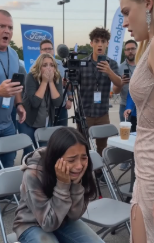
My mother looked at me, and the pride on her face nearly knocked the breath out of my chest.
Then she turned to Mr. Sinclair.
“You tried to hide my child?”
He adjusted his cuff. “This is being exaggerated.”
My mother stepped forward. “No. A slap is not an exaggeration. Erasing her work is not an exaggeration. Using money to steal a child’s moment is not an exaggeration.”
The local news camera zoomed in.
Mr. Sinclair noticed.
For the first time, he looked afraid.
Mr. Calloway took the microphone from the stage.
His voice carried through the auditorium.
“The public test will proceed only if Anika Parker chooses to activate the robot.”
Everyone looked at me.
My cheek burned.
My sleeves were frayed.
My jacket was old.
My hands were shaking.
But the robot sat waiting at the demo line because I had made sure it could.
Dr. Ellis walked to me and held out the control tablet.
“You earned this,” she said.
I looked at my mother.
She nodded, tears running down her face.
So I stepped onto the stage.
The applause started before I reached the controls.
At first it was scattered. Then louder. Then thunderous. Folding chairs creaked as people stood. Students clapped. Parents clapped. Even some of the sponsors clapped, maybe from guilt, maybe from admiration, maybe because the cameras were watching.
I did not care.
For once, the sound was not humiliation.
It was mine.
I took the tablet.
Dr. Ellis stood beside me. “Ready?”
I looked at the robot.
The machine was not beautiful in the polished way Audrey wanted things to be beautiful. It was practical, heavy-wheeled, scratched from testing, patched with student-made brackets and hand-labeled wires.
Like me, maybe.
Built from what was available.
Still working.
“Ready,” I said.
I pressed activate.
The rescue robot rolled forward.
The room went silent again, but this time it was the silence of people holding hope.
The robot approached the first obstacle, scanned, adjusted, and turned cleanly.
Applause burst from the back row.
It climbed the low debris ramp.
It paused at the smoke-marker zone, sent back a thermal reading, then released the small medical kit exactly inside the target circle.
PASS.
The word appeared on the screen.
The auditorium erupted.
My mother covered her mouth with both hands.
Dr. Ellis squeezed my shoulder.
And Audrey Sinclair stood below the stage, crying quietly while her father walked out past the sponsor banner with cameras following him.
The investigation started that afternoon.
Sinclair Industries withdrew from the program within a week, though everyone knew they had not really withdrawn by choice. The district suspended their sponsorship pending review. Mr. Sinclair’s edits to the event folder became part of a public report. Audrey was removed from the student ambassador program and assigned disciplinary service hours in the workshop she had tried to treat like a background prop.
For three days, the clip of her slapping me spread everywhere.
I hated that.
But then another clip spread wider.
The robot stopping perfectly before the obstacle.
My name on the repair notes.
My mother crying when Dr. Ellis said, “Your daughter did that.”
That was the clip people remembered.
A month later, Dr. Ellis called me into the robotics lab.
The lab smelled like solder, rubber wheels, and coffee. It was my favorite smell in the world.
She handed me an envelope.
“What’s this?” I asked.
“Open it.”
Inside was a letter from the Michigan Youth Engineering Foundation.
I read the first line.
Then read it again because I thought I had misunderstood.
They were offering me a summer engineering fellowship.
Paid.
With transportation covered.
My knees went weak.
Dr. Ellis smiled. “They saw the demo.”
“My clothes?” I whispered before I could stop myself.
Her expression softened.
“No, Anika. Your work.”
I pressed the letter to my chest.
For the first time in a long time, the future did not feel like a locked door.
It felt like a machine I might be able to build.
Audrey returned to the workshop near the end of the semester.
She came in without makeup, wearing jeans and an old T-shirt. She looked uncomfortable around the tools, like the room had no place for her performance.
I was recalibrating a wheel motor when she stopped beside my table.
“I’m not here to ask for forgiveness,” she said.
“Good,” I replied without looking up.
She nodded.
“I deserved that.”
I tightened a screw. “You deserved more than that.”
“I know.”
Silence stretched between us.
Then she placed something on the table.
A printed statement.
“I told the review board everything,” she said. “About my dad. About the file. About what I did. I also told them the slap was my choice, not his.”
I finally looked at her.
Her eyes were red, but steady.
“I still hate what you did,” I said.
“You should.”
“But telling the truth matters.”
She swallowed. “I’m trying to learn that.”
I picked up the statement.
It was signed.
Audrey Sinclair.
Not sponsor daughter.
Not student ambassador.
Just her name.
That was a beginning.
Not redemption.
Not yet.
But a beginning.
On the last day of school, the rescue robot was displayed in the front lobby. The Sinclair banners were gone. In their place was a new plaque.
COMMUNITY DAY RESCUE ROBOT — FINAL PUBLIC TEST ACTIVATED BY ANIKA PARKER.
COLLISION SENSOR REPAIR LEAD: ANIKA PARKER.
BUILT BY DETROIT STUDENT ENGINEERS.
I stood in front of it with my mother.
She touched the plaque lightly.
“You know,” she said, smiling through tears, “your jacket is famous now.”
I looked down at the patched sleeve.
For the first time, I did not want to hide it.
Every stitch meant we had kept going.
Every patch meant something had been saved instead of thrown away.
Just like the robot.
Just like me.
Months later, when people asked me about that day, they always expected me to talk about Audrey’s slap.
But that was not the part I remembered most.
I remembered the moment before the demo, when the room waited to see whether I would run.
I remembered Dr. Ellis opening the folder.
I remembered my mother asking, “My daughter did that?”
I remembered pressing activate with shaking hands and watching the robot move forward because my repair held.
Audrey tried to humiliate me in front of everyone.
Her father tried to hide my name behind sponsor money.
The room hesitated because power makes people afraid.
But the project file did not hesitate.
The test footage did not hesitate.
The robot itself did not hesitate.
It rolled forward on the sensor I repaired, carrying proof in every clean turn.
And when it passed the final trial, the whole room finally understood what my mother had known from the beginning.
I was never the charity story.
I was the engineer who saved the launch.
THE END
