Part 2: The Signature That Turned Her Smile Hollow
The coordinator did not read the name out loud at first.
She stared at the page as if the ink had changed shape in her hands. Behind her, the model shelter zone sat under bright event lights, its canvas walls clean, its emergency supply shelves perfectly labeled, its little pretend stove staged beside folded blankets and water filters. It was supposed to look hopeful.
But nobody was looking at the shelter anymore.
They were looking at Savannah Blake.
Her diamond necklace caught the light every time her throat moved.
“Ms. Whitaker,” one of the teachers said carefully, “what does it say?”
The event coordinator’s fingers tightened around the Coat Issue Log. Her glasses slipped slightly down her nose, but she did not push them back. She looked first at me, then at Savannah, then toward the sponsor table where Savannah’s parents sat frozen beside the mayor, the school principal, and half the cameras in Tulsa.
Finally, she said, “The removal request was entered at 8:14 this morning.”
Savannah’s mother stood up so fast her chair scraped the floor.
“That’s impossible,” she said.
Ms. Whitaker turned the page toward the room.
There, beneath the typed entry, sat a digital approval line.
Savannah Blake — Sponsor Liaison Access.
A sound moved through the crowd, not a gasp exactly, but something worse. A wave of people understanding at the same time.
Savannah shook her head. “No. I didn’t— Someone used my login.”
I pressed my palm against my cheek. It still burned from the slap, but somehow the pain felt far away now, like it belonged to another girl standing in another room.
Ms. Whitaker’s voice stayed calm. “This log says your account requested that Tessa Li’s name be removed from the repair and discovery record.”
Savannah’s eyes flicked toward the phones still lifted around us.
That was the moment I saw it.
She was not scared of what she had done.
She was scared that everyone had seen her fail.
Her father, Mr. Blake, pushed back from the sponsor table. He was tall, silver-haired, and polished in the way rich men become polished when no one ever tells them no. He walked toward the display with a slow smile that made my stomach clench.
“Clearly,” he said, “there has been a misunderstanding.”
The principal nodded too quickly. “We should handle this privately.”
“No,” I said.
The word came out rough, barely louder than a breath.
Every head turned.
My throat tightened, but I forced myself to keep standing. “She slapped me in public. She accused me in public. She tried to erase my name in public.” I looked at Ms. Whitaker. “So the record should stay public.”
Savannah’s face twisted.
For one second, the girl in the white gown vanished, and I saw the panic underneath.
Then Mr. Blake leaned closer to me and lowered his voice.
“Careful, Tessa,” he said softly. “A scholarship girl should know when a door is about to close.”
My hands went cold.
Ms. Whitaker heard him.
So did the camera crew behind her.
And from somewhere in the crowd, a student whispered, “Oh my God, did he just threaten her?”
The cameraman lifted his lens higher.
Mr. Blake realized too late that his microphone was still clipped to his lapel from the sponsor interview.
His threat had gone straight into the room speakers.
Part 3: The Sponsor Table Went Silent First
The echo of Mr. Blake’s words seemed to hang above us, ugly and impossible to pull back.
A scholarship girl should know when a door is about to close.
No one moved.
Even Savannah stopped pretending to cry.
Her father’s hand flew to the microphone clipped near his tie. His fingers fumbled with it, but the damage had already spilled through every speaker in the hall.
At the sponsor table, the mayor looked down at her program like she wished the paper could swallow her. The principal’s smile had collapsed into something gray and helpless. Savannah’s mother stood with one hand pressed to her pearl bracelet, her lips parted but silent.
I had spent years noticing how rooms changed when people like the Blakes entered them.
Chairs were offered. Voices softened. Mistakes became misunderstandings.
But now, for the first time, the room did not bend toward them.
It watched.
Ms. Whitaker stepped closer to Mr. Blake. “Sir, please return to your seat.”
He laughed once, sharp and fake. “You are making a spectacle out of a student clerical issue.”
“A student was struck,” Ms. Whitaker said.
Savannah snapped, “She provoked me.”
I looked at her then.
Really looked.
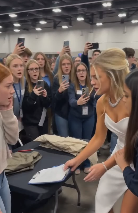
Her white gown shimmered under the lights, perfect and expensive, but her hands were curled so tightly at her sides that her nails pressed crescents into her palms. Her whole life had been built like that gown: flawless from a distance, stitched with pressure underneath.
“You hit me because my name was on a page,” I said.
Her eyes flashed. “You don’t understand what my family gave this fair.”
“I know what I gave it,” I replied.
The words surprised me. They did not shake.
Behind the display table, a boy from the robotics club stepped forward. His name was Elias. He was usually quiet, always wearing headphones around his neck, always pretending not to hear drama.
“I saw Tessa after school,” he said. “Three days in a row. She stayed fixing the shelter curtain because the seam kept splitting.”
Savannah turned on him. “Nobody asked you.”
A girl from the art committee raised her phone. “I have pictures. Tessa was there when the rest of us left.”
Then another voice came from the back. “She also found the coat issue.”
I turned.
Mr. Alvarez, the facilities supervisor, stood near the emergency exit in his faded navy jacket. He had a stack of folded documents in one hand and a look on his face I had never seen before.
Anger.
Not loud anger. The steady kind.
He walked through the crowd slowly, and people moved aside for him.
Savannah’s mother stiffened. “What are those?”
Mr. Alvarez did not answer her.
He handed the papers to Ms. Whitaker.
“These are the original maintenance scans,” he said. “Before the sponsor office requested edits.”
The principal went pale. “Miguel, why do you have those?”
“Because someone told my staff to delete them,” Mr. Alvarez said. “And I don’t delete records when students are about to be blamed.”
Ms. Whitaker opened the first page.
Her mouth tightened.
Then she looked at me with something like sorrow.
“Tessa,” she said quietly, “this goes beyond the coat log.”
Savannah whispered, “Dad.”
Mr. Blake did not look at her.
And that scared me more than anything.
Part 4: The Deleted File Had My Mother’s Name
Ms. Whitaker carried the papers to the nearest document camera.
The screen behind the model shelter flickered, then filled with the scanned maintenance report. My name appeared in small black letters beside the repair hours. Then came the coat issue entry: emergency coats assigned to the wrong storage rack, mislabeled by size, creating a shortage for the children’s shelter simulation.
That was the mistake I had caught.
That was why the shelter curtain mattered.
That was why I had stayed late, hands raw from needlework and cold metal clips, while sponsor kids rehearsed speeches under warm lights.
But Ms. Whitaker did not stop there.
She clicked to the next page.
A second report appeared.
Not from that week.
From eight years earlier.
My chest tightened before I understood why.
The header read: Tulsa Winter Relief Drive Archive.
Below it, under Volunteer Emergency Response Notes, was a name I had not expected to see anywhere near that room.
Lena Li.
My mother.
The floor seemed to tilt.
I heard someone say my name, maybe Elias, maybe a teacher, but the room had thinned around me. Suddenly I was ten years old again, sitting at our kitchen table while my mother stitched donated coats under a yellow lamp, humming softly, telling me every button mattered because cold always found the smallest opening.
My mother had died two years later.
No ceremony. No sponsor plaque. No bright lights.
Just hospital bills, folded clothes, and a sewing tin I still kept under my bed.
Ms. Whitaker’s voice softened. “This archive says the original shelter coat distribution system was designed by Lena Li and a facilities team after a winter shortage.”
I gripped the edge of the table.
Savannah stared at the screen like it had betrayed her.
Her father moved at last. “That archive is irrelevant.”
Mr. Alvarez turned on him. “No, sir. It is not.”
He placed one final page under the camera.
This one had a sponsor note attached.
Blake Family Foundation — Legacy Display Revision Request.
My eyes moved across the document.
The wording was smooth, professional, almost pretty.
It requested that old volunteer names be removed from public display to “streamline donor recognition.”
Then, at the bottom, a handwritten note in blue ink:
Keep Blake family central. Remove Lena Li reference if necessary.
My whole body went still.
Not because I was shocked anymore.
Because something inside me had quietly locked into place.
Savannah had not just tried to erase me.
Her family had erased my mother first.
Savannah’s mother covered her mouth.
Mr. Blake’s face hardened. “That note is being taken out of context.”
I turned toward him.
For years, I had thought my mother’s work disappeared because ordinary people’s work always disappeared. Because people who fixed things rarely got stages. Because someone had to be invisible so someone else could be celebrated.
But now I saw the truth with awful clarity.
Invisible was not an accident. Invisible was a decision.
“My mother made this system?” I asked.
Mr. Alvarez nodded. “She helped build it when the city shelter almost failed that winter.”
I looked at Savannah.
Her face was no longer pale.
It was empty.
“You knew,” I said.
She swallowed.
And her silence answered before her mouth could.
Part 5: Savannah’s Perfect Dress Started Coming Apart
Savannah took one step back.
Her crystal heel caught the edge of the carpet, and for a second she looked like she might fall. Her mother reached for her, but Savannah jerked away.
“I didn’t know about her mother,” she said.
The words came out too fast.
Not I didn’t do it.
Not I’m sorry.
Only that.
Mr. Blake snapped, “Savannah, be quiet.”
Something changed in her face when he said that.
It was small, but I saw it.
The superior expression cracked, and underneath it was a girl who had heard that command a thousand times behind closed doors.
Be quiet.
Smile.
Stand there.
Do not ruin the family image.
The cameras moved closer.
Ms. Whitaker turned off the document camera, but the screen still glowed blue behind her, as if the truth had left a stain.
The principal cleared his throat. “We need security to escort—”
“No,” Savannah said.
Everyone looked at her.
Mr. Blake’s jaw tightened. “Savannah.”
She looked at him, and her voice trembled with fury. “You said it was just donor formatting.”
Her father’s eyes turned cold.
“Not here,” he said.
Savannah laughed once, but it broke in the middle. “That’s what you told me. You said poor families exaggerate their contributions because they want sympathy. You said her name on the record would distract from the foundation.”
My breath caught.
The room shifted again, but this time the attention was not on me.
It was on the Blakes swallowing each other alive.
Savannah looked at me then, and for the first time, she looked younger than eighteen. “I thought you were trying to take something from us.”
“You slapped me,” I said.
Her eyes filled, but I did not soften.
“I know,” she whispered.
Mr. Blake stepped forward. “This is enough.”
Mr. Alvarez blocked him.
He was not tall like Mr. Blake. He did not wear an expensive suit. But he stood between him and the records like a door that would not open.
“No,” Mr. Alvarez said. “It became enough when your office called my staff and told them to wipe the archive.”
The principal whispered, “Miguel…”
Mr. Alvarez turned to him. “And you knew.”
The principal closed his eyes.
The sponsor table erupted.
Parents stood. Teachers whispered. Students leaned into each other, phones still recording. The mayor’s assistant started typing furiously into a tablet.
Ms. Whitaker looked at the principal. “Is that true?”
He did not answer.
He did not have to.
Then a new voice cut through the chaos.
“Play the voicemail.”
Everyone turned toward the entrance.
A woman stood there in a dark green coat, rain shining on her shoulders. She carried a small recorder in one hand and a worn sewing tin in the other.
My knees almost gave out.
Because I knew that sewing tin.
It was mine.
And the woman holding it was my mother’s old friend, Mrs. Moreau, the one person who still sent me birthday cards with pressed flowers inside.
She looked straight at me and said, “Your mother left proof too.”
Part 6: The Voice From Eight Years Ago
Mrs. Moreau walked toward me with careful steps, as if crossing that room hurt her.
She had silver-threaded brown hair tucked beneath her collar and tired eyes that sharpened when they landed on Mr. Blake. I had known her as the woman who brought soup when my mother was sick, who smelled faintly of lavender soap, who never stayed long because grief made our apartment feel too small.
I had never seen her look dangerous before.
“Tessa,” she said gently, placing the sewing tin in my hands.
The metal was dented at one corner. My thumb found the scratch near the lid where I had dropped it when I was eleven. I wanted to open it, but I was afraid my hands would shake too badly.
Mrs. Moreau turned to Ms. Whitaker. “Lena asked me to keep this if anything ever happened to her files.”
Mr. Blake scoffed. “This is absurd theater.”
Mrs. Moreau looked at him. “You always did hate witnesses.”
The room went so silent I heard the hum of the lights.
She held up the recorder. “Eight years ago, Lena Li was told her volunteer design would be credited at the winter relief ceremony. The day before the event, the credit vanished. She called me from the school storage room.”
My chest ached.
Mrs. Moreau pressed play.
Static crackled.
Then my mother’s voice filled the hall.
Soft. Tired. Real.
“I don’t care about a plaque, Elise. I care that if they erase the people doing the work, they’ll keep using us until nothing is left. Blake’s office said donor names matter more because donors keep doors open. But what about the hands that build the doors?”
A small sound escaped me.
I covered my mouth, but it was too late.
My mother continued through the recorder, her voice trembling but clear.
“I made copies. Not because I want revenge. Because one day Tessa will be old enough to understand that kindness without credit becomes exploitation.”
Savannah was crying now, silently, mascara darkening beneath her lashes.
Mr. Blake lunged toward the recorder. “Turn that off.”
Security moved at last, stepping between him and Mrs. Moreau.
The mayor stood. “Mr. Blake, stop.”
That single word carried more weight than every polite sentence before it.
Stop.
The man who had spent years being thanked, photographed, and obeyed suddenly looked very alone.
Mrs. Moreau stopped the recording.
Then she opened the sewing tin.
Inside were folded receipts, old volunteer badges, photographs, and a yellowed copy of the original relief system plan. My mother’s handwriting covered the margins. Names of custodians, parents, students, shelter workers.
Not one sponsor name appeared on the design page.
Mrs. Moreau handed me a photograph.
My mother stood beside the old version of the shelter display, younger than I remembered, smiling shyly with a needle tucked behind one ear.
Behind her, half-hidden near the storage shelves, stood Mr. Blake.
Watching.
On the back, in my mother’s handwriting, were six words:
He wants the credit, not the work.
Part 7: The Girl Who Finally Chose The Truth
Savannah stared at the photograph in my hand as if it were burning her from across the room.
Her father spoke first.
“Savannah,” he said quietly, dangerously, “we are leaving.”
She did not move.
He held out his hand.
That gesture seemed rehearsed. The perfect father guiding his perfect daughter out of an unfortunate misunderstanding. A family retreat before the lawyers arrived. A smile, a statement, a donation, and eventually everyone would be told to forget.
Savannah looked at his hand.
Then she looked at me.
My cheek was still red. My sweater sleeve had stretched where someone had grabbed me earlier in the crowd. I probably looked exactly like what she had called me without saying the word: poor, breakable, temporary.
But I did not feel temporary anymore.
I held my mother’s photograph against my chest.
Savannah lifted her chin.
“No,” she said.
Mr. Blake’s hand stayed in the air.
The room seemed to inhale.
“What did you say?” he asked.
Savannah’s voice shook, but she did not lower it. “I said no.”
Her mother whispered, “Savannah, please.”
Savannah turned toward the cameras. Her face crumpled for half a second, then hardened into something raw and human.
“I used my sponsor login this morning,” she said. “I requested Tessa’s name be removed from the ceremony file.”
A murmur rippled through the hall.
I closed my eyes.
There it was.
The thing I had needed and dreaded at the same time.
Savannah kept going. “I did it because I was angry. Because my father told me the foundation needed to be protected from embarrassment. Because I believed him when he said people like Tessa were always looking for a way to make families like ours look cruel.”
She swallowed hard.
Then she faced me.
“But I slapped her because I wanted to. Not because he made me. Not because anyone tricked me. I wanted to make her feel small.”
My chest tightened.
The apology had not come yet, but the truth had.
And somehow the truth mattered more.
Mr. Blake’s face turned red. “You ungrateful little—”
“Don’t,” Savannah said.
Her voice cracked like glass.
“You taught me to smile at cameras while other people cleaned up behind us. You taught me to call it leadership when we arrived after the work was done. You taught me that if a name didn’t fit the picture, we could remove it.”
She took off the diamond necklace.
Her fingers trembled as she unclasped it.
Then she placed it on the sponsor table like evidence.
“I’m done fitting the picture.”
Her mother began to cry.
The mayor’s assistant stepped closer to Ms. Whitaker and whispered something. Ms. Whitaker nodded, then announced that the ceremony would be paused pending a formal review.
But the cameras did not lower.
Mr. Blake looked around the room, searching for one loyal face.
He found none.
Then the principal finally spoke, his voice thin and broken. “The school board will need to investigate all donor credit revisions from the past decade.”
Mr. Blake turned on him. “You signed them.”
The principal flinched.
And just like that, the second collapse began.
Part 8: The Shelter Opened Under Her Mother’s Name
By sunset, the fair no longer looked like a celebration.
It looked like the place where a beautiful lie had been taken apart piece by piece.
The sponsor banners were removed first. Not dramatically. Not with cheers. Two custodians simply climbed ladders and unhooked the glossy Blake Family Foundation signs while reporters filmed from behind the rope line.
The principal was escorted to a side office with board members.
Mr. Blake left through the rear entrance, surrounded by people in suits who spoke into phones and refused to answer questions.
Savannah stayed.
That surprised me.
She sat alone on a folding chair near the model shelter, her white gown pooled around her like spilled milk, her crystal heels abandoned beneath the table. Without the necklace, without her father beside her, she looked less like royalty and more like someone waking up in a house she had never chosen.
I did not go to her.
Not then.
Ms. Whitaker found me near the supply shelves, holding my mother’s photograph.
“Tessa,” she said, “the committee wants to ask you something.”
I almost laughed. After everything, my first instinct was still fear.
“What?”
She glanced toward the shelter entrance. “We would like to reopen the model zone tonight. Not under the Blake name.”
My fingers tightened around the photo.
Ms. Whitaker continued, “Under your mother’s.”
For a moment, I could not speak.
The hall noise faded into the soft scrape of memory: my mother’s needle through fabric, her voice telling me cold found the smallest opening, her hands smoothing donated coats like they were precious.
“She wasn’t famous,” I said.
“No,” Ms. Whitaker replied. “She was necessary.”
That broke something in me.
Not loudly. Not in a way the cameras could use.
I turned away and cried into my sleeve, quiet and furious and relieved all at once. Mrs. Moreau wrapped an arm around me without saying anything. Mr. Alvarez stood nearby, pretending to study the supply labels so I could have my dignity.
Twenty minutes later, the crowd gathered again.
The mayor did not give a polished speech. She looked shaken, and for once that made her sound honest. She announced an independent review, a student protection policy, and a public archive of all volunteer contributions connected to the relief program.
Then Ms. Whitaker handed me the ribbon.
It was not silk.
It was a strip of repaired tent fabric, cut from the old curtain I had mended after school.
A laugh trembled out of me.
It was the first real thing I had held all night.
I stood at the entrance to the model shelter. My cheek still hurt. My boots were still scratched. My sweater was still faded. But when the cameras turned toward me this time, I did not feel exposed.
I felt seen.
Ms. Whitaker said into the microphone, “This shelter zone is hereby renamed the Lena Li Relief Work Archive, honoring the volunteers, students, and workers whose hands built what others once claimed.”
The room applauded.
Not wildly.
Steadily.
Like rain beginning after a long drought.
I cut the fabric ribbon.
The shelter opened.
And then Savannah Blake stepped forward.
The applause thinned into nervous silence.
She stopped several feet away from me. Her eyes were red. Her hands were empty.
“I’m not asking you to forgive me,” she said.
“Good,” I replied.
A faint, painful smile crossed her mouth. “I deserved that.”
I waited.
She reached into the small clutch at her side and pulled out a folded paper.
“My family planned to announce a private scholarship tonight,” she said. “In my name.”
My stomach tightened.
Savannah looked toward the cameras, then back at me. “I signed it over before my father left.”
She handed the paper to Ms. Whitaker, not me.
“The money will fund student workers directly,” she said. “Repairs, transport, meals, supplies. No sponsor speeches. No portraits. No family branding.”
Her voice shook.
“And the first award should be named after Lena Li.”
I stared at her.
I wanted to hate the gesture.
Part of me did.
But Mrs. Moreau touched my shoulder, and I thought of my mother saying kindness without credit became exploitation.
This was not forgiveness.
This was credit being returned.
Ms. Whitaker read the paper, then looked stunned. “Savannah, this is your entire trust allocation for the foundation program.”
Savannah nodded. “Then it can finally do something useful.”
Her mother sobbed once behind her.
Savannah did not turn around.
That was the shocking part no one expected. The villain of the night did not vanish in disgrace, and the poor girl did not become perfect through suffering. Instead, one girl lost her crown, another found her mother’s name, and the money that had once erased people became the first thing forced to remember them.
Months later, the archive wall went up in the renovated shelter center.
My mother’s photo was not in the middle.
I chose that.
She would have hated being made larger than everyone else.
Instead, her picture sat among dozens of others: custodians, students, nurses, drivers, seamstresses, cafeteria workers, parents, and volunteers whose names had been found in old boxes, deleted files, forgotten emails, and sewing tins.
At the bottom of the wall was one sentence from her recording.
What about the hands that build the doors?
I read it every time I passed.
And every time, I touched the repaired strip of tent fabric framed beneath it, knowing my mother had not disappeared after all; she had simply been waiting for me to open the door.
