Part 2: The Photo That Fell Face Up
The photo landed on the marble floor between Seraphina’s crystal heels and my stained dress.
For one second, nobody bent to pick it up.
The gala lights shone across the glossy paper, turning the image silver at the edges. I could see only part of it from where I stood: the back hallway, the scholarship donation table, a hand reaching into the locked collection box.
Then the staff member gasped.
Seraphina’s fingers tightened around the folder. “That’s private committee material.”
The staff member, a woman named Maren Voss, looked terrified, but she still reached for the photo. Seraphina stepped on one corner of it.
Not hard enough to tear it.
Hard enough to claim it.
The donors watched from their round tables, forks suspended above plates, champagne glasses frozen halfway to mouths. The string quartet near the staircase had stopped playing so abruptly that the last violin note seemed to hang in the ceiling.
I could feel cake sliding down the front of my dress.
Chocolate frosting. White silk. Heat in my face.
Seraphina had done exactly what she wanted. She had made me look messy before the ceremony, before the cameras, before the committee could announce why I had been chosen.
But she had not planned for the folder.
And she definitely had not planned for the photo.
Maren lifted her chin. “Miss Aldridge, please take your foot off the evidence.”
Seraphina laughed softly. “Evidence? Don’t be dramatic.”
Mr. Aldridge rose from the front donor table.
Her father moved slowly, with the confidence of a man who expected rooms to rearrange around him. His tuxedo was perfect, his silver cufflinks catching the chandelier light. The Aldridge name was printed on the donor wall behind him in gold letters larger than most people’s dreams.
“Maren,” he said, “I’m sure this can wait.”
Maren’s face went pale.
She worked for the foundation. Everyone knew that. Everyone also knew Mr. Aldridge could destroy a staff career with one quiet phone call.
But she did not step back.
“No, sir,” she said. “It can’t.”
A murmur rolled through the ballroom.
Seraphina looked at her father for help, then at me with pure hatred. “She ruined her own dress and now she’s trying to turn this into some pathetic performance.”
I stared at her.
I wanted to say something sharp. Something brave.
But all I could think was that I had spent two months taking extra shifts at the bookstore after school so I could quietly replace the scholarship money that had vanished. I had watched the fund balance drop and heard adults call it a bookkeeping delay. I had donated my own work money because I knew three students were waiting on those grants.
And now I stood there covered in cake while the girl whose family owned half the room called me embarrassing.
Maren bent down and pulled the photo from beneath Seraphina’s shoe.
The corner was creased.
But the image was clear.
She turned it toward the donors.
The hand in the photo wore a diamond bracelet shaped like a serpent.
The same bracelet glittering on Seraphina Aldridge’s wrist.
Part 3: The Bracelet Made The Room Stop Breathing
Seraphina snatched her hand behind her back.
That tiny movement condemned her more than any confession could have.
A donor near the front table whispered, “Is that her?”
“No,” Seraphina said immediately. “That angle proves nothing.”
Maren held the photo steady, though her fingers trembled. “This was taken by the hallway security camera outside the scholarship office.”
Mr. Aldridge’s voice sharpened. “The hallway cameras were offline last week.”
Maren looked at him.
So did everyone else.
He realized his mistake a second too late.
I saw it pass across his face: not guilt, exactly, but calculation. Like he was rearranging the disaster in his head, deciding which person could still be sacrificed.
Seraphina’s mouth opened, but no sound came out.
The committee chair, Mrs. Calder, stepped forward from the stage. She was older, elegant, and usually so composed that even her anger sounded like etiquette. Now her lips were pressed into a thin white line.
“Mr. Aldridge,” she said, “how did you know which camera was involved?”
The silence after that question was enormous.
My heart hammered so hard I could feel it in my throat.
Mr. Aldridge smiled. “Because I was informed there had been a technical issue in that corridor.”
“By whom?”
He did not answer.
Maren opened the folder again. “The volunteer journal shows Helena Reese reported the missing scholarship balance eleven days ago. She then donated her own wages across three separate payments to keep the emergency grants from being canceled.”
A sound moved through the ballroom.
Not pity.
Something heavier.
Recognition.
People turned toward me, really turned toward me, and I hated that cake was still on my dress. I hated that my hands were shaking. I hated that the truth had to arrive with me looking exactly how Seraphina wanted me to look.
Mrs. Calder looked at me. “Helena, is that true?”
I swallowed.
“Yes,” I said. “I didn’t want the students to lose their grants.”
Seraphina laughed again, but it sounded cracked. “So she bought herself a hero moment.”
My face burned hotter.
“No,” Maren said.
The word came out quiet, but it cut through the whole room.
She pulled another page from the folder. “Helena asked that her donations be listed anonymously.”
Mrs. Calder took the paper.
Her expression shifted.
“She didn’t want recognition,” Mrs. Calder said.
For the first time all night, Seraphina looked unsure where to put her eyes.
Then Maren reached deeper into the folder and removed a second photo.
This one showed the scholarship office from inside.
The collection box was open.
And Seraphina was not alone.
Part 4: Her Father Was In The Second Photo
Mr. Aldridge moved before anyone else could react.
He did not lunge. Men like him did not lunge in public. He simply stepped forward with one hand extended, as if the photo already belonged to him.
Mrs. Calder pulled it back.
“Do not touch this,” she said.
His polite mask hardened. “You are mishandling foundation property.”
“No,” Mrs. Calder replied. “I am preserving evidence.”
The word evidence changed the temperature of the room.
Someone near the rear doors called security. Another donor whispered into a phone. The cameraman assigned to film the ceremony lifted his lens without waiting for permission.
Seraphina’s face had gone blank.
She stared at the second photo like she could erase it by refusing to blink.
I could not see it fully until Mrs. Calder turned it toward the stage light.
There was Seraphina, standing beside the open collection box.
And behind her, half-turned toward the office door, stood Mr. Aldridge.
His hand was on the ledger.
The ballroom erupted.
“No,” Seraphina whispered.
It was not denial.
It was panic.
Mr. Aldridge looked at his daughter, and in that glance I saw something cold pass between them. Not love. Not protection. Warning.
Maren’s voice shook, but she kept reading. “The journal entries show the emergency scholarship fund was short by eighteen thousand dollars before Helena’s payments restored the minimum balance. The missing amount corresponds to a transfer marked as donor event expenses.”
Mrs. Calder looked sick. “Event expenses?”
Maren nodded. “Specifically, floral upgrades, stage lighting, and private guest accommodations.”
The flowers.
The stage lights.
The crystal glasses.
The room itself seemed to become ugly around me.
I looked at the enormous white roses spilling from silver vases, at the glowing donor wall, at the luxury that had been paid for while scholarship students waited for money that was supposed to help them breathe.
Seraphina turned on me suddenly. “You weren’t supposed to know.”
The words escaped before she could catch them.
Her father closed his eyes.
Every camera turned toward her.
I stood there with frosting drying on my dress and heard my own voice come out steadier than I felt.
“Why?”
Seraphina’s chin trembled.
For one second, she looked less like the girl who had shoved cake into my dress and more like a cornered child standing under a chandelier too heavy for the ceiling.
Then her father said, “Seraphina, not another word.”
She flinched.
That was when I realized something terrifying.
Seraphina had humiliated me by choice.
But she had not built the lie alone.
Part 5: The Ledger Had My Name Circled
Mrs. Calder ordered the ballroom doors closed.
Not locked. Just guarded.
No one was allowed near the stage table except committee members, security, and the staff holding the records. The donors hated that. Rich people did not like being treated as witnesses when they had arrived expecting to be thanked.
I stood behind a side curtain while Maren found me a clean wrap from the coat check.
It was black, plain, and too large. I pulled it around my stained dress, but I could still smell sugar and cream.
Maren looked at me with wet eyes. “I’m sorry I didn’t bring the folder sooner.”
“You brought it,” I said.
She pressed her lips together and nodded, like that was the most forgiveness she could accept.
On the stage, Mrs. Calder opened the ledger.
Pages turned under the microphone, each one loud through the speakers.
Then she stopped.
Her face changed.
“What is it?” asked one of the committee members.
Mrs. Calder did not answer at first.
She looked at me.
Then at Mr. Aldridge.
Then at Seraphina.
Finally, she lifted the ledger so Maren could see.
Maren covered her mouth.
My stomach twisted. “What?”
Mrs. Calder’s voice lowered. “Helena, your name is circled in the donor office notes.”
I stepped forward despite myself.
There it was.
Helena Reese.
Circled in red ink.
Beside it, a handwritten note:
Move her away from the stage before announcement.
Below that:
If questioned, frame as unstable volunteer seeking attention.
My body went cold from the inside out.
Seraphina stared at the ledger, tears gathering in her eyes now, though she tried to hold them back.
Mrs. Calder looked at her. “Did you write this?”
Seraphina shook her head quickly. “No.”
Mr. Aldridge said, “This is absurd.”
Maren leaned closer to the page. “That’s not Seraphina’s handwriting.”
The room seemed to tighten.
Mrs. Calder looked toward Mr. Aldridge.
He smiled.
Not warmly.
Carefully.
“You cannot possibly think I wrote childish notes in a volunteer ledger.”
“No,” Maren said quietly.
She turned the page.
A business card had been clipped to the back.
Aldridge Foundation Communications Office.
And beneath the card was another line in the same red ink:
Seraphina handles the scene. Cameras stay off until dress issue resolved.
My knees weakened.
The cake.
The shove toward humiliation.
The timing before cameras.
It had not been an impulsive cruelty.
It had been scheduled.
Seraphina began crying silently.
I looked at her. “You knew they wanted me moved.”
She wiped her face angrily. “I knew they wanted you away from the stage.”
“And the cake?”
Her mouth twisted.
“That was my idea,” she whispered.
The honesty landed like a slap.
“I thought if you looked ridiculous, nobody would listen to you.”
I stared at her, unable to speak.
Then Mrs. Calder turned one more page and found the donor receipt that made Mr. Aldridge’s smile disappear.
Part 6: The Money Had Been Moved Twice
The receipt was not for flowers.
Not for lighting.
Not for guest accommodations.
It was a bank transfer confirmation, folded into the ledger so tightly that its edges had worn soft.
Mrs. Calder read it once.
Then again.
Her composure cracked.
“This transfer was made from the emergency scholarship account into a private foundation reserve,” she said.
Mr. Aldridge said nothing.
Maren stepped beside her. “And then?”
Mrs. Calder’s hand trembled. “Then the same amount was transferred to Aldridge Holdings.”
A deep, stunned silence filled the ballroom.
Even the people who did not understand finances understood the name.
Aldridge Holdings was not a charity vendor.
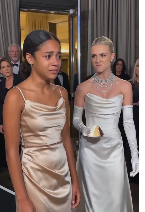
It was Mr. Aldridge’s company.
Seraphina whispered, “Dad?”
He did not look at her.
That was the answer.
The room began moving around me in fragments. Security speaking into radios. Committee members whispering urgently. Donors stepping away from the Aldridge table as if corruption were contagious. A reporter near the staircase typing with both thumbs.
Mrs. Calder faced Mr. Aldridge. “You used scholarship funds to cover your company’s shortfall?”
His face darkened. “You are making accusations you cannot support.”
Maren pulled another sheet from the folder. “The volunteer journal supports the missing balance. The ledger supports the transfer. The photos support access to the office.”
“And Helena’s donations restored the fund,” Mrs. Calder added, her voice breaking with anger. “A student working hourly wages covered what your company stole.”
The word stole rang through the ballroom.
Mr. Aldridge turned sharply. “Be careful.”
I had heard powerful people say careful twice that night.
Both times, it sounded like a threat dressed as advice.
Seraphina stepped toward him. “Tell me it isn’t true.”
He looked at her then, and something in his expression made her shrink.
“You wanted that ceremony,” he said. “You wanted the Aldridge name protected. Do not pretend innocence now.”
She recoiled as if he had struck her.
Her mother, who had been silent at the donor table all night, suddenly stood.
“Richard,” she said.
Mr. Aldridge turned. “Sit down, Evelina.”
She did not.
Her hands were shaking, but her voice was clear.
“No.”
The whole ballroom turned.
Evelina Aldridge walked toward the stage, diamonds flashing at her ears, face pale with a kind of fear that looked years old.
“I signed one document,” she said. “One. You told me it was to stabilize the foundation reserve.”
Mr. Aldridge’s jaw tightened. “Not here.”
“Yes,” she said. “Here.”
Then she looked at me.
And I realized the night still had one secret left.
Part 7: The Woman At The Donor Table Finally Spoke
Evelina Aldridge reached into her evening bag and removed a small white envelope.
It looked too delicate to matter.
But Mr. Aldridge’s expression changed the second he saw it.
“Evelina,” he warned.
She ignored him.
Her fingers trembled as she handed the envelope to Mrs. Calder. “I received this yesterday from an accountant who resigned from Aldridge Holdings.”
Mrs. Calder opened it.
Inside was a flash drive and a printed note.
Maren read the note first.
Her face drained of color.
“What does it say?” I asked.
Nobody answered immediately.
Then Maren looked at me with an expression so gentle it scared me.
“It says the scholarship transfer wasn’t the first one.”
The room blurred.
Mrs. Calder inserted the flash drive into the gala presentation laptop. The giant screen behind the stage, meant to show smiling scholarship recipients and donor names, flickered to life.
Files appeared.
Years.
Amounts.
Student names.
Emergency grants delayed, reduced, redirected.
Beside several entries, one phrase repeated:
Reallocated for donor relationship management.
The donors saw it.
The committee saw it.
The cameras saw it.
And then a folder opened with the title:
Reese Case.
My last name.
My breath stopped.
Maren clicked once, then froze.
Mrs. Calder whispered, “Helena…”
I stepped closer.
On the screen was an old grant application.
Not mine.
My brother’s.
Jonah Reese.
He had applied for an emergency education grant three years earlier, after our mother’s medical bills had swallowed everything. He never received it. The rejection letter said funds were exhausted.
I remembered that week.
I remembered Jonah sitting at the kitchen table, pretending he was fine. I remembered him taking night shifts instead of starting the program he had dreamed about. I remembered him telling me not to hate rich people because bitterness was expensive and we were already broke.
The screen showed the truth.
Jonah’s grant had been approved.
Then redirected.
The money went into a donor hospitality account.
My hand flew to my mouth.
The room disappeared for a second.
Not because I fainted.
Because grief can be so old you stop recognizing it until someone says its name.
Seraphina stared at the screen. “I didn’t know.”
I turned to her.
My voice came out quiet.
“You didn’t want to know.”
She flinched.
Evelina covered her face.
Mr. Aldridge finally lost control. “Enough! This foundation exists because of me!”
Mrs. Calder looked at him with cold disgust.
“No,” she said. “It existed despite you.”
Police arrived before the final file finished loading.
But the worst punishment had already happened.
Every person in that ballroom had seen the Aldridge name shrink.
Part 8: The Ceremony Went On Without Their Name
The cameras turned on late.
But when they did, they did not film the ceremony Seraphina had tried to control.
They filmed the truth.
Mr. Aldridge was escorted through the side entrance between two officers, his tuxedo still perfect, his face gray with fury. He did not look at the donors. He did not look at his wife. He did not look at Seraphina.
That was what broke her.
Not the police.
Not the records.
The fact that when everything collapsed, her father abandoned her image faster than she had tried to destroy mine.
Seraphina stood near the stage steps, mascara streaked, hands empty, no longer glowing under the chandelier. Her designer gown looked suddenly heavy, like it had been sewn from every expectation she had failed to carry.
I did not comfort her.
I could not.
Maren helped me clean the worst of the cake from my dress in a side restroom. The stain remained, pale brown across the fabric like a bruise. She offered to find me another dress from the costume donation rack.
I almost said yes.
Then I looked in the mirror.
The stained dress was ugly now. Ruined, maybe.
But it was also proof.
So I went back wearing it.
When I stepped into the ballroom, the sound changed.
No laughter.
No whispers sharp enough to cut.
People stood.
Slowly at first.
Then all at once.
I hated how much I wanted to disappear.
Mrs. Calder met me at the stage. “Helena, we can postpone.”
I looked at the giant screen, where the Aldridge donor slide had been replaced by a blank blue background.
Then I looked at the scholarship students seated near the front, the ones who had almost lost their grants because rich people turned need into decoration.
“No,” I said. “Don’t postpone for him.”
Mrs. Calder nodded.
The ceremony began without music.
Without the Aldridge name.
Without the gold donor wall lit behind us.
Mrs. Calder told the room what had been found. Not every detail. Not enough to turn pain into entertainment. Just enough to make denial impossible.
Then she called my name.
I walked to the center of the stage in my stained dress.
The same place Seraphina had tried to keep me from reaching.
My hands shook when I took the microphone.
“I donated because I knew what it felt like to wait for help that never came,” I said.
My voice trembled, but it did not break.
“I thought the fund had failed my brother because there wasn’t enough money. Tonight I learned there was money. It was just moved away from people who needed it.”
A few people lowered their heads.
Good.
They should have.
I looked at the tables full of donors, committee members, staff, students, and cameras.
“Charity shouldn’t be a stage where powerful people applaud themselves. It should be a door that opens when someone is standing outside in the cold.”
Maren began crying near the side curtain.
Mrs. Calder wiped her eyes.
I kept going.
“So if this fund continues, every student should be able to see where every dollar goes. No hidden transfers. No donor hospitality accounts. No names bigger than the people being helped.”
The applause started small.
Then grew.
Not glittering gala applause.
Not polite rich applause.
Something rougher. Earned. Almost ashamed.
Evelina Aldridge stepped onto the stage after me. The room stiffened.
She removed her diamond bracelet and placed it on the podium.
Then her earrings.
Then the necklace at her throat.
“These will be sold,” she said, voice shaking, “and the money will begin repaying what my family took.”
Seraphina stood below the stage, crying openly now.
Her mother looked at her. “You will not be protected from what you did. But you will not be raised inside his lie anymore.”
That was the first unexpected mercy of the night.
Not for me.
For Seraphina.
She turned toward me after the ceremony, but stopped several feet away.
“I’m sorry,” she said.
I looked at the frosting stain on my dress.
Then at the girl who had put it there.
“Don’t make your apology another performance,” I said.
She nodded, tears slipping down her face. “I won’t.”
Months later, the emergency scholarship fund reopened under a new name.
Not Aldridge.
Not Reese.
The Transparent Door Fund.
Every donation, every expense, every grant decision appeared publicly online. Jonah was offered the grant he had been denied three years too late. He used it anyway, starting the program he once thought he had lost forever.
As for me, the committee framed the volunteer journal’s first page and hung it beside the scholarship office door.
Not because I saved the fund alone.
I didn’t.
Maren ran with the folder.
Evelina brought the drive.
Mrs. Calder refused to look away.
Jonah taught me not to let bitterness own what truth could repair.
But under the glass, next to my name, they placed a small photo from that night.
Not the polished ceremony picture.
The real one.
Me in the stained dress, standing at the microphone, refusing to move.
And every time students passed it, they saw the thing Seraphina tried to humiliate out of me: the proof that a girl covered in cake could still be the cleanest person in the room.
