Part 2: The Screenshot Olivia Never Expected To Appear
The screen behind the stage flickered once, then sharpened into a security still so clear that every jeweled necklace in the ballroom seemed to stop moving.
Olivia Fairfax was on it.
Not the Olivia with perfect curls and a soft donor smile.
This Olivia stood alone in the closed ballroom before the guests arrived, holding a silver serving tray beside the central ceremonial table. Her face was turned toward the camera. Her hand was stretched over the place cards.
And beneath her fingers was my name.
Mara Voss.
The room went completely silent.
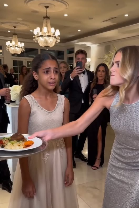
I still had cream sauce on my sleeve. Something sticky had dried near my cheek. My simple blue dress clung coldly to my shoulder where the food had hit, but for the first time since she threw it, people were no longer looking at me like I was the stain.
They were looking at her.
Olivia’s mother, Camilla Fairfax, rose from the donor table with a smile that did not reach her eyes.
“This is inappropriate,” she said. “Henrik, remove that image.”
Henrik Adler, the host, did not move.
He stood beside the laptop with his jaw locked, his hand still resting near the project log folder.
“No,” he said. “The guests deserve to know why the ceremony nearly failed tonight.”
Olivia laughed once. It was too sharp, too high.
“That picture proves nothing. I checked the table. That’s all.”
Henrik clicked forward.
A second image appeared.
This one showed her lifting the ceremonial envelope from beneath the table arrangement.
My stomach dropped.
That envelope held the donor dedication cards, the stage order, and the final project acknowledgment list. I had stayed up three nights rebuilding it after the printer corrupted half the files. Nobody knew because backstage work was only visible when it failed.
Henrik’s voice lowered.
“At 16:42, Olivia Fairfax removed the ceremony envelope.”
The next slide appeared.
Olivia was placing something into the service corridor bin.
A donor gasped.
Someone whispered, “That is the envelope.”
Olivia’s face went white, but Camilla stepped into the aisle before anyone could speak.
“My daughter was correcting a mistake.”
I wiped my cheek with the back of my shaking hand.
“What mistake?” I asked.
Olivia turned on me instantly.
“The mistake of you standing there.”
The sentence landed hard enough that even her own table flinched.
Henrik opened the project log.
“Mara Voss did not steal a central role,” he said. “She was assigned it because she saved the entire medical outreach archive after the Fairfax file disappeared.”
Camilla’s smile vanished.
And then the screen changed again.
Not to Olivia.
To a file path.
FAIRFAX_PRIVATE_REPLACEMENT_LIST_FINAL.
Part 3: The Private List Beneath The Donor Table
The words on the screen looked harmless at first.
Then Henrik opened the file.
A table filled the projection wall, rows of names arranged in neat columns with donor assignments, speech placements, and ceremonial duties. Every person in that room understood lists. Lists decided status. Lists decided access. Lists told rich people where they belonged.
And there, in the line marked Central Honor Role, my name had been crossed out.
Beside it, in red, was Olivia Fairfax.
A sound moved through the ballroom like wind through glass.
Olivia whispered, “That is not mine.”
Henrik clicked the document properties.
Created by: O. Fairfax.
Modified by: C. Fairfax.
The room shifted again, heavier this time.
Camilla did not blink.
“You are humiliating a young woman in front of guests,” she said.
I almost laughed, but my throat hurt too much.
A young woman.
She meant Olivia.
Not the girl still standing in old shoes with food on her dress.
A man near the stage stood slowly. He was older, with silver hair and a dark green tie. I recognized him from the program: Tomasz Lewandowski, chairman of the children’s clinic board in Kraków.
“Henrik,” he said, “where did that replacement list come from?”
Henrik looked at me.
I felt suddenly exposed again.
“The project log flagged it,” he said. “Mara added a note three days ago after the clinic packet disappeared from the archive.”
Tomasz turned toward me.
“You found the missing packet?”
“I found a broken link,” I said. My voice came out quieter than I wanted. “Then an empty folder. Then three renamed files.”
“Why did you keep checking?”
I looked at Olivia, then at the donor tables, then at the stage flowers worth more than my rent.
“Because when things vanish around people like me, everyone assumes we touched them.”
Nobody spoke.
Then, from the back of the ballroom, one of the servers raised a hand.
He looked terrified.
Henrik noticed him. “Luca?”
The young man stepped forward, holding a folded napkin like evidence.
“I saw Miss Fairfax near the service bin,” Luca said. “But I also saw Mrs. Fairfax hand something to the archive manager.”
Camilla’s expression sharpened.
“Careful,” she said softly.
Luca swallowed.
That single word, careful, carried more threat than shouting.
I knew that tone. People with money used it when they wanted poor people to remember rent, contracts, visas, sick parents, younger siblings.
Luca looked down.
Then he looked at me.
“She told him,” he said, voice shaking, “to make sure Mara Voss’s folder did not survive the night.”
The ballroom erupted.
Camilla turned toward the exit.
But before she reached it, the side doors opened.
A woman in a black suit entered with two legal clerks behind her.
She held up an identification card.
“Elena Markovic,” she said. “European Charity Oversight Commission.”
Then her eyes went to the screen.
“Good,” she said. “You found the first list.”
Part 4: The Woman Who Came For The Second List
Camilla stopped walking.
For the first time all night, she looked surprised.
Not afraid yet.
Surprised, as if consequences were a guest she had not approved for entry.
Elena Markovic crossed the ballroom without rushing. Her heels struck the marble in calm, precise beats. The two clerks followed her, each carrying sealed document bags.
Henrik stepped aside as she reached the laptop.
“This event is now under formal review,” Elena said.
Olivia looked from her mother to the guests. Her cheeks were blotched red beneath her makeup.
“Mother?” she whispered. “What does she mean by first list?”
Camilla did not answer.
Elena opened one of the document bags and removed a printed ledger.
“This party was not only a ceremony,” she said. “It was the final presentation before the transfer of the Morava Children’s Sight Fund.”
Tomasz Lewandowski’s face hardened.
“That fund supports clinics in Kraków, Brno, and Split.”
“Yes,” Elena said. “And for six months, someone has been altering volunteer logs and donor attributions to justify redirecting administrative control to Fairfax Global Philanthropy.”
The name rolled through the room like poison wrapped in silk.
Fairfax Global Philanthropy.
Camilla’s empire.
The foundation whose logo appeared on every gift bag, every floral wall, every champagne menu.
Olivia shook her head. “No. This was about the ceremony.”
Elena looked at her with something almost like pity.
“For you, perhaps.”
Then she turned to me.
“Mara Voss, did you create a recovery copy of the project log?”
My hands went cold.
I had.
Of course I had.
Not because I was brave. Because I had learned that systems failed differently around powerful families.
“Yes,” I said.
Camilla laughed under her breath.
“A scholarship girl illegally copying private records. How convenient.”
Elena’s eyes cut to her.
“Private records do not include forged charity reports.”
The ballroom quieted again.
I reached into my worn bag and pulled out the small blue USB drive I had taped inside the lining. My fingers fumbled so badly Luca stepped closer, but I managed to hold it out.
Olivia stared at it like it might explode.
Henrik inserted it into Elena’s secured laptop.
Folders appeared.
Event_Log_Final.
Clinic_Packet_Backup.
Volunteer_Hours_Raw.
And one folder I had not created.
MARA_READ_THIS_AFTER_THE_STAGE.
My breath stopped.
“That is not mine,” I said.
Elena clicked it.
A video file appeared.
The thumbnail showed a man in a hospital bed.
My father.
Part 5: The Video My Father Hid In The Archive
For a second, I forgot the ballroom existed.
The chandeliers blurred. The donors disappeared. Even Olivia’s face became distant, meaningless noise at the edge of my vision.
My father had died two years earlier in Innsbruck after an infection turned cruel faster than doctors could stop it. He had been a volunteer optician, the kind of man who repaired glasses for children and never charged families who counted coins before speaking.
He had no place inside a gala archive.
He had no reason to be on that screen.
Henrik looked at me. “Mara?”
I could not answer.
Elena’s voice softened. “Do you want me to stop?”
I shook my head because stopping felt more terrifying than watching.
She pressed play.
My father appeared in a plain hospital room, thinner than I remembered, but smiling with that tired warmth that used to make our apartment feel bigger than it was.
“Mara,” he said on the screen, “if you are seeing this, then you did what I hoped you would do. You kept records.”
My hand flew to my mouth.
A broken sound escaped me before I could bury it.
His voice continued.
“The Morava Children’s Sight Fund was built by volunteers. Not families with portraits in marble halls. Not foundations that arrive after the work is done. If the Fairfax name is near this archive, be careful.”
Camilla’s face turned rigid.
My father coughed softly in the video and reached for a folder beside his bed.
“I was asked to sign over the volunteer tracking system. I refused. I knew what would happen after I was gone, so I hid copies inside the event archive. Not because I trusted institutions.”
He smiled faintly.
“Because I trusted my daughter to notice when a file was one number out of place.”
I could not breathe.
The entire room watched my grief become evidence.
On screen, my father lifted a page.
“This is the original donor protection clause. No single private foundation can control the fund if volunteer records show community ownership.”
Elena paused the video and opened another document.
There it was.
His signature.
An independent witness stamp.
A clause that made the Fairfax takeover impossible.
Camilla’s voice sliced through the silence.
“That document is outdated.”
Elena shook her head.
“No. It is active.”
Tomasz Lewandowski stood.
“Then Fairfax Global cannot take the fund.”
“No,” Elena said. “They cannot.”
Olivia turned to her mother.
“You told me Mara was stealing our honor.”
Camilla’s eyes stayed fixed on me.
“She is.”
I lowered my hand from my mouth.
“No,” I said, my voice shaking but clear. “Your family tried to steal my father’s work.”
Then the final video frame changed.
My father looked directly into the camera.
“And Mara,” he said, “ask them what happened in Dubrovnik.”
Part 6: The Dubrovnik Name That Broke The Room
Dubrovnik.
The word did not crash.
It opened.
Faces changed across the ballroom in tiny, guilty movements. Tomasz looked down. Henrik closed his eyes. Elena Markovic’s fingers tightened around the edge of the laptop.
Camilla Fairfax went perfectly still.
That frightened me more than anger.
“What happened in Dubrovnik?” I asked.
Nobody answered.
Olivia looked suddenly smaller in her pale gold dress, like a girl who had been handed a knife and only now realized where the blood came from.
“What happened in Dubrovnik?” she repeated.
Elena took a slow breath.
“Three years ago, a mobile clinic shipment was rerouted during a regional charity summit. Forty diagnostic kits disappeared for nine days. The official explanation was customs delay.”
Tomasz’s voice was rough. “Children waited in rural clinics. Some screenings were postponed for months.”
My father’s video remained frozen on the screen behind them, his eyes watching the room he had never lived to enter.
Elena opened another folder from my USB.
Dubrovnik_Incident_Raw.
“I did not save this,” I whispered.
“No,” Elena said. “Your father did.”
The file opened into scanned emails, shipping notices, internal memos.
One message showed Camilla Fairfax requesting the kits be held for a private sponsor demonstration before release.
Another showed the kits displayed at a luxury donor reception.
Another showed a note from my father.
Return them immediately. These are not props.
My chest hurt.
Props.
All those trial-lens boxes, all those carefully arranged tools, all those children waiting somewhere beyond the polished event halls — to people like Camilla, they were props.
Olivia stepped back from her mother.
“You used clinic equipment at a party?”
Camilla turned on her.
“Do not perform morality now. You were happy to wear the family name when it opened doors.”
Olivia flinched as if slapped.
For a moment, I saw the machinery behind her cruelty. Not an excuse. Never that. But a room built around a girl until she believed kindness was weakness and attention was oxygen.
Elena clicked another file.
This one was an audio recording.
Camilla’s voice filled the ballroom.
“Volunteer names are decorative. Donor names are permanent. Remove Voss from the central role before the ceremony.”
Then another voice answered.
Olivia’s.
“And if she refuses to step aside?”
Camilla replied, calm as glass.
“Then make her look unstable.”
The audio stopped.
Olivia covered her face.
The donors erupted.
Henrik struck the microphone once.
“Enough.”
But it was not enough.
Because at the edge of the stage, the archive manager suddenly bolted for the service corridor, clutching a black folder against his chest.
Luca moved first.
He blocked the corridor door.
The folder fell open on the marble.
And hundreds of donor checks spilled across the floor.
Part 7: The Checks Beneath The Marble Floor
The checks scattered like white birds shot out of the air.
Some slid beneath chairs. Some landed in spilled sauce. One stopped beside my old shoe, its amount written in dark blue ink: €50,000.
The payee line was blank.
Elena’s clerks moved immediately, photographing everything before touching a single page.
The archive manager, Felix Bauer, stood with his hands raised, sweat shining on his forehead.
“I was told to hold them,” he said. “That is all.”
Camilla laughed coldly.
“Felix, silence would suit you better.”
Felix looked at her, and something desperate broke open in his face.
“My wife is ill. You promised me the clinic appointment in Vienna. You promised.”
A sick wave passed through me.
Sofia, Luca, Felix — different people, same leash.
Camilla Fairfax did not need loyalty.
She bought fear and called it service.
Elena picked up one check with gloved fingers.
“These donations were recorded as received?”
Henrik opened the live donor dashboard.
“Yes.”
“But not deposited into the fund,” Elena said.
Tomasz stepped closer, his face gray.
“That money was meant for school screenings.”
Felix nodded miserably.
“Mrs. Fairfax said the fund transfer would happen after tonight. She said everything would be cleaned through the new foundation account.”
Olivia sank into a chair.
“No,” she whispered. “No, no, no.”
Camilla looked around the ballroom, measuring exits, allies, damage. Her mind was still working, still arranging people as objects.
Then her gaze landed on me.
“This is what happens,” she said, “when untrained girls are allowed near serious institutions.”
My hands curled.
I thought of my father in the hospital bed, hiding truth in file names.
I thought of my mother cleaning offices in Salzburg at dawn so I could keep my scholarship.
I thought of myself backstage, labeling boxes while Olivia’s friends laughed at my boots.
I stepped closer to the microphone.
My voice shook, but I did not step back.
“Untrained girls notice things because nobody teaches us to ignore them.”
The room went quiet.
I looked at the donors.
“You clapped for logos. You posed beside equipment. You let families like hers tell you charity was a stage. But the children waiting for those clinics never saw your flowers, your menus, or your gowns.”
My throat tightened.
“They only saw empty chairs when the equipment did not arrive.”
No one moved.
Then Olivia stood.
Her mascara had run. Her perfect hair had loosened.
She walked to the donation table, removed the diamond pin from her dress, and placed it beside the checks.
Camilla hissed, “Olivia.”
Olivia looked at me.
“I lied,” she said. “I threw the food because my mother told me to make you lose control.”
The room held its breath.
Then she turned to Elena.
“And I know where the final account ledger is.”
Part 8: The Honor Nobody Could Buy Back
Camilla’s face changed completely.
Not anger.
Not panic.
Hatred.
“Olivia,” she said, each syllable sharp enough to cut, “you will destroy yourself.”
Olivia’s lips trembled.
“I think you already did.”
For the first time, I believed she understood what those words cost.
Not enough to erase what she had done to me. Not enough to make us friends. But enough to split the Fairfax wall from the inside.
She led Elena’s clerks to the grand piano near the far windows. Beneath the polished bench, hidden behind a velvet panel, was a slim leather ledger.
Inside were account numbers, transfer instructions, coded donor initials, and handwritten notes in Camilla’s elegant script.
The final page had my father’s name circled.
VOSS RISK — REMOVE FROM PUBLIC CREDIT.
I stared at it until the letters blurred.
My father had been dead, and they were still afraid of him.
Elena sealed the ledger.
“Camilla Fairfax, you will come with us.”
There was no dramatic chase. No screaming collapse. Just Camilla standing in a million-euro gown while two officers entered quietly and took away the woman every donor had been afraid to offend.
That was somehow more powerful.
The ballroom watched wealth lose its magic.
Henrik returned to the stage after a long silence. His voice was unsteady.
“The central ceremonial role still belongs to Mara Voss.”
I looked down at my stained dress.
“I cannot stand up there like this.”
From beside me, Luca held out a clean white service jacket.
“It is not grand,” he said softly.
I took it.
“It is honest.”
I slipped it over my ruined dress and walked to the stage.
No diamonds. No satin shoes. No family name printed on the wall.
Just my father’s archive, my shaking hands, and a room that finally understood backstage work was still work, even when rich people pretended not to see it.
Henrik handed me the ceremonial envelope.
This time, it was real.
Inside was the donor dedication card. But beneath it was another page, newly printed by Elena’s clerk.
By emergency authority of the Morava Children’s Sight Fund, community control is restored to the volunteer board. The fund’s tracking archive shall be renamed for Stefan Voss.
My father.
The room rose before I spoke.
I looked at Olivia. She was crying silently near the front row, alone now, no mother’s hand on her shoulder, no friends recording beside her.
I did not forgive her that night.
But I did not need her apology to finish what my father started.
I opened the envelope and read the first dedication aloud.
“For every child who waited while adults played at generosity.”
The applause came slowly, then fully, then thundered through the marble hall until the chandeliers trembled.
Months later, the recovered money would reopen clinics in Kraków, Split, and Brno. Felix’s wife would receive treatment through a lawful grant. Luca would become the first paid coordinator from the volunteer staff. Olivia would testify against her mother and disappear from society pages.
And me?
I kept the service jacket.
Not because it was beautiful.
Because it reminded me that the night they tried to cover me in shame, I stood on their stage wearing proof that honor was never something they could throw at me or take away.
They had mistaken my old shoes for weakness, when all along they were the only feet in that ballroom steady enough to carry the truth.
