SAVANNAH DELETED MY NAME FROM THE RECORD BUT THE HORSE REMEMBERED WHO SAVED HIM
Part 2: The Question They Asked While I Was Covered
The engineer’s question did not sound loud.
It sounded final.
The microphone was still live, hanging over the stage area like it had been waiting for the room to stop pretending. Nacho cheese slid cold down the front of my shirt. A few chips had landed in my hair. My hands were shaking so badly that I could not even wipe my face without making myself look smaller.
The engineer repeated it, slower this time.
“Anjali, tell them what Savannah deleted from the record.”
Savannah’s father stopped mid-call.
Savannah stopped breathing.
The bleachers were packed with parents, county guests, boosters, school staff, and little kids in therapy riding helmets holding paper programs. All those phones that Savannah’s friends had lifted to humiliate me were still recording.
I looked at the screen.
My initials were everywhere.
A.M. — emergency tack inspection.
A.M. — sensory route adjustment.
A.M. — night feed schedule.
A.M. — final safety fix.
But the deleted entry was highlighted in red.
The words blurred at first, not because I could not read them, but because I already knew what they meant.
I swallowed.
Savannah hissed, “Don’t you dare.”
Her voice cracked across the speakers because she had forgotten the microphone was live too.
Everybody heard her.
I turned toward the crowd and forced my mouth to move.
“She deleted the injury warning,” I said.
A woman in the front row gasped. One of the county officials straightened.
The presenter, Mr. Bell, went pale. “What injury warning?”
I looked at the therapy horse standing inside the small demonstration ring, his chestnut coat brushed until it shone under the arena lights. His name was Atlas. He was gentle with children, patient with wheelchairs, calm around sudden noises.
But not that week.
“Atlas was limping after rehearsal,” I said. “Not badly. Just enough that I knew something was wrong. I entered a warning so he wouldn’t be used for the ceremony until the farrier checked him.”
The room went dead quiet.
Savannah’s father lowered his phone.
Savannah laughed, but it came out broken. “She’s lying. She wanted to ruin the event because she wasn’t chosen originally.”
The engineer clicked again.
A video opened.
It showed me alone in the arena two nights earlier, kneeling near Atlas’s front leg under the dim security lights. I was not posing. I was not smiling. I was holding a flashlight in my teeth and running my fingers carefully above his hoof while he rested his nose against my shoulder.
Then the screen showed Savannah entering the control booth later that same night.
She typed.
She deleted.
She replaced the warning with: CLEARED FOR PUBLIC DEMONSTRATION.
Someone in the bleachers said, “Oh my God.”
Mr. Bell whispered, “Savannah.”
Her father stepped forward. “This is being taken out of context.”
I finally wiped nacho cheese from my chin and looked at him.
“Atlas could have been hurt in front of those children,” I said. “That was the context.”
Then Atlas lifted his head.
The crowd shifted as the horse took one slow step toward the ring gate.
He looked straight at me.
And before anyone could stop him, Atlas pushed the gate open with his chest and walked across the arena toward the girl Savannah had called a prop.
Part 3: Atlas Crossed The Ring For Me
Nobody moved at first.
Not the presenters.
Not the officials.
Not Savannah’s friends with their phones frozen in the air.
Atlas walked slowly, carefully, like every step mattered. His reins dragged loose against the sand. The volunteer assigned to hold him whispered his name, but Atlas did not turn back. He came straight to me, past the sponsor logo, past the folding table covered in ribbon decorations, past the nacho tray that had turned my clothes into a joke.
Then he stopped inches from my chest and lowered his head.
His warm breath touched my ruined shirt.
The entire room watched as he pressed his forehead gently against me.
I broke.
Not loudly.
Not dramatically.
Just one small breath collapsing inside my ribs.
Because Atlas knew.
He knew I had sat with him when the lights were off. He knew I had changed the walking route because the squeaky bleacher rail scared him. He knew I had replaced the loose buckle before anyone important cared enough to notice. He knew my hands, my voice, my patience.
Savannah had money.
But Atlas remembered work.
A little boy in the front row whispered, “He picked her.”
That was when the applause started.
Small at first. Then louder. Then rolling through the bleachers like thunder nobody had rehearsed.
Savannah spun toward her father. “Make them stop.”
Her father’s face had turned the color of wet paper.
Mr. Bell stepped to the microphone, his voice uneven. “Everyone, please remain seated while we review the safety records.”
The county official, a woman named Marjorie Ellis, walked into the ring. She wore a dark blazer and had the kind of expression that made adults suddenly remember rules.
“Who had access to alter animal welfare entries?” she asked.
The engineer answered before anyone else could lie.
“Three people. Me. Mr. Bell. And the sponsor administrator account.”
Marjorie looked at Savannah’s father. “Mr. Covington?”
He tried to smile. “My daughter occasionally assists with donor materials.”
“Animal clearance is not donor material.”
Savannah’s eyes filled, but not with remorse. With rage.
“You’re all acting like she’s some hero,” she snapped, pointing at me. “She’s a scholarship kid who cleaned stalls because she had nothing better to do.”
Atlas shifted beside me.
His ear flicked toward her voice.
I placed a hand on his neck. “Easy.”
He settled instantly.
Marjorie saw it.
So did everyone else.
She turned back to Savannah. “And yet the horse responds to her.”
Savannah’s jaw trembled.
Her father moved close and muttered something to her, but the microphone caught enough.
“Stop talking before you cost me the contract.”
Savannah stared at him.
For one second, her anger had nowhere to go.
Then the engineer said, “There’s another deleted file.”
The room changed again.
Mr. Covington’s head snapped up. “Do not open that.”
Marjorie folded her arms.
“Open it.”
Part 4: The File Marked Private Donor Use
The engineer hesitated only once.
Then he opened the file.
The sponsor logo vanished from the big screen, replaced by a folder marked PRIVATE DONOR USE — NOT FOR PROGRAM STAFF.
A sound moved through the room, not a gasp exactly, more like everyone realizing the floor beneath the event was not floor at all.
Inside the folder were photos.
Not of Atlas smiling with children.
Not of volunteers painting fences.
Not of therapy riders gaining confidence one slow lap at a time.
These photos were different.
Expensive private parties. Covington family guests posing with Atlas. Children in formal clothes sitting on him without helmets. Adults laughing beside champagne tables while volunteers stood in the background looking tense.
Mr. Bell whispered, “Those sessions were never approved.”
Marjorie Ellis stepped closer to the screen. “Were therapy animals used for private donor entertainment?”
Mr. Covington’s face hardened. “Careful. My family funded this program when nobody else would.”
The engineer clicked another document.
Invoice.
Invoice.
Invoice.
Each one charged as a “heritage animal experience.”
Atlas’s name appeared on every page.
My stomach turned.
I looked at the horse beside me. His eyes were soft, trusting, completely unaware that people had been selling his gentleness.
Savannah shook her head. “I didn’t know about that.”
Her father looked at her like she had betrayed him by existing.
“You knew enough.”
The words landed on her face like a slap.
For the first time, I saw something behind Savannah’s cruelty that was not power. It was fear trained into a perfect posture.
But then she looked at me, and that fear twisted back into defense.
“This still has nothing to do with me throwing food.”
“No,” I said quietly. “That part was all yours.”
Several people murmured.
Savannah flinched.
Marjorie asked Mr. Bell, “Why were these not reported?”
Mr. Bell’s mouth opened and closed.
Then the engineer clicked one more file.
A scanned resignation letter appeared, dated six months earlier.
Mr. Bell’s name was on it.
Under reason for resignation, he had typed: Repeated pressure from sponsor family to ignore animal welfare boundaries.
But the status beside it read: NEVER SUBMITTED — SAVED TO DRAFT.
Mr. Bell’s shoulders sank.
“I tried,” he said. “Then they threatened to pull funding. We had twelve children waiting for sessions. I thought if I stayed, I could protect the horses quietly.”
Marjorie’s expression softened for one second, then sharpened again.
“Quiet protection is not enough when records are being falsified.”
I looked at the screen, then at Savannah.
“Why delete my warning?”
Her lips parted.
Her father answered for her.
“Because your warning would have delayed the donor ride.”
The bleachers erupted.
Savannah whispered, “Dad.”
He pointed at me.
“And because a girl like her should have been grateful to be near this program at all.”
Atlas jerked his head up.
Then the barn doors behind the arena opened, and an older woman in mud-covered boots walked in carrying a battered leather folder.
She looked at Mr. Covington and said, “You said the same thing to her mother.”
Part 5: The Woman From The Old Stable
The woman’s name was Eleanor Briggs.
I knew her before most people did.
She was the retired stable manager who had taught me how to wrap a strained leg, how to read a horse’s ears, how to tell the difference between fear and stubbornness. She smelled like hay, peppermint treats, and rain-soaked leather. She had never cared about donors, banners, or applause.
When Eleanor walked into that arena, Atlas made a soft sound in his throat.
He knew her too.
Mr. Covington went completely still.
“Eleanor,” he said. “This is not your concern anymore.”
She smiled without warmth. “You made it my concern when you put that horse under lights with a sore foot.”
Marjorie Ellis turned to her. “Do you have relevant records?”
Eleanor lifted the folder.
“I have the original welfare logs from before the program changed systems. And I have a letter from Anjali’s mother.”
My breath disappeared.
“My mother?”
Eleanor looked at me gently. “Your mother helped build the first version of this program.”
The room tilted.
My mother had died when I was eight. I remembered her as warm hands, tired eyes, and a voice singing softly while folding laundry after late shifts. She had told me stories about horses, but I thought they were just stories poor people told children so they could dream somewhere larger than the room they lived in.
Eleanor opened the folder.
A photograph appeared on the screen after the engineer scanned it.
A younger version of my mother stood beside a chestnut mare, one hand resting on the animal’s neck. Next to her stood Eleanor. Behind them was an old painted sign:
COMMUNITY THERAPY RIDING PILOT — FOUNDED BY LEENA MORGAN AND ELEANOR BRIGGS
The name hit me so hard I reached for Atlas to stay upright.
Leena Morgan.
My mother.
Savannah stared at the screen.
Mr. Covington said, “That pilot failed.”
Eleanor snapped, “It was buried.”
The crowd quieted.
She pointed at him. “Leena designed the child-safety route, the sensory introduction method, the quiet-hour program, all of it. Your company sponsored the pilot for three months, then claimed the concept as a Covington initiative after she got sick.”
I could hear my own pulse.
Mr. Covington laughed under his breath. “That is a serious accusation from a woman who lost her job.”
Eleanor removed another paper.
“Then explain why your signature is on the transfer agreement.”
The document appeared on the screen.
There was Mr. Covington’s name.
There was my mother’s name.
And beside her signature was a note in handwriting I recognized from old birthday cards:
I do not consent to removal of my name from this program.
The arena seemed to fold inward.
Savannah whispered, “Dad, what did you do?”
He did not look at her.
He looked at me.
And his expression told me the truth before his mouth did.
He had known exactly who I was from the beginning.
Part 6: The Signature My Mother Refused To Give
The nacho stain on my shirt had dried stiff against my skin.
I could feel it when I breathed.
Somehow that mattered. Somehow, with my mother’s stolen work on the screen and half the county staring at me, I still felt the humiliation Savannah had thrown onto my body. I still felt poor. Still exposed. Still like the girl everyone could look at and decide what she deserved.
Then Eleanor stepped beside me and placed my mother’s letter in my hands.
The paper was creased, soft from years of being unfolded and folded again.
“Read it,” she said.
My voice failed.
So Eleanor read it for me.
“‘If anything happens to me, I want Anjali to know the horses were never charity to me. They were language. They were how frightened children learned the world could be gentle again.’”
The room blurred.
Eleanor continued, her voice shaking now.
“‘Do not let them turn this into a sponsor story. It belongs to every child who was told to be quiet, every parent who could not afford private therapy, and every volunteer who stayed after dark because love did not fit into business hours.’”
Someone in the bleachers cried openly.
Savannah’s face collapsed, but she stayed silent.
Her father did not.
“This is emotional manipulation,” he said. “A dead woman’s letter does not override legal ownership.”
Marjorie Ellis looked at the transfer document. “No, but forged consent does.”
His mouth tightened.
The engineer zoomed in.
My mother’s supposed signature on the final transfer looked wrong. I knew it instantly. Too sharp. Too tall. Too clean. My mother’s real handwriting curved softly, like she hated hurting paper.
Eleanor placed another page down.
“This is Leena’s hospital form from the same week. She could barely hold a pen.”
The screen split the signatures side by side.
They did not match.
The county official turned to Mr. Covington.
“Who submitted the final transfer?”
He said nothing.
Savannah stepped back from him.
“Dad?”
He looked at her then, and something ugly passed between them. Not love. Not guilt. Ownership.
“You wanted a legacy,” he said coldly. “This is what legacy costs.”
Savannah’s eyes filled with tears.
“No,” she whispered. “I wanted you to be proud of me.”
He laughed once. “Then you should have learned when to keep your mouth shut.”
The words destroyed the last of her performance.
Savannah looked at me.
For once, she did not look rich. She looked small.
Then her friends’ phones buzzed almost together.
One of them gasped.
The video of her throwing food at me had gone live.
But the clip did not end with my humiliation.
It ended with Atlas walking to me.
And underneath, someone had already written the caption:
THE HORSE KNEW WHO REALLY SAVED HIM.
Part 7: Savannah Finally Told The Whole Truth
By nightfall, the arena had become impossible to control.
News vans gathered near the entrance. Parents refused to leave. County officials sealed the control booth records. Volunteers moved Atlas and the other horses back to the stable under Eleanor’s supervision, away from cameras, away from the noise.
I sat on an overturned feed bucket in the tack room, wearing a borrowed sweatshirt two sizes too big.
It smelled like cedar chips and horse shampoo.
My ruined shirt was folded in a plastic evidence bag.
That should have made me feel better.
It didn’t.
Savannah stood at the doorway, arms wrapped around herself.
Her designer boots were dusty now. Her perfect hair had fallen loose around her face.
“I didn’t know about your mother,” she said.
I stared at the floor.
“But you knew about me.”
She swallowed.
“Yes.”
The honesty surprised me enough to make me look up.
She stepped inside slowly. “He told me you were a problem. He said your mother had tried to steal credit from our family years ago. He said if your name got too visible, people would start asking questions.”
“So you threw food on me.”
Her face twisted.
“I wanted everyone looking at your clothes instead of the screen.”
There it was.
Ugly. Plain. True.
My throat tightened. “You wanted me embarrassed enough to run.”
She nodded.
“I hate you for that,” I said.
She flinched, but she accepted it.
“I know.”
For a few seconds, the only sound was Atlas shifting in his stall.
Then Savannah pulled out her phone.
“There’s a voice memo,” she said. “From this morning. My father told me to delete your file. He said your initials were showing up too much. He said your mother had already been difficult once.”
My hands went cold.
“Why are you telling me?”
Savannah looked toward the stable aisle, where her father’s lawyers were speaking with officials.
“Because he just told me I was replaceable.”
Her laugh was hollow.
“I spent my whole life thinking if I performed well enough, dressed right enough, smiled at enough donors, he would finally see me as his daughter instead of his display piece.”
She wiped her face quickly, angry at her own tears.
“And then Atlas walked past me like I wasn’t even there.”
I said nothing.
She held out the phone.
“I’ll give it to Ms. Ellis.”
“Don’t do it for me,” I said.
Savannah’s hand shook.
“I’m not sure I know how to do anything for the right reason yet.”
That answer was the first thing she had said all day that sounded real.
Then we heard shouting outside.
Mr. Covington’s voice.
Eleanor’s.
Marjorie Ellis’s.
Savannah ran first.
I followed.
In the arena entrance, Mr. Covington had grabbed Eleanor’s leather folder, and papers were scattered across the dirt.
One page landed at my feet.
It was not a transfer form.
It was a deed.
And across the top, in my mother’s handwriting, were the words:
THE HORSES MUST NEVER BELONG TO COVINGTON.
Part 8: The Horse Program That Chose Its Heir
The deed changed everything.
Not immediately.
Truth never moves as fast as humiliation.
Humiliation takes seconds. Truth takes signatures, witnesses, copies, lawyers, officials, and one exhausted girl sitting under fluorescent lights while adults finally admit what they should have seen years ago.
The deed showed that the original therapy land had never belonged to Covington Outreach at all.
It had been leased.
The land, the first barn, and the pilot program rights had been placed into a small community trust by Eleanor Briggs and my mother. The trust had one condition written so clearly that even Mr. Covington’s lawyer stopped talking when Marjorie read it aloud.
If the program is ever used for private profit or donor entertainment, stewardship transfers to Leena Morgan’s direct heir, supervised by a public board.
Everyone looked at me.
I almost laughed.
Me, in borrowed clothes.
Me, with nacho stains sealed in evidence.
Me, who had spent the morning trying not to panic because applause felt like something meant for other people.
Mr. Covington said, “She is seventeen.”
Marjorie replied, “Then the board supervises until she is of age.”
He pointed at Savannah. “And what about my family’s investment?”
Eleanor stepped forward. “You can invoice shame if you find a buyer.”
Savannah made a sound that might have been a laugh, or the last piece of fear leaving her body.
Her voice memo sealed the inquiry. The deleted warning, the forged transfer, the private donor invoices, my mother’s letter, the original deed—one by one, the story became too heavy for money to lift.
The Community Day Therapy Horse program was suspended for three weeks.
Not closed.
Rebuilt.
The sponsor banners came down first.
Then the private donor packages disappeared.
Then the old sign was restored, the one from the photograph, with one change painted beneath it:
LEENA MORGAN COMMUNITY THERAPY RIDING TRUST
At the reopening, nobody let me wear old shoes because Eleanor bought me boots and threatened to throw me into a hay pile if I argued.
Savannah came too.
She did not stand on stage.
She mucked stalls with two volunteers who had every reason not to speak to her. She did the work badly at first. Then quietly. Then better.
When she saw me watching, she said, “I’m still sorry.”
“I’m still angry,” I answered.
She nodded. “That seems fair.”
Atlas stood between us, chewing like humans were exhausting.
The first rider that morning was a little girl who had been afraid to enter the ring. I showed her how to place her hand on Atlas’s neck and feel his breathing.
“Does he know me?” she whispered.
I looked at Atlas, then at the restored sign with my mother’s name shining in fresh paint.
“He will,” I said. “Just give him something honest to remember.”
The little girl smiled and took her first step.
And for the first time in my life, when everyone watched me, I did not feel exposed.
I felt witnessed.
Part 2: The Question They Asked While I Was Covered
The engineer’s question did not sound loud.
It sounded final.
The microphone was still live, hanging over the stage area like it had been waiting for the room to stop pretending. Nacho cheese slid cold down the front of my shirt. A few chips had landed in my hair. My hands were shaking so badly that I could not even wipe my face without making myself look smaller.
The engineer repeated it, slower this time.
“Anjali, tell them what Savannah deleted from the record.”
Savannah’s father stopped mid-call.
Savannah stopped breathing.
The bleachers were packed with parents, county guests, boosters, school staff, and little kids in therapy riding helmets holding paper programs. All those phones that Savannah’s friends had lifted to humiliate me were still recording.
I looked at the screen.
My initials were everywhere.
A.M. — emergency tack inspection.
A.M. — sensory route adjustment.
A.M. — night feed schedule.
A.M. — final safety fix.
But the deleted entry was highlighted in red.
The words blurred at first, not because I could not read them, but because I already knew what they meant.
I swallowed.
Savannah hissed, “Don’t you dare.”
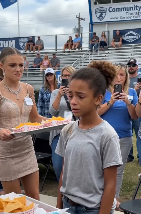
Her voice cracked across the speakers because she had forgotten the microphone was live too.
Everybody heard her.
I turned toward the crowd and forced my mouth to move.
“She deleted the injury warning,” I said.
A woman in the front row gasped. One of the county officials straightened.
The presenter, Mr. Bell, went pale. “What injury warning?”
I looked at the therapy horse standing inside the small demonstration ring, his chestnut coat brushed until it shone under the arena lights. His name was Atlas. He was gentle with children, patient with wheelchairs, calm around sudden noises.
But not that week.
“Atlas was limping after rehearsal,” I said. “Not badly. Just enough that I knew something was wrong. I entered a warning so he wouldn’t be used for the ceremony until the farrier checked him.”
The room went dead quiet.
Savannah’s father lowered his phone.
Savannah laughed, but it came out broken. “She’s lying. She wanted to ruin the event because she wasn’t chosen originally.”
The engineer clicked again.
A video opened.
It showed me alone in the arena two nights earlier, kneeling near Atlas’s front leg under the dim security lights. I was not posing. I was not smiling. I was holding a flashlight in my teeth and running my fingers carefully above his hoof while he rested his nose against my shoulder.
Then the screen showed Savannah entering the control booth later that same night.
She typed.
She deleted.
She replaced the warning with: CLEARED FOR PUBLIC DEMONSTRATION.
Someone in the bleachers said, “Oh my God.”
Mr. Bell whispered, “Savannah.”
Her father stepped forward. “This is being taken out of context.”
I finally wiped nacho cheese from my chin and looked at him.
“Atlas could have been hurt in front of those children,” I said. “That was the context.”
Then Atlas lifted his head.
The crowd shifted as the horse took one slow step toward the ring gate.
He looked straight at me.
And before anyone could stop him, Atlas pushed the gate open with his chest and walked across the arena toward the girl Savannah had called a prop.
Part 3: Atlas Crossed The Ring For Me
Nobody moved at first.
Not the presenters.
Not the officials.
Not Savannah’s friends with their phones frozen in the air.
Atlas walked slowly, carefully, like every step mattered. His reins dragged loose against the sand. The volunteer assigned to hold him whispered his name, but Atlas did not turn back. He came straight to me, past the sponsor logo, past the folding table covered in ribbon decorations, past the nacho tray that had turned my clothes into a joke.
Then he stopped inches from my chest and lowered his head.
His warm breath touched my ruined shirt.
The entire room watched as he pressed his forehead gently against me.
I broke.
Not loudly.
Not dramatically.
Just one small breath collapsing inside my ribs.
Because Atlas knew.
He knew I had sat with him when the lights were off. He knew I had changed the walking route because the squeaky bleacher rail scared him. He knew I had replaced the loose buckle before anyone important cared enough to notice. He knew my hands, my voice, my patience.
Savannah had money.
But Atlas remembered work.
A little boy in the front row whispered, “He picked her.”
That was when the applause started.
Small at first. Then louder. Then rolling through the bleachers like thunder nobody had rehearsed.
Savannah spun toward her father. “Make them stop.”
Her father’s face had turned the color of wet paper.
Mr. Bell stepped to the microphone, his voice uneven. “Everyone, please remain seated while we review the safety records.”
The county official, a woman named Marjorie Ellis, walked into the ring. She wore a dark blazer and had the kind of expression that made adults suddenly remember rules.
“Who had access to alter animal welfare entries?” she asked.
The engineer answered before anyone else could lie.
“Three people. Me. Mr. Bell. And the sponsor administrator account.”
Marjorie looked at Savannah’s father. “Mr. Covington?”
He tried to smile. “My daughter occasionally assists with donor materials.”
“Animal clearance is not donor material.”
Savannah’s eyes filled, but not with remorse. With rage.
“You’re all acting like she’s some hero,” she snapped, pointing at me. “She’s a scholarship kid who cleaned stalls because she had nothing better to do.”
Atlas shifted beside me.
His ear flicked toward her voice.
I placed a hand on his neck. “Easy.”
He settled instantly.
Marjorie saw it.
So did everyone else.
She turned back to Savannah. “And yet the horse responds to her.”
Savannah’s jaw trembled.
Her father moved close and muttered something to her, but the microphone caught enough.
“Stop talking before you cost me the contract.”
Savannah stared at him.
For one second, her anger had nowhere to go.
Then the engineer said, “There’s another deleted file.”
The room changed again.
Mr. Covington’s head snapped up. “Do not open that.”
Marjorie folded her arms.
“Open it.”
Part 4: The File Marked Private Donor Use
The engineer hesitated only once.
Then he opened the file.
The sponsor logo vanished from the big screen, replaced by a folder marked PRIVATE DONOR USE — NOT FOR PROGRAM STAFF.
A sound moved through the room, not a gasp exactly, more like everyone realizing the floor beneath the event was not floor at all.
Inside the folder were photos.
Not of Atlas smiling with children.
Not of volunteers painting fences.
Not of therapy riders gaining confidence one slow lap at a time.
These photos were different.
Expensive private parties. Covington family guests posing with Atlas. Children in formal clothes sitting on him without helmets. Adults laughing beside champagne tables while volunteers stood in the background looking tense.
Mr. Bell whispered, “Those sessions were never approved.”
Marjorie Ellis stepped closer to the screen. “Were therapy animals used for private donor entertainment?”
Mr. Covington’s face hardened. “Careful. My family funded this program when nobody else would.”
The engineer clicked another document.
Invoice.
Invoice.
Invoice.
Each one charged as a “heritage animal experience.”
Atlas’s name appeared on every page.
My stomach turned.
I looked at the horse beside me. His eyes were soft, trusting, completely unaware that people had been selling his gentleness.
Savannah shook her head. “I didn’t know about that.”
Her father looked at her like she had betrayed him by existing.
“You knew enough.”
The words landed on her face like a slap.
For the first time, I saw something behind Savannah’s cruelty that was not power. It was fear trained into a perfect posture.
But then she looked at me, and that fear twisted back into defense.
“This still has nothing to do with me throwing food.”
“No,” I said quietly. “That part was all yours.”
Several people murmured.
Savannah flinched.
Marjorie asked Mr. Bell, “Why were these not reported?”
Mr. Bell’s mouth opened and closed.
Then the engineer clicked one more file.
A scanned resignation letter appeared, dated six months earlier.
Mr. Bell’s name was on it.
Under reason for resignation, he had typed: Repeated pressure from sponsor family to ignore animal welfare boundaries.
But the status beside it read: NEVER SUBMITTED — SAVED TO DRAFT.
Mr. Bell’s shoulders sank.
“I tried,” he said. “Then they threatened to pull funding. We had twelve children waiting for sessions. I thought if I stayed, I could protect the horses quietly.”
Marjorie’s expression softened for one second, then sharpened again.
“Quiet protection is not enough when records are being falsified.”
I looked at the screen, then at Savannah.
“Why delete my warning?”
Her lips parted.
Her father answered for her.
“Because your warning would have delayed the donor ride.”
The bleachers erupted.
Savannah whispered, “Dad.”
He pointed at me.
“And because a girl like her should have been grateful to be near this program at all.”
Atlas jerked his head up.
Then the barn doors behind the arena opened, and an older woman in mud-covered boots walked in carrying a battered leather folder.
She looked at Mr. Covington and said, “You said the same thing to her mother.”
Part 5: The Woman From The Old Stable
The woman’s name was Eleanor Briggs.
I knew her before most people did.
She was the retired stable manager who had taught me how to wrap a strained leg, how to read a horse’s ears, how to tell the difference between fear and stubbornness. She smelled like hay, peppermint treats, and rain-soaked leather. She had never cared about donors, banners, or applause.
When Eleanor walked into that arena, Atlas made a soft sound in his throat.
He knew her too.
Mr. Covington went completely still.
“Eleanor,” he said. “This is not your concern anymore.”
She smiled without warmth. “You made it my concern when you put that horse under lights with a sore foot.”
Marjorie Ellis turned to her. “Do you have relevant records?”
Eleanor lifted the folder.
“I have the original welfare logs from before the program changed systems. And I have a letter from Anjali’s mother.”
My breath disappeared.
“My mother?”
Eleanor looked at me gently. “Your mother helped build the first version of this program.”
The room tilted.
My mother had died when I was eight. I remembered her as warm hands, tired eyes, and a voice singing softly while folding laundry after late shifts. She had told me stories about horses, but I thought they were just stories poor people told children so they could dream somewhere larger than the room they lived in.
Eleanor opened the folder.
A photograph appeared on the screen after the engineer scanned it.
A younger version of my mother stood beside a chestnut mare, one hand resting on the animal’s neck. Next to her stood Eleanor. Behind them was an old painted sign:
COMMUNITY THERAPY RIDING PILOT — FOUNDED BY LEENA MORGAN AND ELEANOR BRIGGS
The name hit me so hard I reached for Atlas to stay upright.
Leena Morgan.
My mother.
Savannah stared at the screen.
Mr. Covington said, “That pilot failed.”
Eleanor snapped, “It was buried.”
The crowd quieted.
She pointed at him. “Leena designed the child-safety route, the sensory introduction method, the quiet-hour program, all of it. Your company sponsored the pilot for three months, then claimed the concept as a Covington initiative after she got sick.”
I could hear my own pulse.
Mr. Covington laughed under his breath. “That is a serious accusation from a woman who lost her job.”
Eleanor removed another paper.
“Then explain why your signature is on the transfer agreement.”
The document appeared on the screen.
There was Mr. Covington’s name.
There was my mother’s name.
And beside her signature was a note in handwriting I recognized from old birthday cards:
I do not consent to removal of my name from this program.
The arena seemed to fold inward.
Savannah whispered, “Dad, what did you do?”
He did not look at her.
He looked at me.
And his expression told me the truth before his mouth did.
He had known exactly who I was from the beginning.
Part 6: The Signature My Mother Refused To Give
The nacho stain on my shirt had dried stiff against my skin.
I could feel it when I breathed.
Somehow that mattered. Somehow, with my mother’s stolen work on the screen and half the county staring at me, I still felt the humiliation Savannah had thrown onto my body. I still felt poor. Still exposed. Still like the girl everyone could look at and decide what she deserved.
Then Eleanor stepped beside me and placed my mother’s letter in my hands.
The paper was creased, soft from years of being unfolded and folded again.
“Read it,” she said.
My voice failed.
So Eleanor read it for me.
“‘If anything happens to me, I want Anjali to know the horses were never charity to me. They were language. They were how frightened children learned the world could be gentle again.’”
The room blurred.
Eleanor continued, her voice shaking now.
“‘Do not let them turn this into a sponsor story. It belongs to every child who was told to be quiet, every parent who could not afford private therapy, and every volunteer who stayed after dark because love did not fit into business hours.’”
Someone in the bleachers cried openly.
Savannah’s face collapsed, but she stayed silent.
Her father did not.
“This is emotional manipulation,” he said. “A dead woman’s letter does not override legal ownership.”
Marjorie Ellis looked at the transfer document. “No, but forged consent does.”
His mouth tightened.
The engineer zoomed in.
My mother’s supposed signature on the final transfer looked wrong. I knew it instantly. Too sharp. Too tall. Too clean. My mother’s real handwriting curved softly, like she hated hurting paper.
Eleanor placed another page down.
“This is Leena’s hospital form from the same week. She could barely hold a pen.”
The screen split the signatures side by side.
They did not match.
The county official turned to Mr. Covington.
“Who submitted the final transfer?”
He said nothing.
Savannah stepped back from him.
“Dad?”
He looked at her then, and something ugly passed between them. Not love. Not guilt. Ownership.
“You wanted a legacy,” he said coldly. “This is what legacy costs.”
Savannah’s eyes filled with tears.
“No,” she whispered. “I wanted you to be proud of me.”
He laughed once. “Then you should have learned when to keep your mouth shut.”
The words destroyed the last of her performance.
Savannah looked at me.
For once, she did not look rich. She looked small.
Then her friends’ phones buzzed almost together.
One of them gasped.
The video of her throwing food at me had gone live.
But the clip did not end with my humiliation.
It ended with Atlas walking to me.
And underneath, someone had already written the caption:
THE HORSE KNEW WHO REALLY SAVED HIM.
Part 7: Savannah Finally Told The Whole Truth
By nightfall, the arena had become impossible to control.
News vans gathered near the entrance. Parents refused to leave. County officials sealed the control booth records. Volunteers moved Atlas and the other horses back to the stable under Eleanor’s supervision, away from cameras, away from the noise.
I sat on an overturned feed bucket in the tack room, wearing a borrowed sweatshirt two sizes too big.
It smelled like cedar chips and horse shampoo.
My ruined shirt was folded in a plastic evidence bag.
That should have made me feel better.
It didn’t.
Savannah stood at the doorway, arms wrapped around herself.
Her designer boots were dusty now. Her perfect hair had fallen loose around her face.
“I didn’t know about your mother,” she said.
I stared at the floor.
“But you knew about me.”
She swallowed.
“Yes.”
The honesty surprised me enough to make me look up.
She stepped inside slowly. “He told me you were a problem. He said your mother had tried to steal credit from our family years ago. He said if your name got too visible, people would start asking questions.”
“So you threw food on me.”
Her face twisted.
“I wanted everyone looking at your clothes instead of the screen.”
There it was.
Ugly. Plain. True.
My throat tightened. “You wanted me embarrassed enough to run.”
She nodded.
“I hate you for that,” I said.
She flinched, but she accepted it.
“I know.”
For a few seconds, the only sound was Atlas shifting in his stall.
Then Savannah pulled out her phone.
“There’s a voice memo,” she said. “From this morning. My father told me to delete your file. He said your initials were showing up too much. He said your mother had already been difficult once.”
My hands went cold.
“Why are you telling me?”
Savannah looked toward the stable aisle, where her father’s lawyers were speaking with officials.
“Because he just told me I was replaceable.”
Her laugh was hollow.
“I spent my whole life thinking if I performed well enough, dressed right enough, smiled at enough donors, he would finally see me as his daughter instead of his display piece.”
She wiped her face quickly, angry at her own tears.
“And then Atlas walked past me like I wasn’t even there.”
I said nothing.
She held out the phone.
“I’ll give it to Ms. Ellis.”
“Don’t do it for me,” I said.
Savannah’s hand shook.
“I’m not sure I know how to do anything for the right reason yet.”
That answer was the first thing she had said all day that sounded real.
Then we heard shouting outside.
Mr. Covington’s voice.
Eleanor’s.
Marjorie Ellis’s.
Savannah ran first.
I followed.
In the arena entrance, Mr. Covington had grabbed Eleanor’s leather folder, and papers were scattered across the dirt.
One page landed at my feet.
It was not a transfer form.
It was a deed.
And across the top, in my mother’s handwriting, were the words:
THE HORSES MUST NEVER BELONG TO COVINGTON.
Part 8: The Horse Program That Chose Its Heir
The deed changed everything.
Not immediately.
Truth never moves as fast as humiliation.
Humiliation takes seconds. Truth takes signatures, witnesses, copies, lawyers, officials, and one exhausted girl sitting under fluorescent lights while adults finally admit what they should have seen years ago.
The deed showed that the original therapy land had never belonged to Covington Outreach at all.
It had been leased.
The land, the first barn, and the pilot program rights had been placed into a small community trust by Eleanor Briggs and my mother. The trust had one condition written so clearly that even Mr. Covington’s lawyer stopped talking when Marjorie read it aloud.
If the program is ever used for private profit or donor entertainment, stewardship transfers to Leena Morgan’s direct heir, supervised by a public board.
Everyone looked at me.
I almost laughed.
Me, in borrowed clothes.
Me, with nacho stains sealed in evidence.
Me, who had spent the morning trying not to panic because applause felt like something meant for other people.
Mr. Covington said, “She is seventeen.”
Marjorie replied, “Then the board supervises until she is of age.”
He pointed at Savannah. “And what about my family’s investment?”
Eleanor stepped forward. “You can invoice shame if you find a buyer.”
Savannah made a sound that might have been a laugh, or the last piece of fear leaving her body.
Her voice memo sealed the inquiry. The deleted warning, the forged transfer, the private donor invoices, my mother’s letter, the original deed—one by one, the story became too heavy for money to lift.
The Community Day Therapy Horse program was suspended for three weeks.
Not closed.
Rebuilt.
The sponsor banners came down first.
Then the private donor packages disappeared.
Then the old sign was restored, the one from the photograph, with one change painted beneath it:
LEENA MORGAN COMMUNITY THERAPY RIDING TRUST
At the reopening, nobody let me wear old shoes because Eleanor bought me boots and threatened to throw me into a hay pile if I argued.
Savannah came too.
She did not stand on stage.
She mucked stalls with two volunteers who had every reason not to speak to her. She did the work badly at first. Then quietly. Then better.
When she saw me watching, she said, “I’m still sorry.”
“I’m still angry,” I answered.
She nodded. “That seems fair.”
Atlas stood between us, chewing like humans were exhausting.
The first rider that morning was a little girl who had been afraid to enter the ring. I showed her how to place her hand on Atlas’s neck and feel his breathing.
“Does he know me?” she whispered.
I looked at Atlas, then at the restored sign with my mother’s name shining in fresh paint.
“He will,” I said. “Just give him something honest to remember.”
The little girl smiled and took her first step.
And for the first time in my life, when everyone watched me, I did not feel exposed.
I felt witnessed.
