Part 2: The Second Screen Opened Before She Could Run
The second piece of evidence appeared before Piper could reach the hallway.
It was not dramatic at first.
Just a small notification sliding onto the projector screen while the admissions officer’s response sat frozen behind it. A gray box. A subject line. A timestamp.
But Piper saw it and changed completely.
Her face went white under her perfect makeup, and her hand tightened around the strap of her bag like she could physically pull the truth back into darkness.
The teacher at the doorway, Mrs. Alvarez, did not move.
“Piper,” she said quietly, “sit down.”
Piper laughed once, too sharp. “I need to call my mother.”
“Your mother is already here.”
That sentence hit the room like dropped glass.
Everyone turned toward the office window.
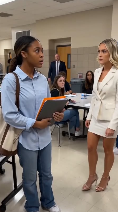
A woman in a cream blazer stood on the other side, arms crossed, lips pressed flat. I had seen her face on banners at school fundraisers, on scholarship luncheon flyers, on the framed photo near the front desk.
Claudia Whitmore.
Piper’s mother.
Board donor. Committee chair. The woman who smiled in every picture beside students she called “future leaders.”
She was not smiling now.
My cheek still stung from Piper’s slap. The print of her hand burned across my skin, hot and humiliating. Students stared at me with the same stunned pity that somehow made everything worse.
But I kept holding the paper.
The printed list of questions from the night-shift students.
The questions Piper had tried to keep from being asked.
Mrs. Alvarez walked to the laptop and read the notification aloud.
“Forwarded thread from North Valley Admissions Office. Subject: Missing student access questions.”
The admissions officer on the screen, Mr. Peter Langford, looked confused. “I sent that ten minutes ago.”
The adult in charge of the meet-up, Dean Morales, clicked it open.
The room fell silent.
There were two versions of the same question list.
The version Piper had handed to the presenter was short and polished.
Campus tours. Honors housing. Leadership brunch. Private advising.
The original list was different.
Fee waivers.
Evening class availability.
Transportation after 10 p.m.
Whether students working full-time could still qualify for the bridge scholarship.
Whether undocumented parents’ income would affect student aid.
Whether students who had missed the early session because of work could still submit admissions forms.
I heard someone whisper, “She deleted all of those?”
Dean Morales scrolled.
Then he stopped.
At the bottom of the thread was a reply from Mr. Langford.
All night-shift student questions are approved for live response. Please do not filter access-related concerns.
The room turned toward Piper.
She stood by the blocked doorway, breathing fast.
Then her mother opened the office door and said, “This meeting is over.”
Part 3: Her Mother Came Prepared To Protect Her
Claudia Whitmore entered like she expected the room to rearrange itself around her.
And for a second, it almost did.
Adults straightened. Students lowered their phones halfway. Even Dean Morales moved like he was about to explain instead of demand.
That was power.
Not loud.
Practiced.
Claudia looked at Piper first, then at me. Her eyes paused on my cheek.
Not with concern.
With calculation.
“Piper,” she said, “do not say another word.”
Piper’s lip trembled. “Mom—”
“Not one.”
Mrs. Alvarez stepped between Claudia and the door. “A student was struck in front of witnesses.”
Claudia’s expression barely shifted. “Then we will handle that through proper channels, not a public spectacle.”
I felt heat rise in my throat.
“A public spectacle is what she made me,” I said.
The room went still.
Claudia turned to me fully.
“And you are?”
My fingers tightened around the question sheet. “Nora Bennett.”
Her face changed.
It was tiny. Almost nothing. A blink too slow. A breath caught before it became sound.
But Piper saw it too.
“Mom?” she whispered.
Claudia ignored her.
Dean Morales frowned. “Mrs. Whitmore, do you know Nora?”
Claudia smiled, but it was too polished to be warm. “I know many students. That is what happens when one supports education.”
Mrs. Alvarez looked at the screen. “Then perhaps you can explain why Piper had access to admissions materials she was not authorized to edit.”
“She is a student ambassador,” Claudia said smoothly.
“She deleted questions from working students.”
“She curated a chaotic list.”
“She slapped Nora.”
Claudia’s smile vanished.
The air changed.
Piper wiped at her eyes angrily. “She was trying to embarrass me.”
I looked at her. “By asking questions other students wrote?”
“You made it sound like I hid them.”
“You did hide them.”
The words came out steadier than I felt.
Dean Morales returned to the forwarded email. “Mr. Langford, can you confirm whether the original questions were sent to this meet-up account?”
On the video call, the admissions officer adjusted his glasses.
“Yes,” he said. “They came through the shared portal at 6:12 p.m.”
Dean Morales asked, “Who downloaded the edited version?”
Mr. Langford clicked something off-screen.
Piper’s breathing became louder.
He looked back at the camera.
“The edited list was downloaded under Whitmore Foundation Guest Credentials.”
The entire room seemed to lean backward.
Claudia said, “Guest credentials are widely used.”
Mr. Langford’s voice sharpened. “Not for admissions material.”
Dean Morales scrolled again.
Another attachment appeared.
A spreadsheet.
Title: Bridge Scholarship Priority Candidates.
Piper made a small sound.
Claudia said, “Do not open that.”
Dean Morales looked at her.
Then he clicked.
Part 4: The Spreadsheet Was Not For Students
The spreadsheet filled the projector screen in rows of color-coded names.
At first, nobody understood what they were seeing.
Then the headings became clear.
Student Name.
Parent Employer.
Donor Connection.
Public Story Value.
Risk Level.
Bridge Scholarship Recommendation.
My stomach folded inward.
Public story value.
The phrase sat there like something rotten dressed in office language.
Students around me began reading faster.
“Why is my brother on there?” someone whispered.
“Risk level?”
“What does donor connection mean?”
Dean Morales slowly scrolled down.
There were dozens of names. Some highlighted green. Some yellow. Some red.
The green names had notes like “strong family donor tie,” “good media fit,” “ambassador-ready,” and “parent available for luncheon.”
The red names were different.
“Works nights.”
“Limited polish.”
“Transportation barrier.”
“Financial need high but weak optics.”
My hand went numb.
Then I saw my name.
Nora Bennett.
Red row.
Risk Level: High.
Note: Persistent. Likely to ask process questions. Mother history may resurface.
For a moment, every sound disappeared.
Mother history?
My mother had died when I was eleven. She had worked two jobs, taken night classes, and filled notebooks with plans to go back to school. She had told me college was not a dream. It was a door.
I just had to keep knocking.
“What does that mean?” I whispered.
Claudia stepped forward. “That file is internal and illegally displayed.”
Dean Morales looked furious now. “Internal to whom?”
Claudia did not answer.
Mrs. Alvarez did.
“To the Whitmore Foundation.”
Piper’s face crumpled. “Mom, what is that file?”
Claudia’s eyes flashed. “Piper, enough.”
But Piper was staring at the screen as if her own last name had become unfamiliar.
Dean Morales scrolled to the top of the spreadsheet.
Prepared by: Claudia Whitmore.
Reviewed by: Whitmore Access Committee.
Source: Community Center Admissions Outreach.
Mr. Langford spoke from the video call, his voice tight.
“That scholarship is supposed to be need-based. The college does not permit donor ranking by image value.”
Claudia’s mouth hardened. “The foundation supplements the scholarship. We have the right to ensure recipients represent the program well.”
A boy in the second row stood up. He still wore his grocery store uniform.
“So working nights makes us bad representation?”
Claudia did not look at him.
That answered more than words could.
I stared at the note beside my name.
Mother history may resurface.
“What did my mother have to do with your scholarship?” I asked.
The office door opened again.
An older man stepped inside holding a battered cardboard box.
He wore a faded maintenance jacket and looked like he had run across the parking lot.
“Nora,” he said gently, “your aunt called me.”
I knew him immediately.
Mr. Ellis.
My mother’s old night-school counselor.
He placed the box on the table and looked at Claudia.
“Tell her whose idea the Bridge Scholarship really was.”
Part 5: The Box My Mother Left Behind
Claudia Whitmore did not move.
But every polished part of her seemed to tighten at once.
Mr. Ellis placed the cardboard box on the front table with both hands, as if it carried something breakable. Dust clung to the tape. On the side, written in blue marker, was my mother’s name.
Mara Bennett.
Seeing it in public made my chest hurt.
I stepped closer without meaning to.
“What is that?”
Mr. Ellis looked at me with tired kindness. “Your mother’s night-school project files.”
My throat closed.
Claudia laughed softly. “This is inappropriate.”
Mr. Ellis did not even glance at her. “So was stealing from a dead student.”
The room erupted.
Dean Morales raised his hand, but nobody quieted right away.
Piper stared at her mother. “Stealing?”
Claudia’s voice went sharp. “You do not understand adult history.”
“No,” Piper whispered. “I think I’m starting to.”
Mr. Ellis opened the box.
Inside were folders, notebooks, old flyers, handwritten drafts, and a photograph of my mother standing in this same community center years earlier. Her hair was pulled back. Her smile was shy. She held a poster that read:
NIGHT BRIDGE: COLLEGE ACCESS FOR WORKING STUDENTS
My knees nearly gave out.
Mr. Ellis steadied me by the elbow.
“Your mother designed the first version of the admissions meet-up,” he said. “Not as a charity event. As a system. Questions collected from students who could not attend. Fee-waiver support. Evening advising. Transportation vouchers.”
I looked at the projector screen, at the deleted questions.
“They were her questions.”
“They were her promise,” he said.
Claudia stepped in. “Mara never implemented anything formally.”
Mr. Ellis removed a folder and opened it.
“Because she got sick. And because the Whitmore Foundation offered to ‘preserve’ her work.”
His voice broke slightly on the word preserve.
He held up a signed agreement.
“Mara allowed the foundation to fund the project under one condition: it had to remain open to working students first.”
Dean Morales took the paper and scanned it.
On screen, my mother’s signature appeared.
Below it was Claudia Whitmore’s.
Then another page appeared.
Amendment Request.
Submitted after Mara Bennett’s death.
Change: Remove working-student priority language.
Approved by: Claudia Whitmore.
My chest went cold.
I heard my own voice before I felt myself speak.
“You waited until she died.”
Claudia’s mask cracked.
“She was idealistic. The program needed donors to survive.”
“No,” Mr. Ellis said. “It needed integrity.”
Piper covered her face with both hands.
But the worst line appeared at the bottom of the amendment.
Reason for change: Original founder no longer available to contest revisions.
And that was when I stopped shaking.
Part 6: Piper Finally Saw What She Was Guarding
The slap had made me feel small.
The spreadsheet made me feel studied.
But that sentence made something inside me stand up.
Original founder no longer available to contest revisions.
That was not a mistake.
That was not poor judgment.
That was someone looking at my mother’s death and seeing a convenient signature gap.
I turned to Claudia.
“You built your foundation story on her absence.”
Claudia’s face went rigid. “I built a program that helped hundreds of students.”
“You helped the ones who made good pictures.”
Several students murmured.
The boy in the grocery uniform lifted his phone higher.
Claudia looked around and finally seemed to understand that the room had changed beyond her control. The students were not an audience anymore. They were witnesses.
Piper stepped toward the box.
Her hands trembled as she picked up one of my mother’s flyers.
It had a handwritten line across the bottom:
No student should lose a future because their shift ended too late.
Piper read it twice.
Then she looked at the edited question list on the screen.
Her voice broke.
“I deleted that exact question.”
Claudia snapped, “Piper.”
Piper shook her head. “No. You told me those questions made the event look messy. You told me Nora was trying to hijack the meet-up.”
“She was.”
“She was asking what her mother built this for.”
The room went silent.
For the first time, Piper looked at me without trying to win.
“I didn’t know,” she said.
I touched my cheek. “You knew enough to slap me.”
She flinched.
Good.
I wanted the truth to hurt somewhere besides my face.
Dean Morales turned to Mr. Langford on the screen. “Can the college suspend foundation involvement pending review?”
Mr. Langford nodded. “Immediately. I will escalate this tonight.”
Claudia’s eyes sharpened. “You do that and the funding disappears.”
Mrs. Alvarez stepped forward. “Then it was never access. It was leverage.”
Claudia grabbed her handbag from the chair. “Piper, we are leaving.”
Piper did not move.
Her mother stared at her. “Now.”
Piper looked at the screen again.
At the deleted questions.
At the spreadsheet.
At my mother’s box.
Then she opened her own bag and pulled out a tablet.
“I have the donor rehearsal notes,” she said.
Claudia went still.
Piper’s voice shook, but she kept going.
“They told ambassadors how to redirect ‘unflattering’ questions. My mother made us practice.”
She placed the tablet on the desk.
“And there’s a recording.”
Part 7: The Recording Changed The Whole Room
Nobody breathed while Piper unlocked the tablet.
Her fingers slipped twice.
Claudia stared at her daughter with a coldness that made even Piper shrink, but she did not stop.
The file opened.
Audio filled the room.
Claudia’s voice came through first, calm and polished.
“Remember, students asking about emergency grants, night classes, immigration paperwork, food assistance, or appeal processes should be redirected to private follow-up. We do not center hardship in the public session.”
A younger voice asked, “What if they insist?”
Claudia answered, “Then identify them. Persistent students often become reputational risks.”
My skin went cold.
Piper pressed pause.
Nobody said anything.
Then she whispered, “There’s more.”
She played the next section.
Claudia again.
“Nora Bennett may attend. If she brings up archived materials, do not engage. Her mother’s old involvement has no relevance to the current Bridge brand.”
Bridge brand.
Not scholarship.
Not access.
Brand.
Mr. Ellis closed his eyes.
Mrs. Alvarez looked like she might cry from anger.
Dean Morales asked, “Piper, why did you record this?”
Piper stared at the tablet.
“Because I hated those meetings,” she said. “Because everyone acted like kindness was a stage direction. Because I thought if I saved proof, maybe one day I could prove I wasn’t like her.”
She looked at me.
“Then today I was exactly like her.”
The honesty landed heavily.
I did not forgive her.
But I believed she had finally stopped lying to herself.
Claudia’s voice became thin. “Piper, you are destroying your family.”
Piper looked at her mother.
“No. I’m showing what you already destroyed.”
Claudia raised her hand.
Not high.
Just enough.
Piper stepped back, and the room noticed.
Dean Morales moved between them. “Mrs. Whitmore, you need to leave this room.”
Claudia laughed. “You cannot remove me from a program my foundation funds.”
Mr. Langford spoke from the screen.
“Yes, we can.”
Every head turned.
He continued, “North Valley College is freezing the Bridge Scholarship partnership pending investigation. All admissions outreach data access from the Whitmore Foundation is revoked as of now.”
Claudia’s mouth opened.
No sound came.
The screen behind him changed as he shared a new document.
Bridge Scholarship Original Charter.
My mother’s name appeared at the top.
Mara Bennett, Founder.
And beneath the founder clause, one sentence was highlighted:
If donor influence compromises working-student access, program authority returns to the founder’s named beneficiary.
Dean Morales looked at me.
“Nora,” he said softly, “do you know who your mother named?”
I already knew before he said it.
But hearing it still broke me.
Part 8: The Questions Finally Got Answered
My name appeared on the charter in my mother’s handwriting.
Nora Bennett.
I was seven years old when she wrote it.
Too young to understand scholarships, donor influence, community access, or why my mother came home from night school with ink on her fingers and hope tucked into every tired smile.
But she had named me.
Not as an owner.
Not as a mascot.
As the person who would know what it felt like when doors almost closed.
I covered my mouth.
Mr. Ellis put a hand on my shoulder. “She said you always asked the questions other people were afraid to ask.”
That hurt in a beautiful way.
Claudia left the room with two district officers beside her. She did not look back at Piper. Piper watched her go anyway, because daughters still look for mothers even when the truth tells them to stop.
The meeting did not resume immediately.
How could it?
A slap, a deleted list, a stolen program, a frozen foundation partnership—it was too much for one community center room with folding chairs and bad coffee.
But then the boy in the grocery uniform raised his hand.
His voice was quiet.
“So… can we still ask about evening classes?”
That was when I cried.
Not loudly. Not helplessly. Just enough for Mrs. Alvarez to pass me a tissue and pretend she was not crying too.
Mr. Langford stayed on the call. Dean Morales pulled up the original list. Mr. Ellis sat beside my mother’s box. One by one, the questions Piper had deleted were read aloud.
Fee waivers.
Night classes.
Late bus routes.
Appeal forms.
Emergency grants.
Work-study.
Application deadlines for students who had already missed two meetings because their bosses would not change their shifts.
And this time, every question got answered.
No one redirected hardship into a private corner.
No one called poverty messy.
No one turned access into a brand.
Three weeks later, the Whitmore Foundation name came down from the Bridge Scholarship page. The program was renamed the Mara Bennett Night Bridge Fund. A public student advisory board replaced the donor committee, and every meeting had one rule printed in bold across the top:
The first questions answered are the ones most likely to be ignored.
Piper was suspended for the slap and removed from the ambassador program. When she returned, she did not ask me to defend her. She gave a statement to the investigation and turned over every donor rehearsal file she had.
One afternoon, she left a folded note on my desk.
I read only the first line.
I am sorry I became the kind of person your mother was fighting.
I kept the note.
Not because it healed my cheek.
Because records matter.
At the first Night Bridge meeting after the investigation, I stood at the front of the same Phoenix community center with my mother’s box open beside me. The room was full of students in work shirts, scrubs, fast-food uniforms, faded hoodies, and tired eyes that still dared to look forward.
My hand shook when I picked up the question list.
Then I heard my mother’s sentence in my head.
No student should lose a future because their shift ended too late.
So I lifted the microphone.
And this time, nobody stopped me from reading every name.
