Part 2: The Face On The Final Recording
The face on the monitor was not Victoria’s.
That was what made everyone stop breathing.
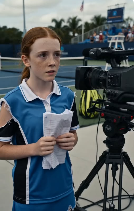
The video showed a narrow backstage hallway behind the media tents, where cables ran along the floor and folding chairs lined the wall. A student in a navy warm-up jacket stood near the exit with her tennis bag hanging from one shoulder. Her eyes were red. Her hands were wrapped tightly around a paper envelope.
Across from her stood a woman in a white blazer.
Elegant. Calm. Familiar.
Cecilia Kensington.
Victoria’s mother.
The woman who owned half the broadcast company covering the championship.
The woman whose name was printed on the sponsor wall outside the main court.
Victoria made a sound so small I almost missed it.
“No,” she whispered.
On-screen, Cecilia leaned closer to the student.
“You are a good player, Livia,” she said. “But national television is not about fairness. It is about the right story.”
The student’s voice shook. “The scout already invited me to the scholarship interview.”
“And now you will decline politely.”
Several students around the filming area gasped.
The executive producer, Daniel Reeves, did not pause the video.
Cecilia continued, “If you insist on making this difficult, people will start asking how your travel fees were covered. I wonder whether your coach followed every reporting rule.”
The student’s face collapsed.
“That’s not fair.”
Cecilia smiled.
“No, darling. It’s television.”
The screen froze on Cecilia’s face.
Beside the monitor, Victoria looked like she had been pulled out of her own body. Her mouth opened, but nothing came out.
Daniel turned toward her. “That was recorded yesterday morning.”
Victoria shook her head. “I didn’t know she said that.”
A boy from the doubles team laughed bitterly. “You didn’t know? You told me my sponsor would drop me if I spoke to the producers.”
Victoria spun toward him. “I never said that.”
“Yes,” he said, stepping forward. “You did.”
Then another student raised her hand.
“And me.”
Another voice came from the back.
“Me too.”
The filming area filled with the sound of truth arriving from every direction.
I stood there with my cheek burning, my patched uniform suddenly visible on every camera, and understood something terrifying.
This had never been just about my interview.
It had been about controlling which students were allowed to be seen.
Victoria looked at me then.
For the first time, she did not look angry.
She looked afraid of the same machine she had used against everyone else.
Then Cecilia Kensington herself walked into the filming area, saw the paused image on the monitor, and stopped cold.
Daniel turned to her.
“Mrs. Kensington,” he said, “would you like to explain why your private intimidation meeting is in our official review footage?”
Part 3: The Contract Hidden Behind The Interview
Cecilia did not rush.
People like her never rushed. They let others panic first, then stepped into the silence wearing control like perfume.
She looked at the cameras, the students, the producers, then finally at me.
Her eyes paused on my patched knees.
Not with surprise.
With calculation.
“This appears to be a private conversation taken out of context,” she said.
Daniel’s jaw tightened. “You pressured a student to withdraw from a scholarship opportunity.”
“I advised a young athlete about media exposure.”
“You threatened her coach.”
“I questioned compliance.”
A reporter near the press rope lifted her microphone. “Mrs. Kensington, did your company attempt to influence the feature selection?”
Cecilia smiled gently. “My company supports student athletics nationwide. I would hope every parent here understands the dangers of turning a teenage misunderstanding into a public attack.”
Teenage misunderstanding.
Victoria slapped me.
Livia was threatened.
Other students had been cornered, warned, and pushed out of opportunities they had earned.
And Cecilia called it a misunderstanding because she knew expensive words could make ugly things sound softer.
Daniel connected another file to the monitor.
“This is the original feature outline sent to our production team six weeks ago.”
A document appeared.
At the top was the championship logo.
Beneath it was a title:
VICTORIA KENSINGTON: LEGACY UNDER PRESSURE.
My stomach dropped.
Victoria stared at the screen.
The outline had been written before producers interviewed any students. Before they reviewed hardship stories. Before I was selected. Before Livia was invited to meet scouts.
It described Victoria as “the emotional center of the tournament broadcast.”
It described other students as “background texture.”
Background texture.
I thought of my mother ironing my old uniform the night before because we could not afford a new one. I thought of the bus rides to the tennis club. The long hours chasing balls under the sun while players with private coaches warmed up on courts I could never pay to use.
Background texture.
Daniel scrolled lower.
Attached was a media influence agreement between Kensington Broadcast Group and the event publicity office. It did not directly say Victoria would receive the feature.
It said something worse.
Sponsor family priority consideration for human-interest segments.
The room erupted.
Victoria turned to her mother. “You said they picked me because of my record.”
Cecilia’s face hardened.
“They should have.”
“No,” Daniel said. “They didn’t. Our independent review team selected Ella Brooks because her story tested highest for authenticity, perseverance, and public impact.”
Cecilia looked at him with cold dislike.
Then she said, “A ball girl is not the face of a national championship.”
The cameras turned toward me.
My throat tightened.
Before I could speak, Livia stepped forward from behind the crew tent.
Her voice shook, but her eyes were fierce.
“Maybe that is why she should be.”
Part 4: The Student Victoria Tried To Erase
Livia Novak looked smaller in person than she had on the screen.
She had a white bandage wrapped around two fingers and the exhausted face of someone who had spent the morning deciding whether truth was worth losing everything.
Daniel moved gently toward her. “Livia, you don’t have to speak here.”
She looked at Cecilia, then at Victoria, then at the crowd of students who were finally watching the right person.
“Yes,” she said. “I do.”
Cecilia folded her arms. “Be careful.”
Livia laughed once.
It sounded broken.
“That’s what you said yesterday.”
The crowd went silent again.
Livia reached into her tennis bag and removed the same envelope from the video. She handed it to Daniel.
“These are the scholarship interview documents,” she said. “I was invited because my regional scores qualified me. But after Victoria found out, she told me the scouts were already committed to her.”
Victoria shook her head. “I was angry. I didn’t mean—”
“You meant every word,” Livia said. “You said girls like me should be grateful just to stand near the main court.”
My chest hurt.
Because I knew that sentence.
Not the exact words.
The feeling.
The way people with clean shoes and family connections made you feel like breathing their air was a favor.
Livia looked at me. “When Ella was picked for the feature, Victoria said she would fix it before broadcast.”
Victoria whispered, “Stop.”
Livia did not.
“She said her mother knew how to make people disappear from a story.”
Cecilia stepped forward sharply. “Enough.”
Security moved closer.
For the first time, Cecilia looked genuinely angry. Not embarrassed. Not worried. Angry that someone she considered replaceable had learned to speak publicly.
Daniel opened the envelope.
Inside were forms, emails, and a printed message.
The message was from Victoria.
If you keep the scout meeting, I’ll make sure everyone knows your coach broke travel rules. Think carefully.
Livia’s hands trembled.
“My coach didn’t break anything,” she said. “He used his own money so I could get here.”
A coach in the back raised his head.
His face went pale.
“Livia,” he said softly.
She turned toward him and tried to smile, but her mouth shook.
“I’m sorry, Coach.”
He walked to her and placed a hand on her shoulder.
“No,” he said. “I’m sorry you thought you had to carry that alone.”
Victoria looked at them, and something inside her seemed to crack.
Then Daniel’s assistant rushed over with a headset pressed to one ear.
She whispered something.
Daniel’s expression changed.
He looked toward Cecilia.
“The network legal team just found a second contract.”
Part 5: The Family Name Behind Every Threat
Cecilia moved before anyone else did.
She reached for Daniel’s tablet.
A security guard stepped between them.
The movement was small, but the meaning was huge.
A woman who had controlled rooms with money and smiles had just been physically stopped from touching the evidence.
Daniel’s assistant, a young producer named Elise, connected the new file to the monitor.
“This was stored under event sponsorship documents,” she said. “It was mislabeled as hospitality vendor terms.”
The document opened.
KENSINGTON BROADCAST GROUP — IMAGE PROTECTION ADDENDUM.
The first paragraphs were dull legal language.
Then Daniel scrolled.
A highlighted section appeared:
All student-centered broadcast materials shall avoid narratives that diminish the legacy profile of approved sponsor-family athletes.
A reporter said, “Meaning?”
Daniel’s voice was grim. “Meaning the contract tried to prevent us from showing any student whose story made Victoria look privileged by comparison.”
My face went hot.
There it was.
Not jealousy.
Not one spoiled girl losing control.
A system built to make sure hardship stayed decorative but never central. Poor students could appear in crowd shots, chase balls, fill emotional background, clap from the sidelines.
But we were not supposed to become the story.
Victoria stared at the addendum like she was reading her own reflection for the first time.
Cecilia’s mask slipped.
“This is business,” she said. “Broadcasts have structure.”
Daniel turned on her. “You structured children out of opportunities.”
Cecilia’s eyes sharpened. “They are not children when they accept national exposure.”
That sentence turned the whole area colder.
Even some of the wealthy parents looked uncomfortable now.
Livia’s coach stepped forward. “You threatened my student with false allegations.”
“I raised concerns.”
“You used fear.”
“I used judgment.”
Then a new voice spoke from the media tent entrance.
“No. You used me.”
Everyone turned.
It was Victoria.
Her face was wet, but her voice had steadied in a strange, fragile way.
Cecilia looked at her daughter with warning. “Do not perform guilt because the cameras are on.”
Victoria flinched.
Then she laughed quietly, painfully.
“That’s all you ever think anything is. Performance.”
Her hands curled at her sides.
“You told me if I wasn’t the face of this tournament, people would forget me. You told me Ella was dangerous because people would pity her.”
I felt every camera shift between us.
Victoria looked at me.
“I believed you,” she said. “And then I slapped her because I was terrified she proved you wrong.”
Cecilia’s mouth tightened.
Daniel asked, “Victoria, did your mother instruct you to pressure other students?”
Victoria closed her eyes.
When she opened them, her whole world changed.
“Yes,” she said. “And I have the messages.”
Part 6: The Match They Tried To Cancel
The championship committee paused the broadcast within minutes.
That was how everyone knew the problem had become bigger than a slap.
The main court announcer told the crowd there was a “temporary production delay.” In the stands, spectators checked their phones. Reporters began posting updates. Parents clustered under sponsor banners that suddenly looked less like decoration and more like evidence.
Victoria handed her phone to Daniel with both hands.
Cecilia watched like she wanted to burn the device with her eyes.
A committee official escorted me to the medical tent to check my cheek. I kept saying I was fine, even though my jaw ached and my hands would not stop shaking.
The nurse gave me an ice pack.
“You don’t have to go back out there,” she said.
But I could still hear the crowd beyond the canvas wall. The national championship moving around me. Shoes on pavement. Cameras rolling. My name traveling through a place where it had never belonged before.
I pressed the ice pack to my cheek.
“I do,” I said.
When I returned, the tournament director, Mr. Halpern, stood with Daniel, two network lawyers, and the head referee. Their faces were serious.
Daniel looked at me carefully. “Ella, the interview feature is temporarily suspended.”
Of course.
My stomach sank.
Cecilia had lost control, but somehow my story was still the first thing to disappear.
Then Daniel continued.
“Not canceled. Suspended until we can air it without sponsor interference.”
Mr. Halpern looked toward the main court. “There’s another issue.”
Livia’s coach stepped forward. “Her scout meeting?”
“Restored,” Mr. Halpern said. “But Victoria’s match is next. Given her admission and the ongoing review, she may be removed from competition.”
Victoria stood a few feet away, pale and silent.
For a moment, nobody spoke.
Then Livia said, “Let her play.”
Everyone looked at her.
Cecilia almost smiled, mistaking mercy for weakness.
But Livia’s voice was calm.
“Not because she deserves protection. Because if she is removed quietly, people will say she was robbed. Let the record show everything clearly. Let her play under the same rules as everyone else.”
Victoria looked at Livia as if she had been handed something too painful to hold.
The head referee nodded slowly. “No special treatment. No media exceptions. No sponsor access.”
Cecilia’s face tightened. “My daughter should not be used as a public lesson.”
I finally spoke.
“No,” I said. “She should have learned one before she slapped me.”
Victoria lowered her eyes.
Cecilia glared at me.
But she had run out of rooms where her glare could make people move.
Part 7: The Testimony That Broke The Broadcast
Victoria lost her match in straight sets.
Not because she was untalented. She was talented. Everyone knew that. Her serve was sharp, her movement fast, her backhand cleaner than most girls our age.
But talent does not protect you from shaking hands.
Every time the crowd murmured, she looked toward the cameras. Every time she missed a point, Cecilia’s face hardened from the restricted seating area where security kept her away from production staff.
Livia won her own match later that afternoon.
The applause for her was different from the applause for Victoria. Not louder at first. Just warmer. Like the crowd had finally understood what pressure looked like when nobody wealthy was packaging it for television.
My interview aired that evening.
Live.
Daniel made that decision after the network replaced the planned sponsor segment with an investigative statement. The broadcast opened not with Victoria’s legacy profile, but with a message from the network president announcing an independent review of Kensington influence in student coverage.
Then the camera cut to me.
I sat beside the practice courts in my old uniform with my repaired seams and patched knees visible under the lights.
Daniel asked me what I wanted people to understand.
I had prepared answers before everything happened.
About working hard.
About helping my family.
About loving tennis even from the sidelines.
But when the camera light turned red, the prepared words disappeared.
So I told the truth.
“I used to think being unseen meant I was safe,” I said. “If nobody noticed me, nobody could take anything from me. But today I learned that being unseen is exactly how people get away with taking things.”
My voice trembled.
I kept going.
“I’m not the best tennis player here. I’m not rich. I don’t have a family name that opens doors. But I know what it feels like to work beside a dream every day and still be told you don’t belong near it.”
Behind the camera, Livia wiped her eyes.
Daniel asked, “And what would you say to students watching who feel the same way?”
I looked straight into the lens.
“Keep records. Keep your voice. And when someone calls your story background, remember that background is where the truth usually gets hidden.”
The clip spread before the championship ended.
By nightfall, the network had released the backstage footage to investigators. Cecilia Kensington stepped down from all youth sports programming. The event committee froze her company’s sponsorship role.
But the final shock came at midnight.
Victoria posted one video.
No makeup. No perfect lighting. No family crest behind her.
She looked straight at the camera and said, “Ella Brooks did not steal my interview. My family tried to steal everyone else’s chance.”
Part 8: The Trophy That Finally Chose The Truth
One year later, I returned to the championship as a guest.
Not as a ball girl.
That felt strange enough.
What felt stranger was walking through the media entrance and watching security wave me through without asking whether I was lost.
My uniform was gone. I wore a simple blue dress my mother had bought on clearance and altered herself. She cried while hemming it, though she pretended the steam from the iron bothered her eyes.
The tournament looked different now.
No Kensington banners.
No sponsor-family feature priority.
No private media rooms where students could be cornered away from witnesses.
A new rule required all scholarship interviews to be logged, recorded, and reviewed by an independent student advocacy panel.
Livia Novak sat on that panel.
She had earned her scholarship.
She hugged me so hard my ribs hurt.
“You ready?” she asked.
“No.”
“Good. That means it matters.”
The ceremony was held on the main court before the final match. Daniel Reeves stood at the microphone, and behind him was a small covered display.
I thought I had been invited to speak about the new student media fairness program.
I was wrong.
Daniel looked at the crowd.
“Last year, a student reminded this championship that talent is not the only thing worth honoring. Integrity matters. Work matters. Courage matters. And sometimes the person carrying the balls sees the game more clearly than everyone sitting above the court.”
My throat tightened.
He pulled the cover away.
It was not a trophy.
It was my old ball-girl badge, framed beside a strip of broadcast transcript from my interview.
Under it was a plaque:
THE ELLA BROOKS STUDENT VOICE FELLOWSHIP.
I stared at it.
For a second, I could not hear the applause.
Then I saw my mother standing in the front row with both hands over her mouth.
Livia was crying openly.
Victoria was there too.
That surprised me.
She stood near the aisle, not with cameras, not with an entourage, just quietly holding a folder. After the ceremony, she came to me and handed it over.
Inside were signed statements, messages, and internal family documents she had continued providing to investigators for months.
“I’m not asking to be part of your ending,” she said.
I looked at her for a long moment.
“Good,” I said. “This isn’t an ending.”
She nodded.
“I know.”
Then she looked toward the framed badge.
“My mother said people like you were dangerous because you made people feel too much.”
I touched the glass over the old badge.
“No,” I said. “People like me are dangerous because we remember what happened when everyone else calls it uncomfortable.”
Victoria lowered her eyes.
The first recipient of the fellowship was announced that afternoon.
A thirteen-year-old junior volunteer from a public park program who had filmed unsafe court conditions at her local club and used the video to get them repaired.
She stepped onto the court wearing sneakers with peeling soles and a smile too big to hide.
I handed her the certificate.
The crowd stood.
And as the applause rose across the stadium, I realized the greatest victory was not that they finally put my name in lights—it was that the next girl in a patched uniform would never have to wait for someone rich to decide her story deserved to be seen.
