Part 2: The Office Already Knew My Name
The soda was still running down my neck when the loudspeaker called us.
“Isabel Moreno and Blair Hawthorne, please report to the main office.”
My name sounded strange over the courtyard speakers.
Too public.
Too exposed.
A few kids laughed nervously, then stopped when Ms. Ortega turned around with a look sharp enough to cut through the movie screen. Parents were still sitting on picnic blankets with popcorn tubs in their laps, whispering in English and Spanish, while younger siblings stared at me like I had become part of the show.
Blair stood beside the snack table with her empty cup still in her hand.
Her white cardigan was spotless.
Mine was soaked.
She had splashed soda in my face because I had reached for the printed parent registration email. Because I had said the Spanish subtitles had not “failed.” They had been removed.
And now everyone knew there was a record.
Blair’s friends lowered their phones too late.
The damage was already done.
Ms. Ortega took the paper from my shaking hand and walked us inside. The school hallway felt too bright after the courtyard lights. My sneakers squeaked against the floor. Soda stuck to my skin. I wanted to wipe my face again, but I refused to look like I was cleaning up her cruelty for her.
Blair walked ahead of me.
Her shoulders were stiff.
She did not look scared until we reached the office.
That was when I saw the woman waiting in the visitor chair.
Vivienne Hawthorne.
Blair’s mother.
PTA president, gala chair, donor liaison, the woman whose name appeared on every banner near the courtyard entrance. She was wearing a navy dress and pearl earrings, sitting perfectly straight with one hand over her phone.
She looked at Blair first.
Then at me.
Then at the soda stains.
Her mouth barely moved.
“Blair,” she said, “do not explain anything.”
Principal Daniels stood near the secretary’s desk, holding a tablet. “Mrs. Hawthorne, a student was assaulted in front of families.”
Vivienne smiled like he had used the wrong word at the wrong dinner party.
“Let’s not make teenage drama into assault.”
My cheek burned hotter than the soda.
Ms. Ortega placed the registration email on the desk.
“It stopped being drama when the subtitle requests disappeared from the screening file.”
Blair snapped, “They didn’t disappear. She’s making this about race because she’s jealous.”
The room went silent.
Principal Daniels looked at the tablet.
Then he tapped the screen once.
The parent registration email opened.
At the top, in bold, was the sentence Blair had tried to bury:
Spanish subtitles requested by 47 families. Confirmed and approved.
Part 3: The Email Had Been Forwarded Twice
Blair’s face changed before anyone said another word.
Not much.
Just enough.
Her eyes flicked toward her mother, then back to the screen. Vivienne Hawthorne did not move at all, which somehow made her look more dangerous.
Principal Daniels scrolled down.
The original registration email showed a clean list: family names, student names, accessibility needs, seating requests, language preferences. Spanish subtitles had been requested again and again, not as a special favor, not as a political statement, but because parents wanted to watch a movie with their kids and understand every line.
My mother’s name was there.
Moreno Family — Spanish subtitles requested.
So were the Garcías, the Torres family, the Aguilars, the Méndez family, the Reyeses, and dozens more.
Blair crossed her arms. “So? Maybe the file didn’t load.”
Ms. Ortega looked at her. “Then why did you tell the projection booth not to turn them back on?”
Blair opened her mouth.
Vivienne answered first.
“My daughter helps coordinate student volunteers. She may have repeated a technical instruction.”
The principal tapped again.
The email thread expanded.
The registration request had been forwarded from the school office to the movie night planning committee.
Then from the planning committee to Vivienne Hawthorne.
Then from Vivienne Hawthorne to Blair.
Attached note:
Keep the program clean and simple. No subtitles on the main screen. It changes the event tone.
Nobody spoke.
Event tone.
That was what my mother’s language had been reduced to.
A tone problem.
The office door was half-open. Outside, a few students had gathered, pretending to need water from the fountain. News moved through schools faster than Wi-Fi.
Blair’s voice shook. “Mom, that wasn’t about Spanish.”
Vivienne’s gaze sharpened.
“Blair.”
But Blair kept staring at the screen.
Principal Daniels said, “Mrs. Hawthorne, you instructed your daughter to override approved parent accessibility requests?”
Vivienne stood. “I instructed my daughter to avoid visual clutter during a public donor event.”
Ms. Ortega’s face hardened. “It was a school family night.”
“It was also a fundraiser.”
There it was.
The sentence that made everything clear.
The movie night had never just been for families. It had been a donor showcase dressed up in popcorn and lawn chairs.
Principal Daniels scrolled farther.
A second attachment appeared.
Budget Allocation: Outdoor Movie Night / Community Inclusion Grant.
Ms. Ortega whispered, “What grant?”
Vivienne reached for her handbag.
Principal Daniels clicked before she could speak.
And the budget opened onto the screen.
Part 4: The Grant Was Never For Donors
The budget looked boring until the numbers started speaking.
Community Inclusion Grant: $18,000.
Approved uses: bilingual event access, translation support, multilingual outreach, family transportation vouchers, adaptive seating.
Actual spending: donor reception tent, premium catering, private parking attendants, branded photo backdrop.
I stared at the screen.
A strange cold moved through me.
Because suddenly the missing subtitles were not an accident. They were not even just Blair trying to embarrass me.
They were proof of a larger lie.
The school had received money to make families feel included.
And the Hawthornes had turned inclusion into decoration.
Ms. Ortega stepped closer to the tablet. “Where are the translation funds?”
Vivienne’s smile disappeared.
“Reallocated.”
Principal Daniels looked up. “By whom?”
Vivienne said nothing.
Blair whispered, “Mom?”
It was the first time she sounded like a daughter instead of a weapon.
The principal opened the next file.
A planning note appeared with Vivienne’s name at the top.
Spanish subtitles may alienate certain donor guests. Offer printed bilingual flyers near back table if requested. Do not emphasize language accommodations during welcome remarks.
My hands curled into fists.
Printed flyers.
Near the back table.
That was supposed to replace parents sitting beside their children and understanding the same movie at the same time.
Ms. Ortega said, “You hid approved services from families.”
Vivienne’s voice turned cold. “I protected the event from becoming divisive.”
I stepped forward before fear could stop me.
“My mother asked for subtitles so she could laugh at the same jokes as my little brother.”
Vivienne looked at me slowly.
“Isabel, this conversation is above your level.”
The words landed with the same sticky humiliation as the soda.
Blair looked at me, then at her mother, and something uncertain passed through her face.
Principal Daniels opened another page.
Volunteer Assignment Sheet.
Projection Booth Assistant: Blair Hawthorne.
Manual Override Access: temporary.
Subtitle File Status: disabled at 6:41 p.m.
Disabled by: B. Hawthorne.
Blair’s breath caught.
Ms. Ortega turned to her. “You personally turned them off.”
Blair’s lips trembled. “I was told to.”
Vivienne snapped, “Do not blame me because you panicked.”
The office went quiet.
Blair stared at her mother as if she had just been abandoned in the middle of her own lie.
Then the secretary stepped in, holding a small paper bag.
“Principal Daniels,” she said softly, “Isabel’s mother is here.”
My stomach flipped.
Behind her, my mother entered wearing her grocery-store uniform, her hair still pinned under a name badge.
She looked at my wet shirt.
Then at Blair.
Then at Vivienne.
And her face changed.
“You,” my mother said.
Part 5: My Mother Recognized The Woman Behind It
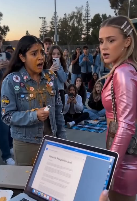
Vivienne Hawthorne went still.
Not surprised.
Caught.
My mother stepped inside with her work shoes squeaking faintly against the office floor. She smelled like rain, paper bags, and the orange soap from the employee sink at the grocery store.
“Mamá,” I whispered.
She touched my cheek, careful around the sticky soda stain.
“Did she do this?”
I nodded.
Blair looked down.
Vivienne’s voice sharpened. “This is a school disciplinary matter.”
My mother turned toward her.
“No, Vivienne. This is what you do when nobody stops you.”
The principal’s eyes narrowed. “You know each other?”
My mother gave a small, humorless laugh.
“I translated her first parent-outreach campaign eight years ago.”
Vivienne’s jaw tightened.
Ms. Ortega looked at her. “For this school?”
“For the district,” my mother said. “Back when the Hawthorne Foundation wanted to look like it cared about immigrant families.”
She reached into her bag and pulled out a folded envelope, soft from age.
“I kept copies.”
Vivienne’s polished face cracked.
“María, be careful.”
My mother placed the envelope on the desk.
“No. I was careful for too long.”
Inside were printed drafts, handwritten translation notes, and an old agreement with my mother’s name: María Moreno — Community Language Consultant.
I had never seen it before.
My mother had always said she helped with school forms sometimes, nothing special. She had never told me her words had been used in district campaigns.
Principal Daniels scanned the first document.
A slogan appeared on the office screen:
Every Family Belongs In The Same Room.
Below it, my mother’s notes filled the margins in Spanish and English.
My chest tightened.
“That was yours?” I asked.
She nodded without looking at me. “The idea, yes.”
Vivienne cut in. “Your mother was paid for translation work.”
My mother looked at her. “Not for the family inclusion model. Not for the bilingual registration system. Not for the parent access plan your foundation still uses.”
The room shifted.
Principal Daniels scrolled through the old agreement.
At the bottom was a clause:
Community consultant retains authorship credit for language-access framework.
Then another file appeared from the current movie night folder.
Language Access Framework: Hawthorne Family Inclusion Model.
My mother’s name was gone.
Mine almost stopped breathing.
Vivienne sighed. “This is ancient history.”
“No,” Ms. Ortega said. “This is the same history. You just used her daughter to expose it.”
Blair whispered, “Mom, did we steal her work?”
Vivienne looked at her daughter.
And said nothing.
Part 6: Blair Heard The Recording No One Expected
The silence after Blair’s question was worse than an answer.
My mother stood beside me, one hand resting lightly on my shoulder. I could feel how tired she was. She had probably left work early, lost pay, hurried across town, and walked into an office where the woman who erased her work was now trying to erase her child’s dignity too.
Principal Daniels asked, “Mrs. Hawthorne, did your foundation remove María Moreno’s authorship credit?”
Vivienne lifted her chin. “The foundation developed the public version.”
My mother said, “From my private notes.”
“From community input.”
“From unpaid community trust.”
Vivienne looked bored now, and somehow that hurt more. “You signed a release.”
My mother froze.
I looked at her. “Did you?”
She shook her head slowly. “No.”
Vivienne opened her phone and sent something to the principal’s email.
Seconds later, a document appeared on the screen.
Release of Consultant Materials.
Signature: María Moreno.
My mother stared at it.
“That is not my signature.”
Vivienne gave a soft laugh. “Convenient.”
My face went hot. “Don’t talk to her like that.”
Blair suddenly said, “Wait.”
Everyone turned.
Her face had gone pale again, but this time the fear was pointed at her mother, not at the evidence.
“What?” Vivienne asked.
Blair pulled out her phone with shaking hands.
“I have the gala rehearsal audio.”
Vivienne’s eyes flashed. “Blair.”
“No,” Blair said. “You said it was just for speech timing.”
She opened a recording.
The office filled with Vivienne’s voice, elegant and smooth.
“Do not mention María Moreno. The old consultant credit creates unnecessary ownership questions. Refer to the framework as Hawthorne-led. If anyone asks about Spanish subtitle funding, say technical limitations required a simplified screen format.”
My mother closed her eyes.
The recording continued.
A man’s voice asked, “And if families complain?”
Vivienne answered, “Most won’t. They’re used to being grateful for whatever they get.”
Something broke in me then.
Not loudly.
Quietly.
Permanently.
Blair stopped the recording.
Her eyes were full of tears now. “You told me Isabel was trying to embarrass us.”
Vivienne snapped, “She was.”
Blair looked at my stained shirt.
Then at my mother.
Then at the screen full of stolen credit.
“No,” she said. “We embarrassed ourselves.”
For one second, I thought Vivienne might slap her own daughter with words.
Instead, she reached for the phone.
Blair stepped back.
Principal Daniels said, “Do not touch that device.”
Outside the office, the courtyard speakers crackled.
A teacher’s voice came through.
“Families, please remain seated. We will be restarting the movie shortly.”
Ms. Ortega looked at me.
“Isabel,” she said softly, “do you want the subtitles restored?”
My throat tightened.
“Yes,” I said. “All of them.”
Part 7: The Courtyard Saw The Real Story
We walked back into the courtyard together.
Not like friends.
Not like everything was fixed.
But like the office could no longer contain what had happened.
My mother stayed beside me. Blair walked behind us with her phone clutched in both hands. Vivienne followed last, escorted by Principal Daniels and the assistant principal, her face frozen in a calm so brittle it looked painful.
The courtyard had changed.
Parents were standing now. Students whispered in clusters. Little kids sat on blankets eating popcorn, confused by adult tension but thrilled the movie had paused long enough for extra snacks.
The screen still showed the movie menu.
No subtitles.
The projector booth volunteer looked down at Principal Daniels, waiting.
Ms. Ortega took the microphone.
Her voice shook once, then steadied.
“Families, we apologize. The Spanish subtitles requested on your registration forms were approved. They were removed without authorization. We are restoring them now.”
A wave moved through the courtyard.
Some parents clapped immediately.
Others looked angry.
My mother’s grip tightened around my hand.
Then Ms. Ortega continued.
“We are also reviewing the use of community inclusion grant funds and language-access materials connected to tonight’s event.”
Vivienne stepped forward. “This is not appropriate for a family gathering.”
A father near the front called out, “Neither is taking our money and hiding our language.”
The crowd murmured louder.
Blair flinched.
She looked at me.
I did not rescue her.
She had to stand inside what she helped do.
Principal Daniels nodded to the booth.
The projector menu shifted.
Spanish subtitles: ON.
Audio description: available.
Caption language options: enabled.
The first Spanish line appeared on the giant screen.
It was only a menu instruction, nothing poetic.
But my mother covered her mouth.
A few rows away, an older grandmother smiled and tapped her grandson’s arm, pointing up as if the words were fireworks.
I felt something in my chest loosen.
Blair stepped to the microphone.
Vivienne hissed, “Blair, no.”
Blair ignored her.
“My name is Blair Hawthorne,” she said, voice trembling. “I disabled the subtitles after my mother told me to keep the screen clean for donor guests.”
The courtyard went silent.
She swallowed hard.
“I also threw soda at Isabel Moreno because I wanted everyone to look at her humiliation instead of the proof.”
My face burned again, but this time I did not lower my head.
Blair looked at the crowd.
“That was cruel. And it was racist. And I am sorry.”
Vivienne walked away before her daughter finished.
Nobody followed her.
Part 8: The Words Stayed On The Screen
The movie restarted twenty minutes later.
Not because everything was normal.
Because families had come to watch a movie with their children, and for once, the adults decided not to make them pay for someone else’s coverup.
The Spanish subtitles stayed on the screen.
Line after line.
Bright, clear, impossible to ignore.
Some families read them quietly. Some laughed at jokes at the same time as everyone else. My little brother leaned against my mother’s shoulder and whispered, “Mamá, now you know what they said.”
She smiled, but her eyes were wet.
“I always knew more than they thought,” she whispered back.
By Monday morning, the story had traveled through the school, the district, and half of Los Angeles parenting groups. Not just the soda. Not just Blair’s confession. The grant budget, the registration emails, the fake consultant release, the gala recording—every piece became part of the official investigation.
Vivienne Hawthorne resigned from the PTA before she could be removed.
The Hawthorne Foundation’s district contract was frozen.
The community inclusion grant was audited.
And my mother’s old language-access framework was restored under its original name:
The Moreno Family Access Plan.
She hated the attention at first.
She said she was only a grocery worker who translated things because parents needed help.
Ms. Ortega told her, “That is exactly why your name belongs on it.”
Blair was suspended for what she did to me. When she returned, she was quieter. Not forgiven. Not fixed. Just quieter, like someone finally hearing the echo of her own voice.
One afternoon, she left a handwritten note in my locker.
I thought status would protect me from shame. It only protected me from learning sooner. I am sorry.
I kept the note.
Not because it healed what happened.
Because records matter.
At the next outdoor movie night, the courtyard looked different. No donor tent. No private parking row. No VIP snack table pretending to be community service.
At the entrance, families filled out registration forms in multiple languages. Volunteers checked accessibility requests before anyone touched the projector. My mother stood beside the booth with a clipboard, arguing gently with Principal Daniels about font size.
When the movie began, the subtitles appeared immediately.
English.
Spanish.
Captions for sound.
Everything families had asked for.
My little brother nudged me. “You fixed it.”
I looked at the screen, then at my mother, then at the rows of parents who no longer had to sit quietly through a story half-hidden from them.
“No,” I said. “We made them stop hiding it.”
And under the courtyard lights, every word stayed where everyone could see it.
