Part 2: The Footage No One Expected To Survive
The chair’s words cut through the ballroom like a glass cracking in someone’s hand.
“Bring up the rest of the footage.”
Victoria Kingsley stopped smiling.
For one second, only one second, her perfect face slipped. The soft pink gloss, the diamond clips in her hair, the practiced tilt of her chin—all of it vanished under something raw and frightened.
I stood beside the stage in my wrinkled silver dress, my cheek still warm from her slap, my fingers curled around the edge of the curtain so tightly the fabric twisted in my palm.
The guests turned toward the giant screen behind the podium.
Victoria laughed once, too loudly.
“Surely we don’t need all this drama,” she said. “It’s a charity ceremony, not a trial.”
The chair of the committee, Helena Weiss, did not look at her. Helena was a tall woman from Vienna with silver hair, black glasses, and the kind of calm that made louder people shrink.
“It became a trial,” Helena said, “when someone assaulted our honoree in front of donors.”
A murmur rolled through the room.
My throat tightened at the word honoree.
For months, I had worked from the storage room behind the old theatre in Prague, checking auction labels, fixing donor lists, staying late to correct errors no one else noticed. I had never imagined anyone would clap for that. I had only wanted the scholarship fund to survive.
A technician touched his keyboard.
The screen blinked.
Then the ballroom appeared in black-and-white security footage.
Backstage. Two hours earlier.
Victoria stood beside the locked cabinet where the ceremonial documents were kept. She was not alone. Her mother, Lady Amalia Kingsley, stood with her, wrapped in champagne silk and impatience.
The sound was faint at first. Then the technician raised the volume.
Victoria’s voice filled the ballroom.
“Just remove her name from the announcement sheet.”
A gasp went up near the front table.
My stomach dropped.
Her mother answered, cold and sharp.
“Do it properly, Victoria. If the girl cries, people will pity her. If the records look confused, people will doubt her.”
My knees almost weakened.
Helena slowly turned toward Victoria.
Victoria’s lips parted.
“That’s edited,” she said quickly. “That has to be edited.”
On screen, Victoria opened the folder. She pulled out the printed program and slid in another page.
A fake one.
The one that listed herself as the central ceremonial representative.
Someone whispered, “Oh my God.”
Victoria’s father, Lord Edmund Kingsley, rose halfway from his seat.
“Turn that off,” he ordered.
But Helena only lifted one hand.
The technician kept playing.
Then came the part I never expected.
Victoria leaned close to her mother and whispered, “If Mila stands there tonight, everyone will ask why a scholarship girl beat me again.”
Again.
The word landed harder than the slap.
I turned toward Helena.
She was staring at the screen as if a missing piece had finally clicked into place.
“Again?” she repeated softly.
Victoria’s mother went pale.
The footage cut to another angle. A staff corridor. Victoria reaching into a drawer. Removing a small black keycard. Using it to enter the judge records office.
The room went silent enough to hear the projector humming.
On screen, she opened a laptop.
She typed.
Then she smiled.
She was trying to change my score.
A sound left my mouth before I could stop it. Not a sob. Not a scream. Just a broken little breath.
Helena stepped closer to the screen.
“Freeze it.”
The image stopped on Victoria’s hand, her bracelet shining under the office light, the screen reflected faintly in the window.
Helena turned to the technician.
“Zoom in on the login.”
Victoria suddenly moved.
She rushed toward the stage.
“No!”
Security stepped between her and the screen.
The zoom sharpened.
The username appeared.
AMALIA.KINGSLEY.ADMIN
Victoria had not used her own account.
She had used her mother’s.
Lady Amalia stood so fast her chair scraped backward.
“This is an internal matter,” she said. “You have no right—”
Helena finally looked at her.
“No right?” she said. “This event funds university places for students who have no safety net. You used it like a private toy.”
Then the screen refreshed again.
A system message appeared beneath the login record.
FILE ACCESS RESTORED BY SECONDARY BACKUP.
Helena’s expression changed.
The technician frowned.
“Madam,” he said quietly, “there’s another hidden log.”
Victoria looked at her mother.
Her mother did not look back.
And that was the moment I realized something worse than cheating had been hiding inside those records.
Part 3: The Name Hidden Beneath Mine
The hidden log opened with a timestamp from three months earlier.
Not tonight.
Not even this year’s ceremony.
Three months earlier, in a locked digital archive no student was supposed to know existed, someone had opened my scholarship profile.
My name appeared on the screen.
MILA VASILEV.
Then another name appeared beneath it.
TEMPORARY STATUS: UNDER REVIEW.
I stared at those words until the room blurred.
Under review?
For what?
I had submitted every document myself. Income proof. School records. Recommendation letters. The essay I rewrote eleven times because I was terrified one wrong sentence could cost me everything.
Helena spoke to the technician.
“Open the review note.”
The technician hesitated.
“It may contain private student information.”
Helena looked at me. For the first time since the footage started, her voice softened.
“Mila, you may refuse.”
Every face turned toward me.
Victoria’s eyes found mine. For once, she did not look cruel.
She looked terrified that I would say yes.
That decided it for me.
“Open it,” I said.
My voice shook, but it carried.
The note expanded.
A scanned letter appeared. It was signed by Amalia Kingsley.
The room seemed to tilt.
The letter claimed my application should be questioned because my family background was “unstable,” my financial documents were “possibly incomplete,” and my presence as a ceremonial representative might “damage donor confidence.”
Damage donor confidence.
Because my mother cleaned hotel rooms in Warsaw before she got sick.
Because my father disappeared when I was ten.
Because my dress came from a secondhand shop behind the tram station.
A cold pressure filled my chest.
Victoria whispered, “Mum…”
Lady Amalia’s mouth tightened. “I was protecting the reputation of the foundation.”
Helena’s hand closed slowly around the microphone.
“By attempting to remove the highest-scoring student?”
Amalia’s face hardened.
“Scores are not everything.”
That was when a man from the donors’ table stood up.
He was older, with a lined face and a dark green tie. I recognized him vaguely from the posters: Henrik Bauer, owner of a Swiss education trust.
“Scores are not everything,” he said, “but fraud is quite specific.”
A few people nodded.
Then the screen changed again.
The system displayed a chain of failed edits.
My score: 98.7.
Victoria’s score: 91.2.
Then an attempted override.
98.7 → 89.4.
Rejected.
Another attempt.
Rejected.
A third.
Rejected.
The final line made the entire room freeze.
OVERRIDE BLOCKED BY EXTERNAL JUDGE SIGNATURE: DR. ELIAS MOREAU.
A woman near the back whispered, “Elias Moreau is here.”
I followed the movement of heads.
At the rear entrance stood an elderly man in a navy coat, holding a cane in one hand and a folder in the other. He had thick white eyebrows, tired eyes, and the quiet dignity of someone who had seen too much to be impressed by wealth.
Helena stepped down from the stage.
“Dr. Moreau,” she said. “You came.”
He walked forward slowly. Every step sounded heavy against the polished floor.
“I was told my scores had been questioned,” he said. “Then I was told the student I ranked first had been struck in public.”
His eyes moved to my cheek.
I looked down.
Victoria’s breathing became uneven.
Dr. Moreau stopped beside me.
“You are Mila Vasilev?”
I nodded.
He opened his folder and removed a page.
“I judged your project anonymously,” he said. “I did not know your name, your dress, your address, or your family history. I knew only your work.”
The words reached some place in me that had been aching all night.
Then he turned toward the committee.
“And I must add something else.”
Lady Amalia’s face changed instantly.
“Elias,” she said sharply. “Not here.”
Dr. Moreau did not look at her.
“This foundation was not created for children like Victoria Kingsley,” he said. “It was created because of one girl who was erased from a list many years ago.”
The room went still.
He placed his folder on the podium.
“Her name was Anneliese Vasilev.”
My breath stopped.
Vasilev.
My grandmother’s surname.
I had never heard her full story. Only fragments. A young woman in Vienna. A prize she never received. A silence my mother refused to explain.
Dr. Moreau looked at me with something like grief.
“Mila,” he said, “the first girl this family stole from was not you.”
Part 4: The Grandmother They Tried To Bury
I wanted to speak, but my tongue felt numb.
Anneliese Vasilev.
My grandmother’s name glowed on the screen like a match struck in a dark room.
Lady Amalia gripped the back of her chair.
“That has nothing to do with tonight.”
Dr. Moreau finally turned to her.
“It has everything to do with tonight.”
He opened the folder again and removed a faded photograph. The technician placed it under the document camera, and the image appeared huge behind us.
A young woman stood on the steps of a music hall in Vienna, wearing a plain navy dress and holding a rolled certificate. She had dark hair pinned neatly at the sides and serious eyes that looked painfully familiar.
My mother’s eyes.
My eyes.
Beneath the photo was a handwritten caption.
ANNELIESE VASILEV — FINALIST, 1978 YOUNG EUROPEAN ARTS FUND.
Dr. Moreau’s voice lowered.
“Anneliese won the original prize. Her work was ranked first by every independent judge. But before the public ceremony, her name disappeared from the official record.”
Helena’s face had gone pale.
“Who replaced her?”
No one answered.
Dr. Moreau looked directly at Lady Amalia.
“Amalia Kingsley.”
The ballroom erupted.
Victoria took one step backward as if the floor had betrayed her.
“That’s not true,” she whispered.
Her mother did not deny it quickly enough.
That silence destroyed her more than any confession could have.
Dr. Moreau continued.
“Anneliese’s family had no influence. No lawyers. No protection. Amalia’s father was chairman then. The records were sealed, the prize was transferred, and Anneliese was told to be grateful she had been considered at all.”
A tight pain spread through my chest.
I remembered my grandmother’s hands. Thin fingers, always moving. Stitching, folding, fixing, never resting. She used to hum while cooking soup in our tiny kitchen in Kraków, but she stopped whenever anyone mentioned competitions, galleries, or rich patrons.
She died before I was old enough to ask why she never displayed her paintings.
Now I knew.
Someone had stolen the beginning of her life and called it tradition.
Victoria looked at me, and for the first time there was no performance in her eyes.
“Mila… I didn’t know that.”
I believed her.
And somehow that made it worse.
Because she had still slapped me.
She had still looked at me and decided I was something beneath her.
Helena stepped back to the microphone.
“I want the archived board minutes opened.”
Lady Amalia snapped, “You cannot open sealed historical files during a public event.”
Henrik Bauer folded his arms.
“As a principal donor, I request transparency.”
Another donor stood.
“So do I.”
Then another.
And another.
The room that had watched me cry now turned against the woman who had built her life on making girls like me disappear.
The technician typed.
A warning appeared.
ARCHIVE REQUIRES DUAL AUTHORIZATION.
Helena inserted her keycard.
Then she looked toward Dr. Moreau.
He removed an old brass keycard from his wallet.
“I kept mine,” he said. “For the day someone finally asked the right question.”
The archive opened.
Rows of scanned records filled the screen.
At first, they were only names.
Then notes.
Then payments.
Then signatures.
My eyes caught one repeated phrase.
DONOR FAMILY ADJUSTMENT.
Again and again.
Different girls. Different years. Different cities.
Vienna. Prague. Lyon. Lisbon. Milan.
Students quietly lowered. Wealthy candidates quietly raised. Ceremonial honors reassigned. Scholarships redirected.
Helena covered her mouth.
Victoria’s voice trembled.
“Mum… how many?”
Lady Amalia’s jaw clenched.
“No one remembers unsuccessful girls.”
The sentence fell into the room like a blade.
I looked at her, my cheek still burning, my grandmother’s stolen photograph behind me.
And something inside me changed.
I stepped toward the microphone.
“My grandmother remembered,” I said.
My voice was small, but the microphone caught every word.
“She remembered so hard it became silence.”
Lady Amalia’s expression flickered.
I looked at Victoria.
“And tonight you tried to make me inherit that silence.”
Victoria lowered her eyes.
Then the archive made a sound.
Another file had unlocked by itself.
The title appeared.
KINGSLEY PRIVATE BENEFICIARY LEDGER.
Helena whispered, “That file was never on our server.”
Dr. Moreau stared at it.
Lady Amalia’s face drained completely.
And Victoria said, very softly, “That’s Father’s ledger.”
Part 5: The Ledger That Bought Applause
Lord Edmund Kingsley moved toward the exit.
Security blocked him before he reached the doors.
He stopped with his hands raised slightly, smiling in that bored noble way people use when they assume rules are decorations.
“Careful,” he said. “This is becoming defamatory.”
Helena did not blink.
“No one is leaving while foundation financial records are open.”
The private ledger loaded slowly, line by line, as if even the computer was afraid of what it carried.
At the top was the Kingsley family crest.
Below it were dates, names, and transfers.
Not donations.
Purchases.
Ceremonial placement — €40,000.
Judge hospitality — €18,500.
Media package upgrade — €12,000.
Background suppression — €7,200.
My skin went cold.
Background suppression.
Helena clicked the file.
Inside were student profiles marked with colored tags.
Red meant “high risk.”
Yellow meant “manageable.”
Green meant “safe.”
My profile had a red tag.
Beside it, someone had written:
FATHER ABSENT. MOTHER ILL. NO PUBLIC IMAGE VALUE. REMOVE FROM STAGE IF POSSIBLE.
I pressed my fist against my mouth.
Not because I was ashamed.
Because if I opened my mouth too soon, I might break.
Victoria read the words on the screen. Her hand shook as she touched her necklace.
“I didn’t write that,” she said.
“No,” Helena said. “But you benefited from a world where someone could.”
Victoria flinched.
That was the first honest lesson of the night.
The ledger continued.
Another name appeared.
ISABELLA CONTI — ROME — SCORE REDUCED.
Then Sofia Markovic — Belgrade.
Elena Petrescu — Bucharest.
Clara Hoffmann — Berlin.
So many girls. So many carefully polished thefts.
Every one of them had probably stood somewhere like I stood tonight, wondering why the room suddenly looked through her.
Henrik Bauer took off his glasses and rubbed his eyes.
“I funded this foundation for twelve years,” he said. “I thought I was paying for opportunity.”
Lady Amalia laughed bitterly.
“You were paying for reputation. That is what all of you pay for.”
The sentence exposed the whole room, not just her.
Several donors looked away.
Then Victoria stepped forward.
Her mother snapped, “Victoria, stay quiet.”
But Victoria kept walking until she stood beside me, close enough that I could smell her expensive perfume mixed with panic.
She looked at the screen, then at the guests.
“I knew my mother pushed things,” she said. “I knew she made calls. I knew doors opened for me. But I told myself everyone’s parents did that.”
Her voice cracked.
“I told myself it didn’t hurt anyone specific.”
She turned toward me.
Then she did something I never expected.
She removed the diamond clips from her hair and placed them on the podium like they suddenly embarrassed her.
“I slapped Mila because I was afraid she proved I was not special.”
A sharp silence followed.
Her mother hissed, “Do not humiliate this family.”
Victoria laughed once, but it broke in the middle.
“You did that years before I was born.”
Lord Edmund’s face hardened.
“Enough.”
He looked at Helena.
“You think you can punish us? This foundation exists because families like mine allow it to exist.”
Dr. Moreau lifted his cane and pointed at the screen.
“No. It exists because girls like Anneliese were robbed and someone wanted to pretend charity could cover the stain.”
Then the ledger jumped again.
A new folder appeared at the bottom.
It had been hidden inside Victoria’s media package.
FINAL CEREMONY SCRIPT — EMERGENCY VERSION.
Helena opened it.
The first page was a speech prepared for Victoria.
It included tears. Gratitude. A humble line about “overcoming pressure.” A joke about mix-ups.
The second page made the room go silent.
It was a statement accusing me of falsifying records.
My name. My family. My scholarship.
All written before the ceremony even began.
They had planned to destroy me publicly if the slap was not enough.
My vision blurred.
Victoria covered her mouth.
“Mila,” she whispered, “I swear I didn’t see that page.”
I did not answer.
Because the last line of the script had taken all air from my lungs.
It said:
AFTER STATEMENT, CONTACT WARSAW HOUSING OFFICE REGARDING MOTHER’S TENANCY REVIEW.
They had not only wanted my place.
They had been ready to threaten my mother’s home.
Part 6: The Apology That Cost Her Everything
I walked off the stage.
No dramatic speech. No shouting. No tears for the cameras.
Just one step down, then another, until I reached the side corridor where the air smelled of dust, flowers, and overheating lights.
Behind me, voices exploded.
Helena calling for order.
Donors demanding copies.
Lady Amalia denying everything.
Victoria saying my name.
I kept walking until I reached the service hallway. The same hallway I had used all evening when I was still invisible enough to carry boxes without anyone asking why.
My reflection appeared in a dark window.
My cheek was red.
My eyes were swollen.
My thrifted dress had a small tear near the hem from when I stumbled.
I looked like someone who had lost.
But behind those doors, the Kingsleys were collapsing.
My phone buzzed.
MAMA.
My hand shook so badly I almost dropped it.
I answered.
“Mila?” My mother’s voice was thin, frightened. “Someone from Warsaw called. They asked questions about our lease. What happened?”
The corridor seemed to narrow.
I pressed my back against the wall.
“Nothing will happen to you,” I said, though I had no proof yet.
“Mila.”
Her voice softened in that way mothers use when they hear the lie underneath bravery.
“Tell me.”
I closed my eyes.
“They tried to use you against me.”
Silence.
Then my mother inhaled sharply.
For a moment I expected fear.
Instead, she said, “Then do not bend.”
Those four words steadied me more than all the applause in the world could have.
Behind me, footsteps rushed into the hallway.
Victoria stopped several feet away.
Her mascara had smudged beneath one eye. Without the diamond clips, her hair had loosened around her face, making her look younger, almost ordinary.
“Please,” she said. “I need to say this without everyone watching.”
I kept the phone to my ear.
“Mama,” I said, “I’ll call back.”
“Do not be alone with people who hurt you,” my mother warned.
Victoria heard it. She winced.
“I won’t,” I said.
I kept the call open and lowered the phone to my side.
Victoria noticed.
Good.
She swallowed.
“I am sorry,” she said.
The words came out plain. No grand performance. No trembling hand over heart. Just a sentence too late.
I stared at her.
“For the slap?” I asked. “For the stolen program? For laughing when people looked at me like I was dirt?”
Her eyes filled.
“For all of it.”
“That is not specific enough.”
She nodded quickly, as if she deserved that.
“I wanted you gone because you made me feel fake. I hated that you worked harder. I hated that judges saw you. I hated that when you stood near me, every compliment I had ever received sounded purchased.”
Her mouth trembled.
“So I punished you for the truth I was scared of.”
For the first time all night, I felt something other than pain.
Not forgiveness.
Recognition.
Victoria Kingsley was cruel, yes. But she was also a girl raised inside a glass cage where applause arrived before effort and fear wore pearls.
That did not excuse her.
It explained the shape of the wound.
The ballroom doors opened again.
Helena appeared.
“Mila,” she said gently, “we need you back.”
I shook my head. “I can’t stand there while they discuss my life like evidence.”
“You do not have to,” Helena said. “But there is one thing only you can decide.”
Victoria stiffened.
Helena looked between us.
“The donors have agreed to suspend the Kingsley family from the foundation board immediately. The authorities will receive the records tonight. But the ceremonial award still needs to be presented.”
I almost laughed.
“After all this?”
“Especially after all this.”
Helena stepped closer.
“The committee wants to rename this year’s award.”
Lady Amalia’s voice rang from the ballroom.
“You cannot!”
Helena did not turn.
“They want to name it after Anneliese Vasilev.”
My breath caught.
On the phone, my mother made a sound like something between a sob and a prayer.
Victoria looked at me.
Then she did something that stunned everyone standing there.
She walked back into the ballroom, climbed the stage, and took the microphone from her mother’s table.
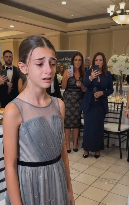
Her voice shook through the speakers.
“I withdraw my name from every award tonight,” she said. “And I ask that every prize my family influenced be reviewed.”
Lady Amalia screamed, “Victoria!”
Victoria looked at the audience.
Then at me in the doorway.
“And I will testify.”
Her father’s face turned dangerous.
“You will do no such thing.”
Victoria’s hands tightened around the microphone.
“Yes, Father. I will.”
The room went silent again.
Then Lord Edmund said the sentence that changed everything.
“You foolish girl. You are not even the one we protected.”
Part 7: The Daughter Who Was Never The Heir
Victoria froze under the chandelier light.
“What did you say?”
Lord Edmund realized too late that anger had opened a locked door.
Lady Amalia whispered, “Edmund, stop.”
But the room had already heard.
Helena stepped forward.
“What does that mean?”
Lord Edmund straightened his jacket.
“It means nothing.”
Victoria’s face had gone white.
“No,” she said. “You said I’m not the one you protected.”
Her father looked away.
And that tiny movement broke her.
She laughed, once, in disbelief.
“All my life you told me I had to carry the Kingsley name. Every tutor, every interview, every charity photo, every speech—because I was the future.”
Lady Amalia gripped the table.
“You are the future.”
Victoria shook her head.
“Then why did he say it like that?”
No one answered.
The hidden ledger still glowed behind them.
The technician, pale and silent, raised his hand slightly.
“There is another attached file.”
Helena turned.
“Open it.”
Lord Edmund shouted, “Do not touch that!”
Security moved closer.
The technician opened the attachment.
A birth certificate appeared.
Then a private adoption agreement.
Then bank transfers to a clinic outside Geneva.
Victoria stared at the screen.
Her name appeared.
VICTORIA KINGSLEY — PRIVATE GUARDIANSHIP RECORD.
Beside it was another name.
BIANCA ROSSI.
Victoria whispered, “Who is Bianca Rossi?”
Lady Amalia sat down as if her bones had failed.
No one spoke.
Dr. Moreau closed his eyes.
He knew.
Somehow, he knew.
Helena read the document silently, then looked at Victoria with a sadness that seemed to age her.
“Bianca Rossi was your biological mother.”
Victoria gripped the podium.
“That’s impossible.”
Lady Amalia’s voice came out flat.
“She was a waitress in Florence.”
Victoria turned to her.
“You told me I was premature. You told me that was why there were no baby photos.”
Her mother did not answer.
Lord Edmund snapped, “We gave you everything.”
Victoria flinched as if the words had struck her.
The room watched the rich girl lose the story she had used to stand above everyone else.
The records continued.
Bianca Rossi had been a young art student. She had received a foundation grant, then lost it after “background concerns.” Months later, pregnant and alone, she signed a guardianship agreement under financial pressure.
My stomach twisted.
Victoria looked at me.
The cruelty between us shifted into something larger and colder.
Her family had not only stolen prizes.
They had collected people’s futures.
Dr. Moreau spoke, his voice rough.
“Bianca came to me once. She asked if I could help her find the family who took her child. By then, the records had vanished.”
Victoria’s mouth opened, but no sound came out.
Lady Amalia finally broke.
“She would have had nothing with that woman.”
Victoria turned slowly.
“That woman was my mother?”
Amalia stood.
“I raised you.”
“You raised me to hate girls like her.”
The sentence shook the room.
Then Victoria looked at the screen again.
Bianca’s last known address: Florence.
Status: deceased.
Victoria pressed both hands over her mouth.
For a moment, she was no longer the girl who slapped me.
She was just seventeen and suddenly motherless in a way she had never been allowed to understand.
Helena lowered her voice.
“There is one more note.”
Victoria shook her head, but Helena read it anyway.
“Bianca Rossi submitted a final letter to the foundation requesting that, if her daughter ever became involved in foundation work, she should be told the truth.”
The attached letter opened.
The handwriting was delicate, slanted, and faded.
Victoria made a broken sound.
There was no long message. Only a few lines.
My daughter deserves a life built on truth, not debt. If she grows up among powerful people, may she learn to protect the ones they overlook.
Victoria sobbed once, covering her face.
Then she lowered her hands.
Something had changed in her expression.
Not softness.
Decision.
She walked to the committee table and picked up the ceremonial silver seal—the one she had tried to steal from me.
Then she carried it across the stage.
Everyone watched.
She stopped in front of me.
“This belongs to you,” she said.
I did not reach for it.
She nodded, accepting that too.
Then she turned to Helena.
“Use my trust fund.”
Her parents stared.
Victoria’s voice steadied.
“All of it. Freeze it if you have to. Fight me if you want. But I want it used to reopen every stolen case in that ledger.”
Lord Edmund surged forward.
“You ungrateful child!”
Security caught him before he reached her.
Victoria did not move.
She only looked at him and said, “No. I am finally grateful to the right people.”
Part 8: The Award That Finally Spoke Her Name
The police arrived before midnight.
Not with sirens, not with drama, but with dark coats, quiet questions, and sealed evidence bags.
Lady Amalia refused to look at anyone as she was escorted into a private side room. Lord Edmund shouted about lawyers until one officer calmly asked why a charity ledger contained housing threats against a student’s mother.
After that, he stopped shouting.
The guests did not leave quickly. They lingered in stunned clusters beneath the chandeliers, their champagne untouched, their faces stripped of the easy expressions they had worn when the night began.
Some looked ashamed.
Some looked afraid.
A few looked relieved, as if a beautiful room had finally admitted it was haunted.
I sat in the front row with my mother on speakerphone hidden in my lap. She had refused to hang up.
“I want to hear your grandmother’s name,” she said.
So I stayed.
Helena returned to the stage after the officers collected the first copies of the files. Her glasses were gone. Her eyes were red.
“This ceremony cannot continue as planned,” she said.
A nervous murmur moved through the hall.
Then she lifted the old photograph of my grandmother.
“But it can begin again.”
The screen behind her changed.
Not to sponsor logos.
Not to Victoria’s prepared speech.
To Anneliese Vasilev standing on the steps of that Vienna music hall, young and serious, holding the certificate she never got to keep.
Helena’s voice trembled.
“Forty-eight years ago, Anneliese Vasilev won the award that later became this foundation. Her name was removed. Her work was buried. Her silence became convenient for everyone who benefited from it.”
My mother began crying softly through the phone.
I pressed it closer to my heart.
Helena looked at me.
“Tonight, her granddaughter earned the highest score from independent judges. Tonight, the same pattern nearly repeated.”
She paused.
“But this time, the record survived.”
The guests rose.
Not all at once.
First Dr. Moreau.
Then Henrik Bauer.
Then a woman from the Lisbon table.
Then the students.
Then the staff who had carried trays all night and watched everything from the edges.
Finally, almost everyone was standing.
The applause began quietly.
I did not move.
For a moment, I could only think of my grandmother’s kitchen, her cracked blue mug, her hands guiding mine over cheap watercolor paper.
Paint what they cannot take, Mila.
I had thought she meant imagination.
Now I understood she meant proof of being alive.
Victoria stood near the side wall, alone. Her parents were gone. Her diamonds were still on the podium. Her face was bare and exhausted.
When our eyes met, she did not smile.
She bowed her head once.
Not asking forgiveness.
Giving witness.
Helena called me to the stage.
My legs felt unsteady, but I walked.
This time, no one stepped into my path.
The ceremonial seal was placed in my hands. It was heavier than I expected, cold at first, then warming against my palms.
Helena announced the new name.
“The Anneliese Vasilev Restoration Award.”
The words broke something open in me.
Not pain.
Not revenge.
Release.
Then came the shocking part no one expected.
Dr. Moreau asked for the microphone.
“There is one final correction,” he said.
He turned toward me.
“Anneliese did not lose everything after they erased her. She continued painting under another name. Quietly. Privately. She refused galleries connected to the Kingsleys, but she sold three works anonymously through a small dealer in Vienna.”
My mother stopped crying.
“What?” she whispered through the phone.
Dr. Moreau smiled faintly.
“One of those paintings entered a private collection in Zurich. It was recently authenticated. The owner passed away last year and left instructions that, if Anneliese’s rightful family was ever found, the painting and proceeds from its exhibition rights should return to them.”
Helena stared at him.
“You knew?”
“I suspected,” he said. “Tonight confirmed the signature.”
He handed me a small envelope.
Inside was a photograph of a painting.
A girl standing before a locked golden door, holding a key made of light.
At the bottom corner was my grandmother’s hidden signature.
A. Vasilev.
Dr. Moreau’s voice softened.
“The painting is titled The Girl Who Was Not Invited.”
My hand flew to my mouth.
My mother whispered, “Mama painted that?”
“Yes,” he said. “And next month, it opens in Vienna under her real name.”
The room blurred completely then.
Not because everyone was watching.
Because somewhere across years of silence, my grandmother had answered.
Victoria stepped forward, hesitated, then spoke from below the stage.
“Mila,” she said, “will you let me help find the others?”
I looked at her.
The girl who slapped me.
The girl whose life had also been built from theft.
The girl who had chosen, too late but not too little, to break the machine that crowned her.
“Yes,” I said. “But not as the face of it.”
She nodded.
“As a witness.”
I held the seal, the envelope, and my phone with my mother still crying on the line.
The cameras flashed again, but this time I did not hate them.
This time, they were not stealing my tears.
They were recording my grandmother’s name returning to the room that had once erased it.
And when Helena asked me to say a few words, I looked at the photograph on the screen and spoke the only truth that mattered.
“She was invited all along. You just locked the door.”
